
Summary: Chapter 5
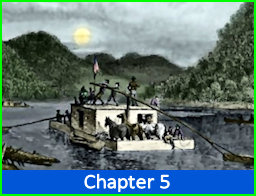
Page 1: Westward Expansion
As population increases rapidly, many Americans take the opportunity to pick up stakes and head west, to make a start fresh on cheap vacant land
Page 2: Bold Investment
The great canal era begins with the opening of the Erie Canal, the first major public works project financed with government backing
Page 3: Dramatic Private Investment
America's first industry is large-scale textile mills, running newly-developed machinery on waterpower, with private investors ushering in a new era of risk-taking
Page 4: First Industrial Complex
After building a successful proof-of-concept mill, Boston investors team up for a follow-on venture that rivals the Erie Canal in scope and expense, paying off handsomely
Page 5: Textile Equipment
Making fabric from raw fiber requires equipment to clean, comb, and spin fibers before they can be woven into the final product, but new machinery does most of the work
Page 6: Vertical Integration
Textile mills are giant layer cakes filled with rows of identical machines, transforming raw fiber into finished fabric, and all driven by giant waterwheels in the basement
Page 7: Giant Game-Changer
In the past, factories had to be located near sources of waterpower, to drive their great waterwheels, but new steam-powered engines enable factories to be located anywhere
Page 8: Steamboats Power Commerce
Canals continue to increase the reach of waterways, while steam-powered vessels can now power against the current, and dock confidently in congested harbors
Page 9: Investors and Corporations
Advances in transportation promote a new wave of corporate ventures, which sell stock to private investors to finance canals, turnpikes, bridges and steamships
Page 10: Indians, Cotton and Locomotives
Indian tribes are evicted from their homeland, and marched off to far-distant Oklahoma, clearing the way for the first big southern cotton plantations
Page 11: Railroads Begin Displacing Canals
Canals are sprouting everywhere, but railroads have already begun moving into the same territory, offering even greater speed without being confined to nearly-level routes
Page 12: Reaching the Pacific
Pioneers are heading all the way to Oregon by wagon, when gold attracts a fresh surge of settlers to California, this time by boat, while whaler ships scour the ocean for better hunting
Page 13: North and South Drifting Apart
Northerners continue heading west, while Southern planters move their slaves to Deep South cotton country, political power shifts westward, and the Mexican War yields yet more land
Page 14: Snapshot, Before the Coming Clash
Americans in mid-century are developing early urban centers that now reach well into the Ohio River Valley
Page 15: The New Midwest
The new 'West' (known today as the Midwest) is developing its own distinctive flavor, while the Mississippi River continues to block migration further west
Page 16: Wild West
Even as settlers continue to move into America's Midwestern heartland, the Pacific coast is acquiring its own distinctive character, being effectively cut off from the rest of the country
Page 17: Century of Movement
The period leading to the Civil War is marked by unrelenting westward movement, and the beginning of a new era devoted to a mix of manufacturing and land development