| |
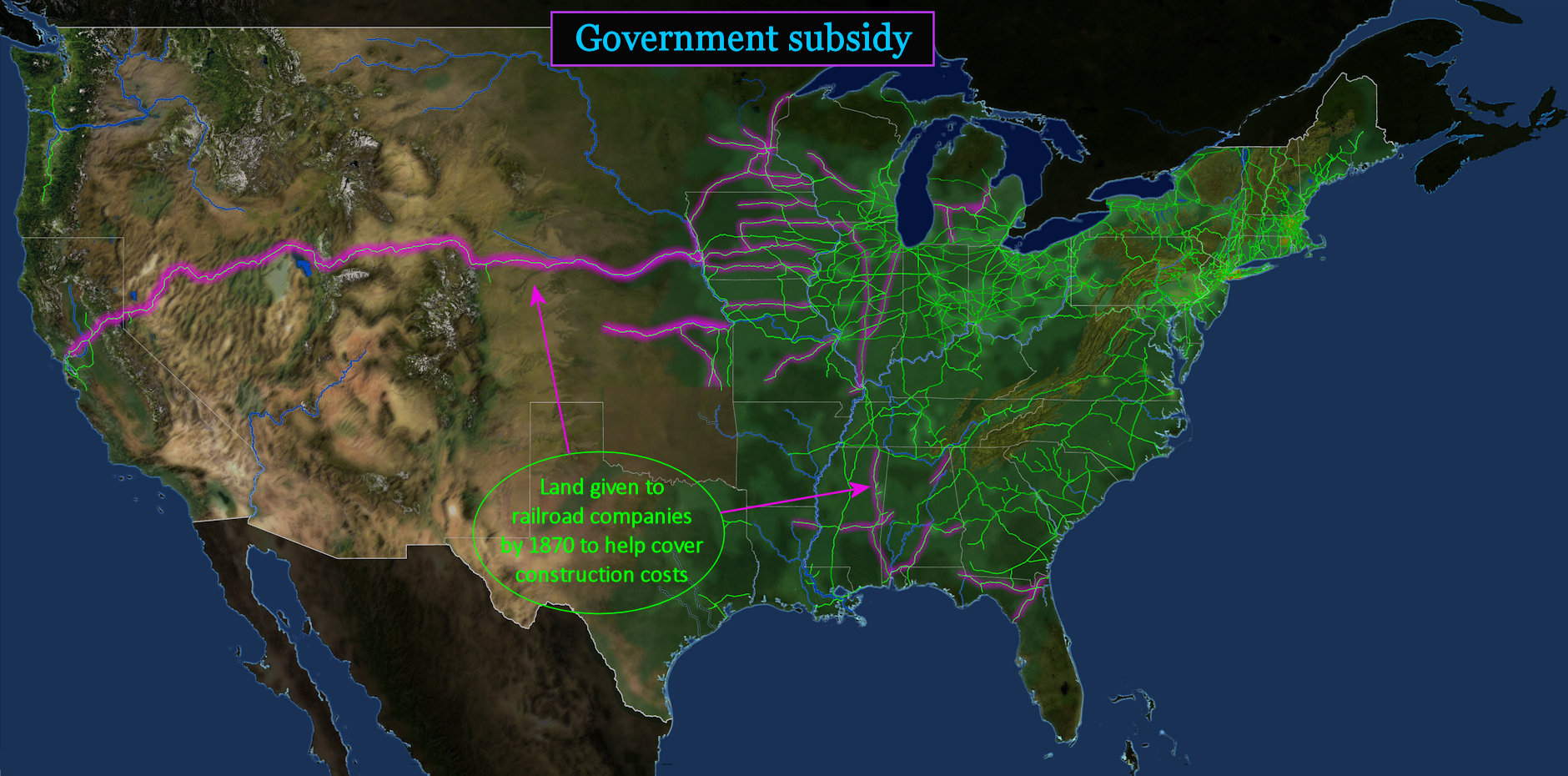
Government Sponsorship Every state wants railroads, because they stimulate business. But not even the federal government has enough money to fund the transcontinental railroad. It does, however, own immense stretches of empty public land. So, starting in 1850, Congress hits upon the scheme of supporting railway growth by giving free land to anyone willing to build a railroad in the sprawling Midwest, or even the South. RED highlights on the map show land granted to railroad companies by 1870. |
| |||||||||
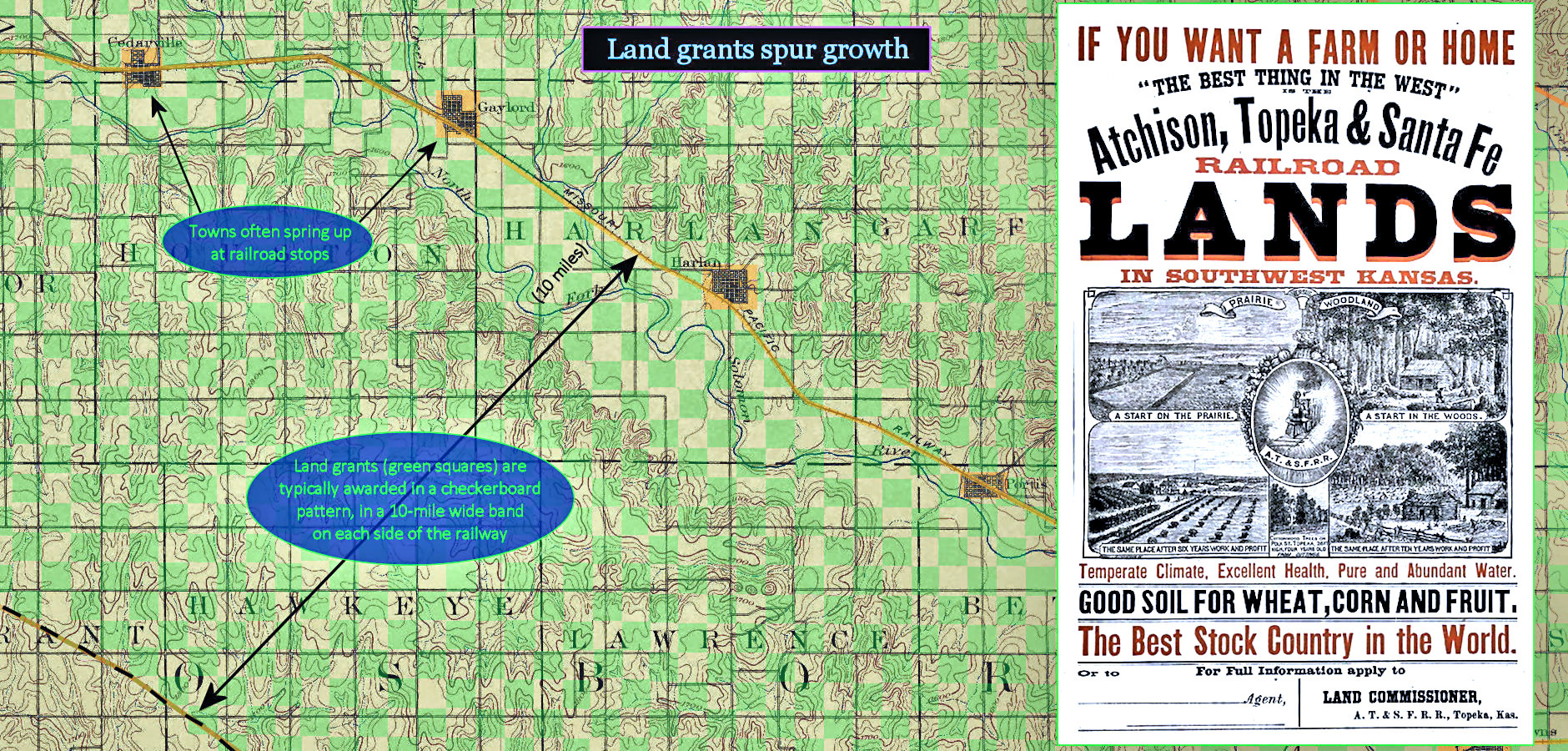
Towns Sprout at Rail Stops This map (part of Kansas) shows how towns have sprouted at each railway stop. The government grants huge tracts of free land to railroad companies, to stimulate growth into unsettled territory. Land grants typically include half of the land (displayed as GREEN squares in the checkerboard pattern, above), in a 10-mile-wide band extending to each side of the railroad. This gives the companies free land, which they can then sell to settlers, to help cover construction costs. The checkerboard pattern ensures that there are no large plots the company can use for other purposes. The railroad thus acts as a land agent to lure settlers (see poster). This is an easy way to trade vacant land for increased settlement, which boosts both business and land values. | |||||||||
| |||||||||
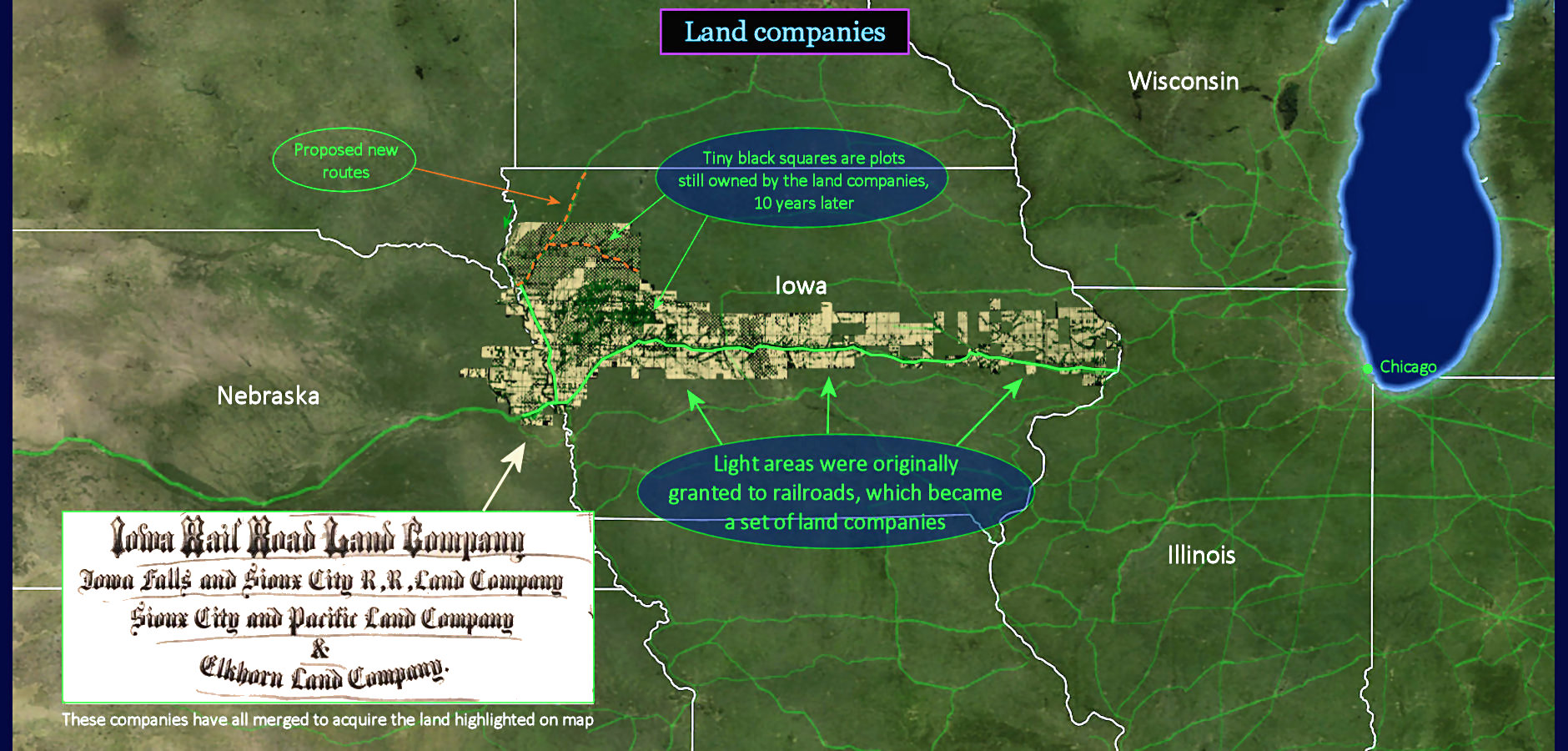
Land Sales Cover the Costs Land is granted to the railroads on a company-by-company basis, but the entanglement between railroad companies and land companies quickly makes for a patchwork arrangement of property rights. Railroads can be owned or acquired by land companies, which are more interested in rising land values than operating trains. The map above shows land in Iowa owned by an odd mix of railroad and land companies in 1870. Tiny BLACK squares indicate lots that have not yet been sold. Note that in areas where proposed rail lines (ORANGE) don't yet exist, the companies have not yet been able to sell plots they were granted, based upon their construction plans. Other less-desirable areas show a similar pattern of remaining unsold lots. | |||||||||
| |||||||||
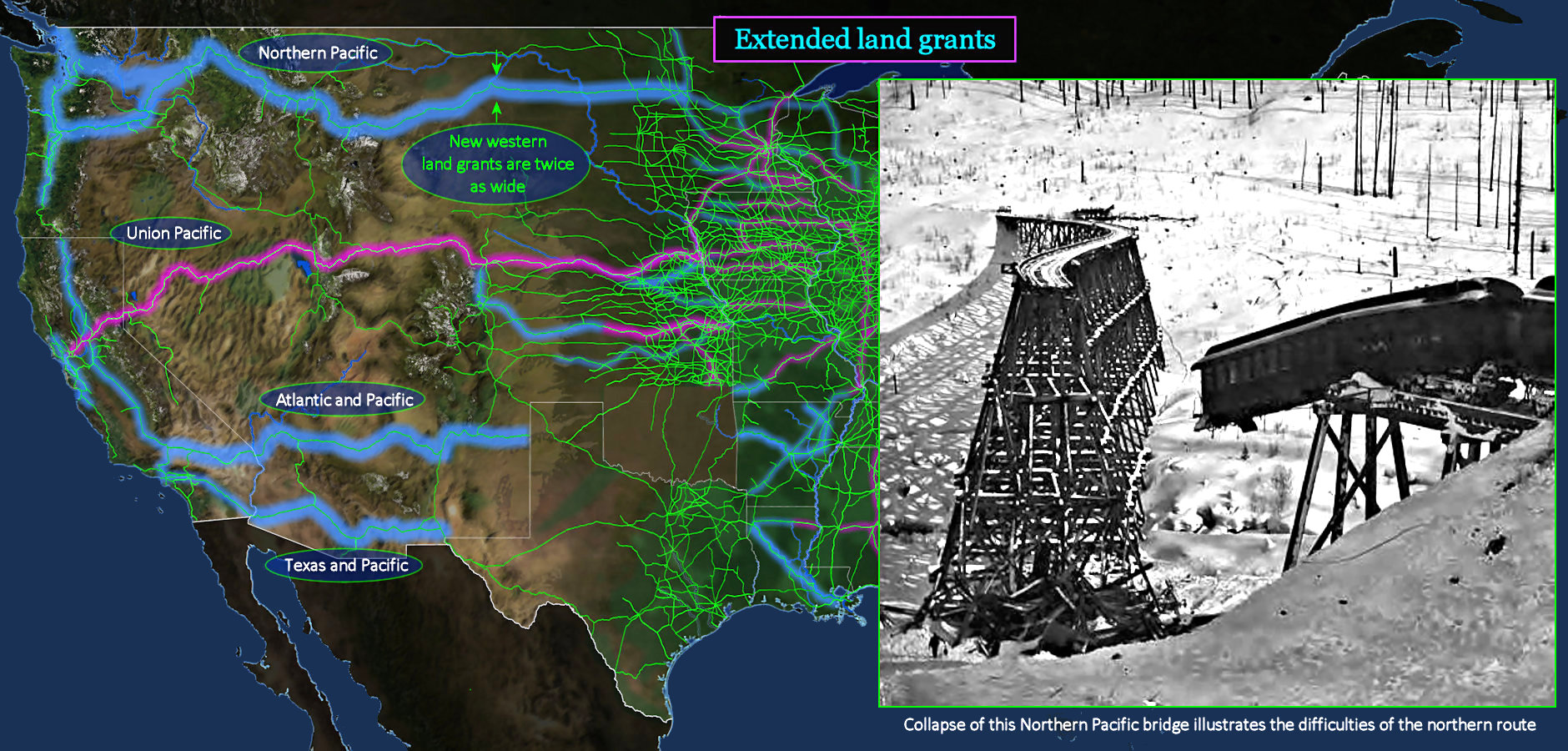
Not a Smooth Road Congress finishes granting land to railroads in 1871, having authorized four long-distance routes to the Pacific. All four routes are awarded extra-wide land grants, because no railroad company was willing to bid on any of the routes with just a 20-mile wide grant. But all four routes run into difficulty during the financial panic of 1873, which eventually bankrupts the Northern Pacific (top-most). Even the transcontinental railroad (Union Pacific) has difficulty weathering the panic, despite the advantages of a direct route to San Francisco. Many have criticized the huge amount of land given away to railroads, but it is unlikely that the great railroad expansion could have occurred without this government support. | |||||||||
| |||||||||
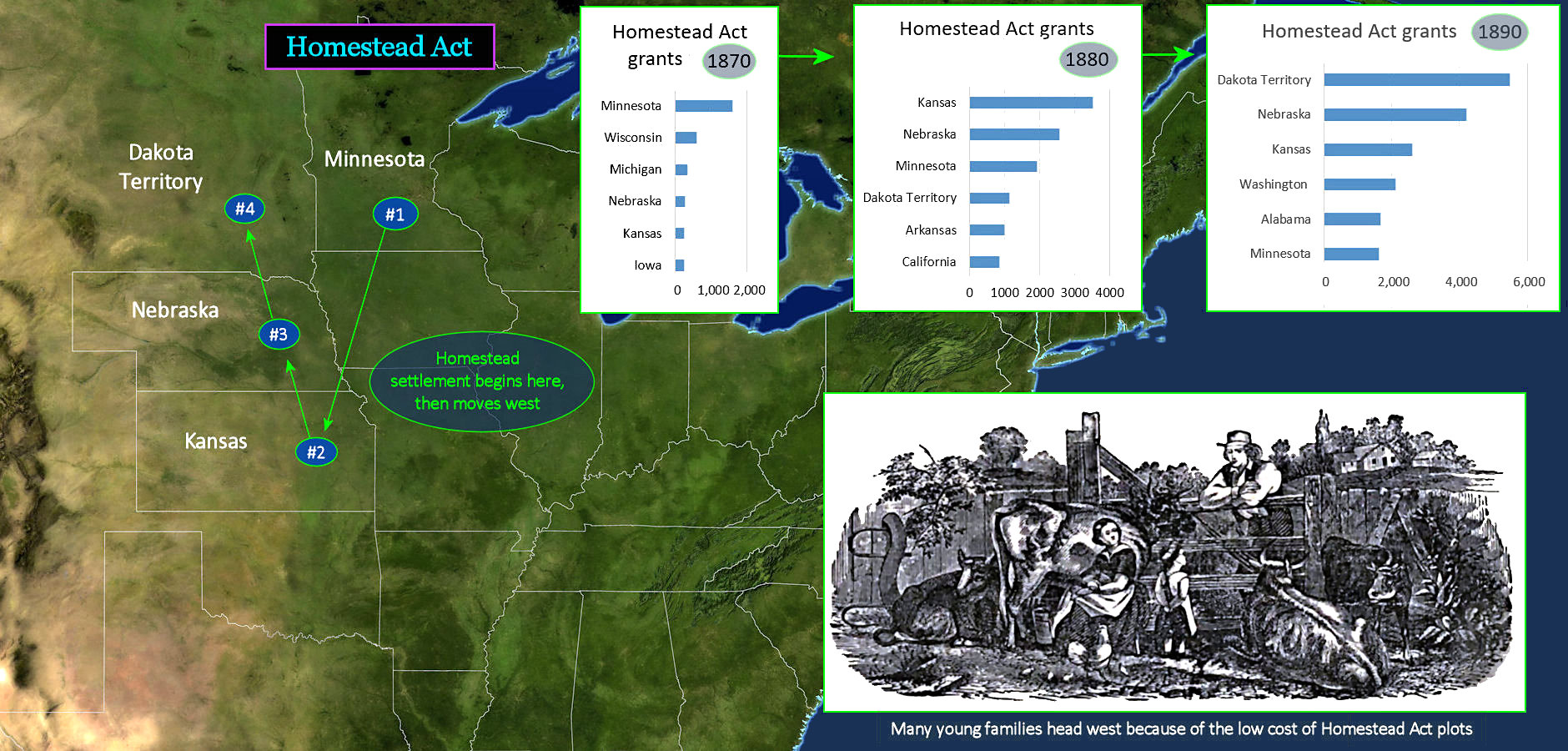
Land to the People Railroad land grants continue a long-standing government policy of encouraging development of unsettled land. Congress had already dabbled in this area back in the 1820s, supporting the construction of canals, bridges, roads, and river and harbor improvements. Today we would call this 'infrastructure spending.' Beginning in 1820, small plots of remote government land were sold to the public for $1 per acre. In the 1860s, when Congress is awarding land grants for the transcontinental railroad, it passes the Homestead Act at the same time. This gives settlers a quarter-mile-square parcel of land for a flat $15. Many of the 'blank' squares in the checkerboard pattern of railroad grants are awarded this way. | |||||||||
| |||||||||
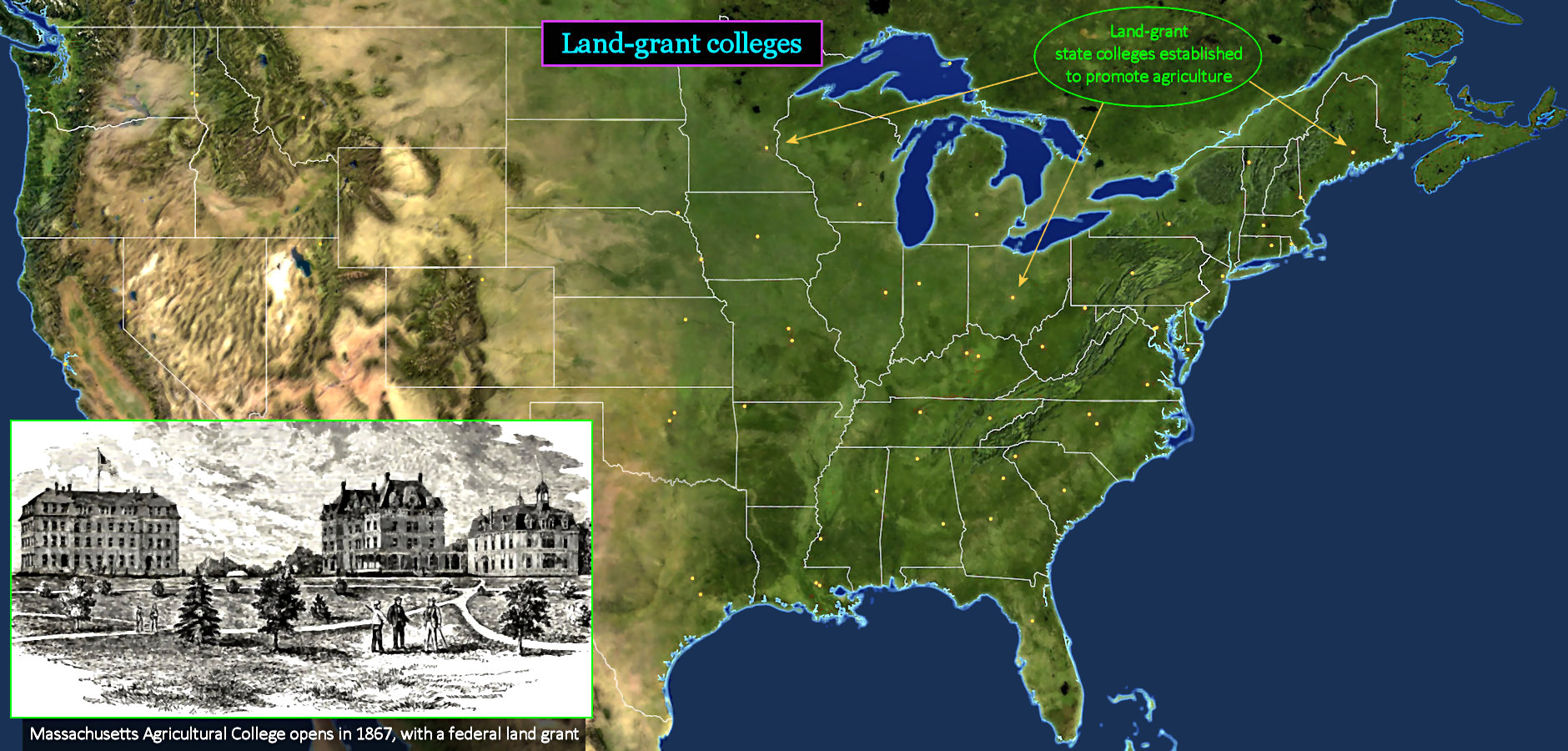
Promoting Agricultural Education During the Civil War, Congress votes to set aside free land in each state for new state colleges. Unlike almost all existing colleges at that time, which teach theology, the new land-grant colleges are intended to promote the science of agriculture. YELLOW dots on the map mark sites of state colleges and universities that receive federal land grants by 1890. Prior to this time, technical subjects have only been taught at West Point, to prepare military engineers responsible for constructing fortifications. By 1890, land-grant state colleges are turning out 1,000 new science graduates, per year. This provides a foundation for many advances in machinery design which occur during the Industrial Era. | |||||||||