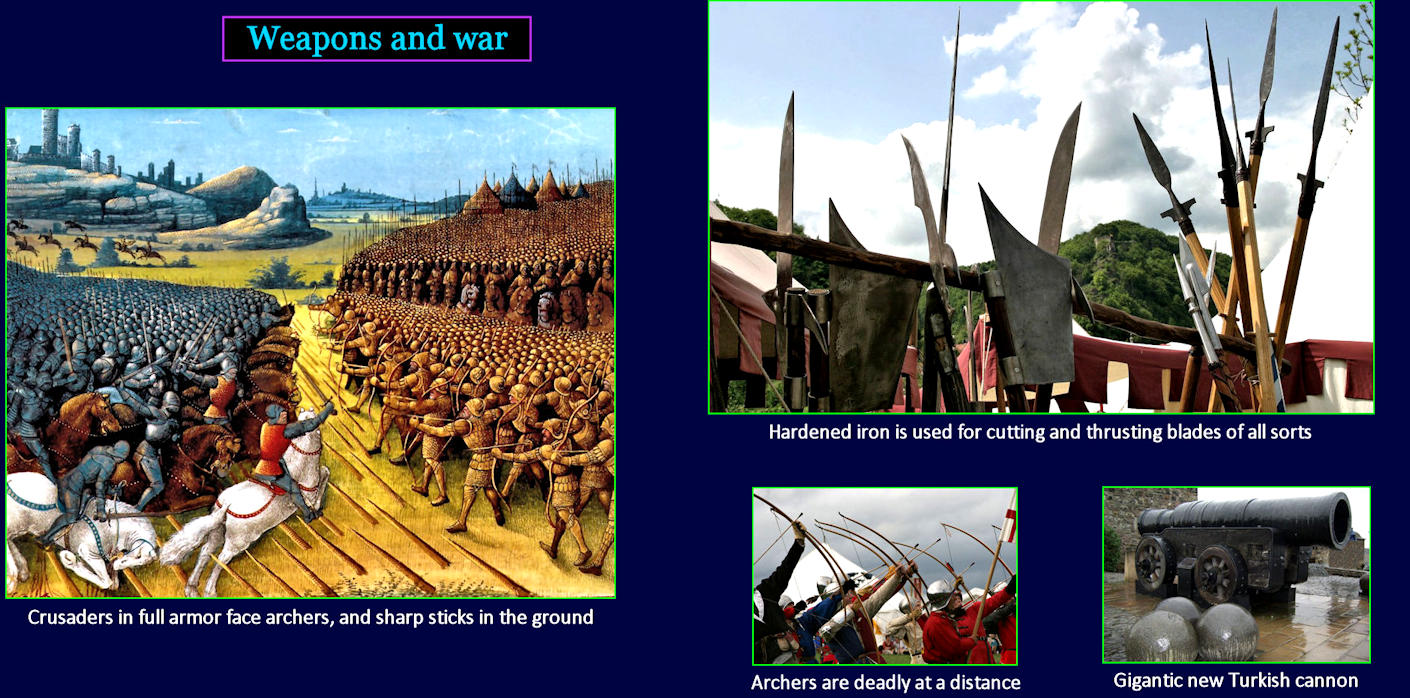
Military TechnologyThe bow and arrow remains a deadly weapon, perfected in the English longbow, while swords, lances and battle axes are still the norm for hand combat. Body armor is gradually upgraded from padded leather to iron. With the development of gunpowder by the Chinese, clumsy wooden catapults are replaced by massive bronze cannons, which fire hand-chiseled stones the size of beach balls. Just shaping the stones is a major job. Armored knights are often mounted on large war horses, which are also often armored. When properly managed, they can plow into massed infantry with irresistible force. This is the 'battle tank' of its day. |
| ||||||||||||||||
| |||||||||
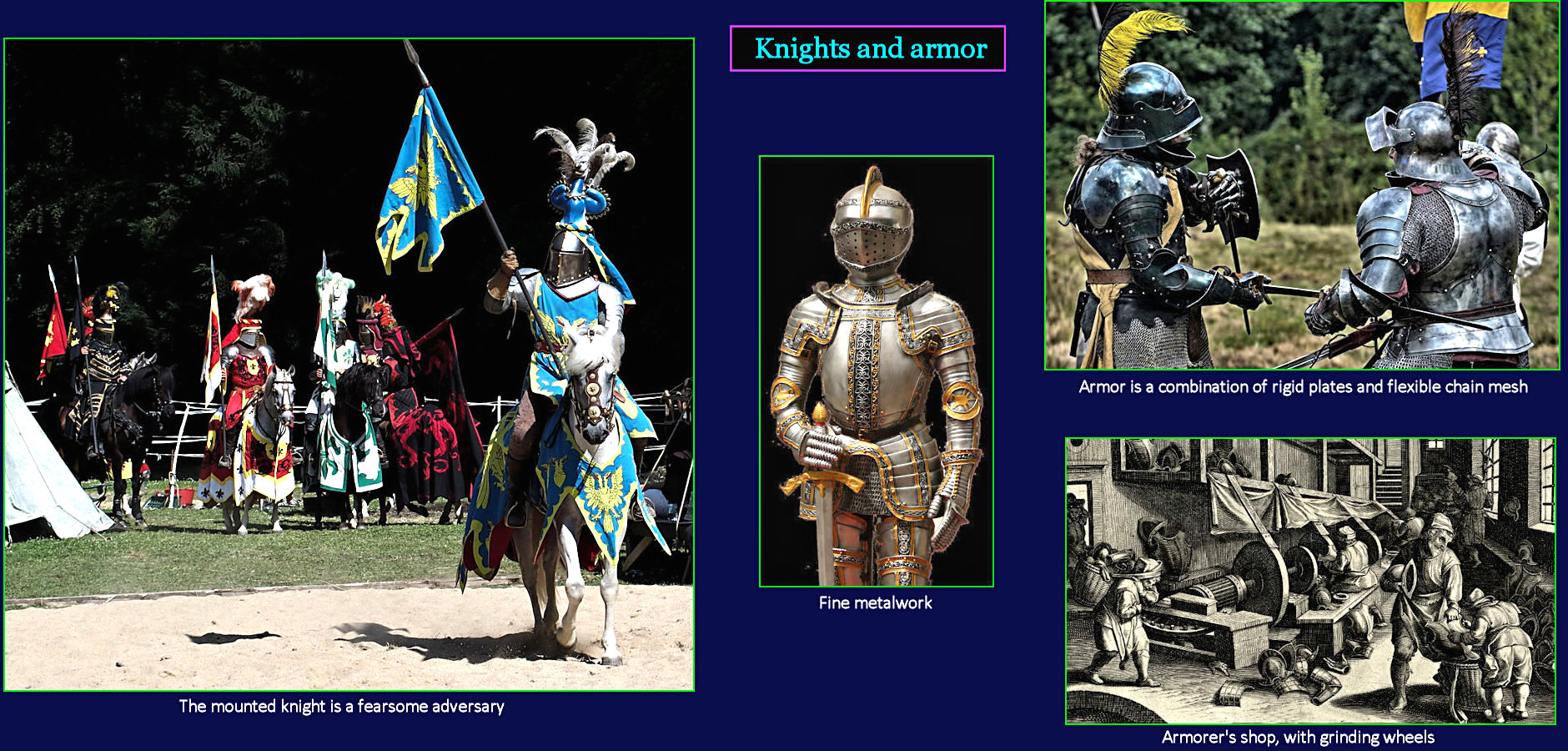
Armor The height of armored technology is the mounted knight. Imagine standing in a battle line, with several hundred mounted knights thundering down on you, at full gallop. The skill of workmen who make armor (lower right) produces marvelous examples of ornate body armor (center), for the wealthy few who can afford it. Everyone else fights in simpler armor, which is gradually made more comfortable by the introduction of a kind of flexible metal 'fabric' called chain mail. This features small interlocking iron rings, that protect areas like the neck and shoulders, but don't restrict movements (top right). | |||||||||
| |||||||||
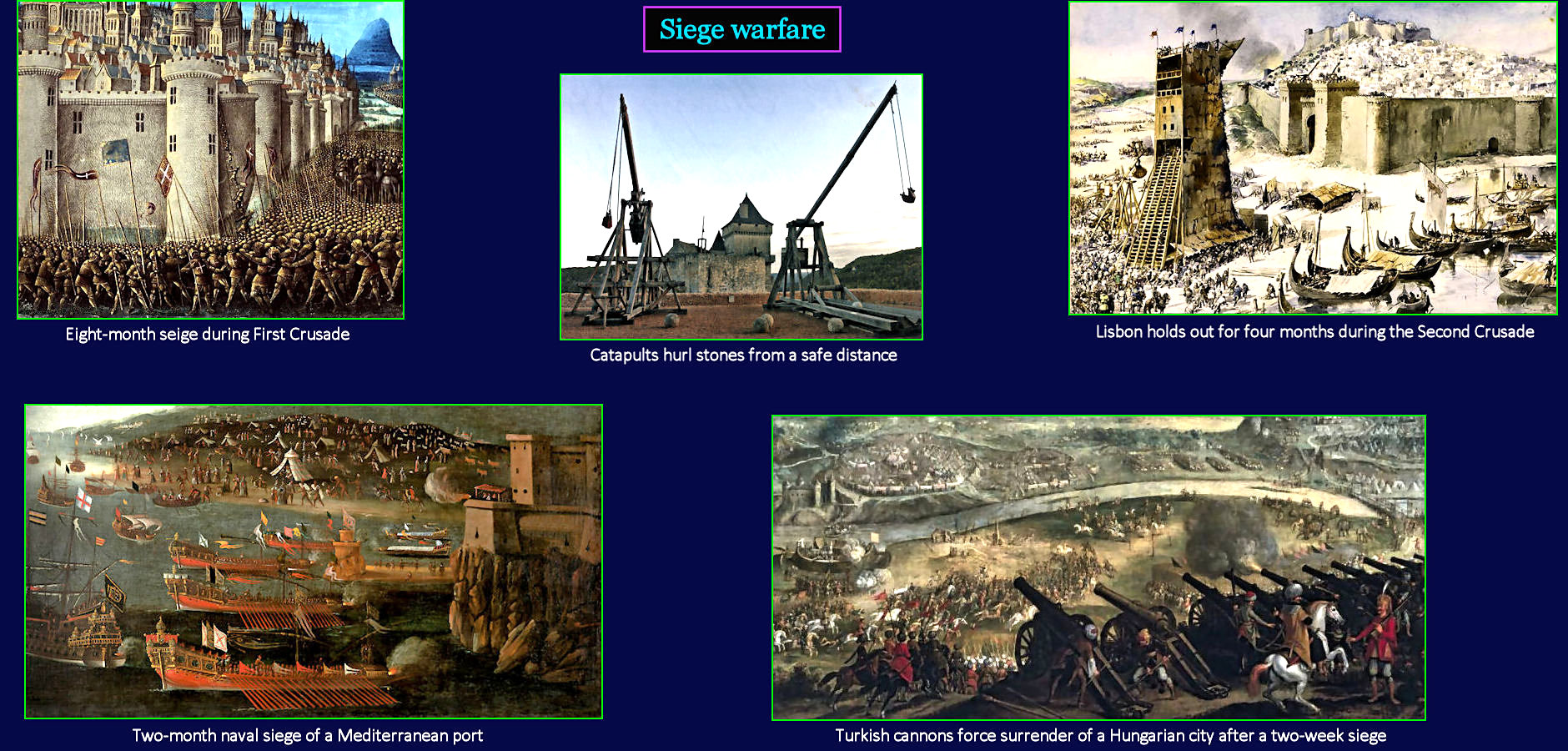
Europe Under Siege The 'siege' is the favored form of battle during the medieval era. This involves surrounding a castle or town, and trying to starve the defenders into surrendering. The great advantage of the siege is that you can assemble a large army in front of a target with few defenders, and (in the best case) win victory without any bloodshed at all. The logic of the siege is brutal. If defenders surrender quickly, the invaders take everything of value, and may levy taxes for years to come, but everyone survives. If defenders stubbornly resist, however, the invaders might manage to breach the defenses anyway. If so, they are likely to take vengeance for all the extra trouble this causes, and slaughter all the men. Remaining women and children are often sold into slavery. | |||||||||
| |||||||||
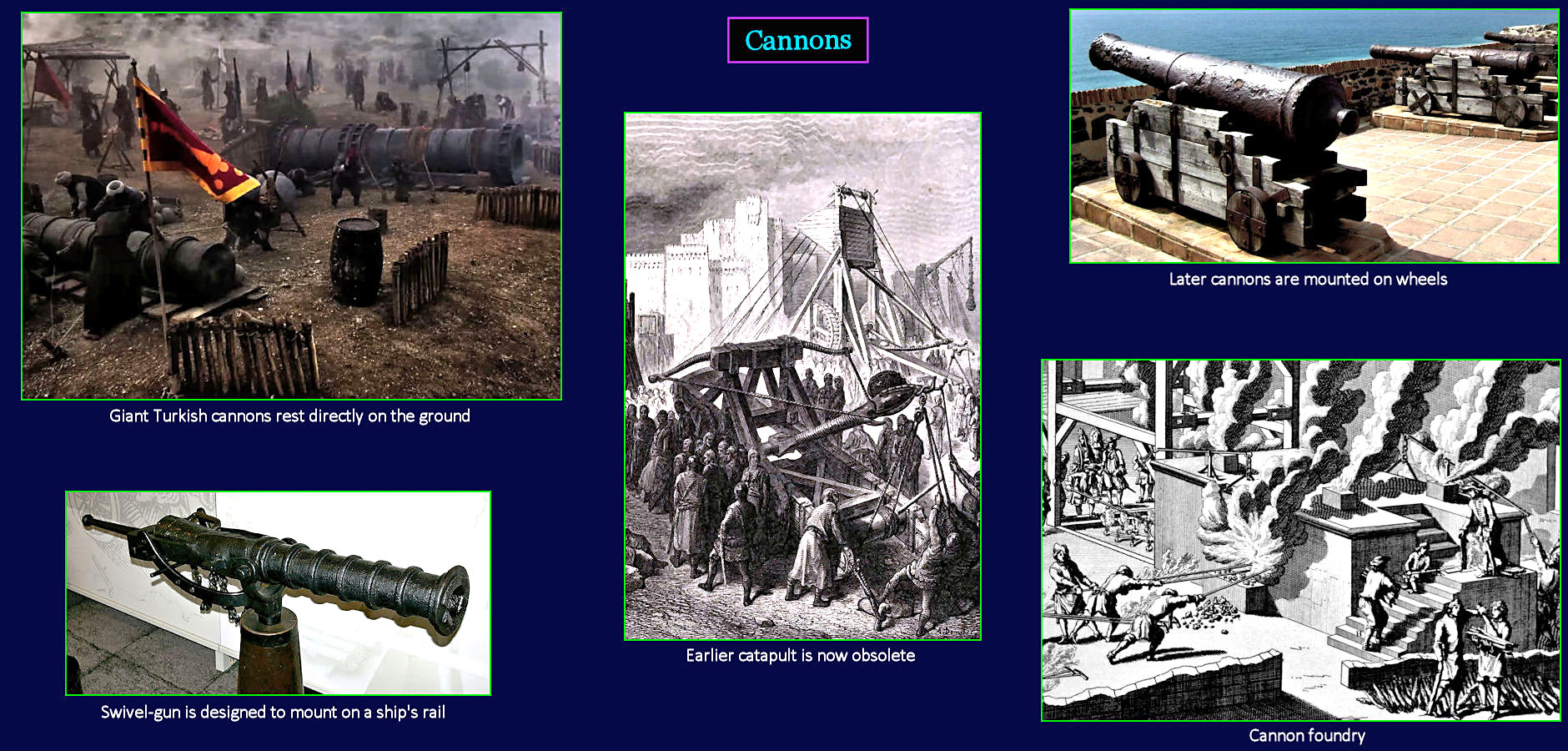
Catapults and Cannons The famous medieval catapult (center) is the original weapon of choice for hurling huge stones at, and over, defensive walls. But it is gradually displaced by the cannon, as gunpowder and the technology of metal-casting improves (lower right). The earliest cannons are massive and unwieldy, resting directly on the ground (top left). Wooden gun carriages (top right) are added later, to make cannons easier to move and reload. The earliest naval cannons are almost tiny by comparison, starting with the handy little swivel gun (lower left). This is mounted on the rail of transport vessels as a defensive weapon, at first. | |||||||||
| |||||||||
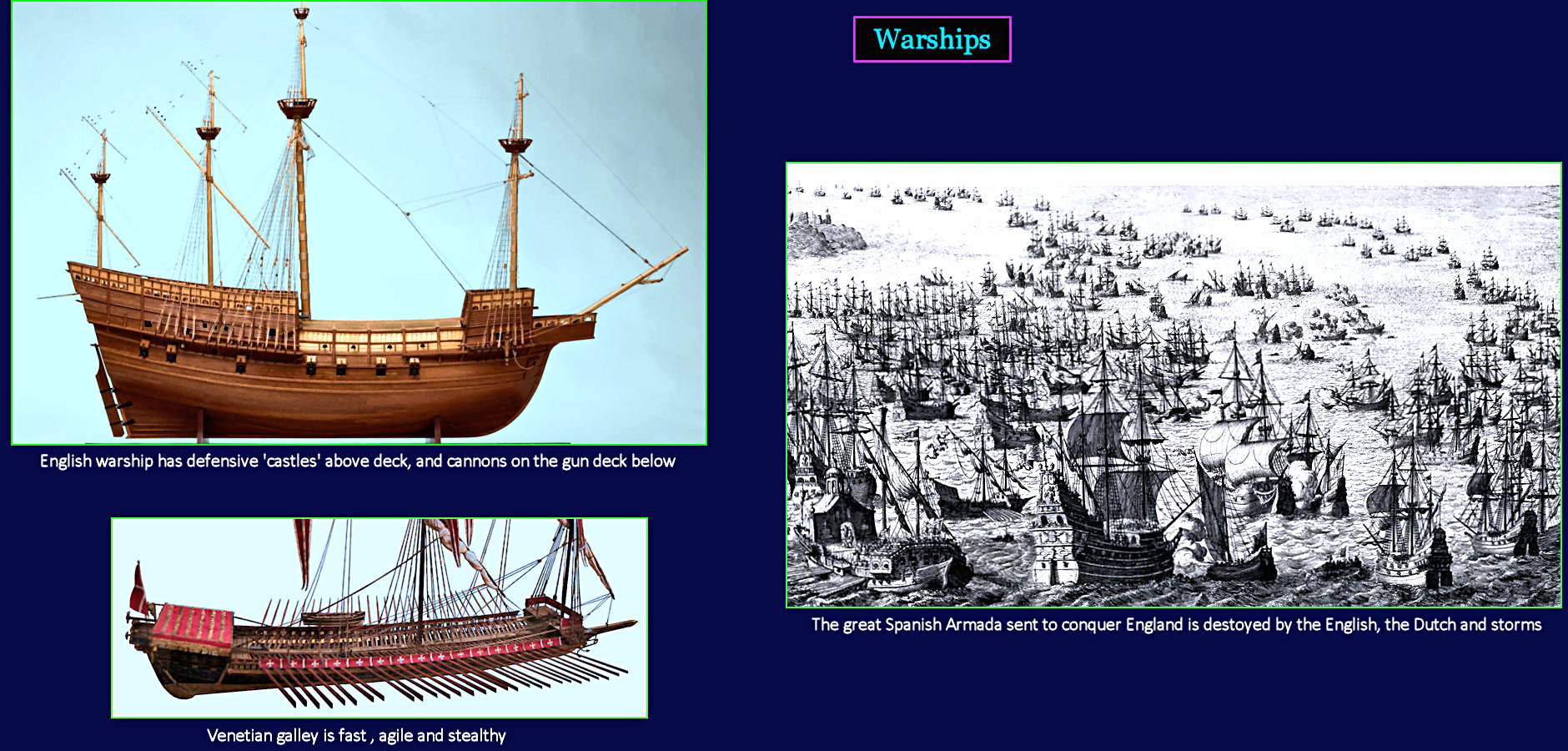
Galleys and Warships Throughout history, the height of technology has been the great warship. The largest warships of the medieval era (top left) are a good example, combining complicated carpentry with the latest weaponry, and well-developed rigging. When massed for battle, they present a stirring sight. The image at right shows the battle between the huge Spanish Armada, and the nearly equal, but better managed English-and-Dutch fleet, which wins. Surprisingly, the oar-powered galley (lower left) is also a formidable weapon. Perfected in Venice, it is actually faster and more maneuverable than larger sailing vessels, especially in the relatively calm waters of the Mediterranean. Galleys often dart out unexpectedly, to attack merchantmen from a hidden cove. | |||||||||
| |||||||||
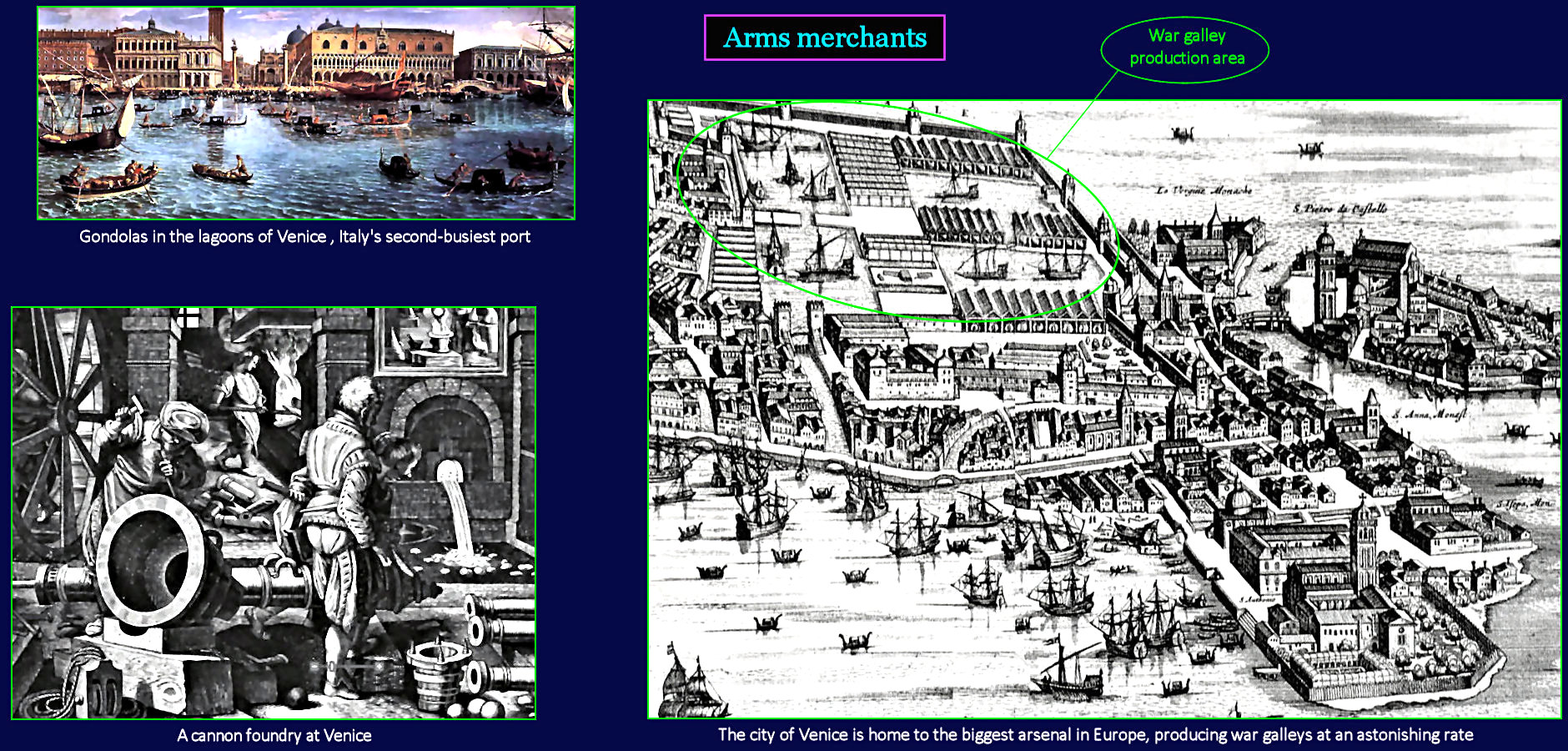
Making Armaments We think of Venice today as a tourist destination full of happy Gondoliers rowing quietly in majestic lagoons (top left). But in the medieval era, it's all-business. The Venice Arsenal is the largest industrial complex in Europe (right), housing 16,000 workers. The main product is the war galley. Each galley is built as a set of modular subassemblies, which (in emergencies) can be assembled into finished warships at the astounding rate of two galleys per day. Cannons are added to the foredeck, as metal-casting technology improves (lower left). | |||||||||