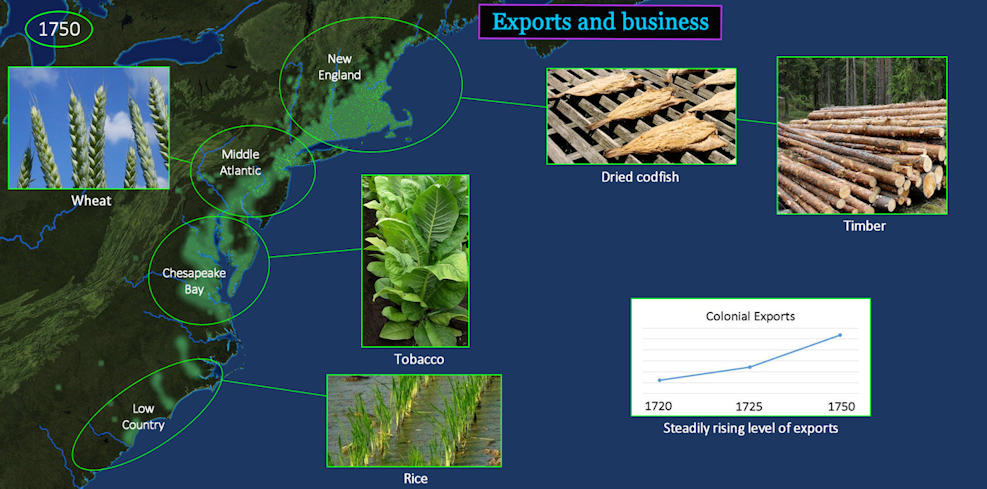
Made in AmericaIn the South, tobacco and rice are the big export products, which generally cover the cost of English imports. But this is only true for the large plantations, with lots of slaves. Bigger farms struggle. The situation up north is much more difficult. Wheat is the big crop, but produces only half the export income of tobacco. New Englanders only get by with the extra income derived from shipping. When England and France go to war during the mid-1700s, colonial shipping gets a temporary boost. English armies in the field need constant supplies. But the good times only last while the war rages. Afterwards, tough times resume. |
| ||||||||
| |||||||||
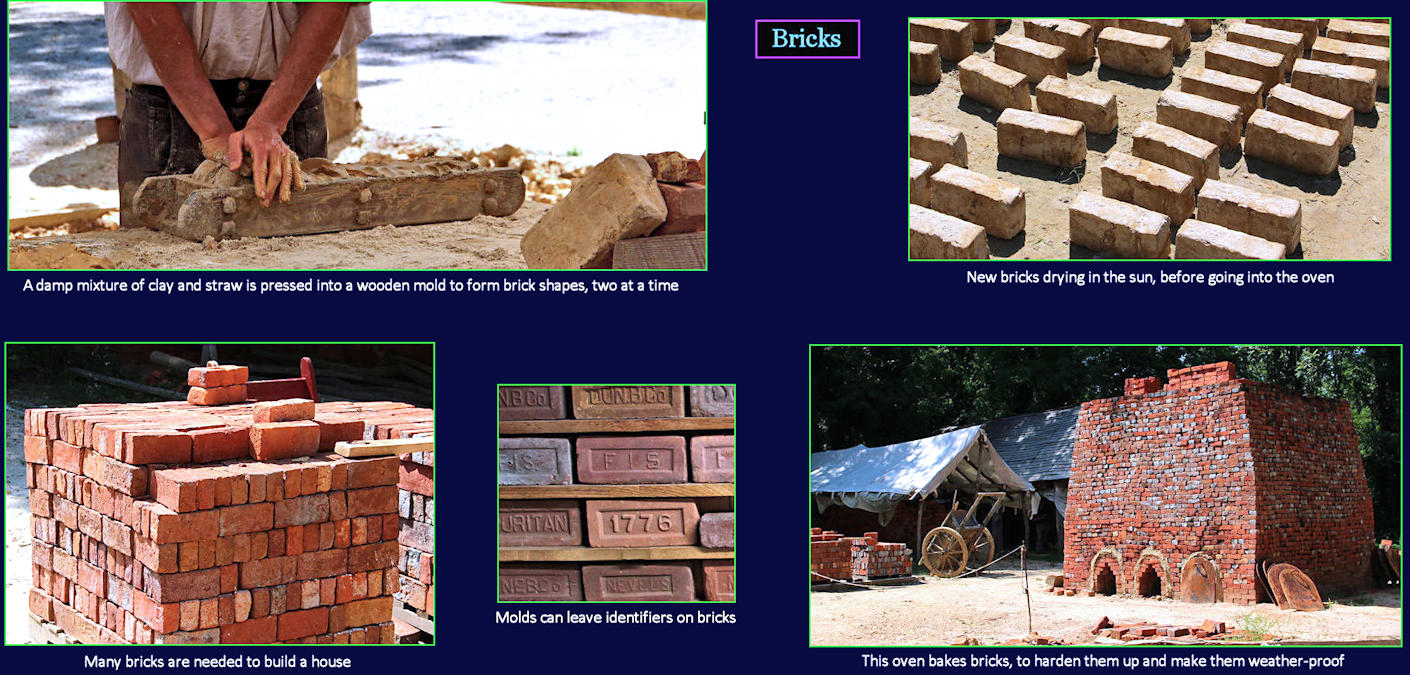
Simple Trades Not everything produced in the colonies is shipped off to England. Building materials, like bricks, are made and sold locally. In areas with abundant natural clay (like Maryland and Virginia), colonists mix the clay with water and straw, and press it down into a wooden mold to make each brick, or pair of bricks (top left). While still soft, the mud is released from the mold and set in in the sun to dry (top right). Because bricks take the shape of the mold, a brand or other identifier can be carved into the bottom of the mold to produce an impression on each brick (center bottom). After hardening, the bricks are baked in a large oven until hard enough to withstand weather (lower right). | |||||||||
| |||||||||
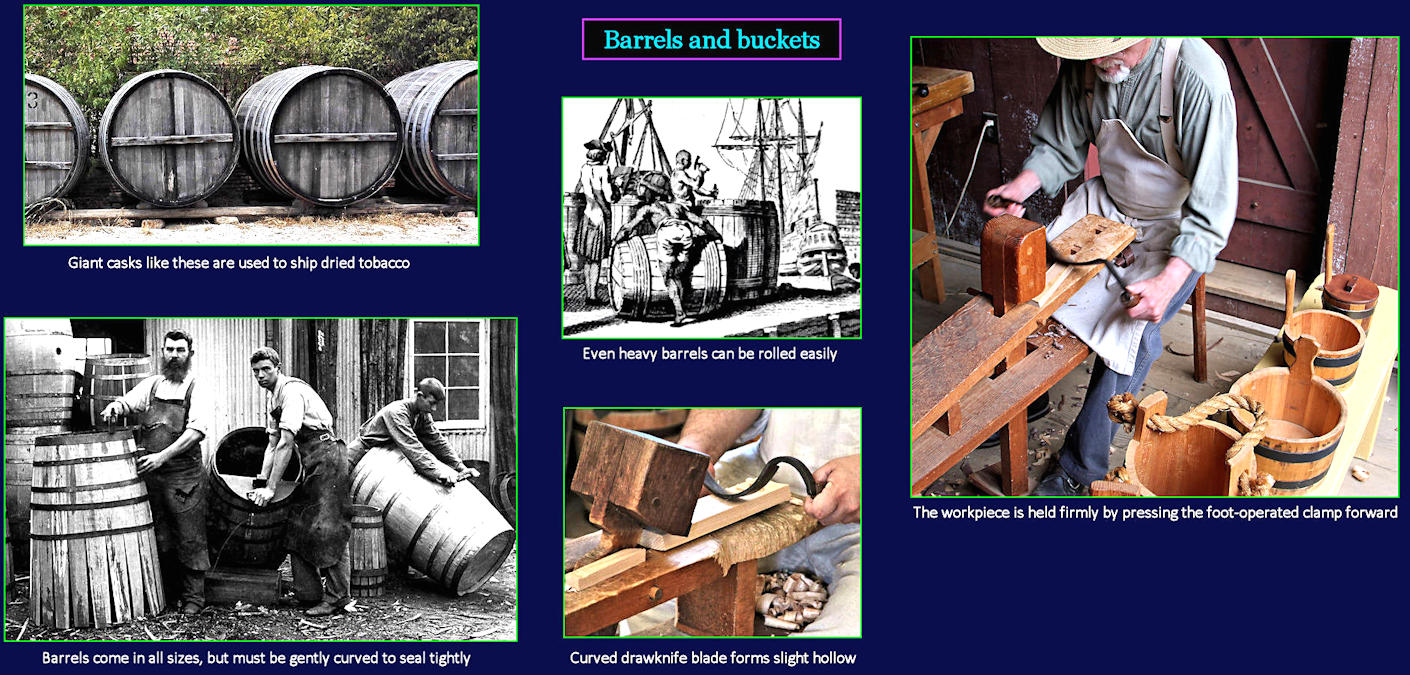
Coopers Barrels and casks are used to transport almost everything. Tobacco casks are huge, holding 1000 pounds of tightly packed, dried tobacco (top left). Barrels are easily moved, since they can be tilted onto their sides, and rolled around with little effort (center top). When filled with a liquid, such as rum, the wood swells until the seams become watertight. The individual pieces of wood used to make a barrel are delicately shaped, with slightly angled edges and tapered ends (lower left). The pieces used to make buckets are slightly scooped out on the inside surface, to make the bucket circular inside. Scooped surfaces are made with a curved draw knife, while the wood is held in a foot-operated bench clamp (center bottom and right). | |||||||||
| |||||||||
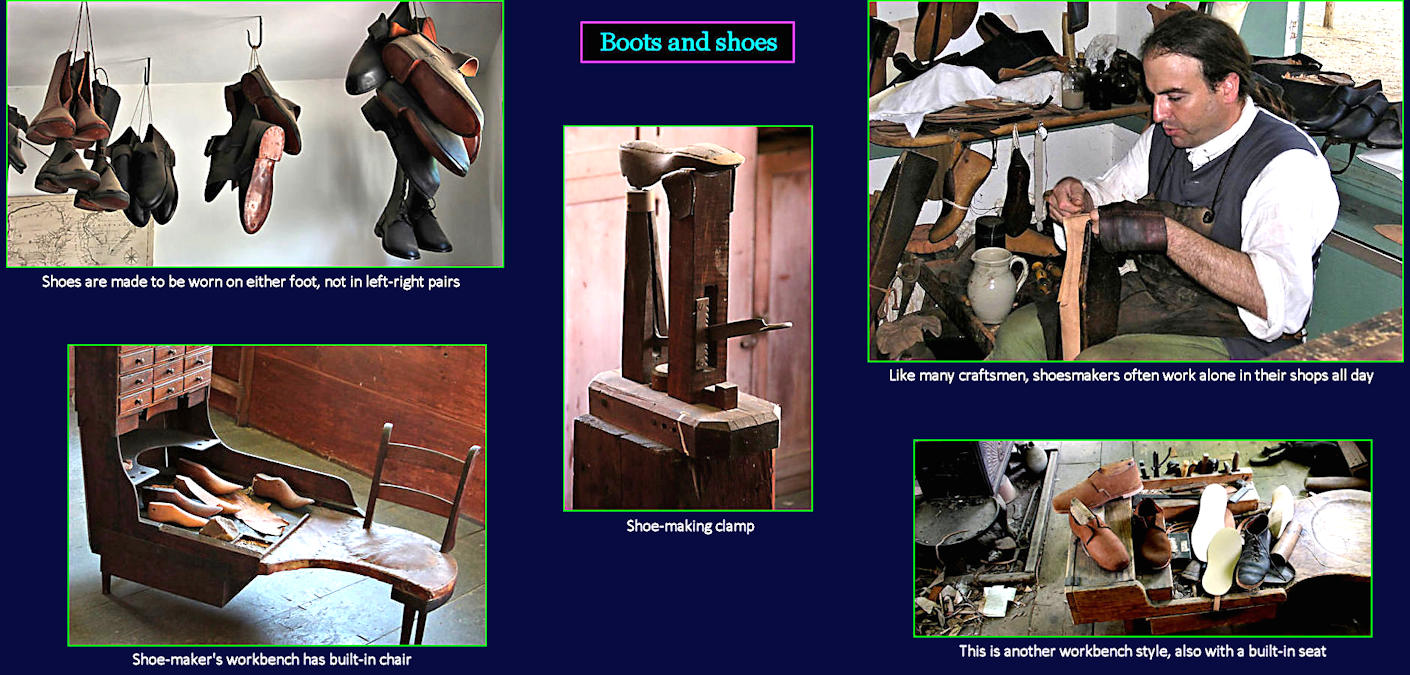
Lots of Shoemakers Everyone needs shoes, which need to be frequently replaced. For this reason, there are more shoemakers than any other type of tradesman, except carpenters (who are only slightly more numerous). Shoes at this time are made to be worn on either foot. They won't be made in left-hand and right-hand pairs until the middle of the 1800s. Shoemakers can set up shop anywhere, as they need just a workbench and a few simple tools. They cut pieces of leather from full cowhides, and then sit at the bench all day, carefully stitching them into the complicated shape required to fit a foot. Special clamps are sometimes used to hold the leather in position while working on the sole (center). | |||||||||
| |||||||||
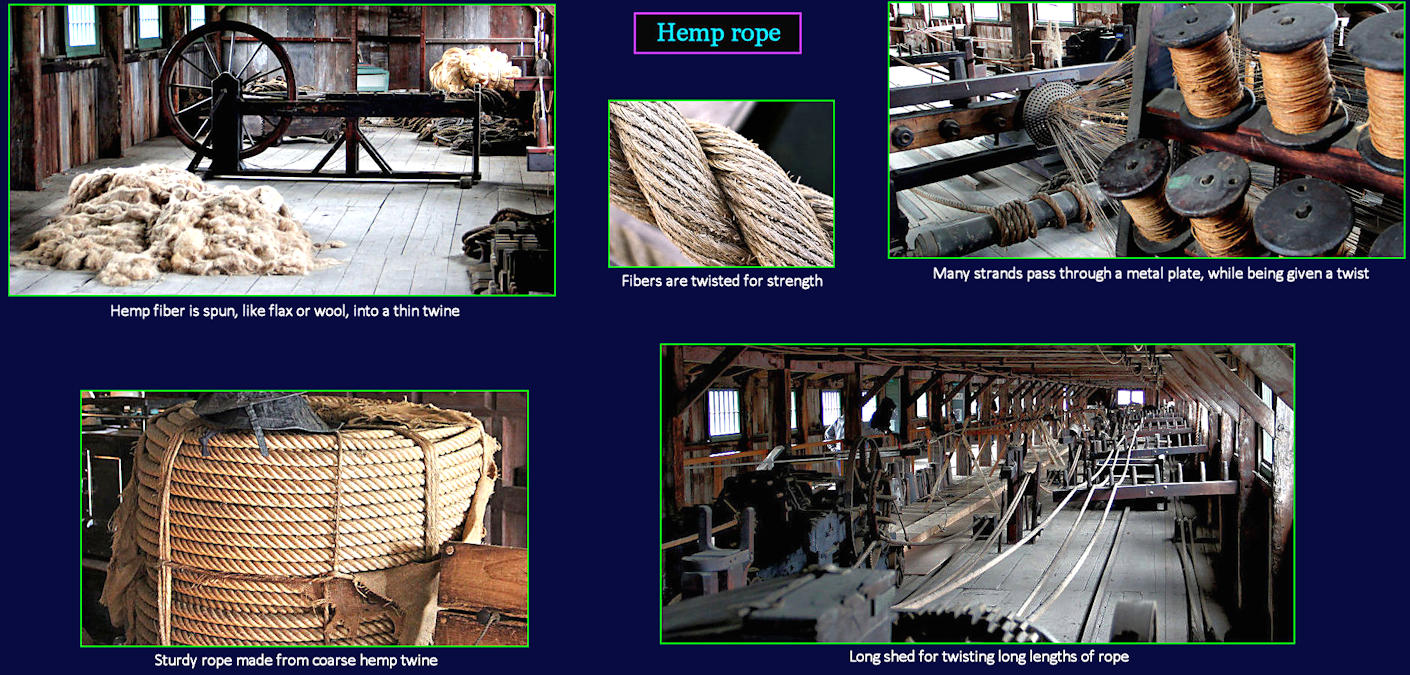
Rigging There are a surprising number of shipbuilders in the colonies, sprinkled along rivers and tidal inlets. This is because vessels are small, and many are needed to move goods throughout the colonies. There is no shortage of wood available for their construction, but rigging all the ships requires lots of rope. To make rope, you start with hemp, which is a tall plant with a very fibrous stem. The stems are broken down into heaps of fiber that resemble raw wool (top left), and spun into a thin twine. Many spools of this twine are set up in a frame, and fed through a metal plate with a hole for each strand (top right). A special mechanism twists the strands into rope, after it passes through the plate. This requires a very long shed (lower right). | |||||||||
| |||||||||
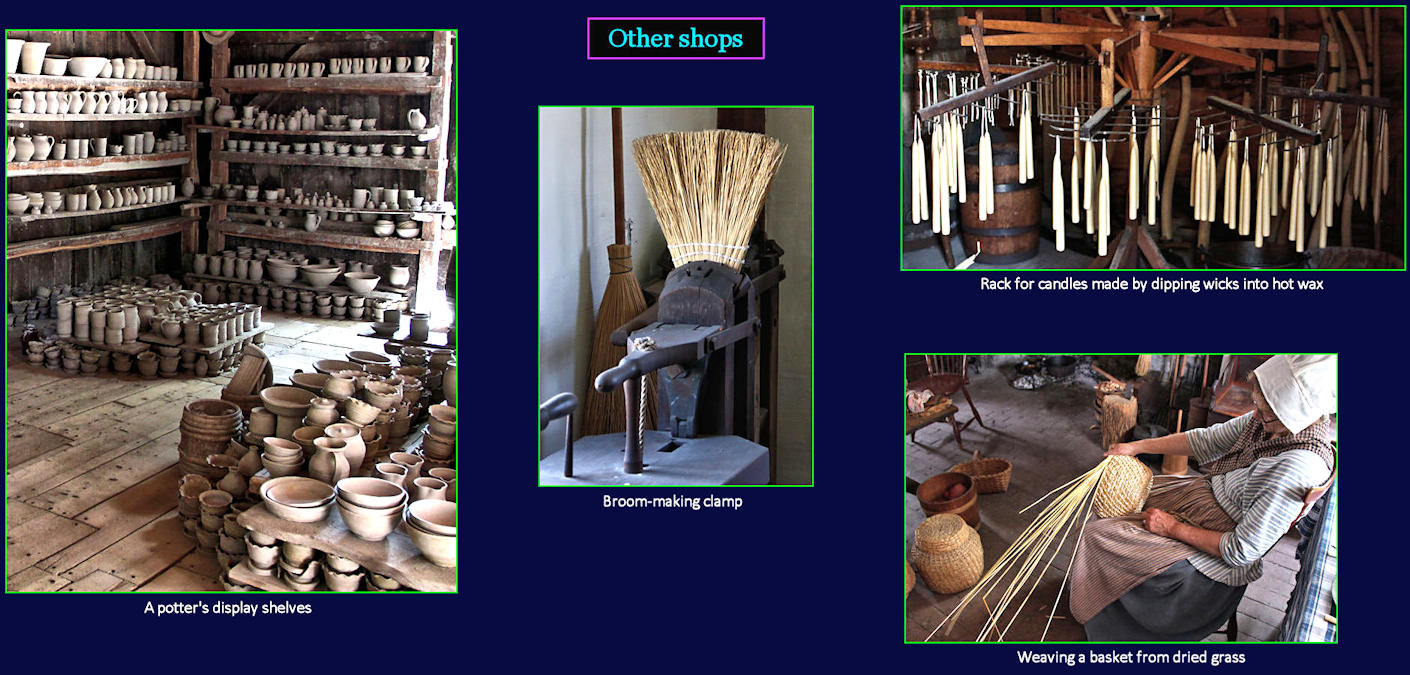
Lesser Trades There are many products that can be made in a small shop, with perhaps one or two assistants. Some can be made in batches, like hand-dipped candles (top right), but most are made one at a time, by hand. You can't make items very quickly this way, and the market for potential buyers in any given area is quite limited. Still, locally-made goods are far cheaper than anything shipped in from London. Although half of all American men still spend their time farming, most of the rest are engaged in the trades, or the few professions requiring special education. The era of factory-based mass production is still in the distant future. | |||||||||