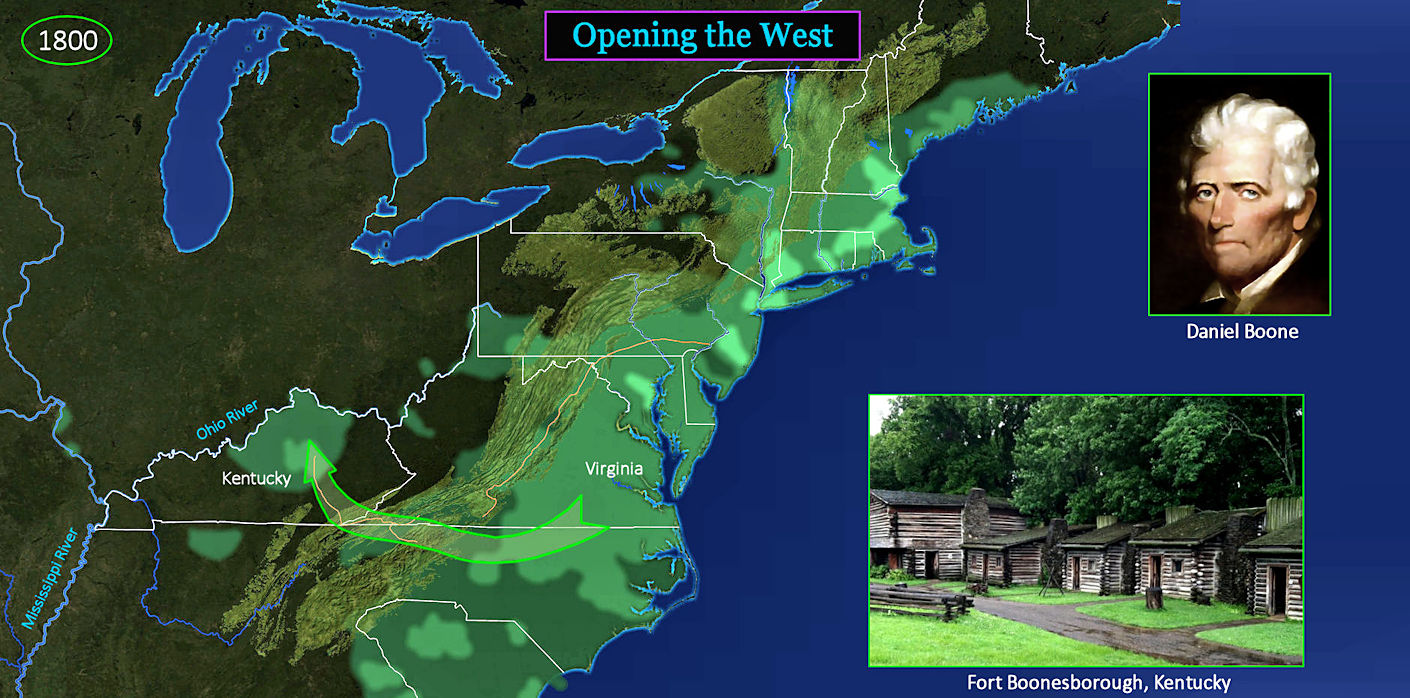
Surging WestThe new gateway opens up the lower Ohio River valley, with almost limitless access to new land. There are Indian settlements everywhere, but surprisingly little armed resistance to the new invasion of white settlers. Back in Europe, France has just emerged from the chaos of the long and bloody French Revolution. Napoleon Bonaparte has emerged as the new military head of state, with big ambitions for military conquest. Napoleon needs money to build his new empire, and by a lucky chance, is willing to sell America a huge chunk of land between the Mississippi River and the distant Western mountains. This is the famous 'Louisiana Purchase.' |
| ||||||||||||||||
| |||||||||
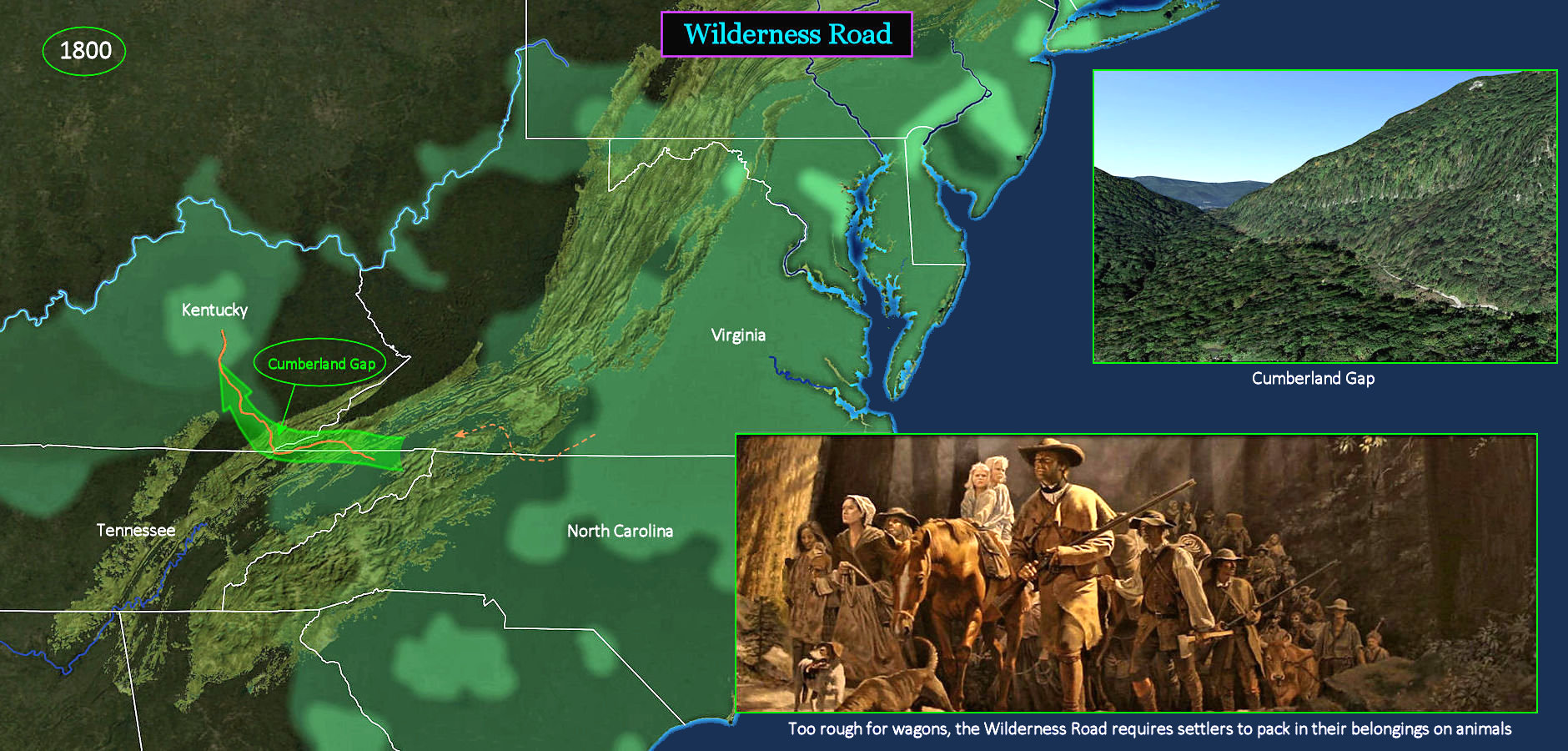
Doorway to the West The new Wilderness Road (ORANGE line) through the Cumberland Gap ushers in a whole new era of expansion for America. Pioneered by Daniel Boone (leading settlers, above), this is a steep trail over rough ground, not suitable for wagons. Even so, some 30,000 Virginians pour through the gap in the first five years. This is convincing proof of the attractive power of new lands, freshly opened. This doesn't mean, however, that the land in Kentucky is that much better than in Virginia. Wild game is much more abundant in the new territory, but many pioneers moving into Kentucky soon discover that it was still just wilderness. They are truly on their own. Again. | |||||||||
| |||||||||
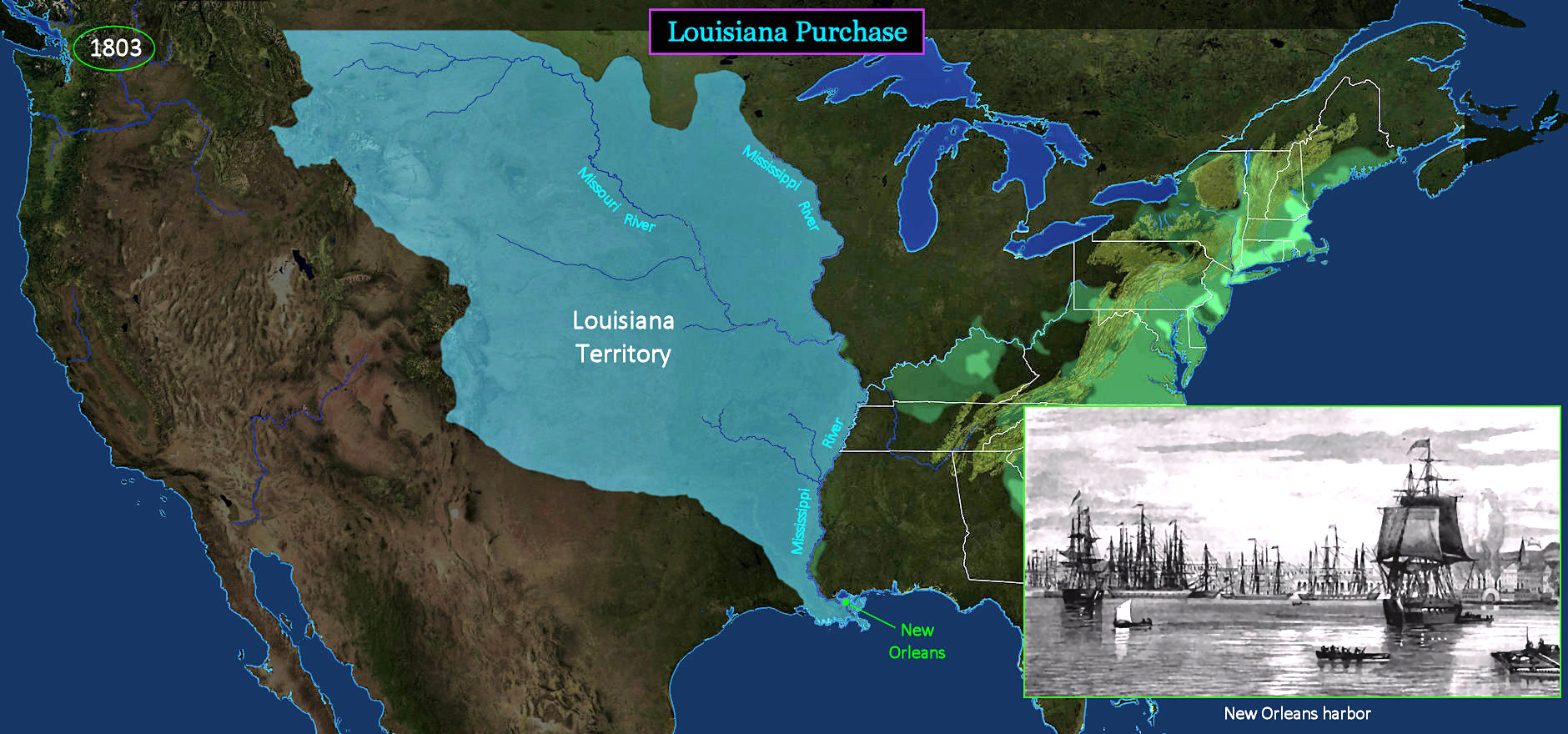
Doubling the Country The westward push gets an unexpected boost from events in Europe. France has just acquired the vast Louisiana Territory (BLUE highlight) from Spain. This includes the vital port city of New Orleans (lower right), which controls shipping along the entire Mississippi River. Newly-elected Thomas Jefferson, America's third President, is eager to buy New Orleans, offering the French $10 million for the city. Napoleon Bonaparte, soon to declare himself Emperor, happens to need money at just this moment to finance his ambitions of European conquest. He offers to sell not just New Orleans, but the entire Louisiana Territory, for just $15 million. America jumps at the offer, and the Louisiana Purchase doubles the size of the country, overnight. | |||||||||
| |||||||||
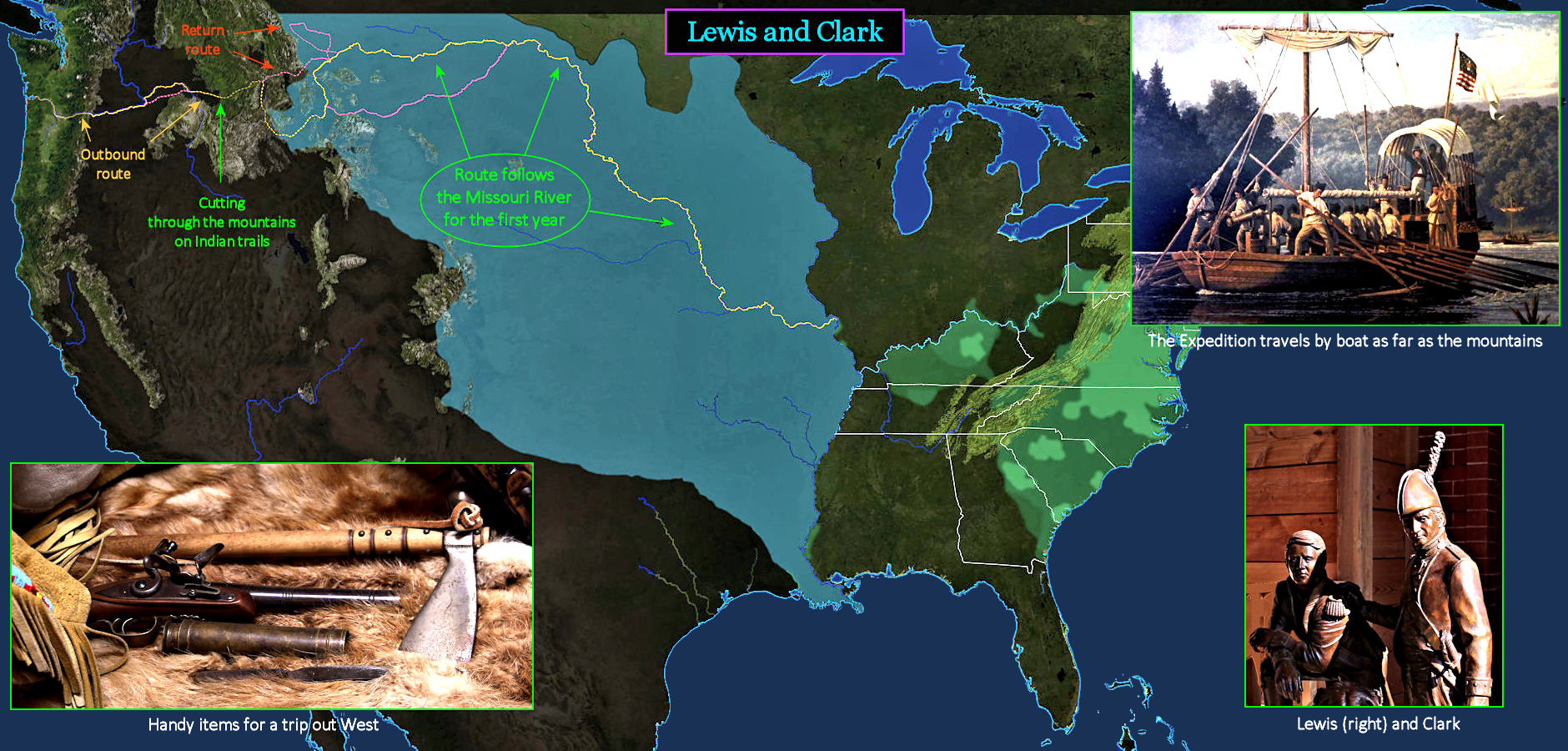
Westward Exploration Jefferson immediately sends out an expedition, led by Lewis and Clark (lower right), to explore the new territory and (hopefully) find an all-water route to the Pacific Ocean. He also wants information about the Western Indian tribes, who are now expected to accept America as their new landlord. The expedition travels mostly by keelboat, following the Missouri River, before crossing the mountains on foot (dotted lines on map). It finally reaches the Pacific by canoe, before returning mostly along the same route. Lewis turns in his report with the disappointing news that most of the new territory is dry grassland, unsuitable for farming. Beyond that, a great range of mountains blocks easy access to the Pacific. | |||||||||
| |||||||||
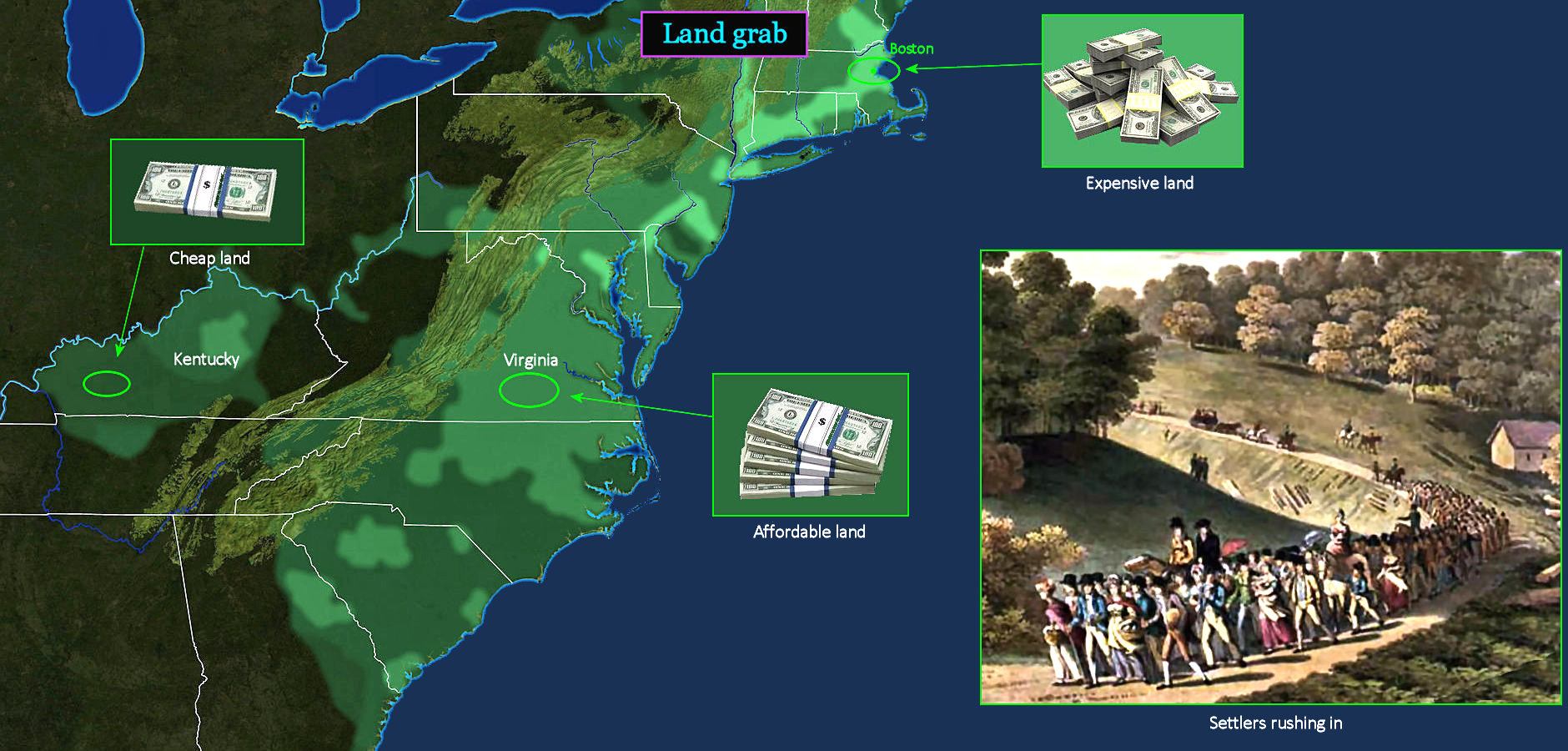
Cheap Western Land The sudden availability of new land sparks a growing flood of settlers from coastal regions to the wide-open expanse just across the mountains. You might wonder why people would be so eager to abandon their homes, and strike out for unbroken wilderness without stores, roads, or even houses. The easy answer is money. The new lands at the edge of previously settled territory are dirt cheap. You can buy 20 acres of land in sparsely settled regions of Kentucky (leftmost GREEN oval) for the same price as a single acre outside Boston. You can buy five acres for the same price as one acre in the broad coastal plains of Virginia. If history is any guide, the newly-settled lands will quickly jump in value. For the young and bold, the lure is irresistible. | |||||||||
| |||||||||
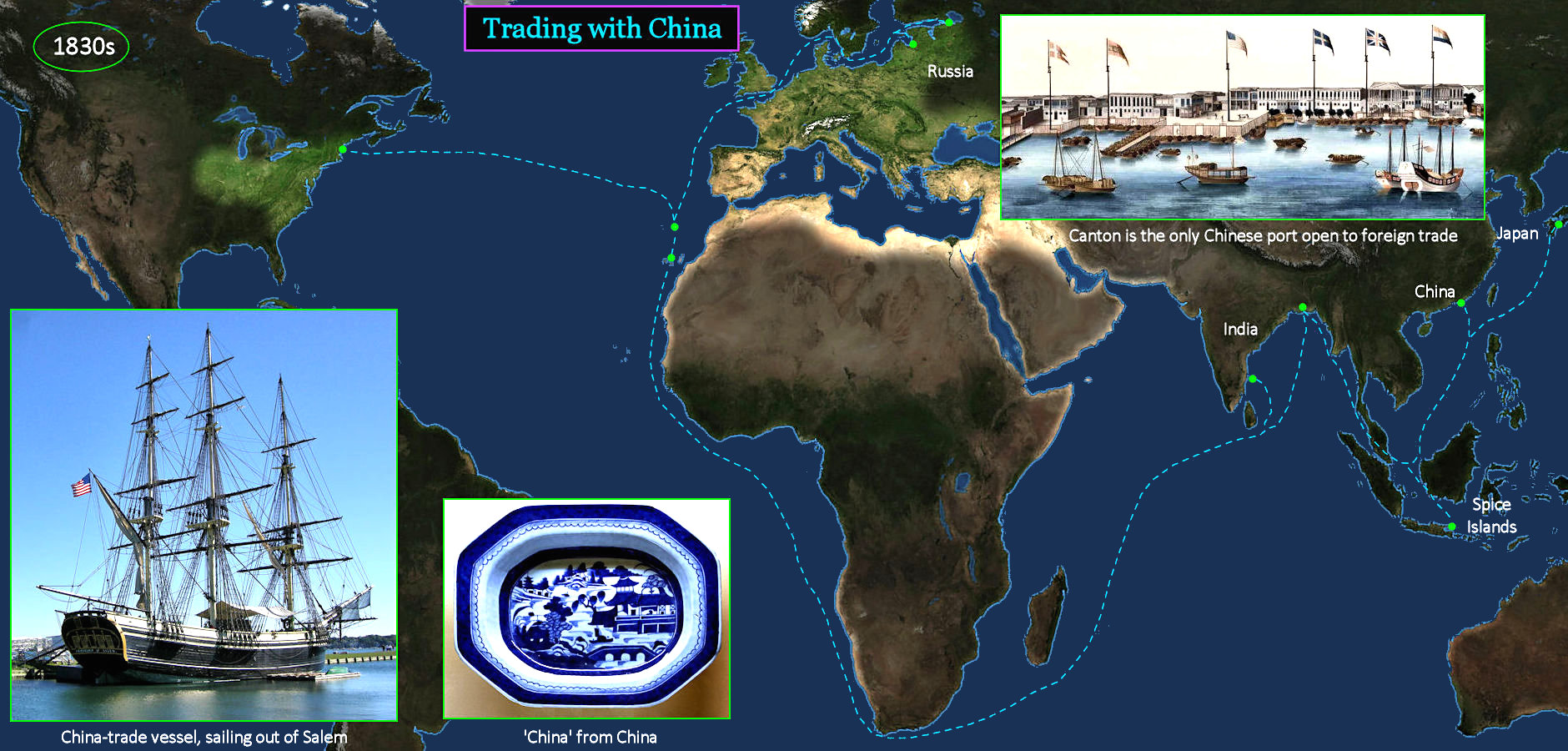
The China Trade While many Americans are heading west in their wagons, enterprising New Englanders are sailing off in the opposite direction. They are attempting to break into markets that have been so profitable for British and Dutch trading companies for the past 100 years. Captains from Salem and Boston are soon gathering cargos from India, China, and even Japan. They return with tea, coffee, spices and silks, which they sometimes then sell in Russia. They also bring home a new kind of blue-and-white porcelain from China (above) that becomes instantly popular among Boston elites. Even today, people sometimes call their best dinnerware the 'good China.' | |||||||||