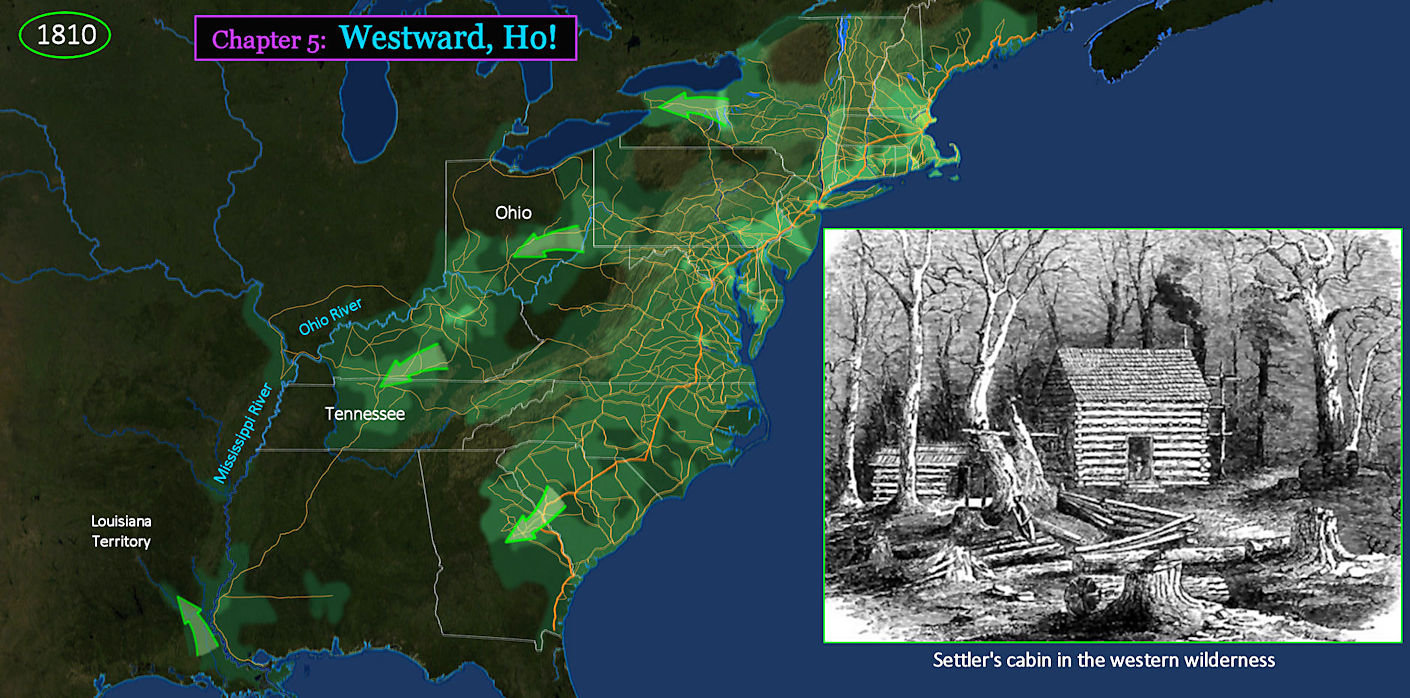
Fertile LandSettlers begin arriving in these areas even before they're organized as states. The area that will soon become the state of Louisiana is also already partly settled, by descendants of French and Spanish colonists. By this time, there are three main routes through the Appalachian Mountains. Once over the main ridges, settlers again spread in all directions (GREEN arrows), including down into Tennessee. The immediate problem for these new western states is getting supplies. The big cities on the east coast are just too distant by road. So supplies arrive mainly by boat, on the Mississippi and Ohio rivers. |
| ||||||||||||||||
| |||||||||
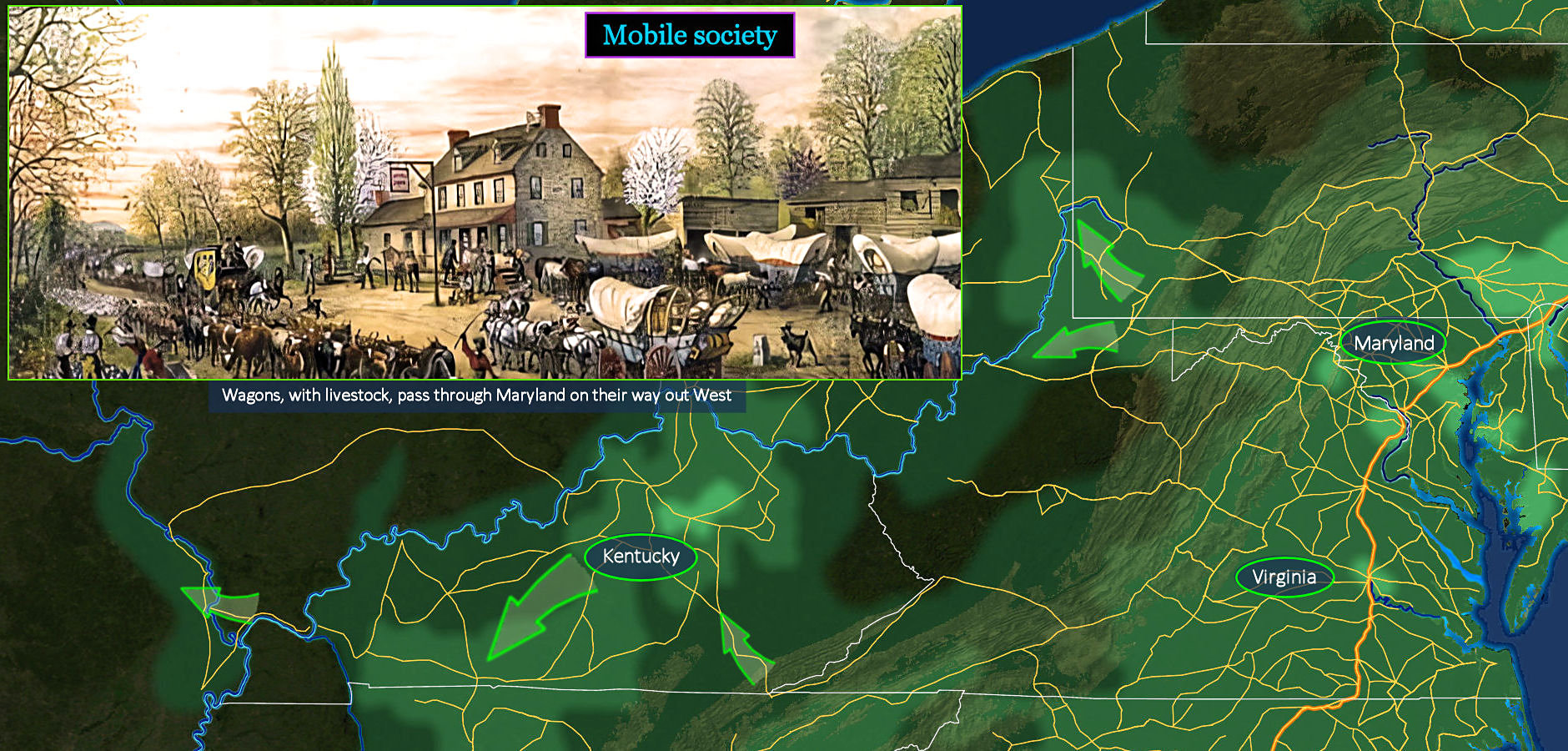
Ready to Go Americans are a surprisingly mobile people. Without cars, or even reliable maps, they are still ready to pack up everything and move on whenever fresh land becomes available. Families sometimes travel in groups, bringing along their livestock, and sometimes their slaves. This trend dates back to the earliest days of America. Virginians, in particular, seem to view the prospect of starting a new life somewhere else as a delightful challenge. A French writer who visits America is stunned at how gay these moving adventures seem to be. Some families move every five or 10 years, whenever crops begin to fail, or prospects for making a fresh start in virgin territory catch the imagination. | |||||||||
| |||||||||
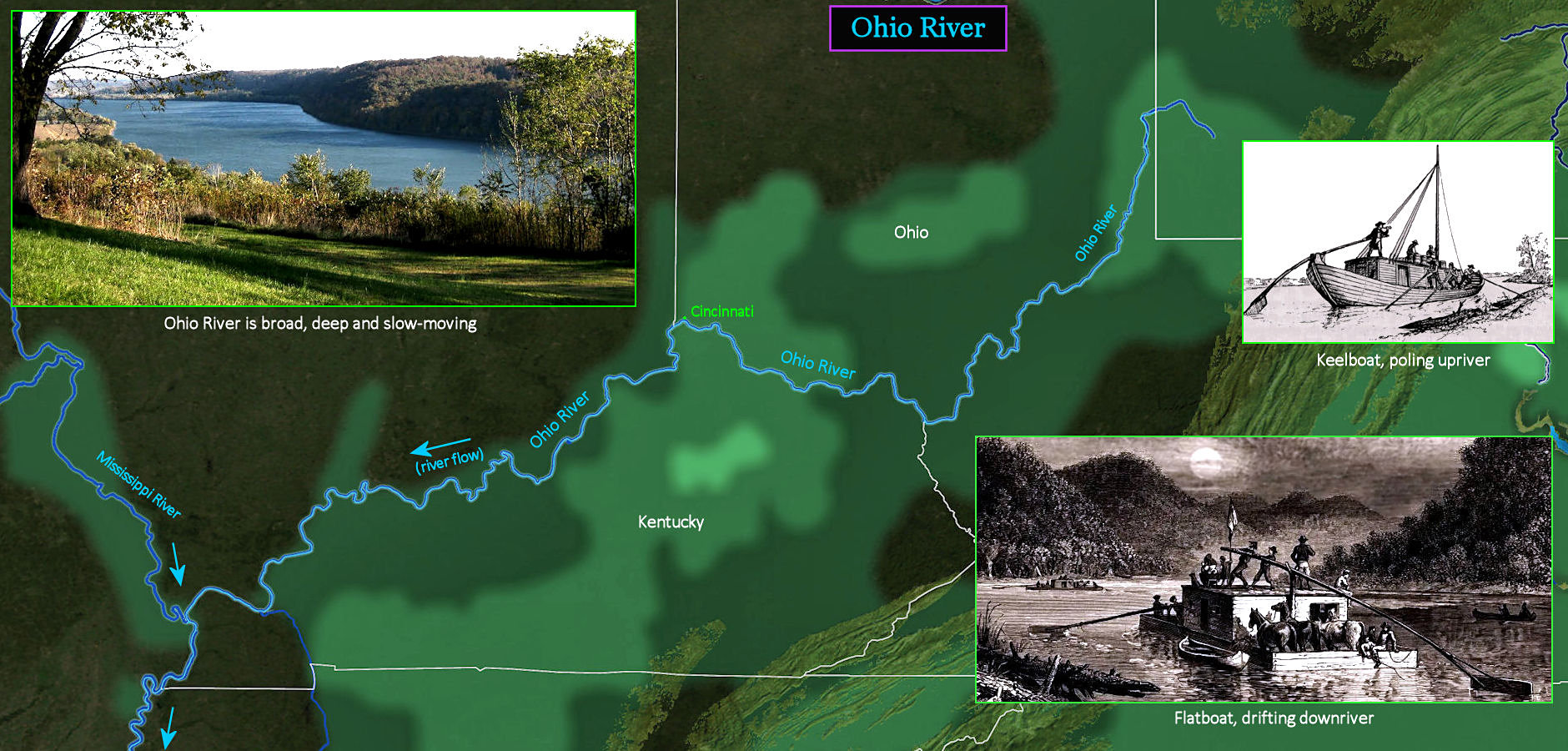
Connecting with the Mississippi The most prominent feature of the western lands is the mighty Ohio River, which is both long and broad. Where it joins the Mississippi, it actually has more water flow than the Mississippi itself. The Ohio is a slow-moving river, making it relatively easy for keelboats to pole or even sail upriver (top right). Flatboats (lower right) normally just float downriver. The Ohio is so wide that it effectively separates Kentucky (on the southern shore) from Ohio (on the northern shore) for the next 50 years. The first bridge across the full channel at Cincinnati won't be complete until after the Civil War. Seasonal rains make for dramatic changes in water levels, which at full flood are nearly 50 feet higher than during the driest periods. | |||||||||
| |||||||||
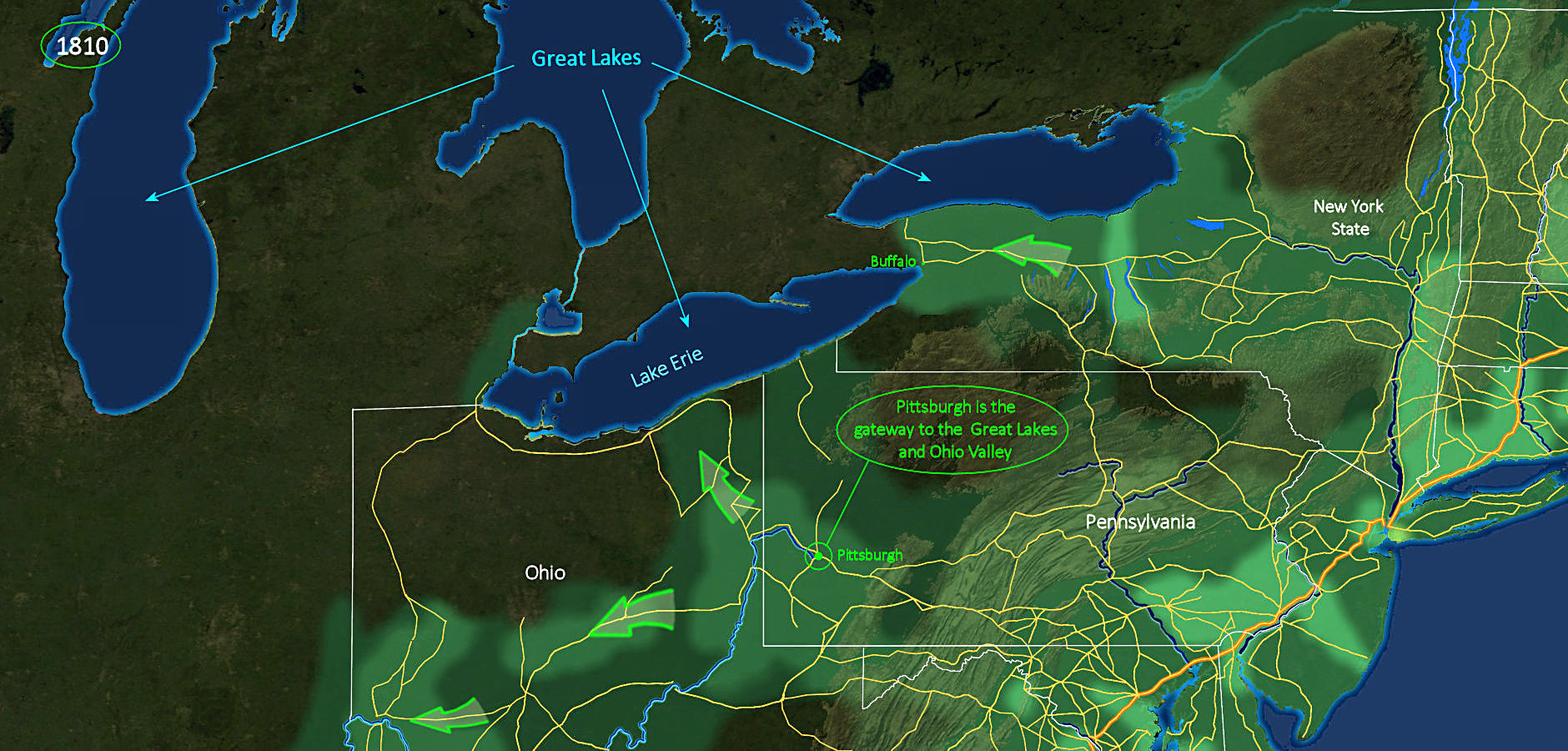
Pittsburgh and Buffalo Most of the early settlers in Kentucky arrive by the southern route, from Virginia. But there are also two northern routes used by pioneers heading for Ohio. The easier route is furthest north, travelling up the Hudson River and then across all of New York State, by wagon road, to the brand new town of Buffalo. This route provides an early connection to Lake Erie, but the road is slow and tedious, and ends at Buffalo. A more popular route is through Pennsylvania to Pittsburgh, at the head of the Ohio River. This route has to struggle through the mountains, but offers better access to the entire Ohio Valley, and Great Lakes. Pittsburgh's strategic location near the Pennsylvania coal fields will later prove important. | |||||||||
| |||||||||
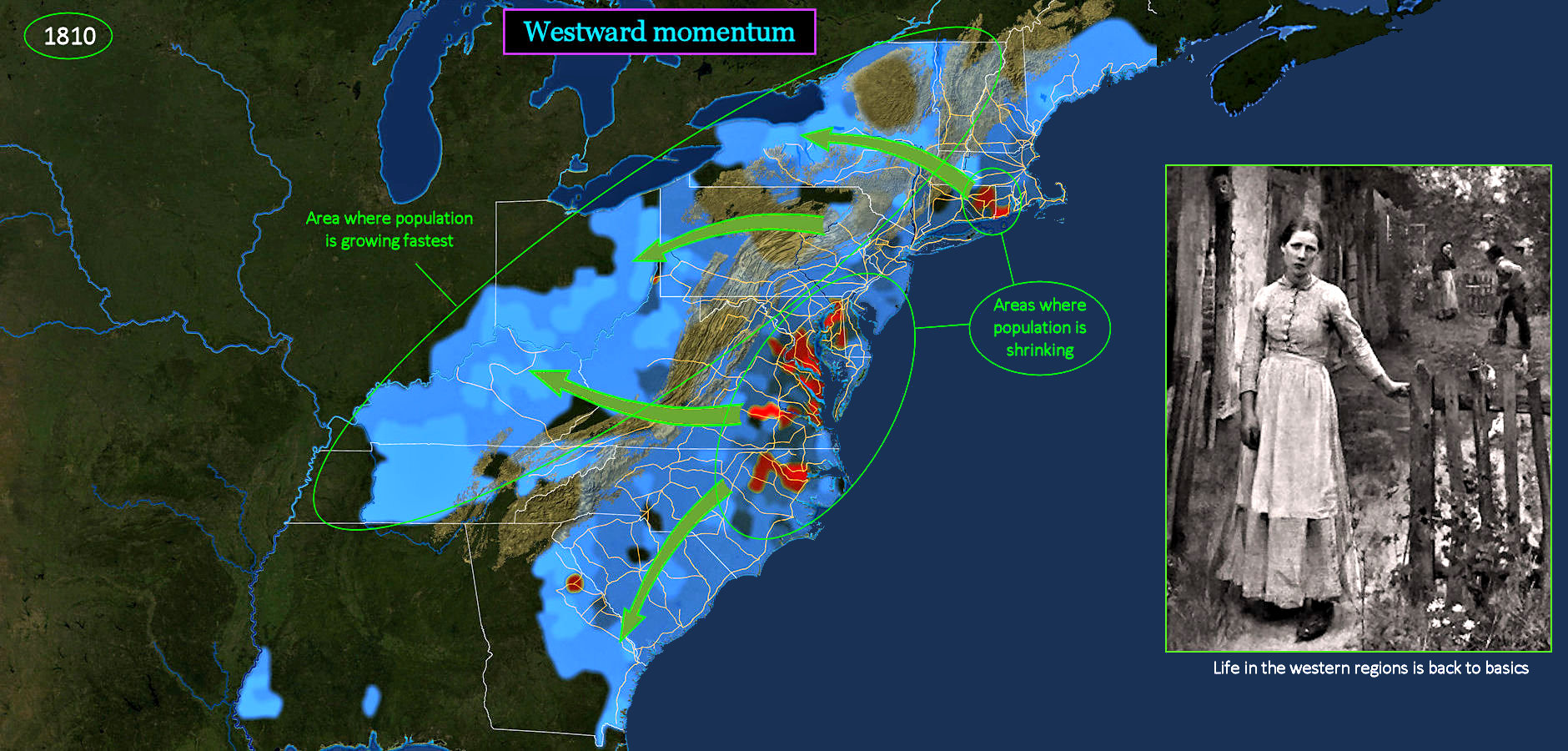
Shrinking East To understand just how powerful the new drive westward has become, it is helpful to look at a new kind of map. The map above is not like the ones shown previously, where GREEN highlighting was used to indicate population DENSITY. In this view, the BLUE highlights indicate population GROWTH. The brighter the blue highlight, the faster the growth. The fastest-growing areas are west of the mountains (LARGEST oval), in areas where settlement is just beginning. Even more startling are the RED-highlighted regions (smaller ovals). These indicate areas where the population is actually shrinking. Most of the red regions are located in Virginia and North Carolina, where tobacco has generally worn out the soil. | |||||||||
| |||||||||
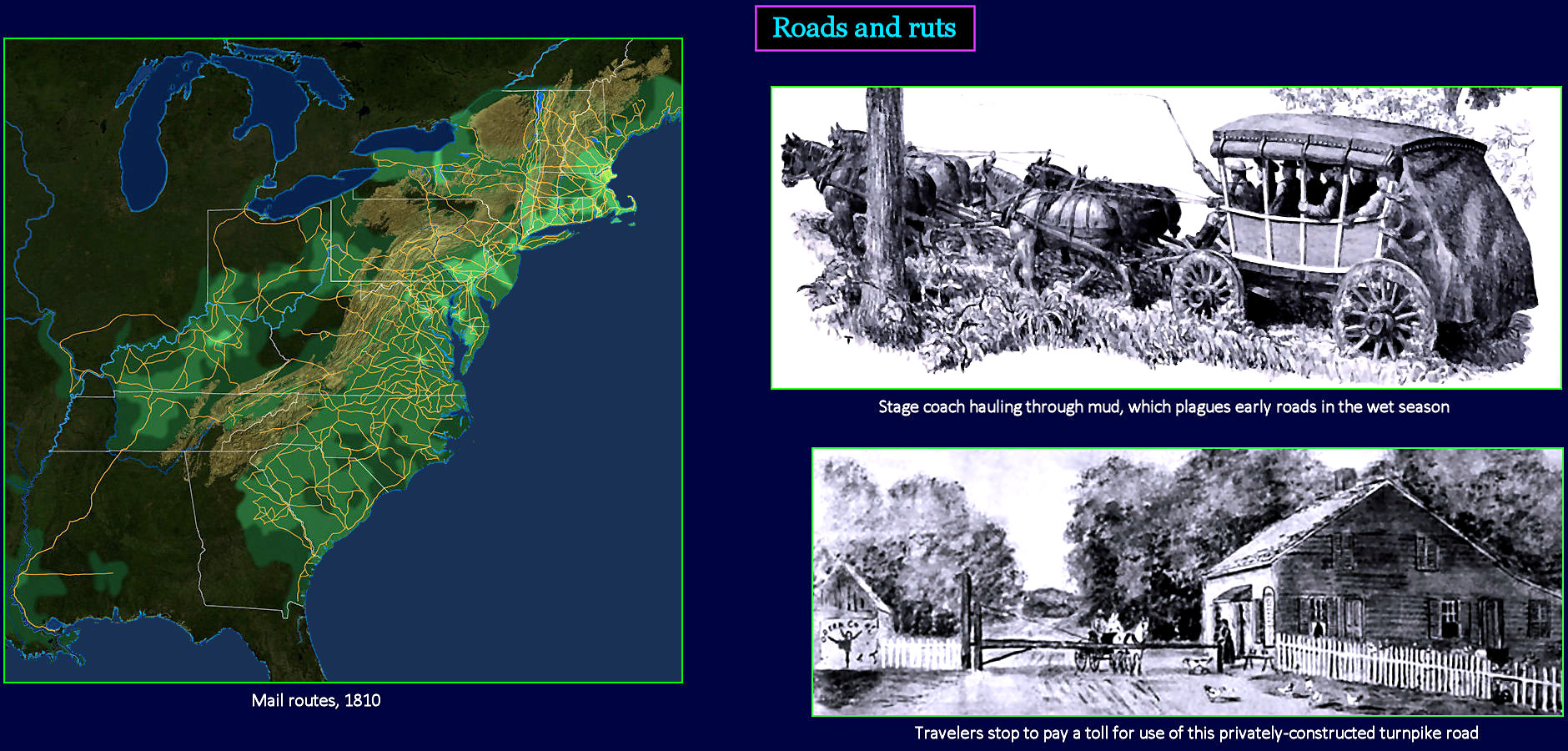
Rough Ride The map shows mail routes in 1810. They are maintained by the Postal Service for the use of its mounted couriers, though many are also suitable for wagons, especially in the East. None of the roads are paved, however, and travel conditions range from bad to worse. In wet weather, wheels sink into the mud (top right), sometimes right up to the wheel hub. When the road surface dries up, the now-hardened ruts provide a jolting ride. Lacking springs, carriage bodies hang from the frame on leather straps, which only partially soften the shock for passengers inside. Early turnpikes (lower right) are an improvement, with somewhat better maintenance. Turnpike companies are among the first incorporated businesses in a still very young America. | |||||||||