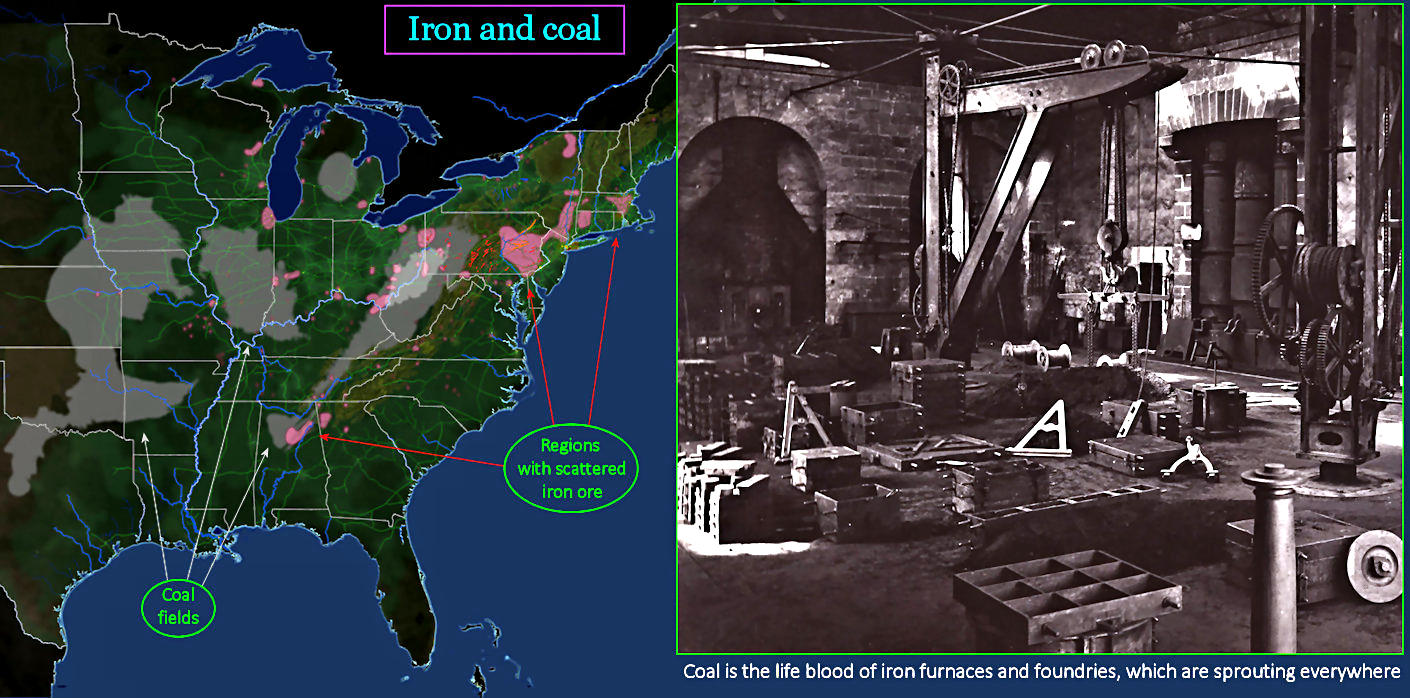
Everything Needs IronAll this requires quantities of iron far beyond previous needs. Railroads need rails, locomotives and bridges. Machines need shafts, gears and rigid iron frames. Steam engines supply the power. In earlier times, iron was extracted from small, widely-scattered deposits. Ore was melted down using charcoal made from the surrounding forest. Small foundries tended to exhaust their local supplies of both ore and trees. Coal becomes the new fuel. Railroad lines into rich Pennsylvania coal fields enable the production of iron in much greater quantities. Additional iron ore is shipped in from newly-discovered deposits in upper Michigan. |
| ||||||||||||||||
| |||||||||
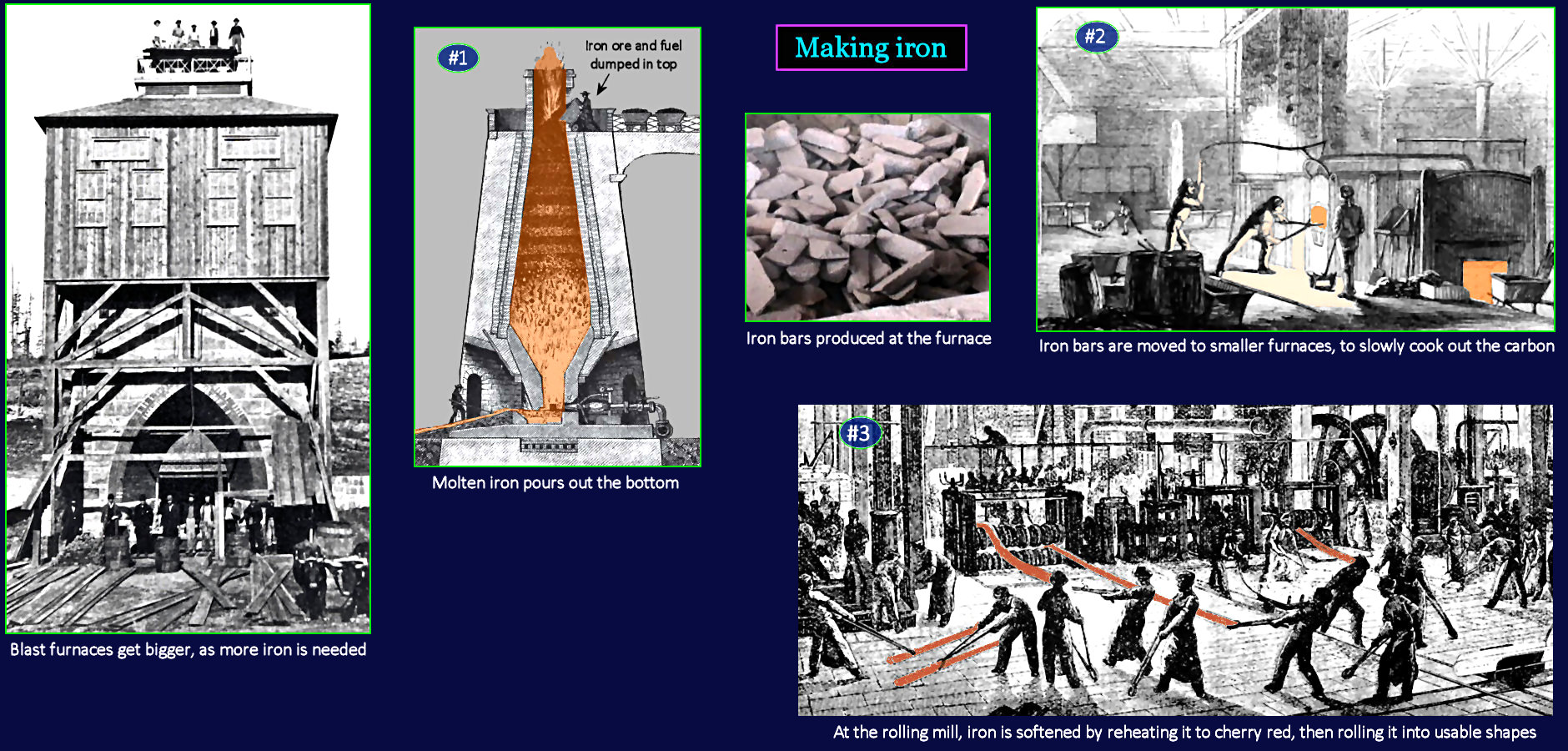
Massive Blast Furnaces Extracting iron from raw ore usually involves three steps, each of which requires a lot of coal. The first is to stoke a hot fire in the bottom of the blast furnace (top center), then dump alternate layers of iron ore and coal (or coke, made from coal) into the top. Limestone is added to remove impurities. As the burning mixture works its way down, the temperature increases until the iron softens, and runs out the bottom in molten form. After hardening into bars, the iron is loaded into a secondary oven (top right) that slowly cooks the iron to remove carbon. Too much carbon makes iron brittle. The iron then goes to a rolling mill, where it is softened by reheating again. This allows rolling it into long, regular shapes, such as sheets, bars or railroad rails (lower right). | |||||||||
| |||||||||
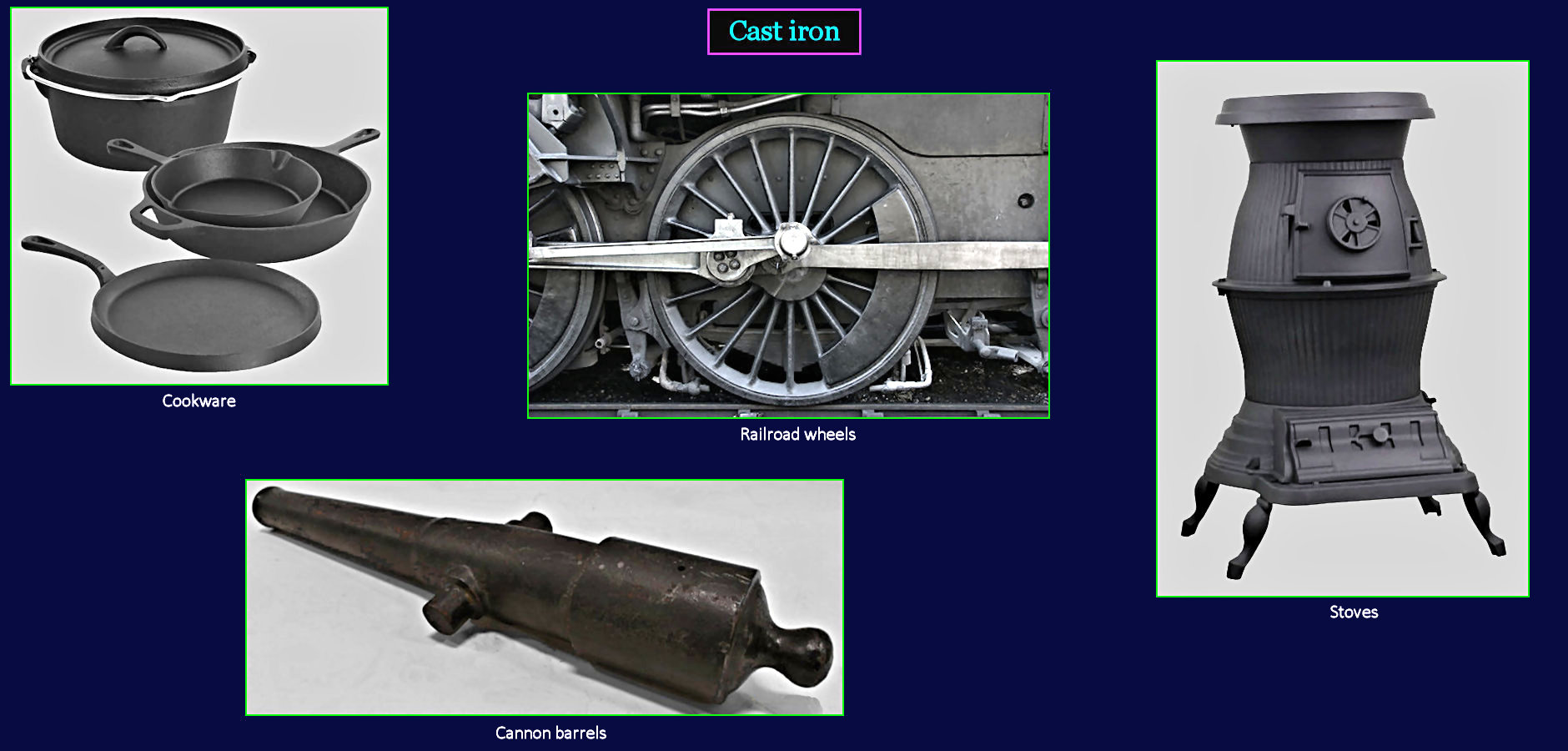
Hard But Brittle The iron that flows out of a blast furnace is brittle, because it naturally contains small amounts of carbon. Such iron is very hard, but only suitable for molding into items which will not be subject to bending. Cast iron doesn't bend. It cracks. That's why you can break up a cast-iron stove by hitting it with a sledgehammer. The items shown above are typical cast iron products. Most other iron products, however, require a less brittle form of iron, which will flex somewhat under stress, without cracking. Flexibility is achieved by slowly boiling the iron in a furnace that cooks out almost all the carbon. This is a long, slow process producing toxic fumes, which are unhealthy for the attending workmen. | |||||||||
| |||||||||
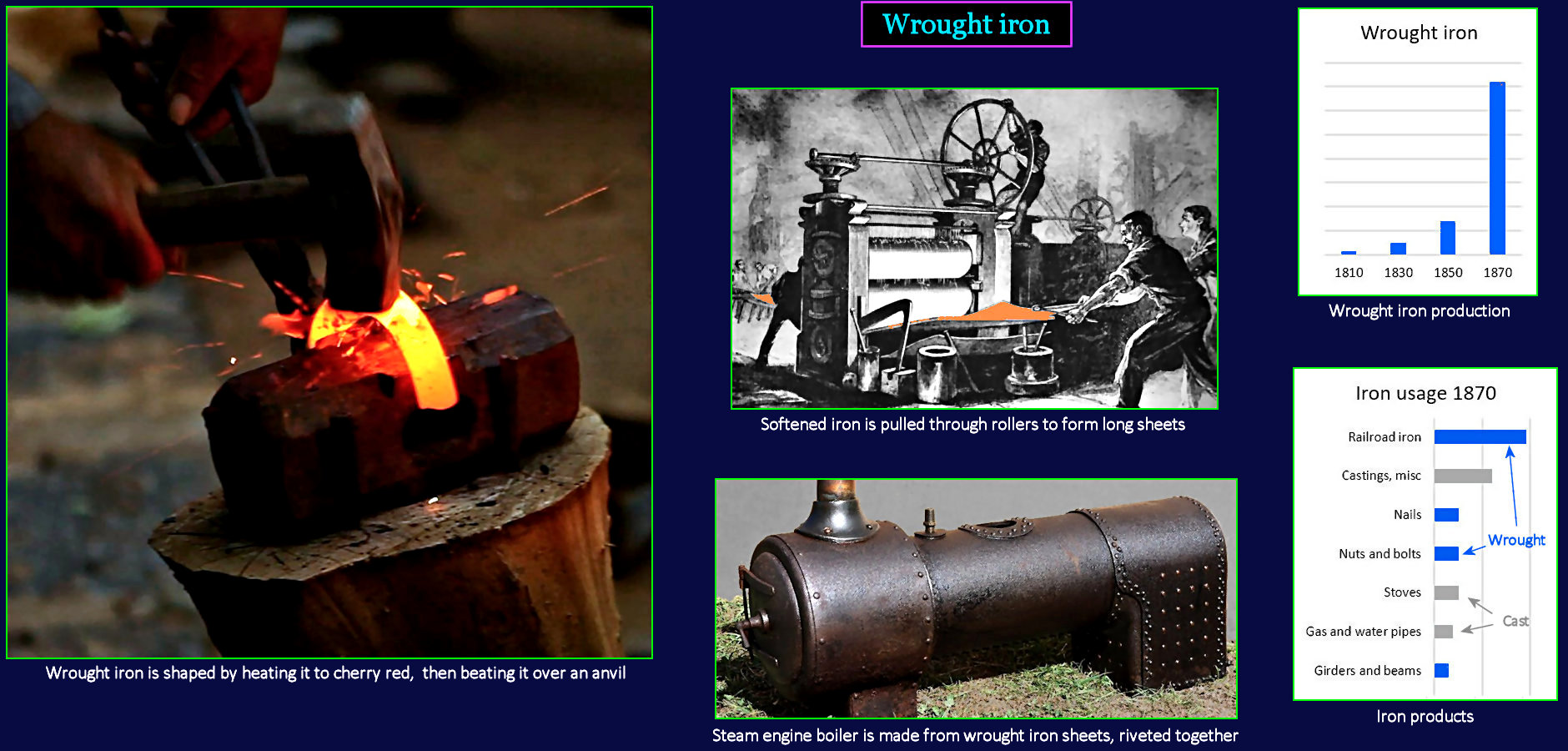
Working the Iron Wrought iron is remarkably flexible, when softened. It can be beaten into simple shapes even when cold, but bends and flows much more easily when heated to cherry red. The simplest example is a horseshoe, formed over the blacksmith's anvil (left). Industrial use of wrought iron rises dramatically after the Civil War (top right). This is primarily due to increasing demand for rails, locomotives, and other industrial equipment. Sheet iron can be rolled into curves, and then riveted together to form steam boilers (bottom center). But not all products require wrought iron. Railroad wheels, stoves and water pipes are all made of cast iron (GRAY items in chart at lower right), which doesn't require the extra step of cooking out the carbon. | |||||||||
| |||||||||
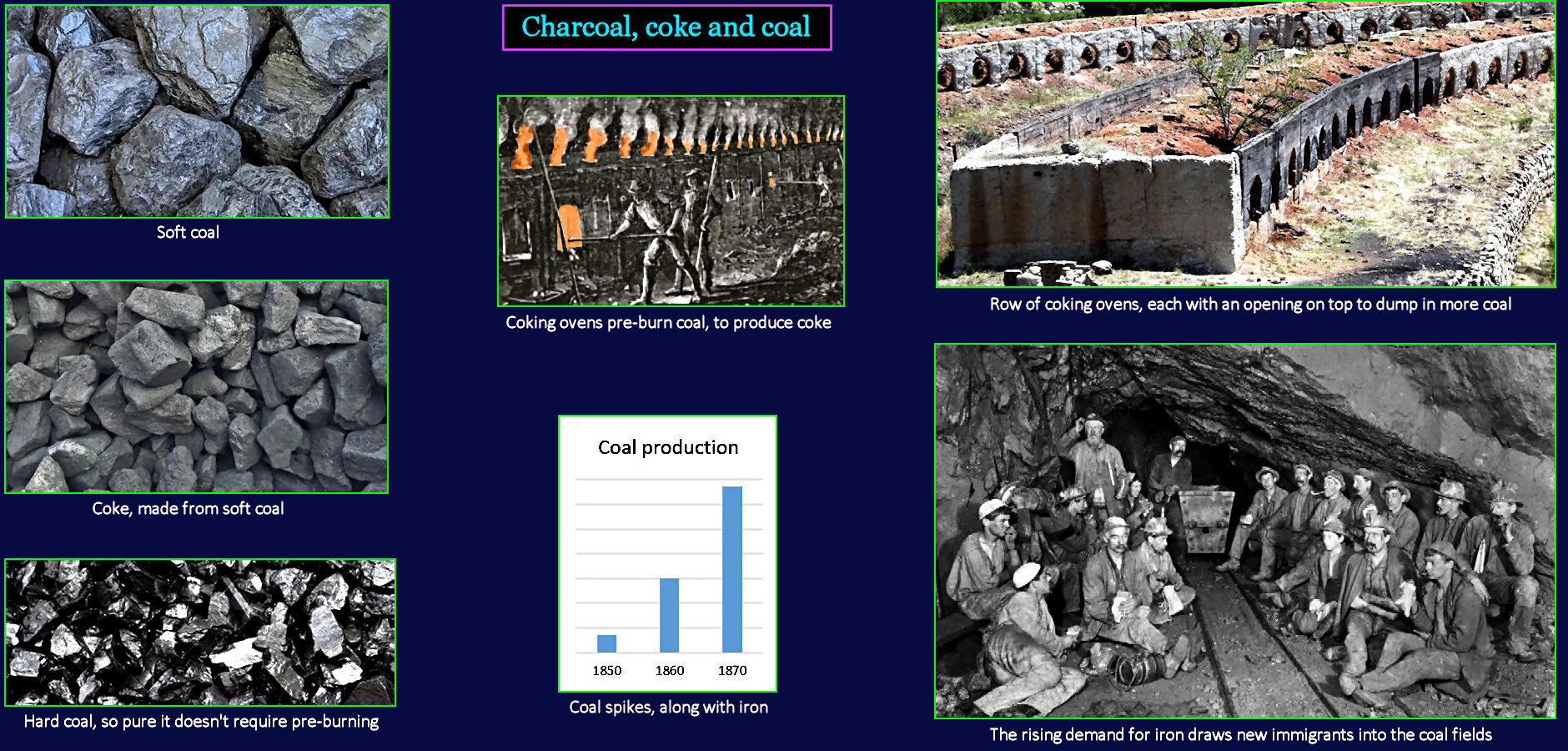
Feeding the Furnaces Before the Civil War, the only fuel that burns hot enough to melt iron is charcoal, made by slowly 'pre-burning' wood under a pile of dirt, to starve the fire of oxygen and drive out impurities. Rapidly rising demand for iron, however, produces a huge new demand for more fuel, which at first is coal. When larger, hot-blast furnaces are developed during the 1870s, 'coke' becomes the fuel of choice, because it burns hotter, and is simple and cheap to make. Like charcoal, coke is produced using a pre-burning process, which also relies on starving the fire of oxygen. But coke is made by pre-burning coal, instead of wood. Hard coal is so pure it doesn't require pre-burning, but is available only in eastern Pennsylvania, around Scranton. | |||||||||
| |||||||||
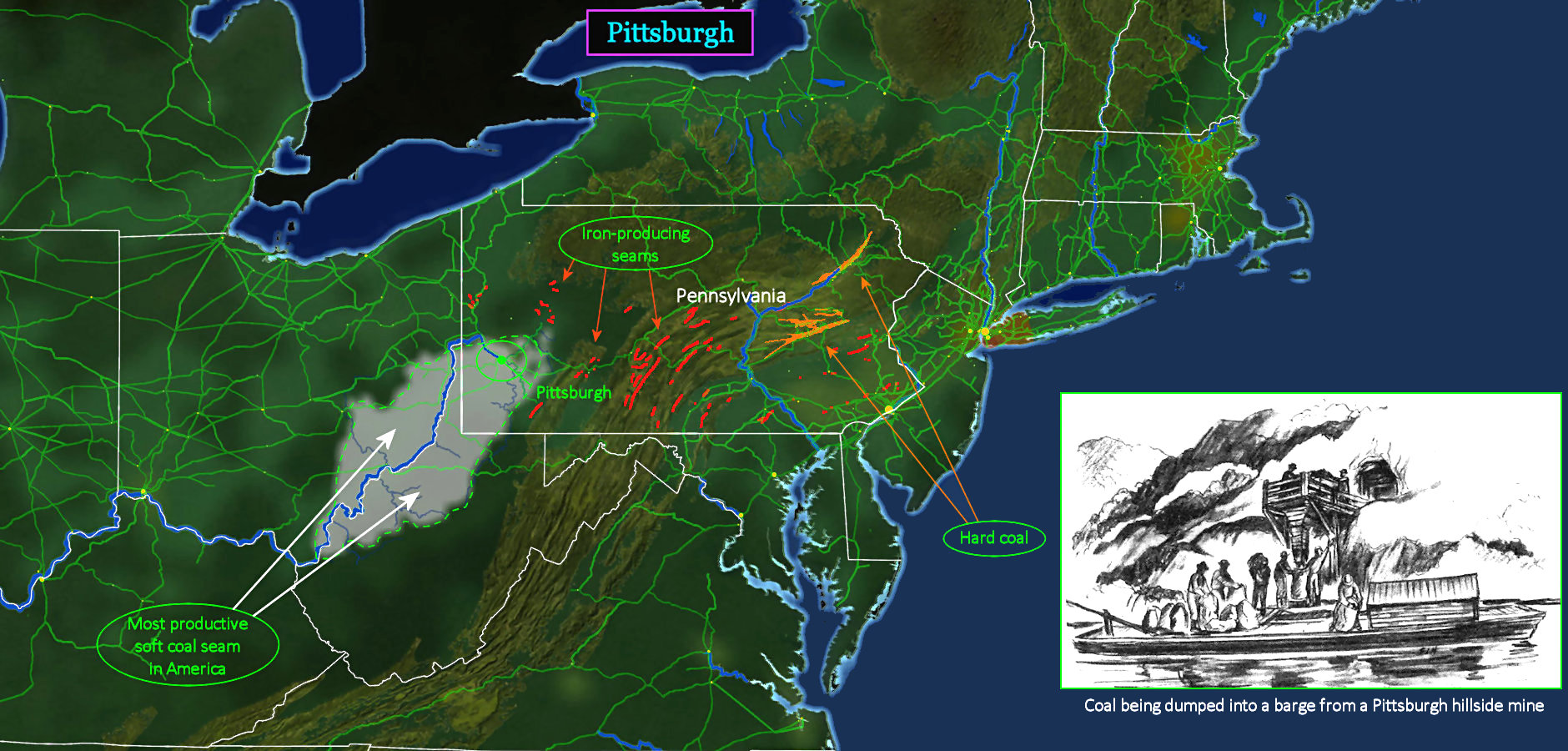
Industrial Sweet Spot As the industrial era is just getting started in America, the most important resource is coal, which is the best fuel for steam engines. It is also essential for producing iron, as blast furnaces consume iron ore and coal in equal quantities to produce liquid iron. The sweet spot for iron production in the 1870s is Pittsburgh, where coal is mined within a mile or two of the blast furnaces. It was first discovered exposed on a hillside right across the river from Pittsburgh. Iron is also located nearby | |||||||||