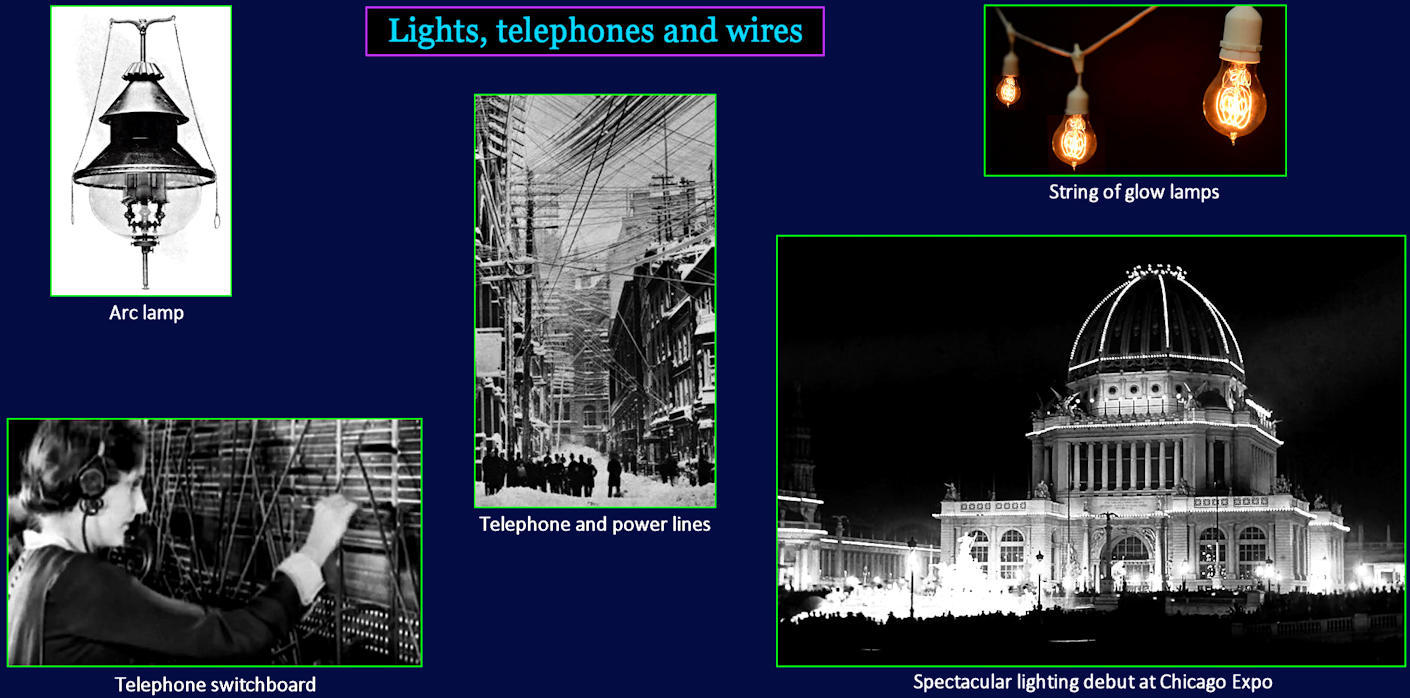
Vanquishing NightBut the most visible change is electric lighting. You can now have light anytime, anywhere you want. No more long winter nights trying to read by an oil lamp. No more carrying candles up the stairs at night. Thomas Edison gets the credit for developing the electric light bulb, but electric arc lamps actually predate Edison's glow lamp. They're simple and bright, allowing cities to replace their gas streetlights with electric versions. Soon, the demand for power and phone lines is so great that a whole new industry is born, supplying electricity to entire cities. This unleashes a major struggle over who will control the infant power grid. |
| ||||||||||||||||
| |||||||||
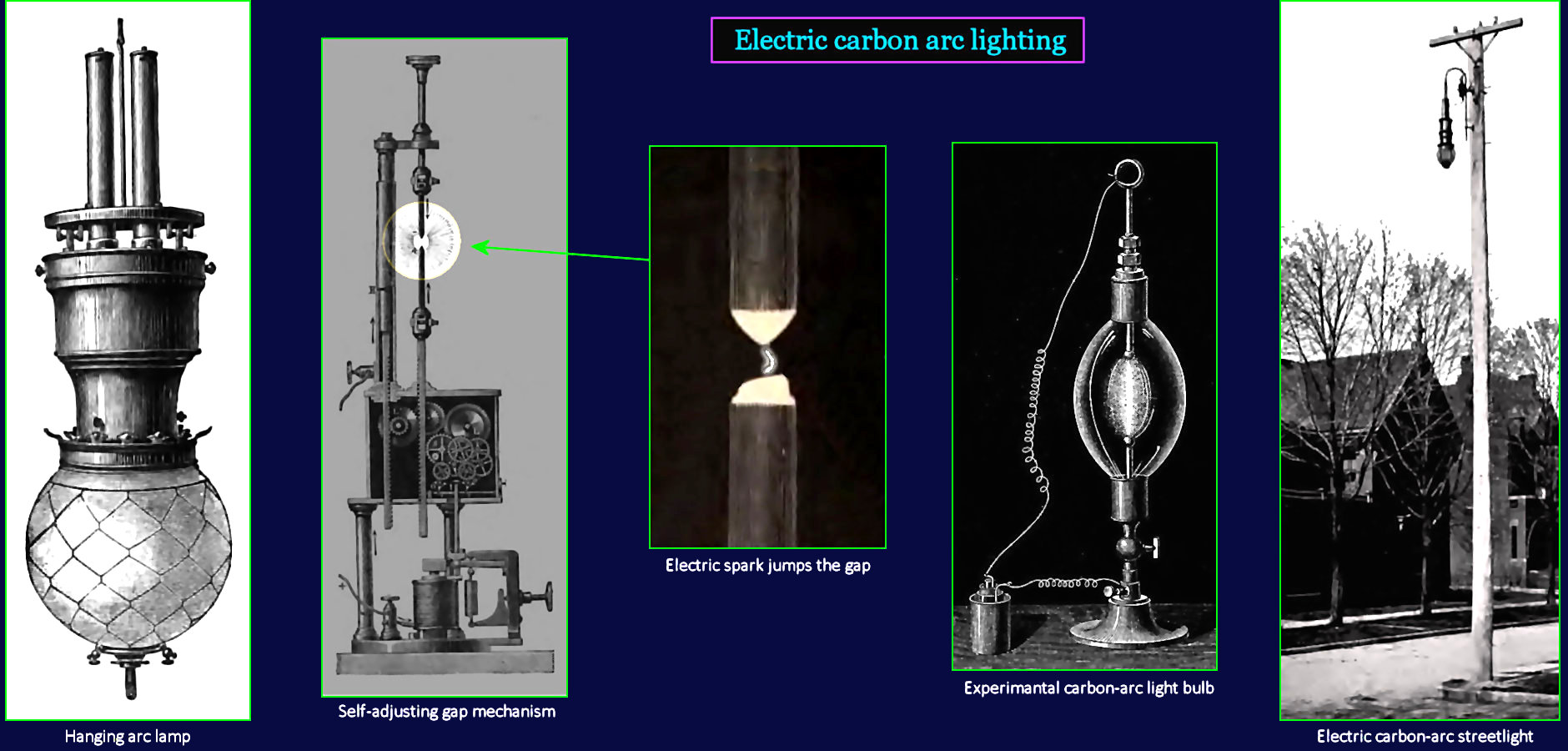
Before Edison The first electric lights are arc lamps, which are already in use by 1870. They're basically just two sticks of carbon, spaced slightly apart. When an electric current is applied to the upper and lower carbons to form a circuit, a bright spark jumps the gap (top center). Once it warms up, the device emits a piercing white light, without drawing much current. But since the tips of the carbons gradually burn back, the rods have to be periodically brought closer together, to maintain the optimum gap. The mechanism shown above (second from left) uses a timer to gradually bring the rods closer. Arc lights are used primarily as streetlights, but also to provide dramatic lighting in theaters, where they sometimes cause fires. | |||||||||
| |||||||||
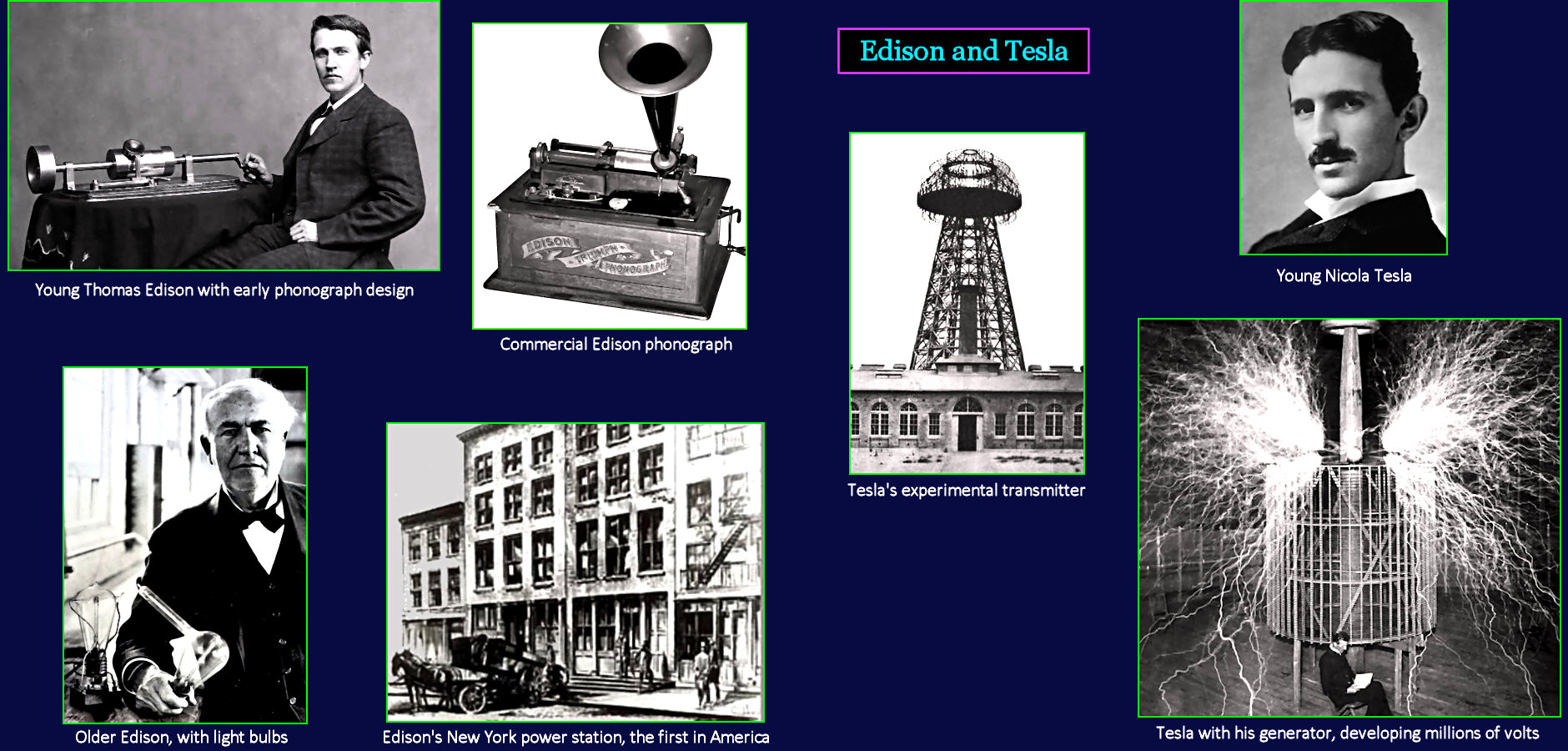
Enter the Giants There are many experimental pioneers in the early days of electricity, but Thomas Edison and Nicola Tesla stand out as true giants. Edison invents the phonograph, creates the first long-lasting light bulb, and builds New York City's first power station, almost at the same time. Tesla is less well known, but perhaps equally brilliant. He actually works briefly for Edison, before leaving to set up on his own. Tesla famously challenges Edison, arguing in favor of using alternating current (AC), instead of direct current (DC) for general usage. The voltage of AC current can be easily boosted with a transformer, permitting transmission over long distances. Tesla wins out, and AC is today's standard. | |||||||||
| |||||||||
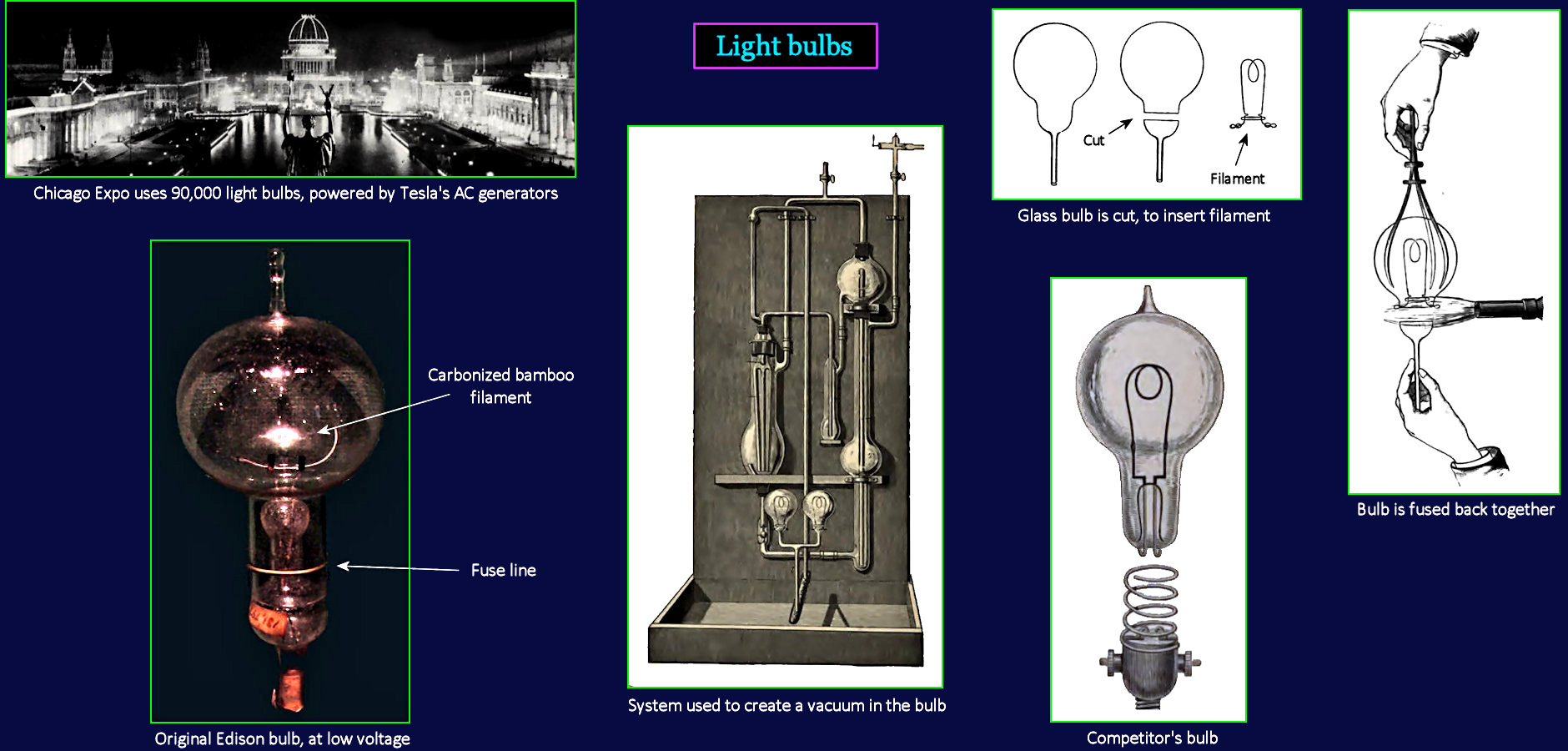
Simple, But Not Obvious The light bulb makes its debut at the Chicago Expo of 1893 (top left). Because the individual bulbs are dim, huge numbers are combined to achieve a stunning effect, when all are suddenly turned on at the same time. Edison isn't actually the first to make an electric light bulb. He just figures out how to keep his bulbs burning longer. Competitors use a glowing filament made of carbonized cotton, but Edison discovers that carbonized bamboo fiber lasts longer. He discovers this by first eliminating almost every other possibility. Edison also uses a better vacuum system to remove air from the bulb, which helps preserve the delicate filament. This requires cutting the bulb, inserting the filament, and then re-fusing the glass in a vacuum chamber (top right). | |||||||||
| |||||||||
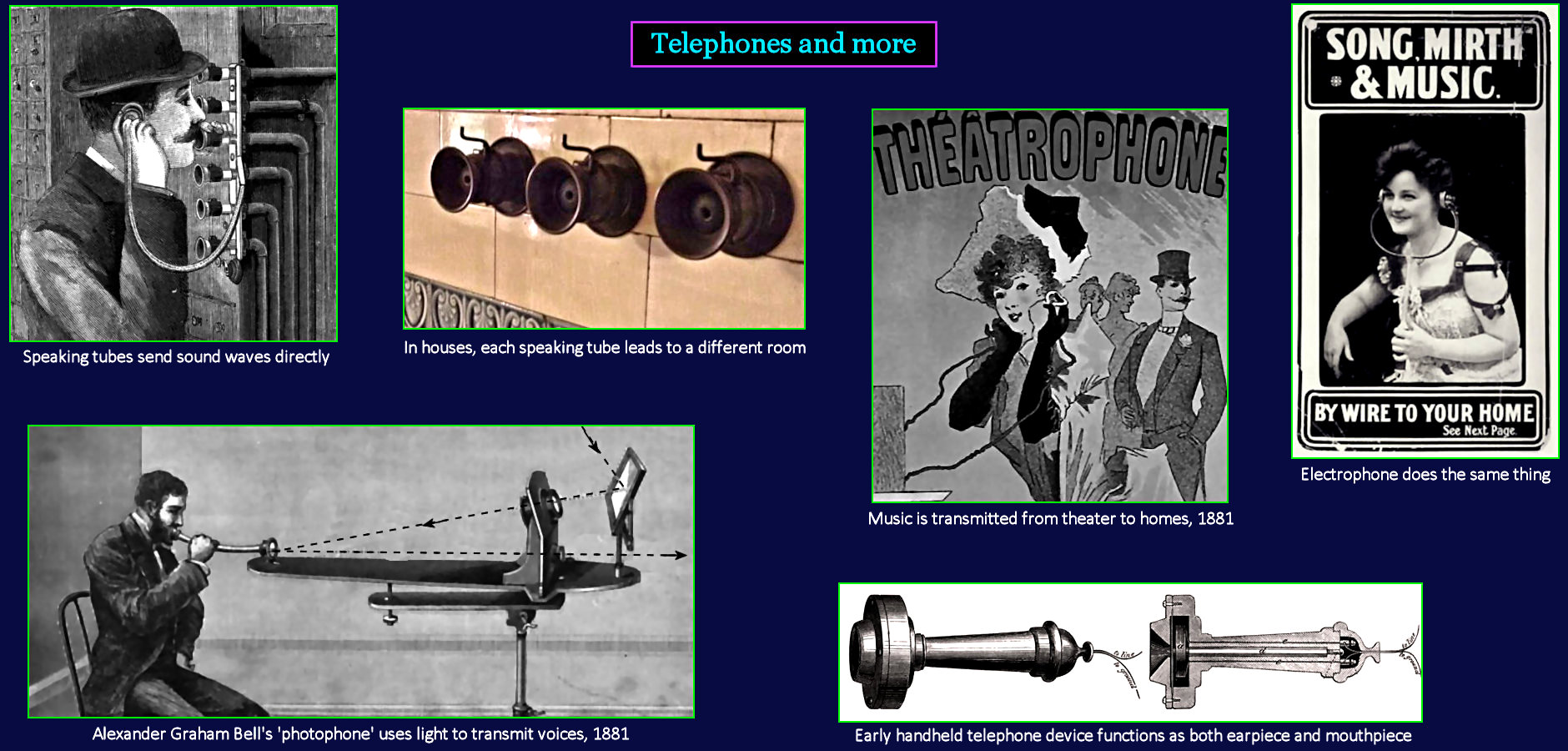
Talking Devices The telephone is another bit of magic, but it isn't the only device developed to transmit the human voice. Speaking tubes (top left) are invented before the Civil War, allowing voices to travel through long tubes to distant rooms. Steamboat captains use them to talk to the engine room, while upscale homes have tubes to talk to servants elsewhere in the house (left center). Advances in telephone technology are rapid after its introduction in 1876. Alexander Graham Bell gets the first patent, although others are working on similar devices at the same time. The Bell Telephone Company is formed in 1877, and by 1890 there are a quarter million telephones in America. Music is transmitted by similar devices (top right). | |||||||||
| |||||||||
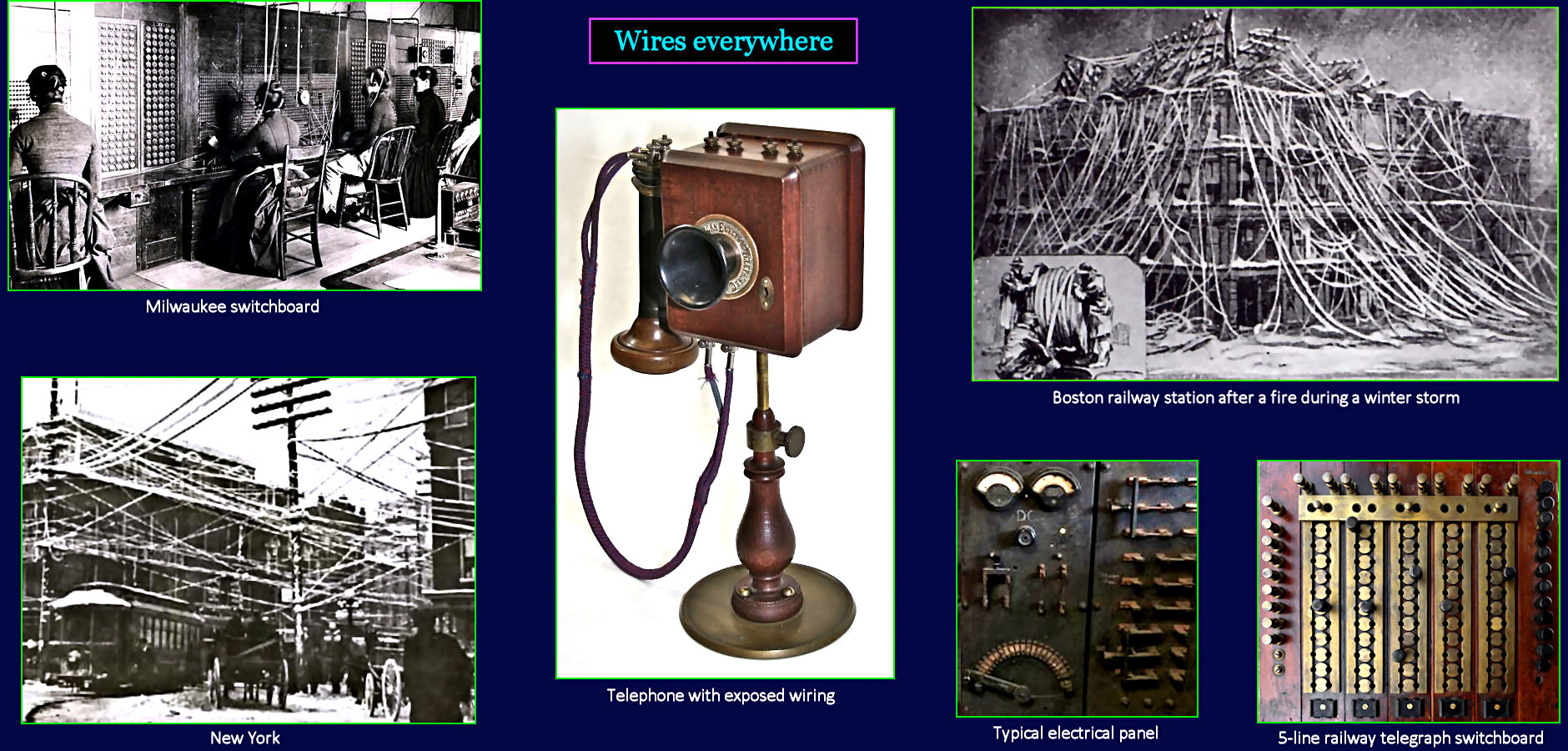
Growing Tangle Electrical equipment is still primitive in the 1890s, but phone service quickly gains popularity. Unlike electric lights, which can all share the same power line (with optional individual switching), telephones usually need a separate wire for each phone. Telephone switchboards (top left) have a large array of sockets, one for each line. Operators are needed to make connections, using a short wire to connect the sockets wired to each end of the call. Separate lines are impractical in rural areas, where many homes typically share the same line, called a party line, until the mid-1900s. Anyone on a party line can listen to anyone else on the same line. Telegraphs remain in service, still used by the railroads that had originally installed them. | |||||||||