| |
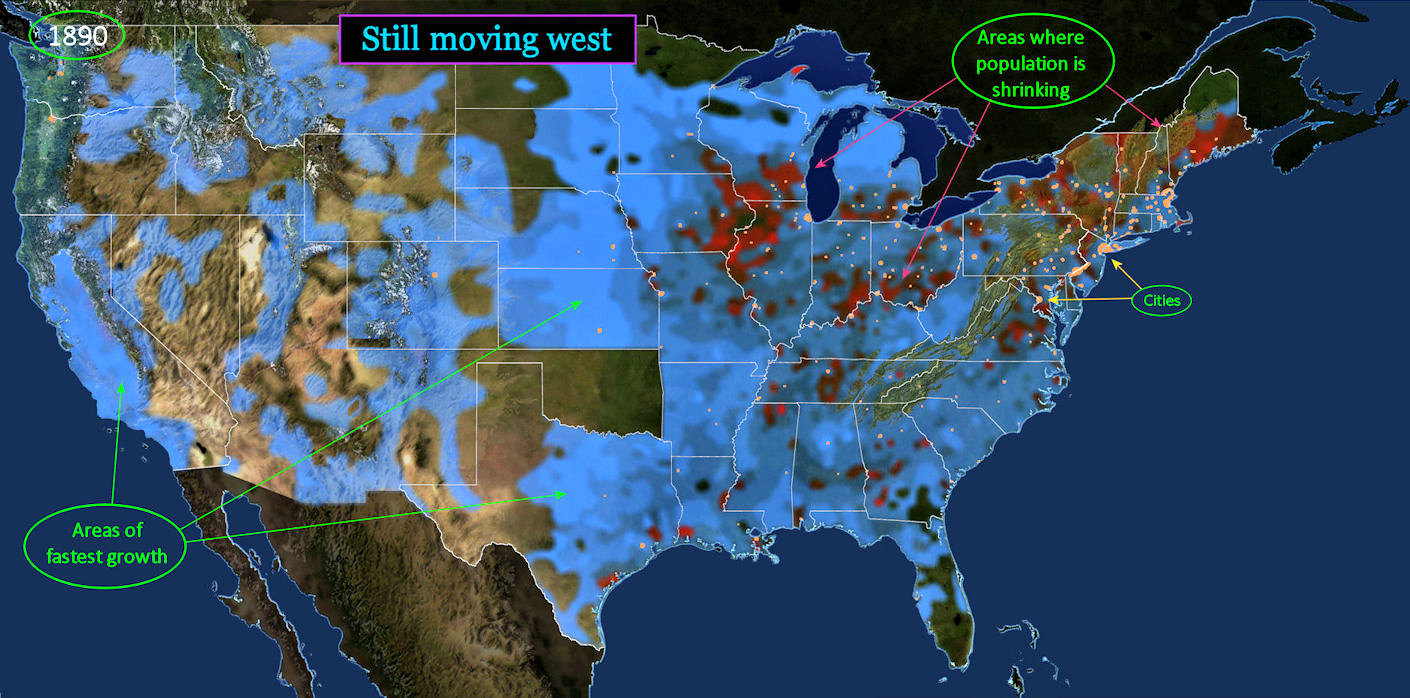
Blue and Red Regions with the brightest BLUE highlights (above) indicate those with the fastest growth rates, including everything in the western half of the country. RED highlights indicate areas with shrinking population, which are mostly in the Midwest and Northeast. Note, however, that this indicates changes at the county level. The states themselves are all still growing somewhat, even as some individual counties are shrinking. The red areas reflect the growing movement of families out of rural counties, into nearby urban centers (in ORANGE). |
| |||||||||
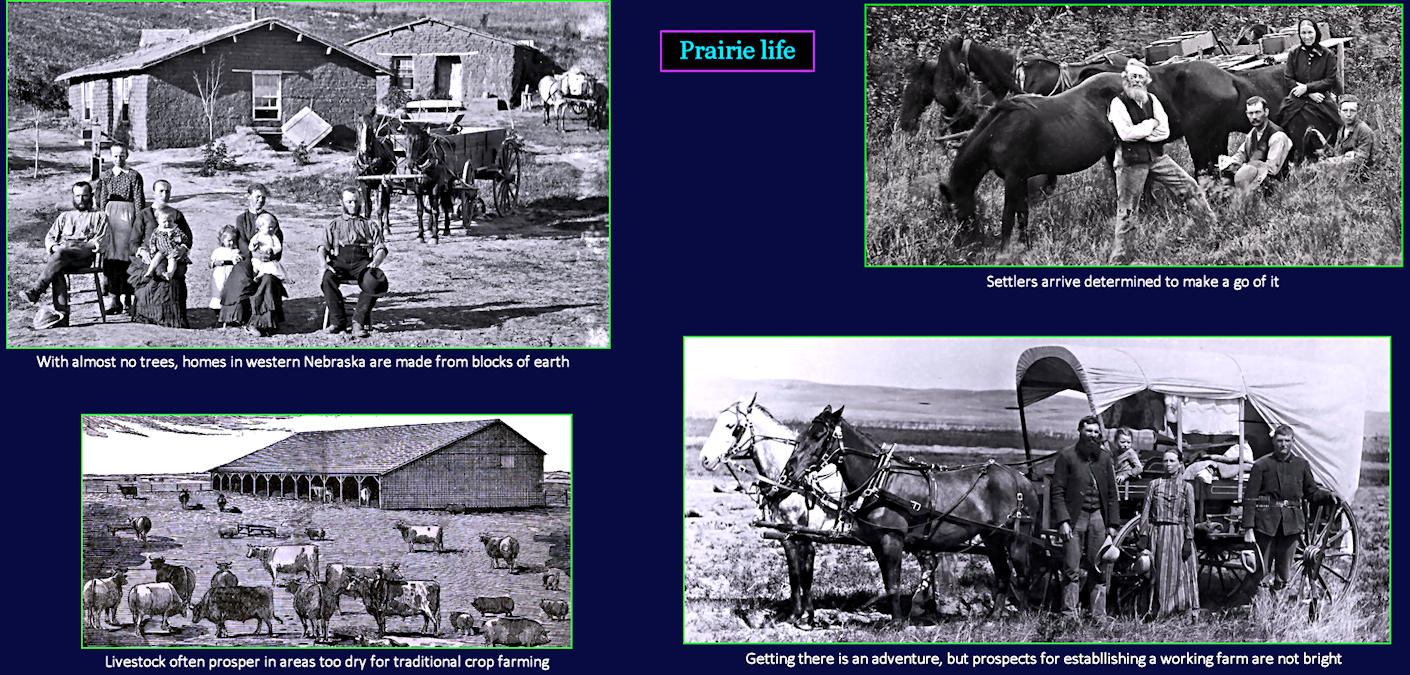
All Alone Trying to make a life for your family out on the prairie takes a lot of ingenuity, and even more grit. There are few trees to make lumber, and nothing that can be used to erect masonry walls. So farmers cut the earth into brick-sized blocks, held together by the roots of prairie grass. Nothing is easy, and the wind never stops blowing. Some wives go mad with the solitude, and the constant wind. Then there are the great rolling thunderstorms, and occasional tornados. But perhaps hardest of all is the lack of neighbors. Farms are scattered, and children have few friends to play with. Schools barely exist. | |||||||||
| |||||||||
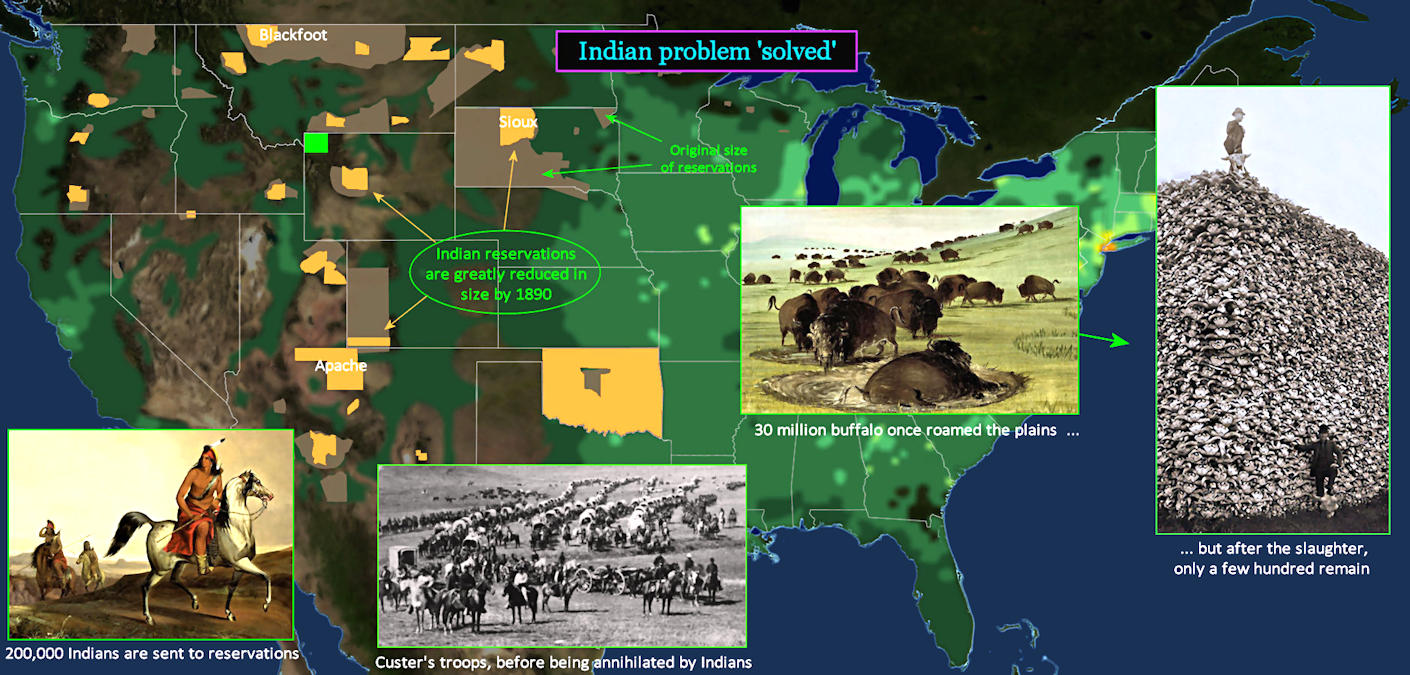
Put Them in a Box ... Somewhere While the Civil War is raging elsewhere, Sioux warriors in Minnesota and the Dakota Territory kill hundreds of settlers, and force another 40,000 to flee. That's enough to send in the Army. Things heat up again after the war, when gold is discovered in South Dakota. General Custer and the cavalry are dispatched to protect settlers, but his entire troop is wiped out when he stumbles upon a group of several thousand Indians, in a battle dubbed 'Custer's Last Stand.' After this, the cavalry gets deadly serious, rounding up Indians and sending them to reservations (YELLOW areas, reduced from previous BROWN areas). At the same time, nearly 30 million buffalo are slaughtered, to weaken Indian resistance. It's a massacre from beginning to end. | |||||||||
| |||||||||
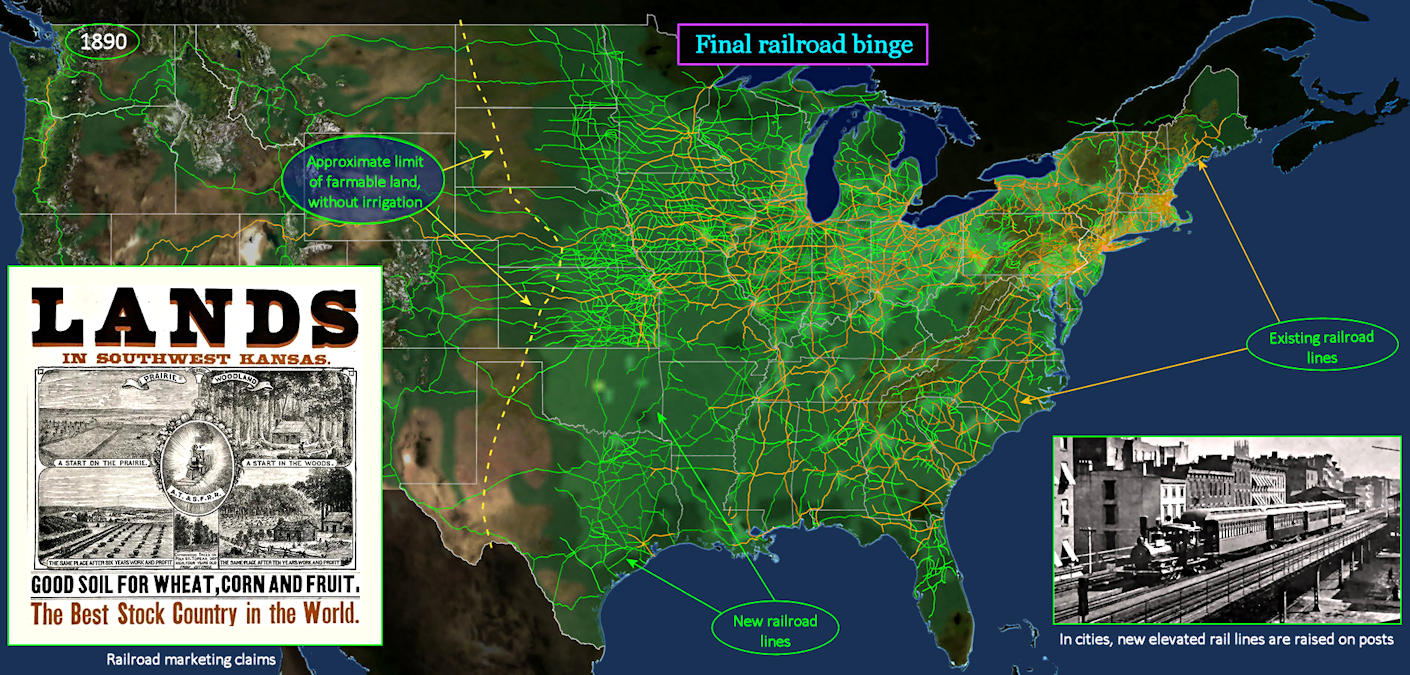
Saturation Point? The GREEN lines are new railroads built since 1870, while ORANGE lines are those built previously. New lines are added everywhere, but especially west of Chicago. This follows the prevailing notion that railroads attract settlers, with business growth not far behind. Railroad advertisements mischaracterize the attractiveness of prairie land, to lure settlers (lower left). In reality, the region lying west of the YELLOW dotted line is generally so dry that it requires irrigation to be farmed at all. Out East, new urban rail lines are raised on stilts (lower right) as cities become more congested. In the South, new rail lines help fill in rural areas, even though the volume of freight traffic scarcely justifies the expense. | |||||||||
| |||||||||
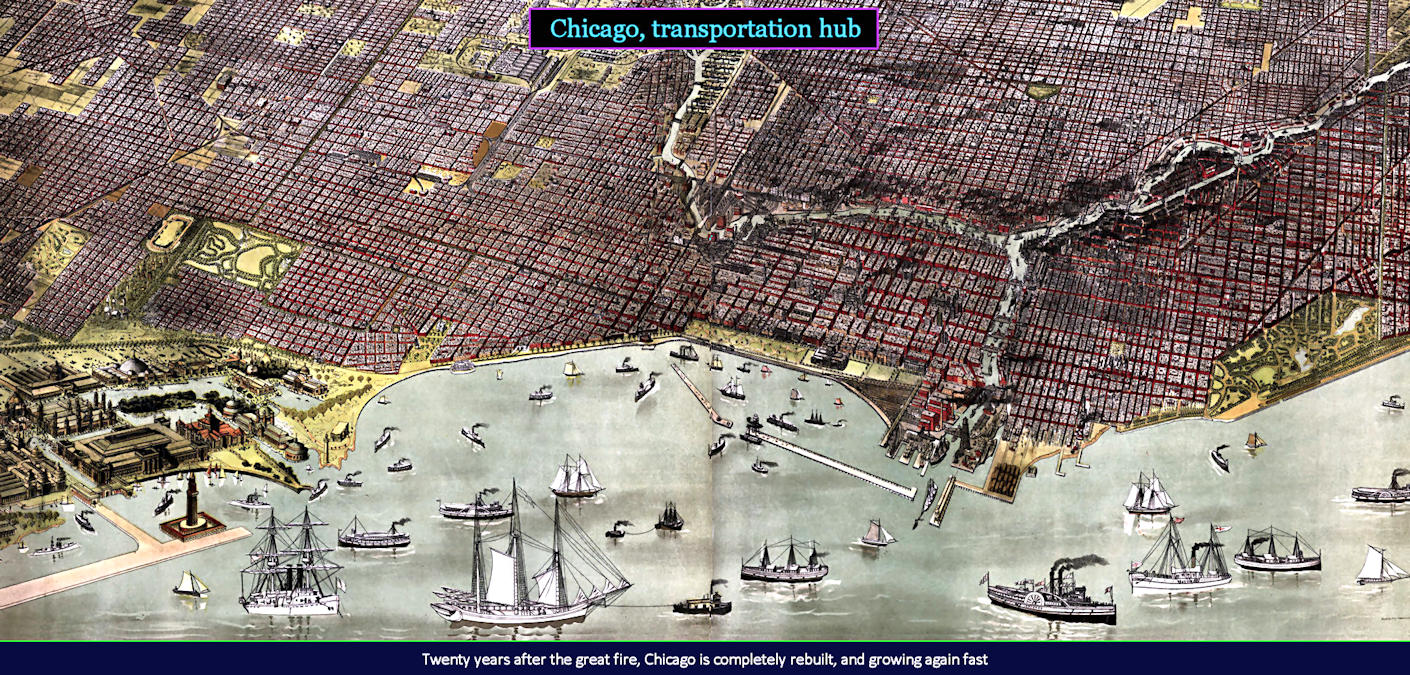
Coming and Going Chicago is now the center of all transportation heading west. Although the downtown area was almost completely destroyed in the Great Fire of 1871, 20 years later the city has been completely rebuilt, surpassing Philadelphia to become America's second largest city. Only New York is larger. All railroads seem to converge in Chicago, as if by magnetism. Corn and wheat arrive from the west, livestock from the south, steel and coal from the east, and timber and farm products from the north. Shipping coming down the Great Lakes will soon increase dramatically. Today, the Chicago Mercantile Exchange remains America's great commodities marketplace. | |||||||||
| |||||||||
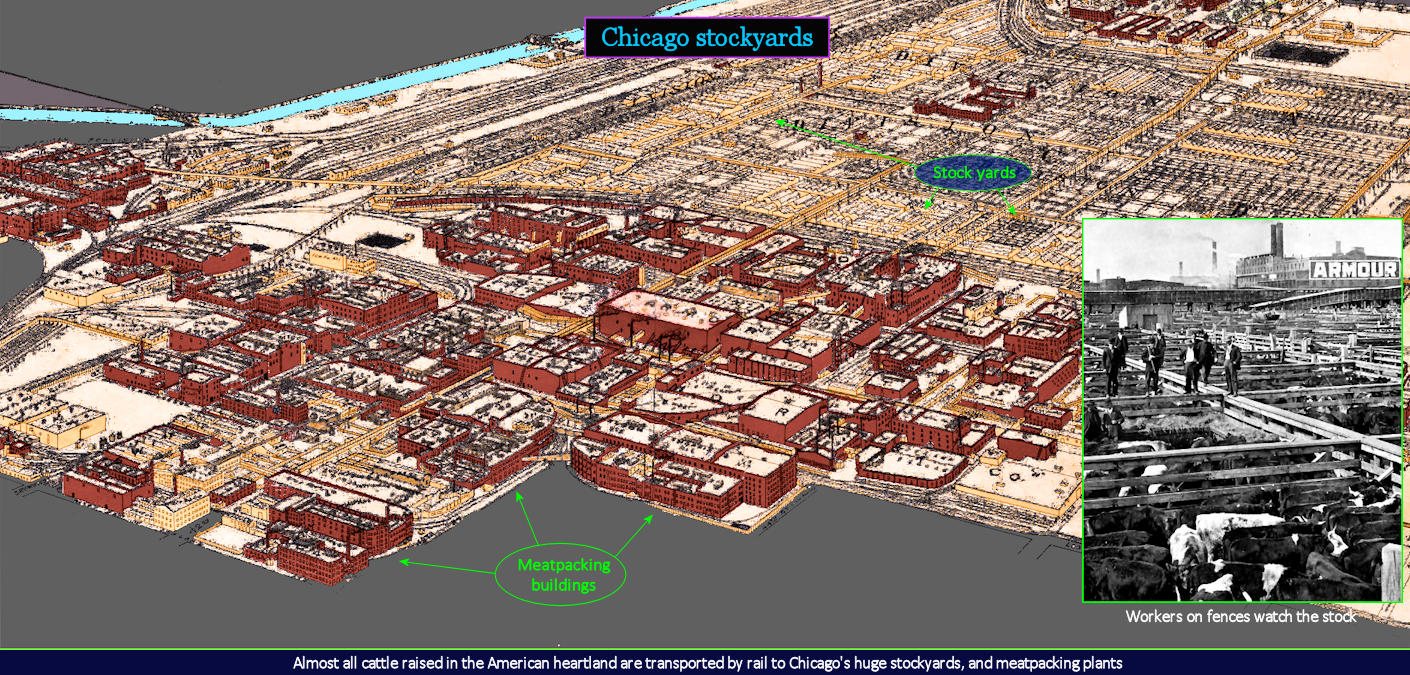
Industrial Meat Situated near the middle of the country, Chicago has become the red-hot center of meatpacking operations in America. In the view above, the buildings in the foreground are slaughterhouses and meatpacking plants (in RED), while sprawling stockyards lie beyond (in YELLOW). Like so much else in the 1890s, the scale is immense. Open-air pens can hold 25,000 live cattle, 100,000 pigs, 10,000 sheep and 1,000 horses. The yards employ 25,000 workers, processing a quarter million animals per day. Hotels, saloons, restaurants and offices line the outskirts. The meatpacking houses are messy and dangerous, while wastewater pollutes the nearby river. | |||||||||