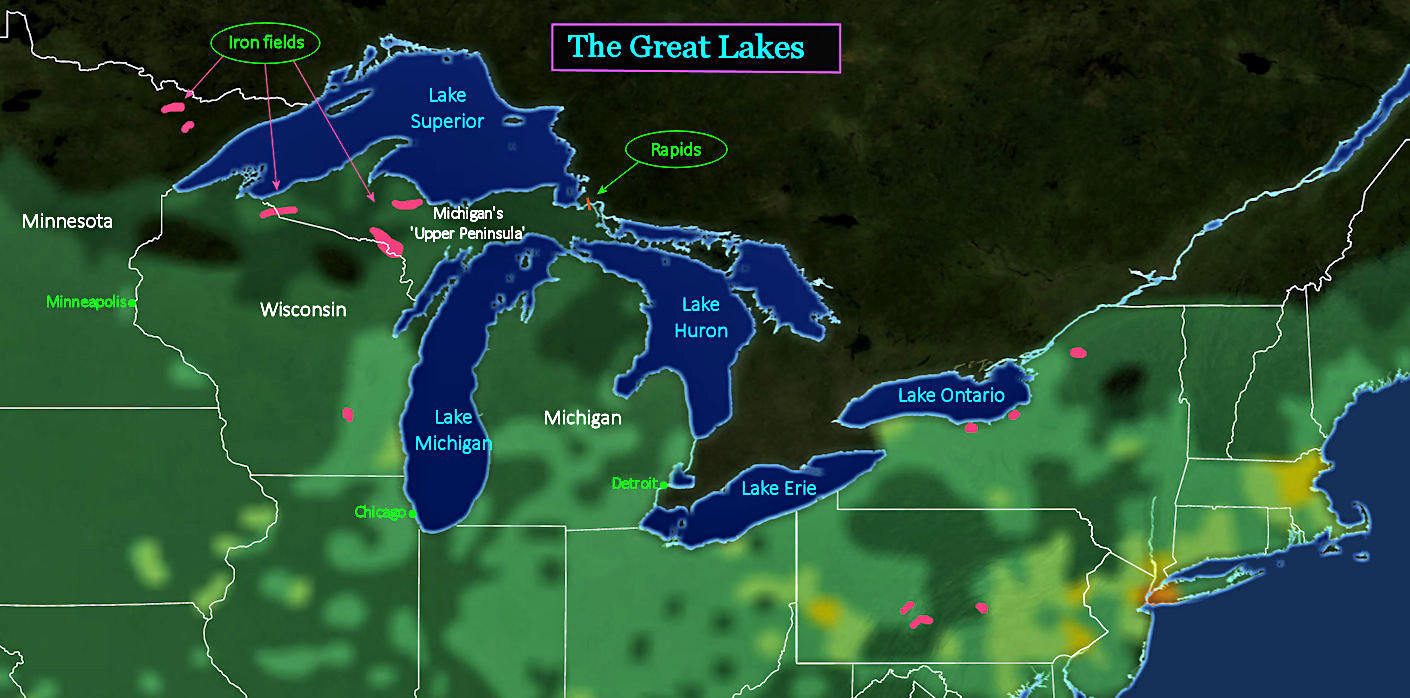
New PotentialThe region is far north, with snowy winters and wet springs, but also long hours of daylight in the summer growing season. Chicago, Minneapolis and Detroit are the big cities, with lake steamers providing vital connections. The important features are the iron deposits (RED highlights) in the 'Upper Peninsula' of Michigan. This is the center of iron mining until 1890, when the great iron range in Minnesota begins to take center stage. Michigan is also blessed with huge stands of timber, which had been bypassed by early settlers intent on moving west from Chicago. After loggers begin building their own railroads into the woods, logging activity spikes. |
| ||||||||||||||||
| |||||||||
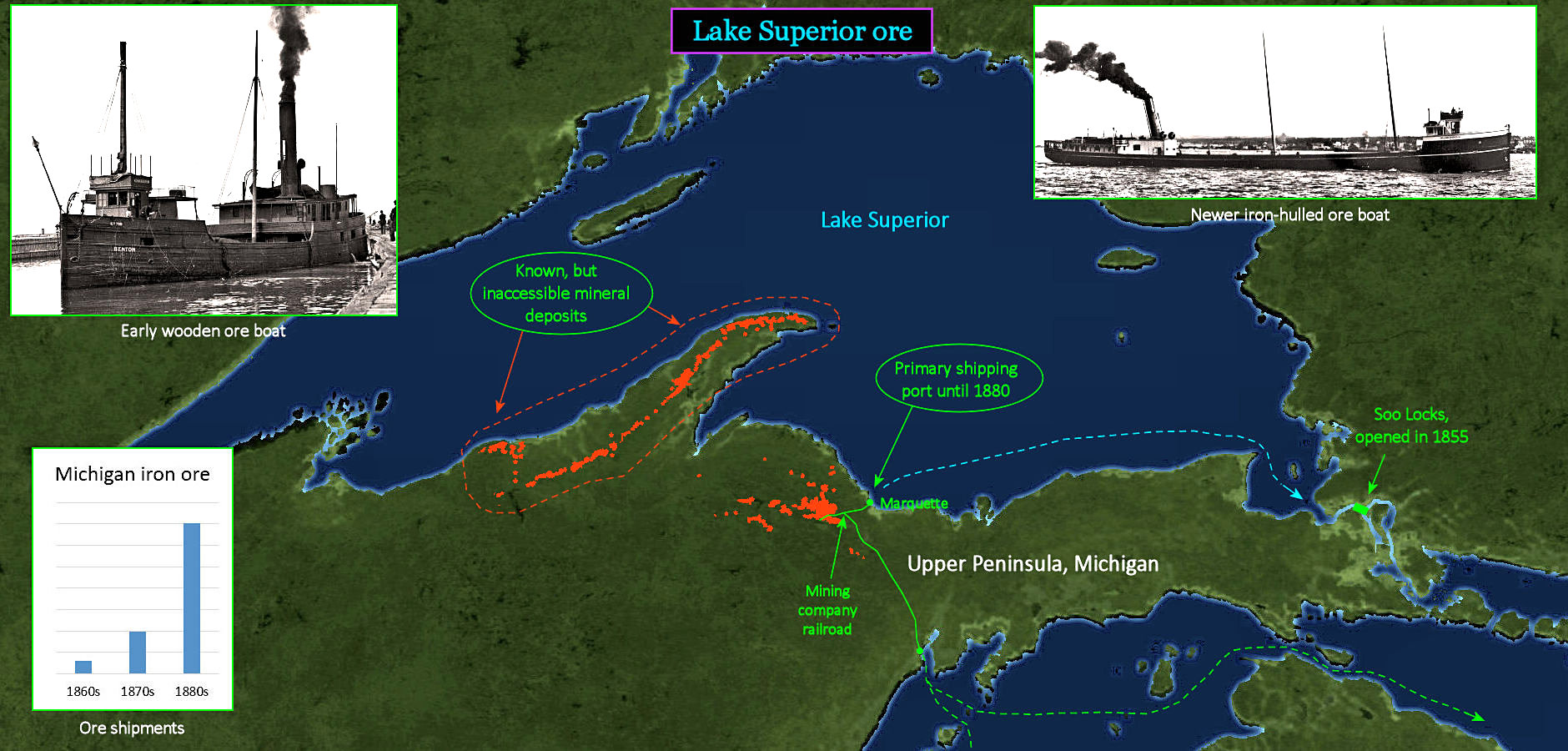
Upper Peninsula Grand Opening The Soo Locks are opened in 1855, but most of the mineral-rich lands (RED highlights) still remain basically inaccessible. The deposits are mostly located on a ridge 600 feet above lake level, making it impractical to get the ore down onto boats. As a result, all ore is shipped from Marquette, which has a short railroad connecting to the surrounding iron ore fields. Ore shipments from Marquette increase rapidly into the 1880s (chart). | |||||||||
| |||||||||
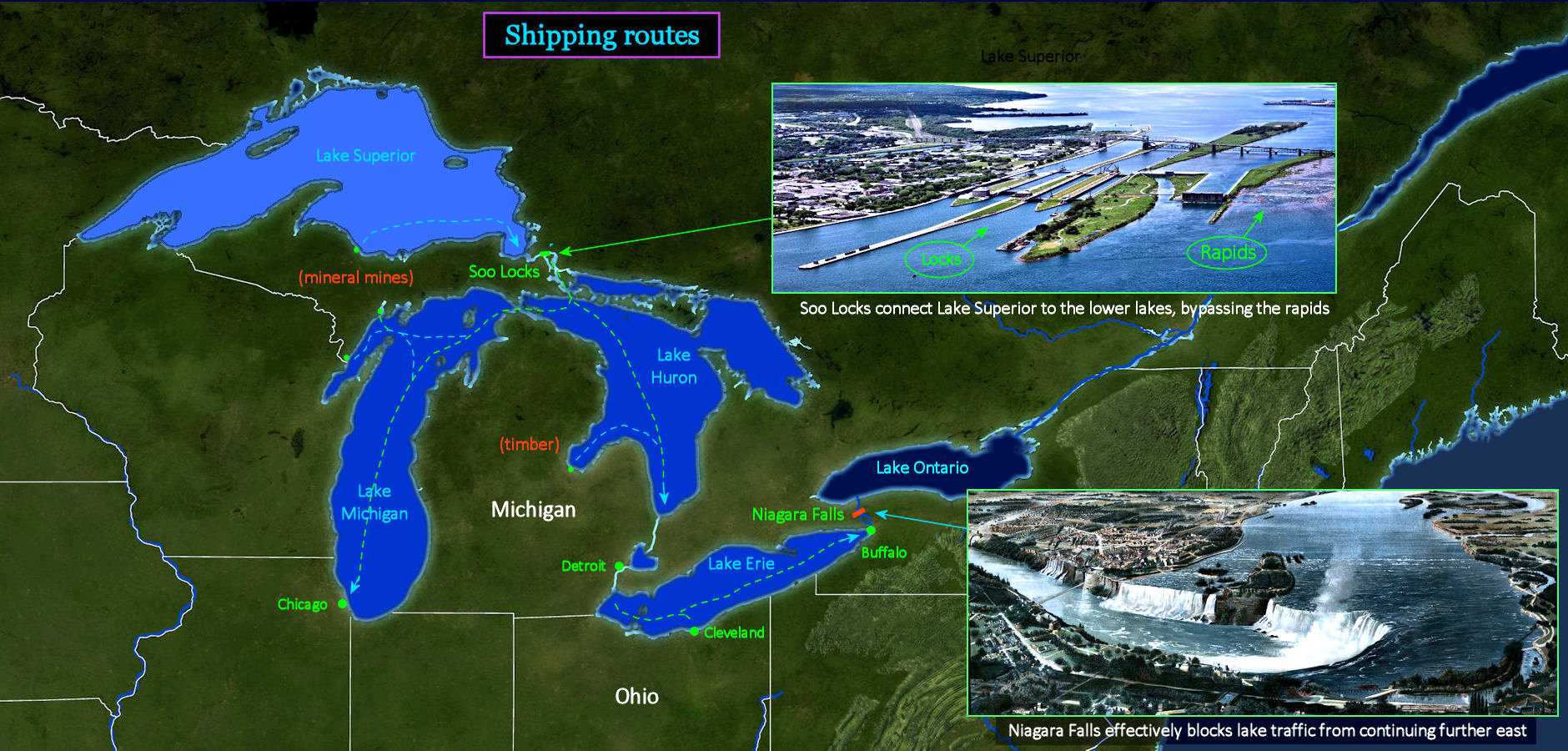
Getting Past the Bump The shipping lanes shown here develop after the completion of Soo Locks, which suddenly enables steamers to move from Lake Superior down to the 'lower lakes.' Steamers can move freely everywhere on the lower lakes, which are all on essentially the same level, until reaching Buffalo, at the far end of Lake Erie. There, blocked by Niagara Falls, the cargo is transferred, to continue traveling east via rail or the Erie Canal. Major cargo-handling facilities develop at Buffalo, Detroit, Cleveland and Chicago. | |||||||||
| |||||||||
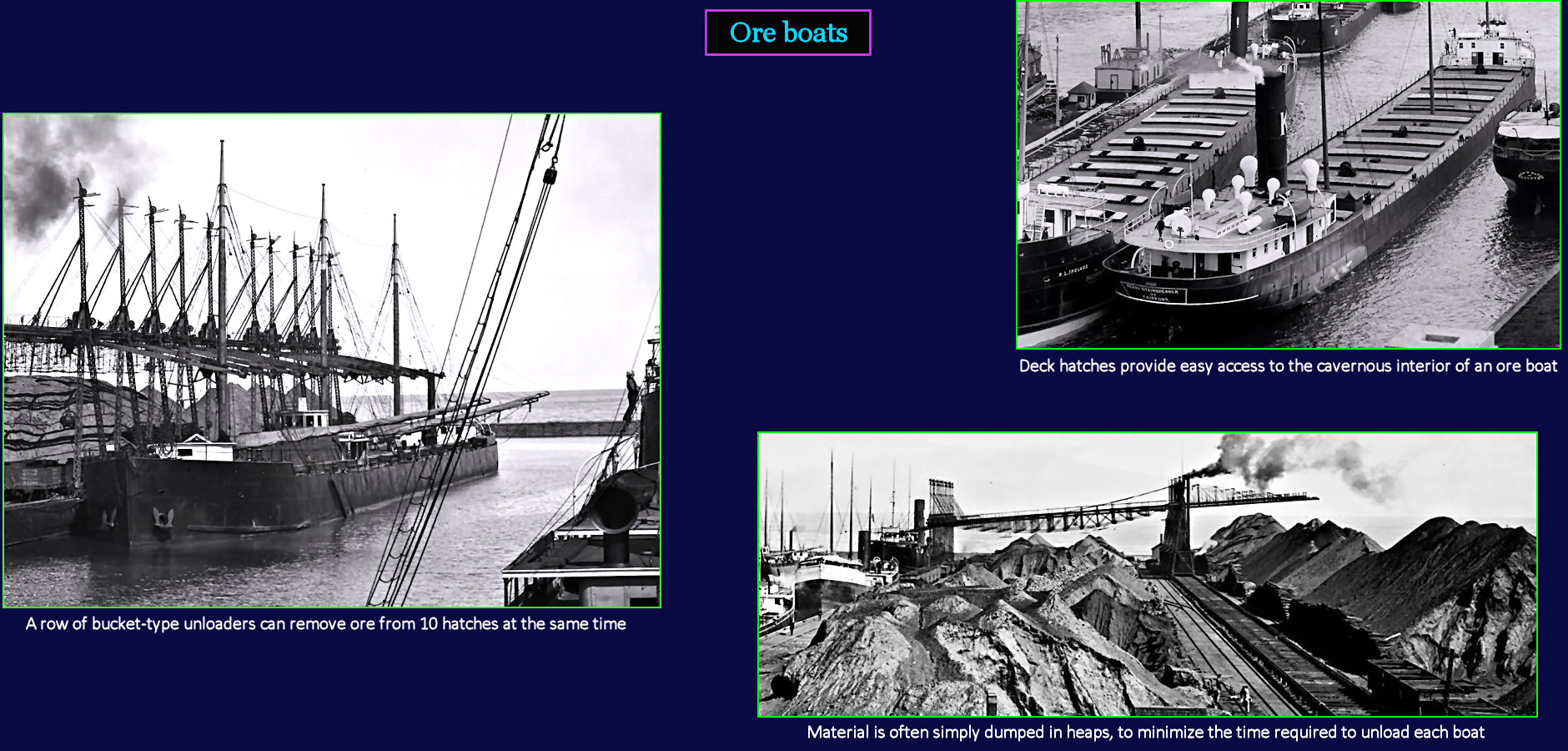
Turning up the Volume By 1890, iron ore boats are arriving in Lake Erie at an average rate of 20 per day, until winter ice suspends operations for the season. Each of the big steamers holds enough ore to fill 40 rail cars. That's a lot of material to unload, every day. When a boat docks, ore is hoisted up bucket by bucket, hatch by hatch, until the hull is empty. Ore might be dropped directly into rail cars waiting below, but more commonly is just dumped into great piles, from which it can be loaded into rail cars when convenient. The largest ore-handling ports are Ashtabula and Cleveland, both in Ohio, with direct rail links to Pittsburgh. Chicago and Buffalo also handle substantial quantities. Most of the big ore boats are built in Cleveland, and in shipyards just south of Detroit. | |||||||||
| |||||||||
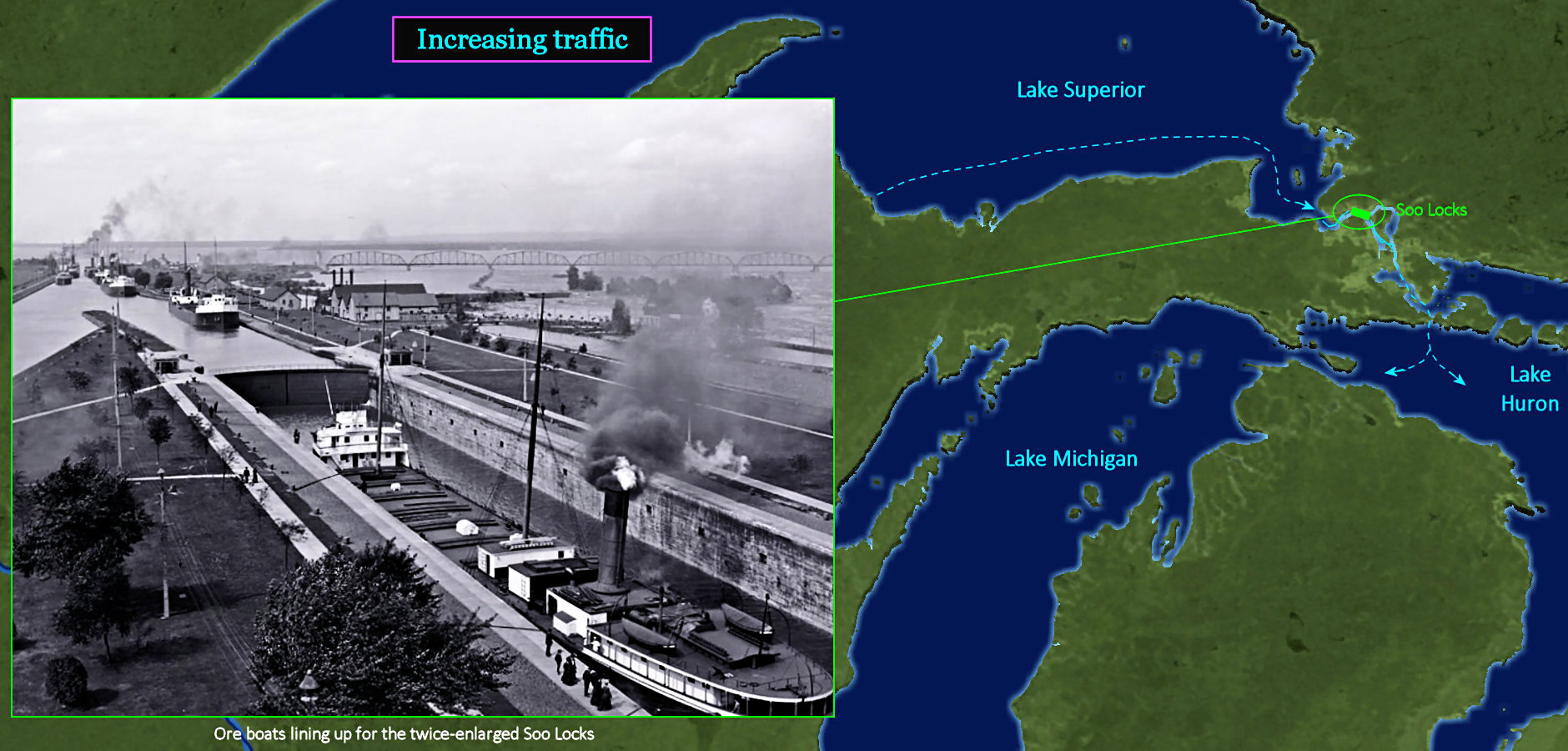
Huge Traffic Boost The Soo locks dwarf anything previously seen in America. The original lock is three times longer than those being used in the Erie Canal, but within 25 years a larger lock is needed, which is half-again bigger. By 1890, there is yet another new lock in operation, this time eight times the size of the Erie Canal locks, and designed to handle four ships at once. Soon, however, ore boats are so long that only one can fit through at a time. | |||||||||
| |||||||||
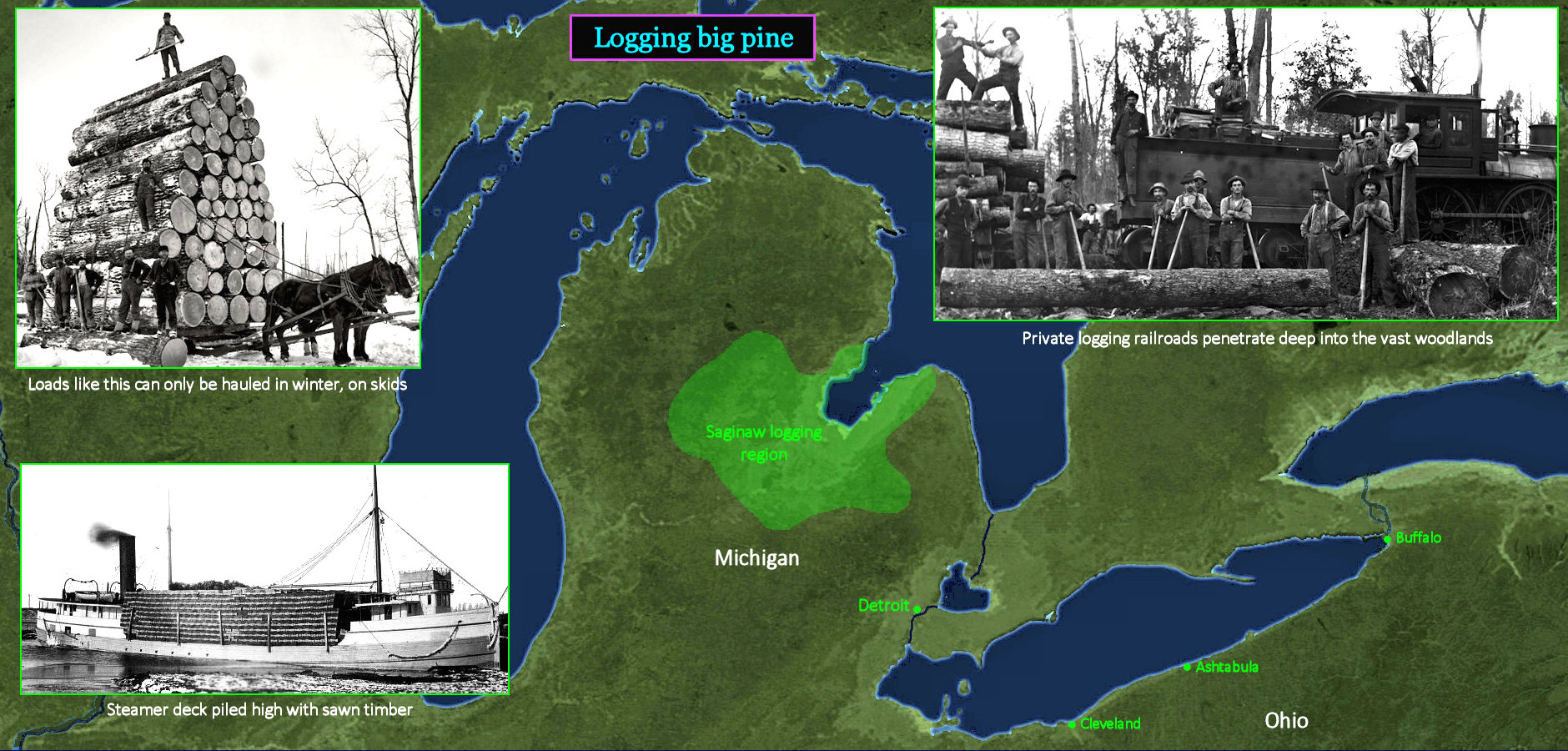
Wood for Housing At the same time that ore boats are streaming down to Ohio, loggers are hauling huge loads of virgin timber from central Michigan. This is mostly white pine, which is hauled in astonishing loads over snow and ice. As the areas close to rivers are logged out, timber companies begin building their own private railroads to reach further into the interior. These are often little narrow-gage affairs. Once the logs arrive at mills lining the shore, they are sawn up and stacked into impressive piles, heading for Cleveland and Buffalo. Even more timber is cut on the western shore of Michigan, bound for Chicago and Milwaukee. After 40 years, Michigan is effectively logged out by 1900. | |||||||||