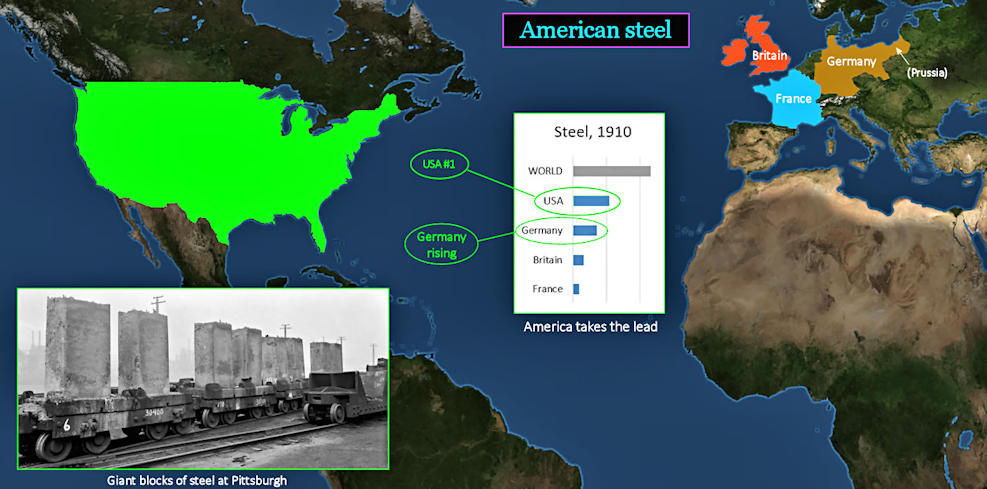
Steel is PowerAmerica is also the world leader in coal production, needed in huge quantities to fuel all the blast furnaces and steel mills. Pennsylvania is still the king of steel, but Alabama and Michigan are also contributing. Helping fuel the growth is the development of an immense new iron-rich region in the wilds of northern Minnesota. With a good harbor nearby, ore can be shipped all the way down the Great Lakes to Cleveland. Surprisingly, Germany also has surging production of steel. It now far surpasses Britain, the previous world leader. This reflects a growing power struggle among European nations, with Germany rising towards the top. |
| ||||||||||||||||
| |||||||||
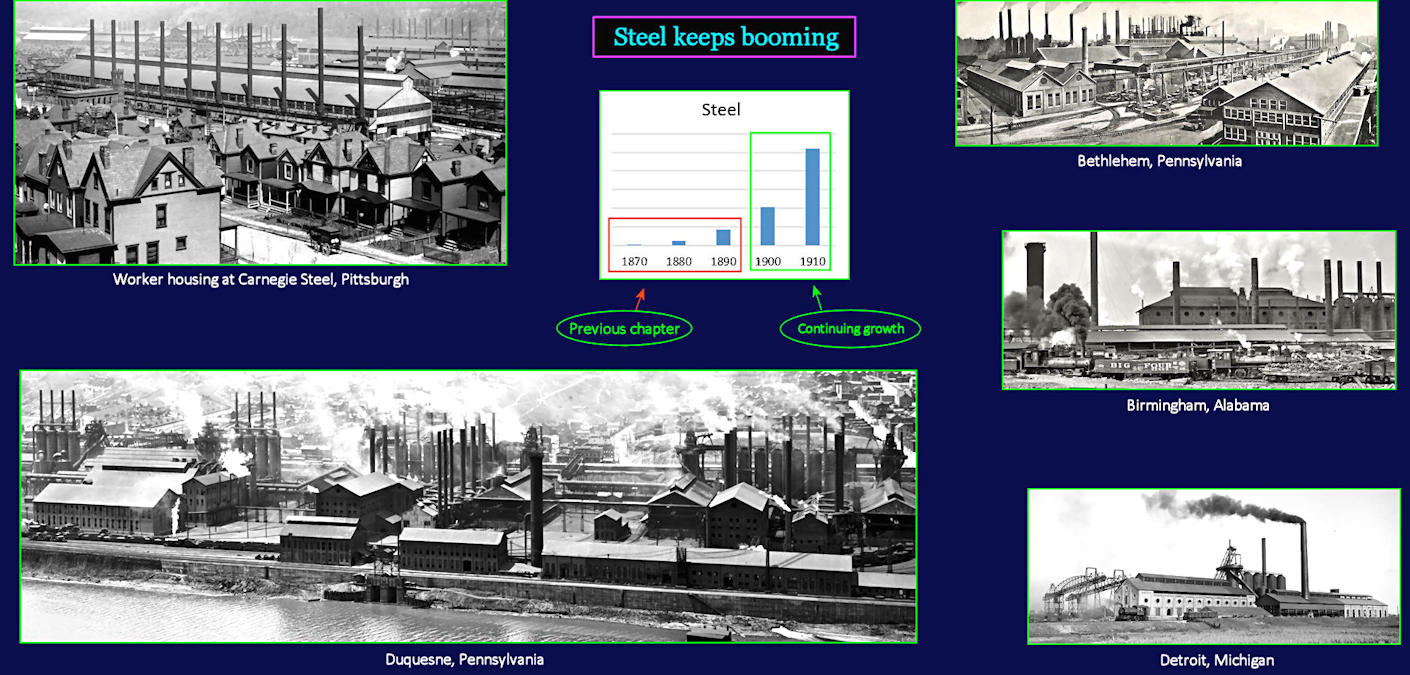
Smoke Everywhere Steel production was already booming back in 1890 (RED box on chart), but by 1910 it's positively exploding. It isn't just Pittsburgh, anymore, as steel plants mushroom all over Pennsylvania. Another pocket emerges down in Alabama, around the iron fields near Birmingham. Railroads are still consuming large quantities of steel rails, but structural steel is also in great demand, as steel-framed buildings are rising everywhere. Production of steel plate is growing just as quickly. | |||||||||
| |||||||||
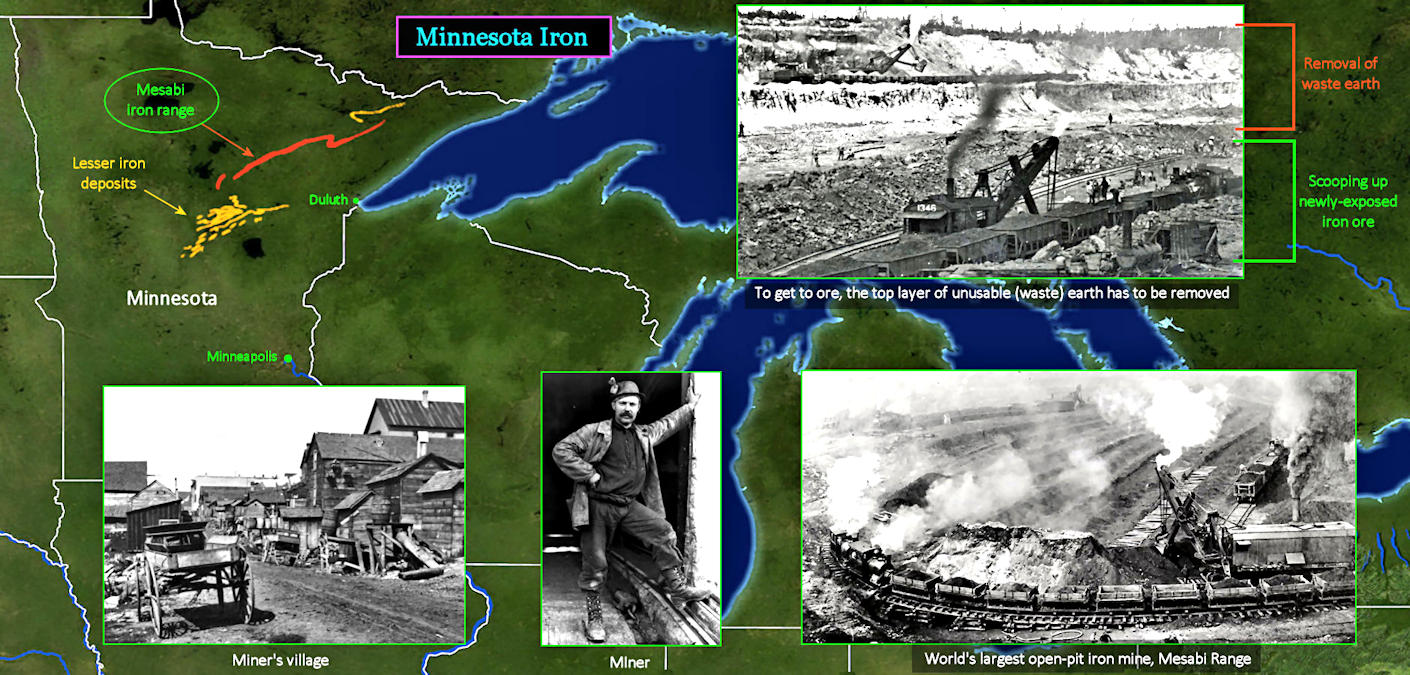
Mother Lode of Iron The great Mesabi Range of iron ore is located deep in the woods of northern Minnesota. It's so extensive that it causes a wild deflection of compass needles in the area, due to the magnetic effect of all the iron below the surface. After railroads reach the region, the amount of ore removed per year is greater than for the entire country of Germany, the world's second largest producer. It's double the amount mined in Britain and France combined, and supplies half of all American iron ore production. The main ore beds are located up to 100 feet below ground level, which requires first removing the overlying (unusable) earth. The exposed ore can then be scooped easily into waiting train cars. It's the highest grade ore on earth. | |||||||||
| |||||||||
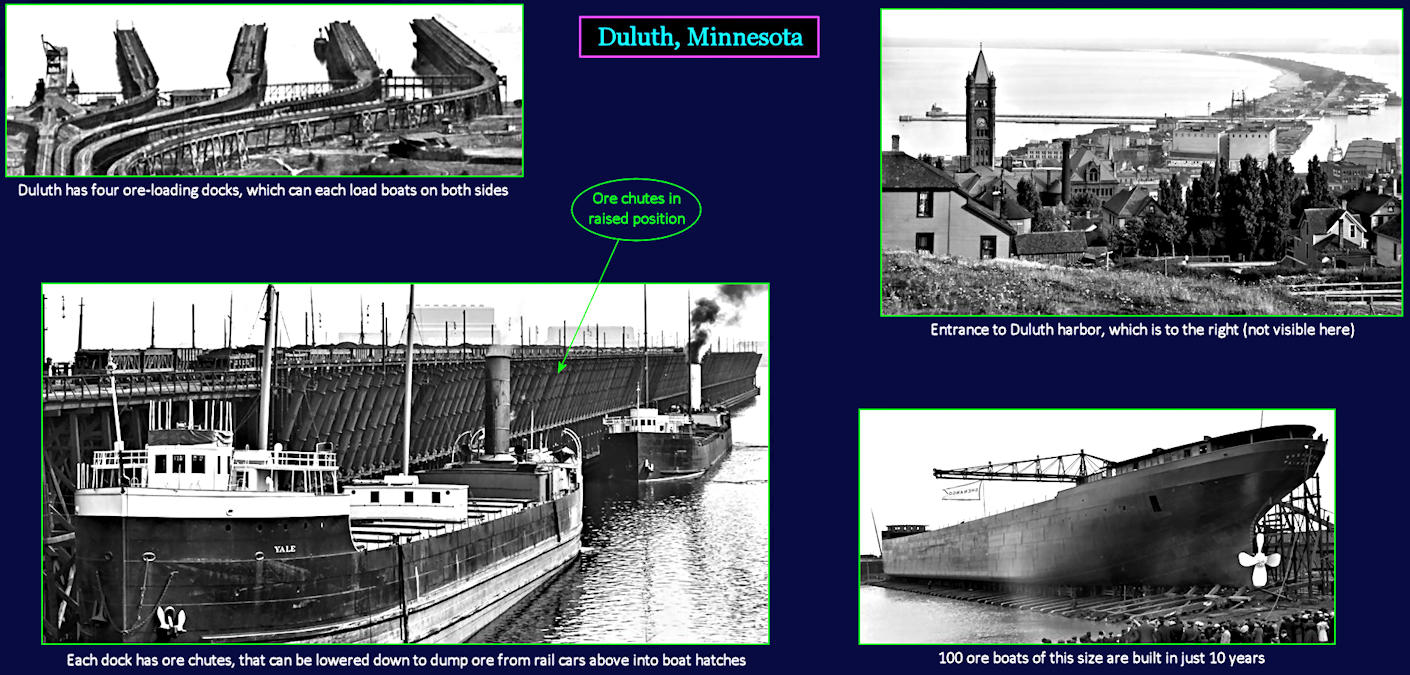
Load 'er Up Most of the ore from the Mesabi Range is shipped by rail down to Duluth, at the very western tip of Lake Superior (scroll up, to locate on map). Four great loading docks (top and bottom left) are built to service the growing fleet of ore boats that move the mountains of ore being scooped from great open-pit mines. By 1910, there are 100 new ore boats longer than 500 feet, which are true monsters (lower right). The largest can hold 6,000 tons, or the contents of 150 rail cars. About a quarter are built near Cleveland, while most of the rest come from boat yards near Detroit. | |||||||||
| |||||||||
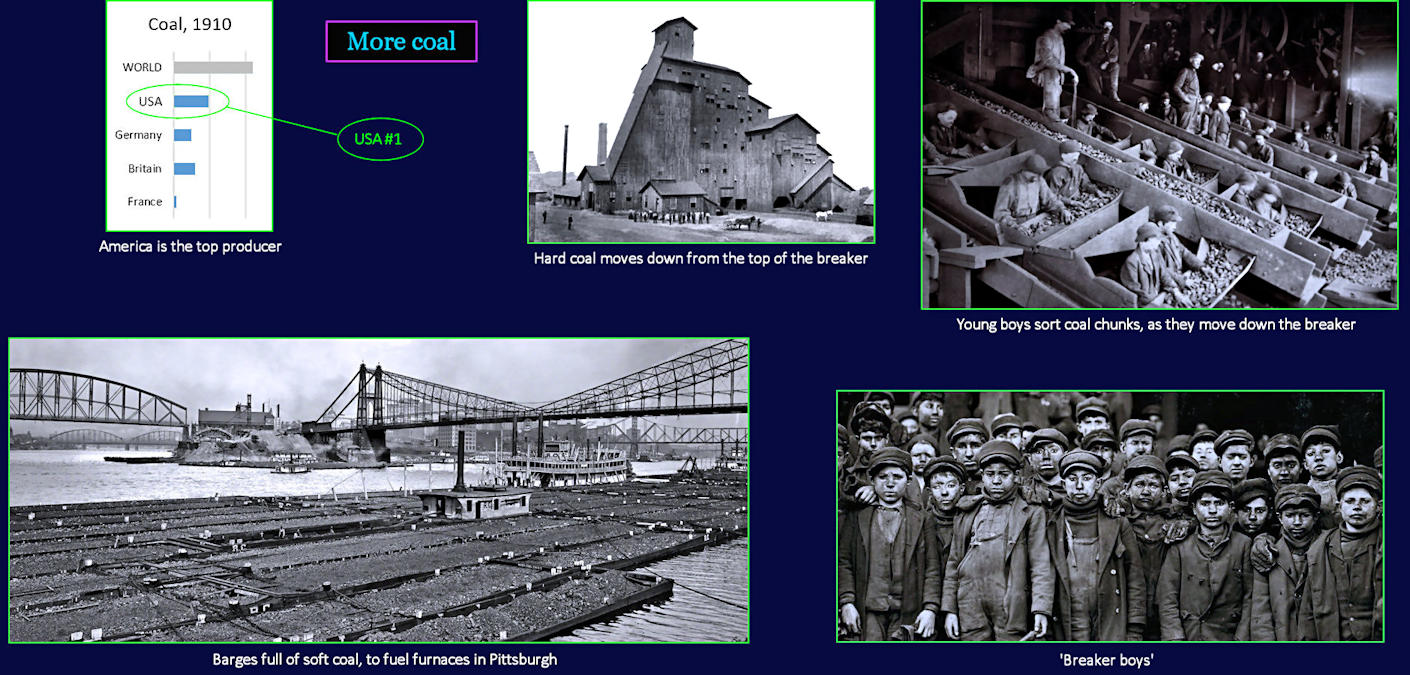
Dig it Out By 1910, America is producing not only more steel, but also more coal than any other nation (top left). Most coal used by steel mills is of the soft variety, mined west of the Appalachian Mountains. It's shipped up to the blast furnaces and steel mills in an endless parade of barges (lower left). But the much smaller fields of hard coal, located on the other side of the mountains near Scranton, are the main source of coal for the Northeast. Unlike soft coal, which crumbles easily, hard coal has to be broken up in tall 'breakers' (top center), which produce chunks in a variety of sizes. Young boys sit all day on wooden benches, sorting the chunks by size instead of going to school. This helps mining families make ends meet. | |||||||||
| |||||||||
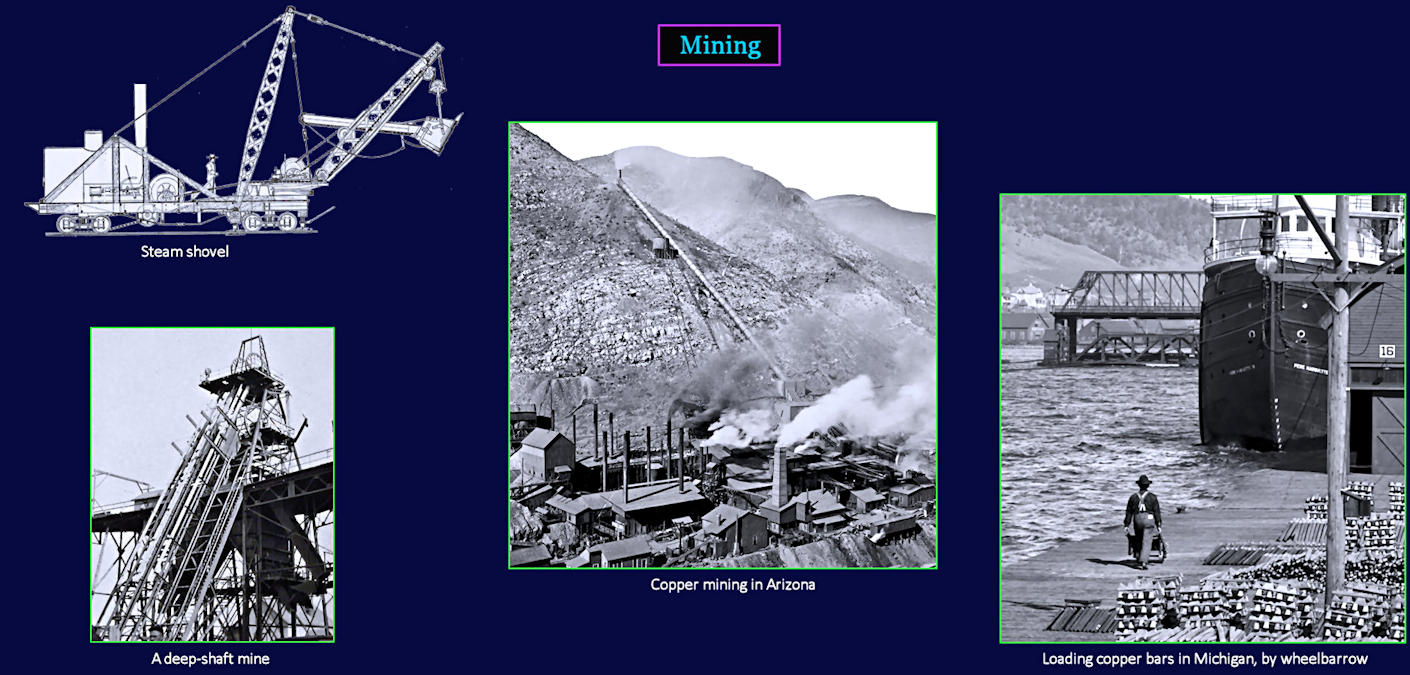
Copper for Electric Wiring Iron ore and coal are the top mining products, but there are also large-scale mining operations producing silver, gold, copper and zinc, mostly in the West. Copper is in demand for electrical wire. | |||||||||