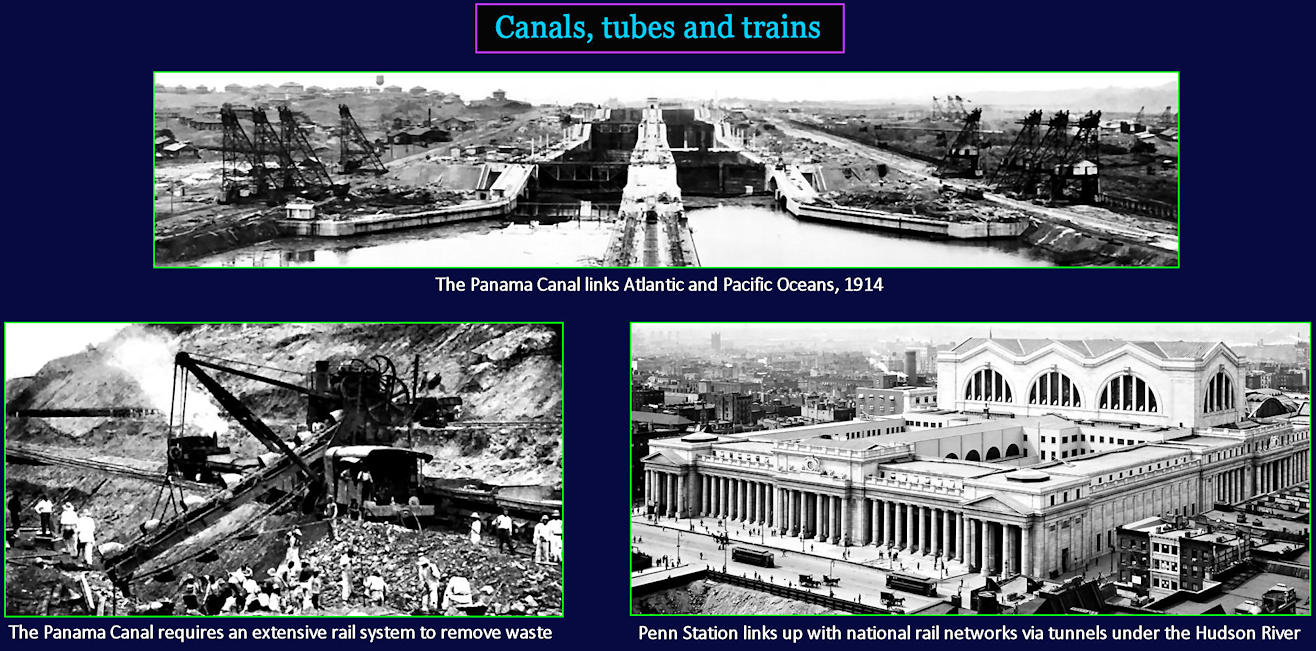
Linking OceansThis was originally a French effort, begun 35 years earlier, after their success digging the Suez Canal in Africa. But the new canal is more difficult, and the French finally give up on the project after 18 years, thoroughly defeated. Teddy Roosevelt buys the unfinished canal, eager to give his battleships a quick connection between the East and West coasts. It takes America another 10 years to finish the canal, using a railroad system to remove the waste. Meanwhile, three different sets of railroad tunnels are built under the Hudson River by 1910, linking New York for the first time with New Jersey. Two magnificent new rail terminals are added, along with an auto tunnel, by 1927. |
| ||||||||||||||||
| |||||||||
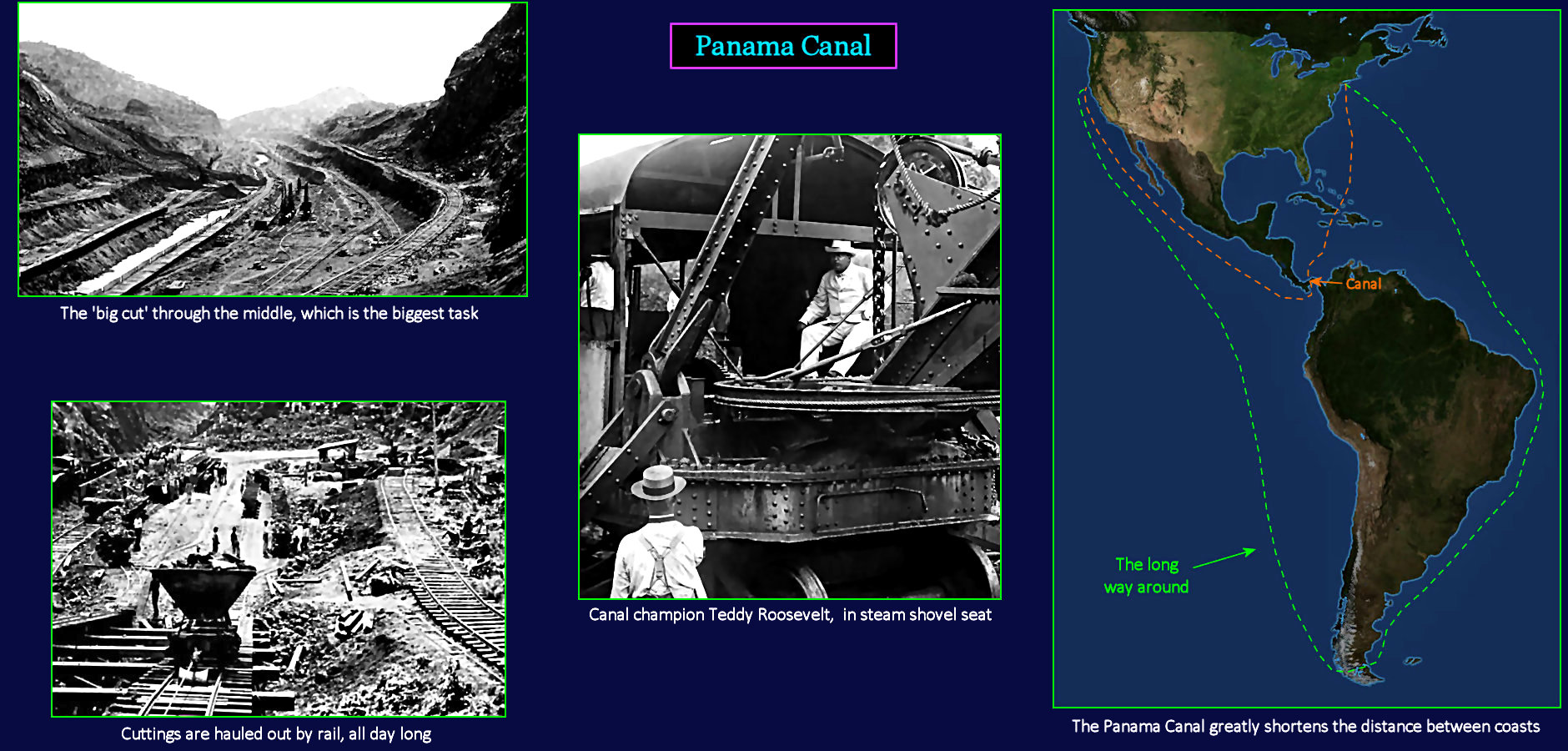
Big Job The Panama Canal route is mostly level, but is blocked by a 200-foot-high ridge in the middle, which is the main obstacle during construction. The French effort to cut through this barrier ends in failure, but Americans finish the job using the equivalent of a thousand tractor-trailer loads of dynamite, and a complete new railway system. As fast as workers blast away at the ridge, the resulting waste material is scooped up and hauled away by rail. On an average day, 160 trainloads of waste are removed. When the canal is opened, the voyage between New York and San Francisco is shortened by 8,000 miles, or roughly a month (see map). | |||||||||
| |||||||||
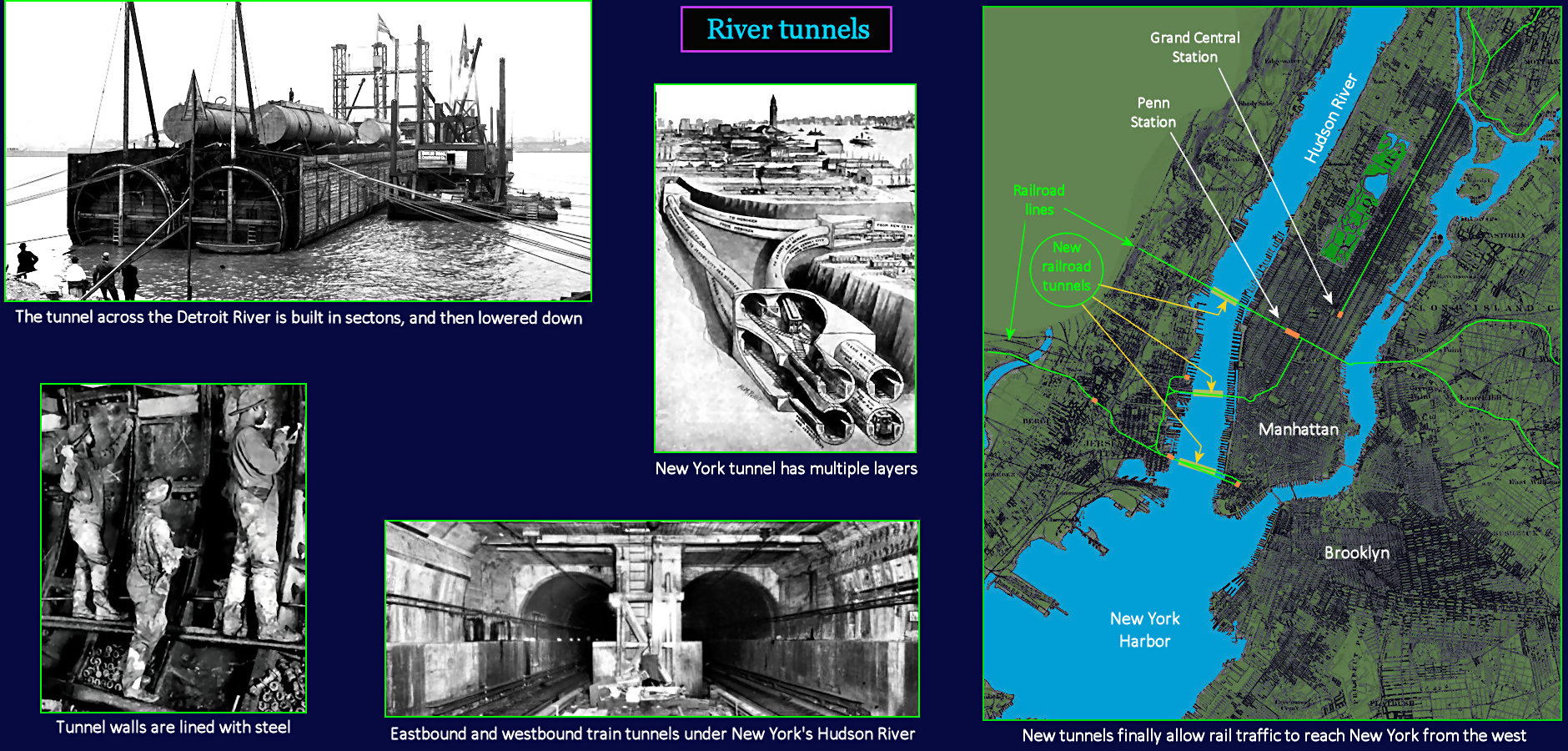
Taking the Low Route In 1900, New York has 150 ferries, mostly connecting with rail terminals on the Jersey side of the Hudson River, because that's the only way to get across. By 1910, however, there are three sets of rail tubes beneath the Hudson (see map). The distance is about a mile and a half, and the tubes have to descend 100 feet to get under the river. The tunnel built by the Pennsylvania Railroad is the most northly of the three, ending at newly-built Penn Station, near the center of the city. Today, the station is still the busiest in America, despite being replaced (above ground) by Madison Square Garden in the 1960s. The other two tunnels are now used by Path trains. | |||||||||
| |||||||||
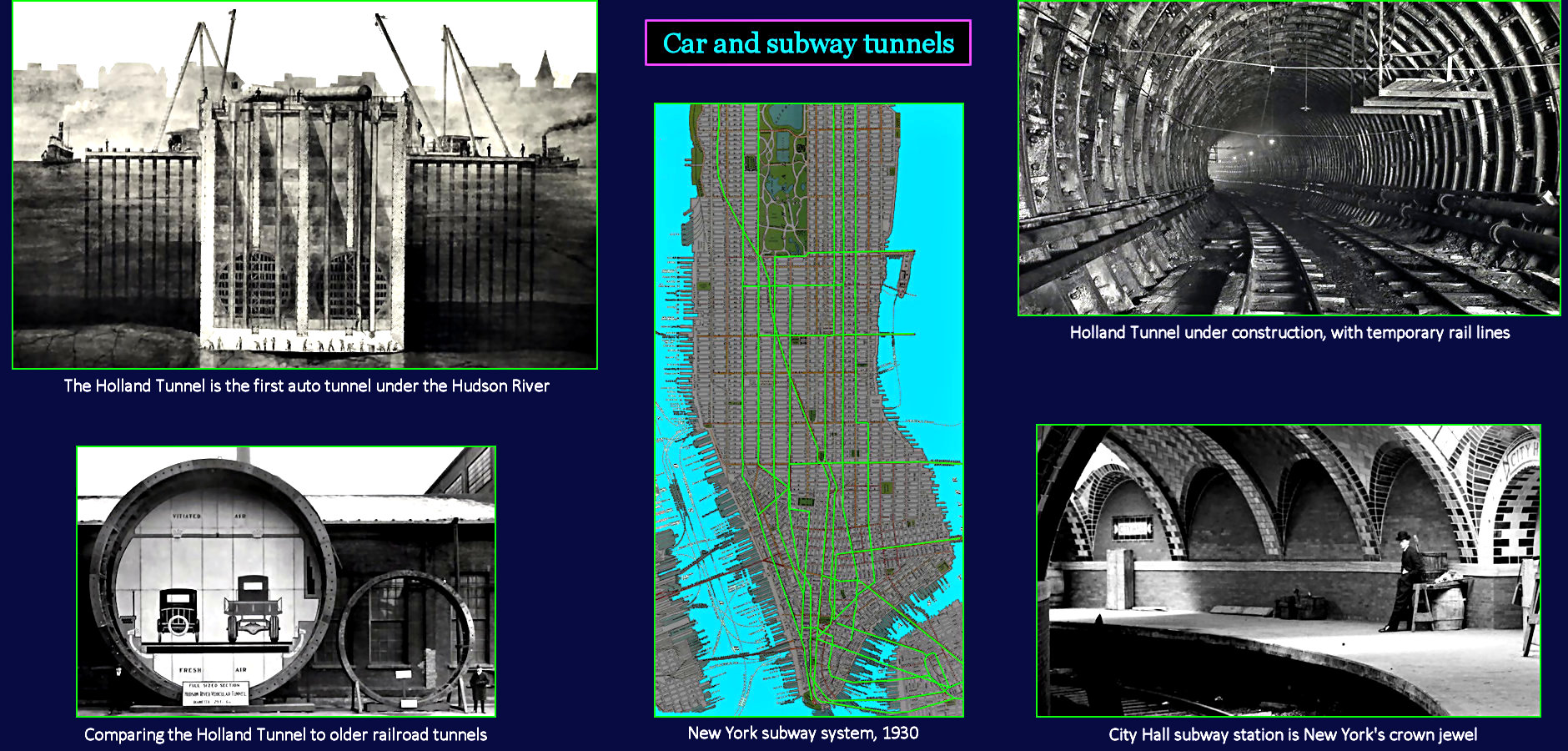
Tubes Under the Rivers The first tunnels are built just for railroads, but there is increasing demand for a Hudson River crossing that can handle vehicles. A bridge is considered, but discarded as too costly. The final solution is the Holland Tunnel, completed in 1927, as the longest underwater vehicle tunnel in the world. It's mechanically ventilated, with vertical fresh air shafts at each end, and a ventilated ceiling. There are two tubes, to handle traffic in both directions. Each tube accommodates two lanes of traffic, requiring a diameter twice that of the older railroad tubes, which contain just a single track (lower left). The New York subway system is largely complete by this time, using tunnels to connect with Brooklyn (center). | |||||||||
| |||||||||
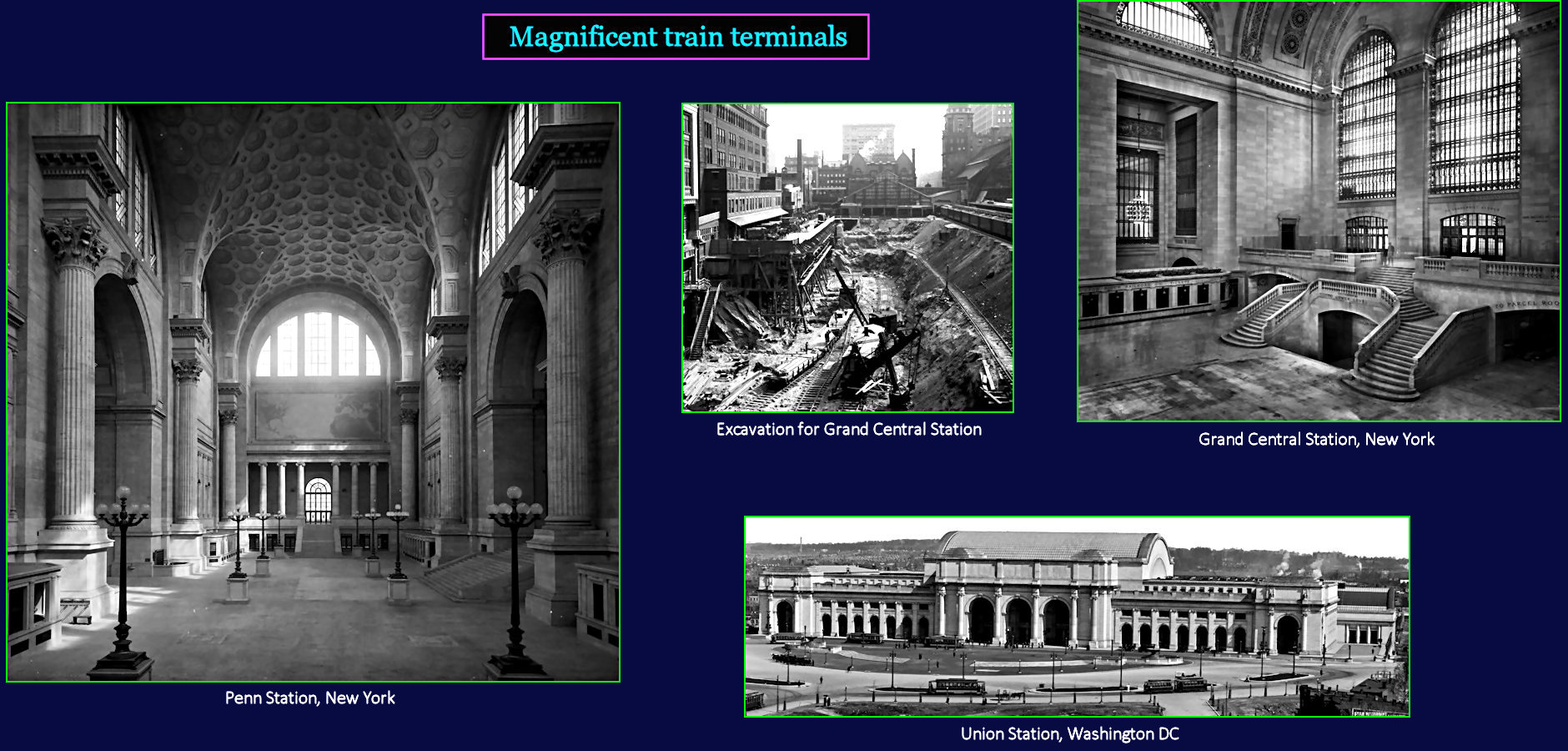
Peak of an Era It's ironic that the great cathedrals of American railroads in New York, Penn Station and Grand Central Station, are completed just as railroads begin losing ground to automobiles as the dominant means of transportation. Majestic Penn Station (left) is headed for eventual demolition almost from the moment it opens. The above-ground structure is reduced to rubble in the 1980s, to make way for a more profitable use of downtown real estate. Grand Central Station remains busy, and has so far been spared the wrecking ball. Union Station in Washington DC, another grand terminal of the same era, is also still operating. | |||||||||
| |||||||||
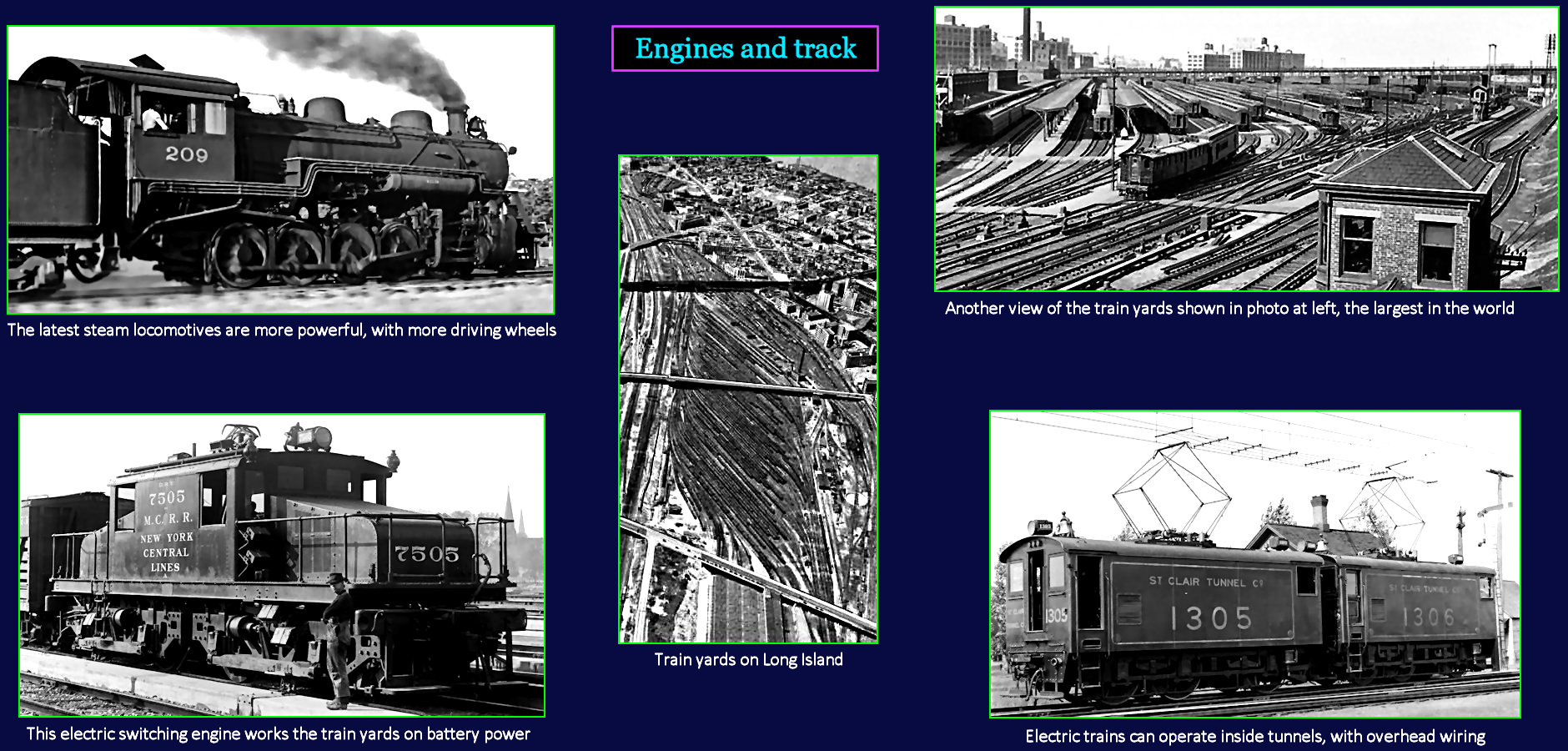
Shuttling all the Rail Cars Although the great railroad era is already beginning to fade, there's still plenty of freight to move. Engines become larger, and railroad switching yards add tracks. Electric locomotives have been around for years, but most are small engines used for shuttling cars around the yards. When railroad tunnels come into use, electric engines are essential, as they emit no exhaust. Some rail lines convert to electric service completely, installing overhead wires that function much like those of older streetcars. | |||||||||