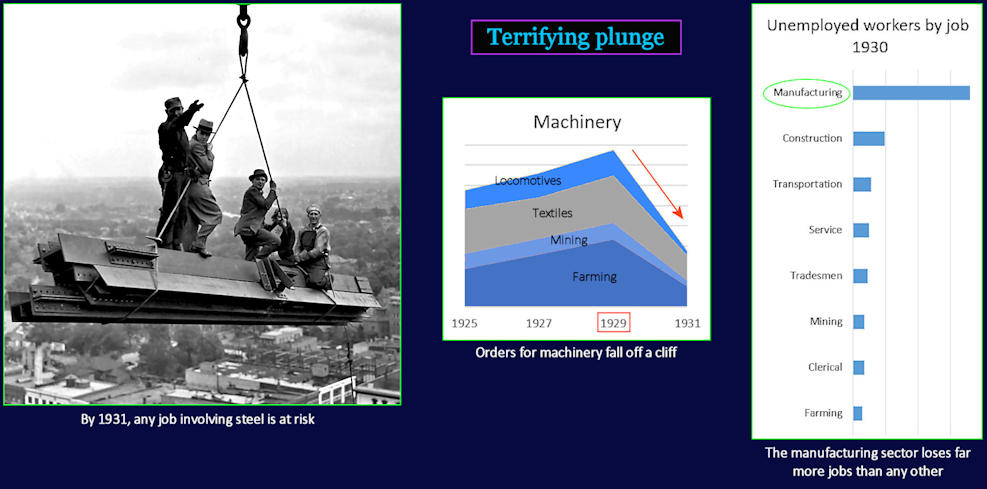
Delayed ReactionIf you compare stock prices in 1930 to those in 1928 (instead of the peak year of 1929, which is clearly an abnormal year), the decline is just 3%. So maybe it's just a freak year, without lasting consequences. A comparison of total economic output for the same two years shows a similar modest decline, of 5%. Based on these two numbers, one could argue that the effects of the great crash are already over. Let the good times resume. But things aren't entirely back to normal. Iron ore production dips only slightly in 1930, but production of steel beams is down a disturbing 15%, while wheat prices have crashed by 30%. Something isn't right. |
| ||||||||||||||||
| |||||||||
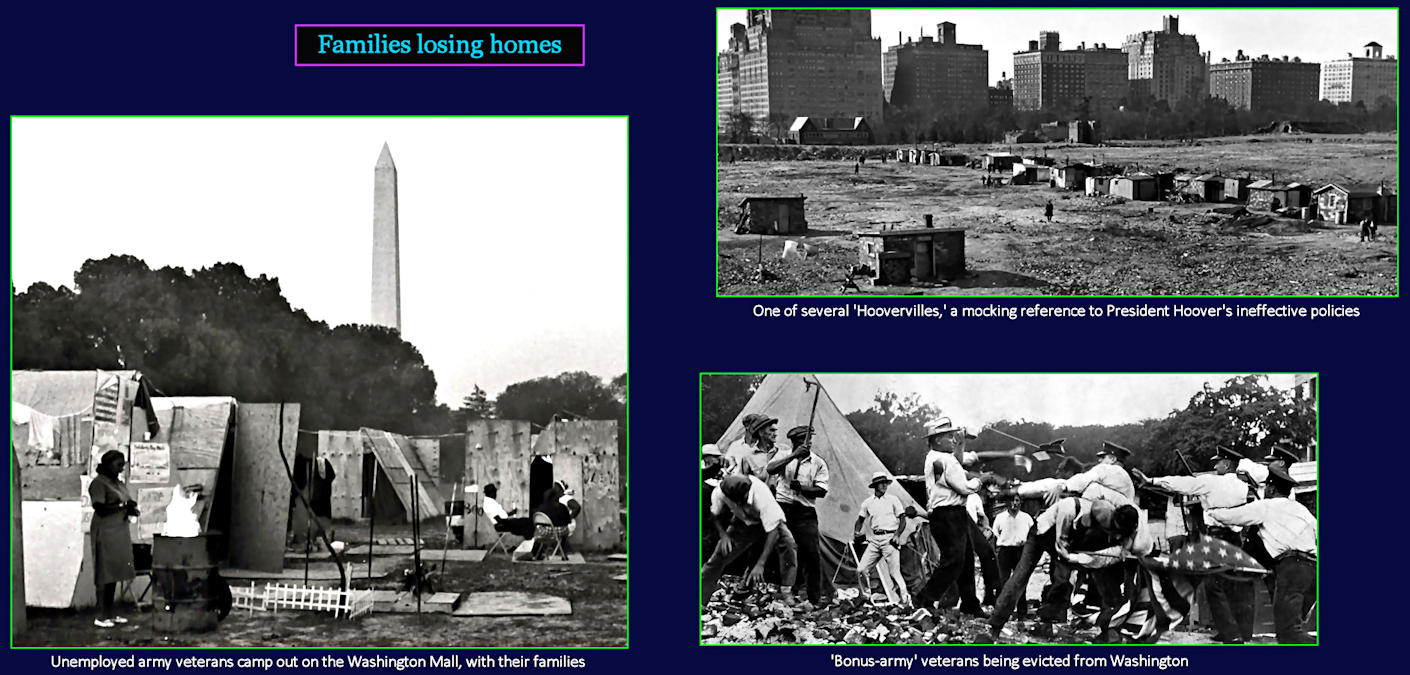
Hoovervilles and the Bonus Army President Hoover pursues practical approaches to ending the slump. Government programs have never been used to provide direct relief to people, so he relies instead on more traditional tweaks to the system. He jawbones against wage cuts and work stoppages. He convinces railroads and public utilities to increase purchases. Interest rates are cut, and Congress passes higher import tariffs that only seem to make matter worse. People remain out of work, leaving America with a growing homeless population. Shantytowns called 'Hoovervilles' appear outside major cities. Army veterans occupy the mall in Washington DC, demanding early release of promised bonus payments for war service. Hoover orders them evicted. | |||||||||
| |||||||||
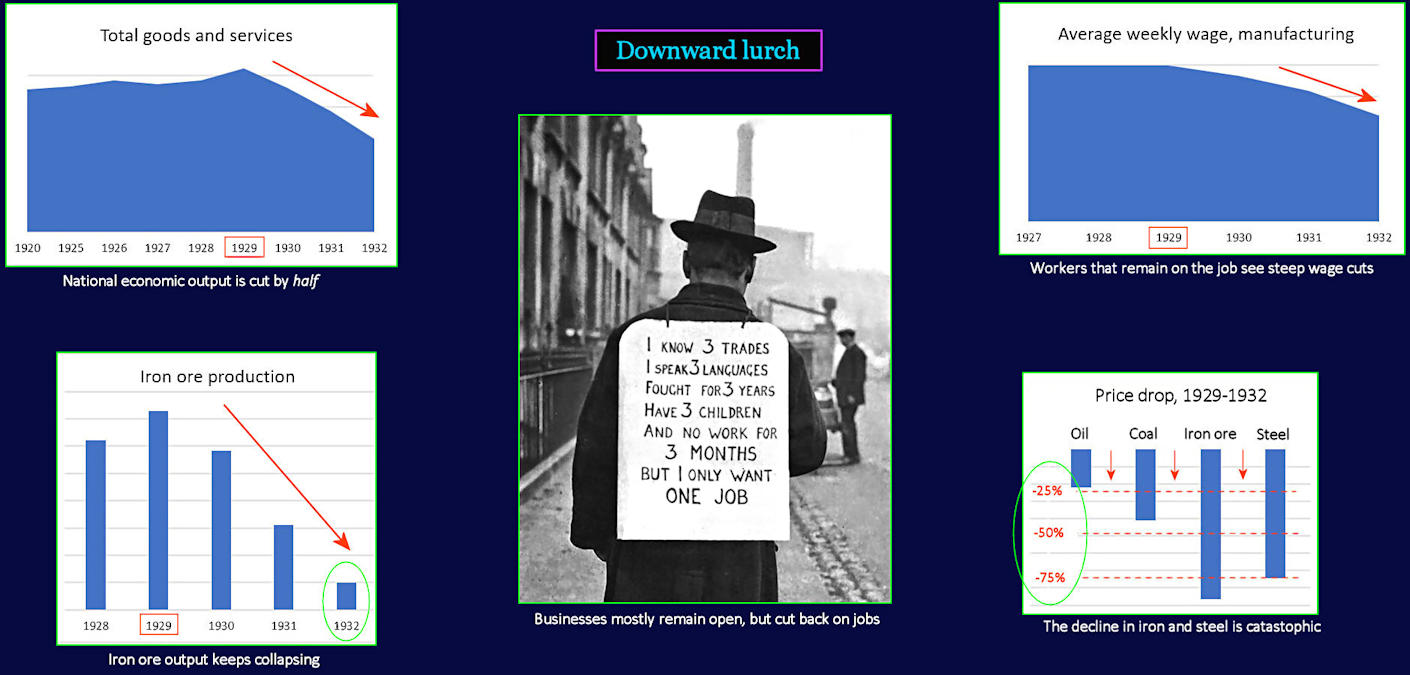
Renewed Decline By the end of 1932, it's apparent that things have definitely not returned to normal. Families which lost their entire income, due to layoffs, have been forced to cut back severely on all spending. There's no choice. This produces a continuing slide in business sales, causing managers to respond with even deeper job cuts. It's a classic vicious cycle. The overall result is a continuing slide in economic health (chart, top left). As conditions deteriorate, businesses cut wages even further for those that still have their jobs (top right). The chart at lower left reveals an even more disturbing situation. Production of iron ore, the bedrock of industry, is down an appalling 80% (lower left), while prices of major industrial products have all dropped sharply (lower right). | |||||||||
| |||||||||
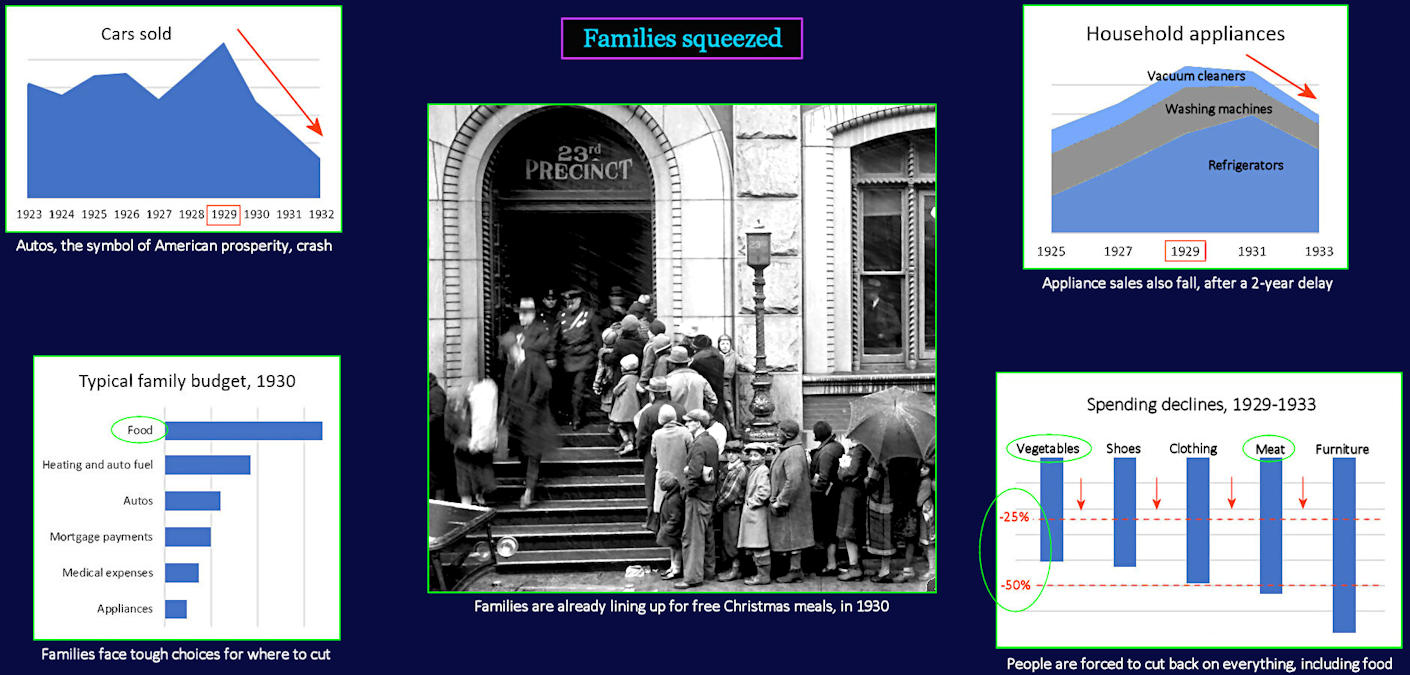
Crashing Hard The future looks bleak, indeed, as America stumbles into its fourth year of decline, in early 1933. In today's modern world, it's difficult to fully grasp what life must have been like during this period. We call a 10% slide in the stock market a 'correction.' A 20% decline is a full-blown 'bear market.' There isn't any term for an 80% plunge in the nation's primary industry, because it never happens. But it does, in 1932. The chart at upper left shows an abrupt and dramatic crash in car sales, beginning immediately, in 1929. The chart at upper right shows that sales for major appliances, which are far less costly, hold steady for two years, but then join the overall downward plunge. Something is fundamentally wrong. | |||||||||
| |||||||||
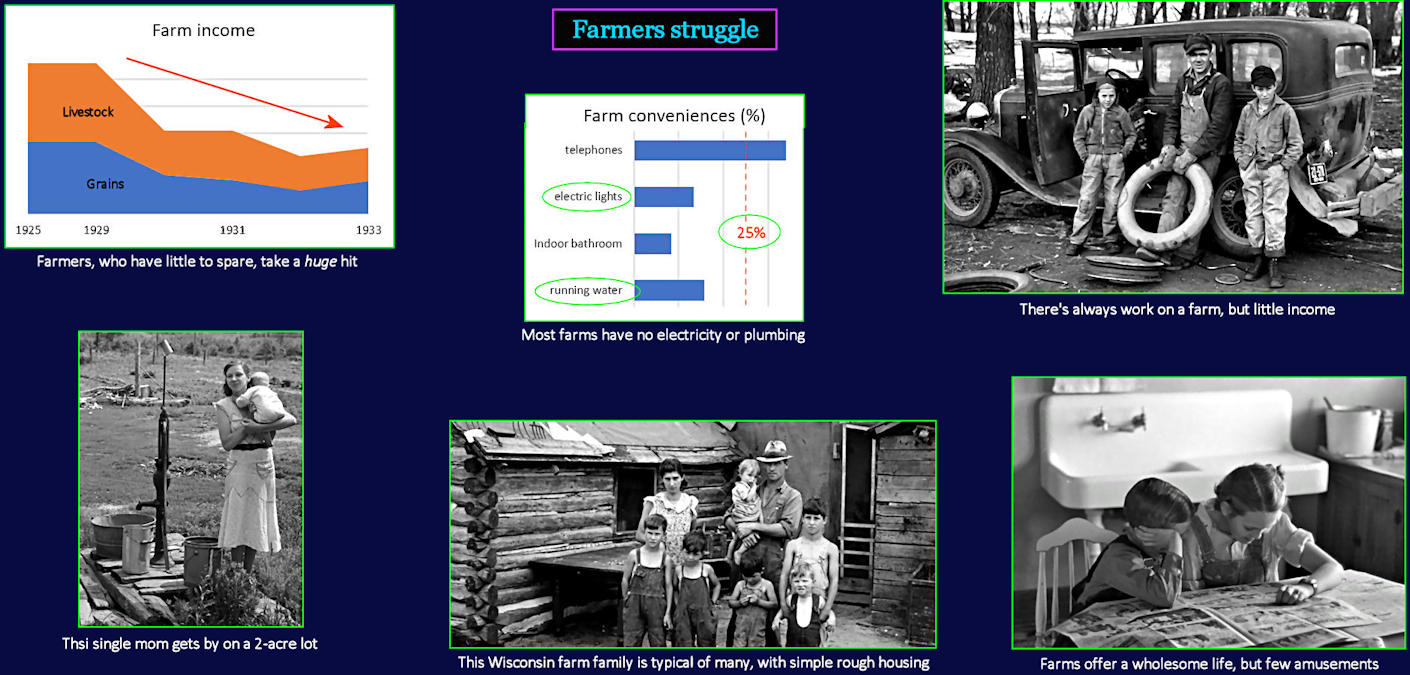
Nowhere to Go There's something wrong on the farm, as well. The chart at top left shows that farm income is down by more than half in 1933, though beginning to tick up. The chart at top center highlights how primitive life on the farm is. Only one-third of farms even have a telephone. But barely one farm in ten has electricity, and even fewer have indoor plumbing. Running water is a relative rarity (lower left). When it comes to running the farm, families are pretty much on their own to maintain everything (top right). Virtually all farmhouses are built by family and friends, resulting in a rustic character which underscores the reality that most farm families have almost no cash income. When you take this basic lifestyle, and then cut income by half, life gets very hard. | |||||||||
| |||||||||
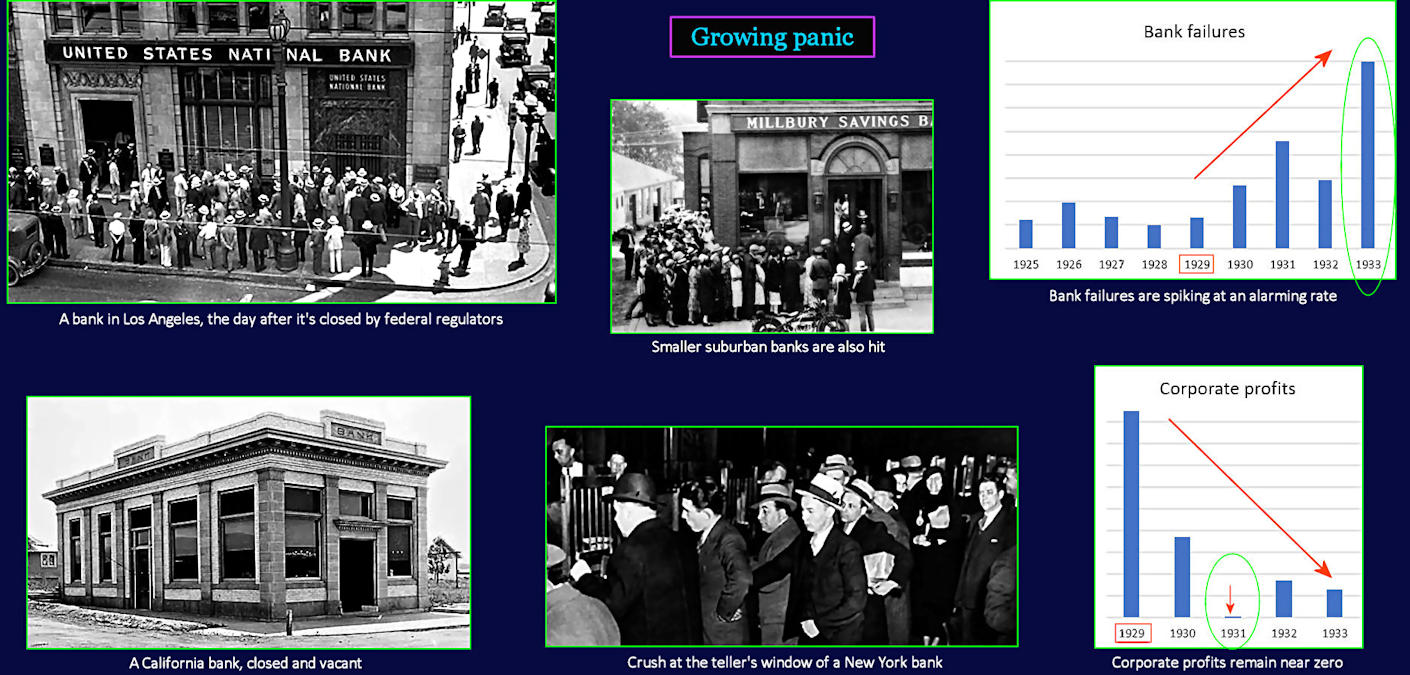
Banks Collapsing By 1933, the situation has become desperate. Families that are in trouble have now completely exhausted their savings, and businesses are limping along with almost no profit. This puts enormous stress on banks. Their primary customers are not the ordinary families that make modest deposits in good times. Rather, banks depend upon prosperous business owners, who need bank loans to run and expand their operations. With dwindling deposits and mounting problem loans, banks are pushed to the edge. People talk, and grow suddenly concerned about the health of their own local bank. Withdrawal frenzy quickly spreads, leading to bank failure. By early 1933, banks are failing at the impossible rate of 20 per day. America is now in full panic mode. | |||||||||