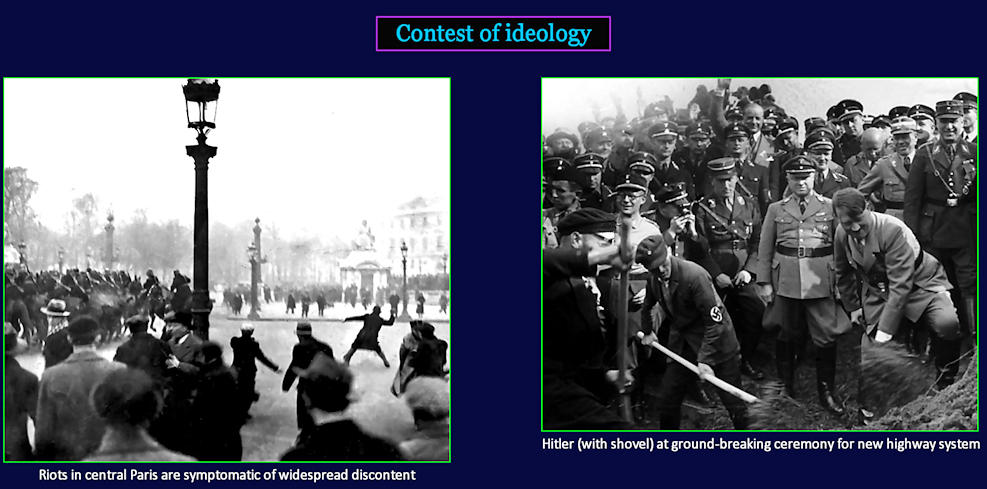
Is Democracy a Failure?As America struggles to extricate itself from the quagmire of Depression, so does the rest of the world. Governments across Europe are faced with the same challenge. How to climb out of the rut, and get back to normal. For the first time, America is beginning to doubt the wisdom of relying upon a democratic system. In a democracy, people get to choose their own rulers, hoping they act effectively in the common interest. The question now is whether democracy is any good at running a complex economy. The first challenge to emerge is Russian-style Communism, which relies on the supposed benevolence of a single, all-knowing party. A newer model of government, called 'Fascism,' combines government with business to create a unified single-party system. This is similar to Communism, but attempts to bring out the best expertise of the country. |
| ||||||||||||||||
| |||||||||
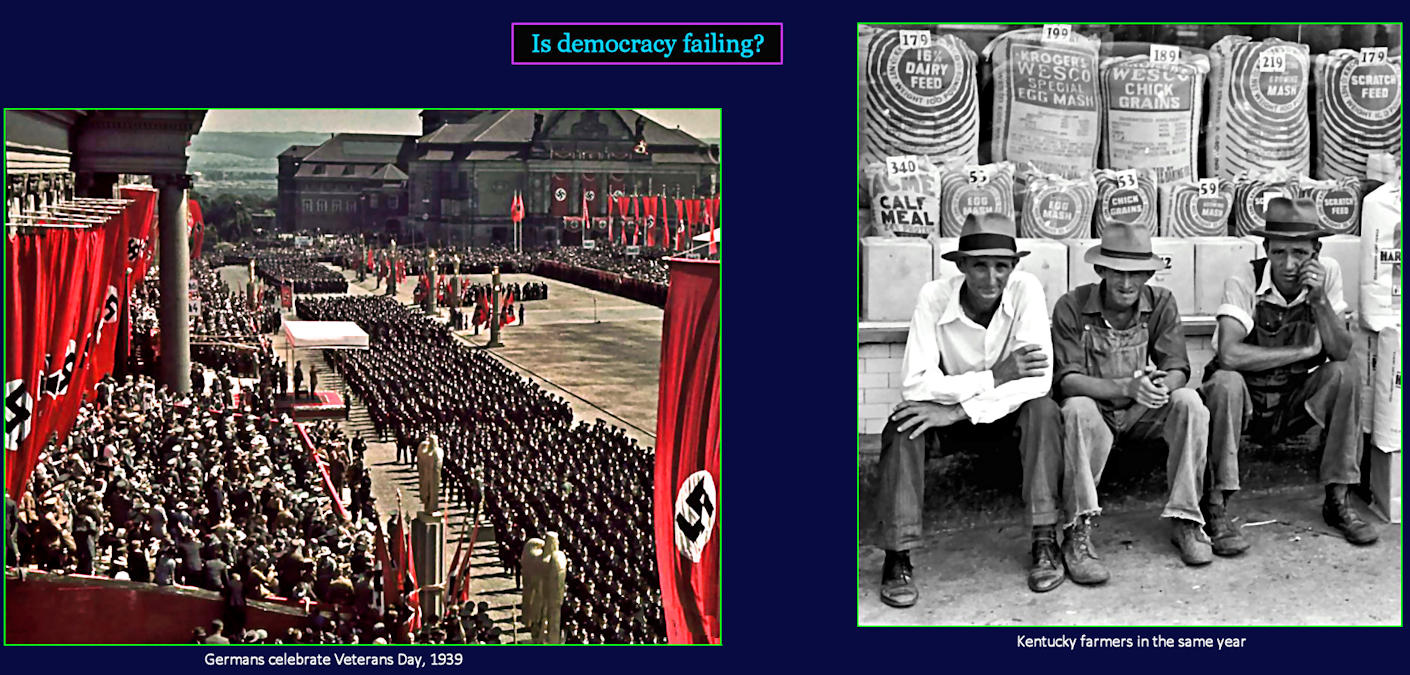
Nazi Dynamism As the 1930s drag on, the world begins to wonder if perhaps America's best days are already behind it. Maybe democracy is just a noble experiment that's bound to fail, eventually. All the New-Deal stimulus spending seems to have done little to bring the unemployment rate back down to normal levels. Meanwhile, the Germans are rebounding strongly under a much different system. German propaganda deepens the perception that the Fascist model is superior, with a tight partnership between business and government that appears to be producing much better results. Nazi parades seen in newsreels present a picture of vitality and progress, contrasting sharply with what Americans see in their own neighborhoods. | |||||||||
| |||||||||
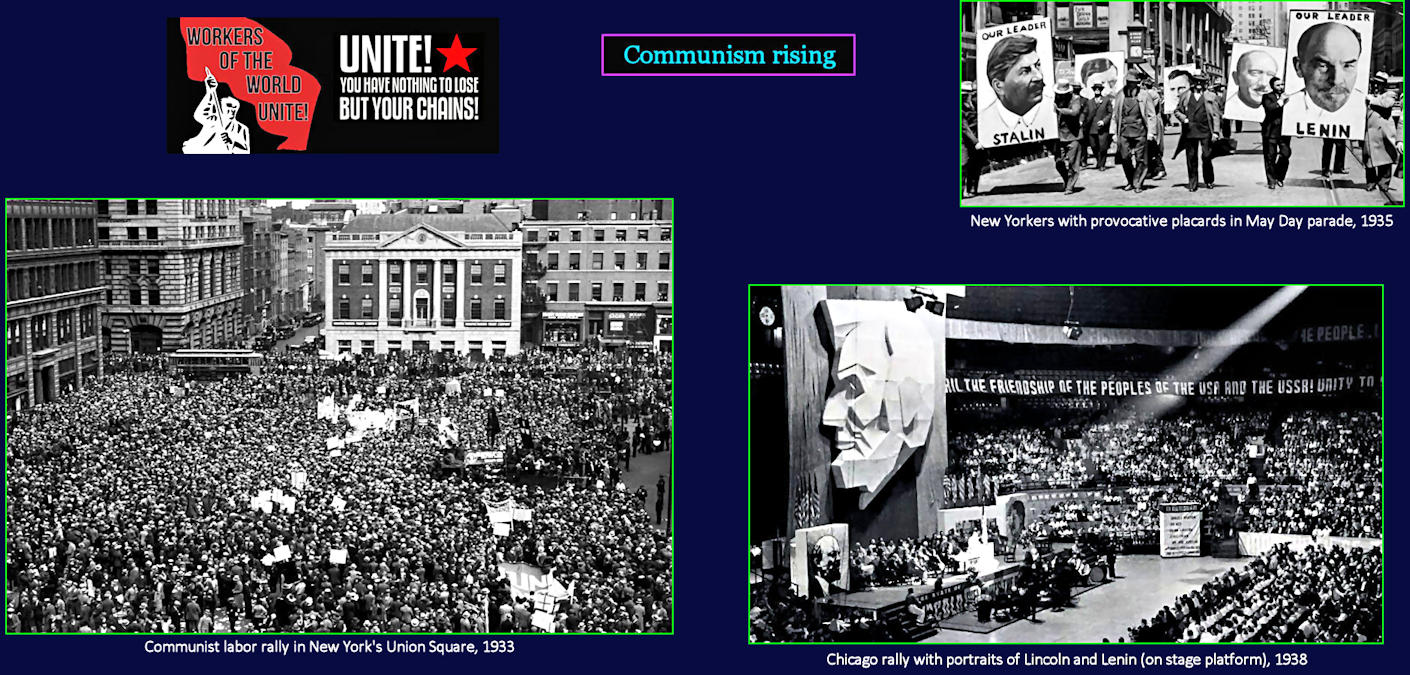
Power to the People Communism presents another alternative that appeals to many in Europe, and America alike. The word 'soviet' is the name given to early Russian village councils, which sprang up in opposition to the Czar. Soviet propaganda promotes Communism as a way to give power to the people, creating the appearance of an autonomous worker's movement. This is in stark contrast to the 'capitalist' system of Europe and America, which seem to be driven by the personal greed of wealthy elites. The Communist International in Moscow, eager to spread its ideology, organizes a world-wide Demonstration Day in 1930, just months after the stock market crash of 1929. Thirty American cities host rallies, from Boston to San Francisco, and continue to do so into the late 1930s. | |||||||||
| |||||||||
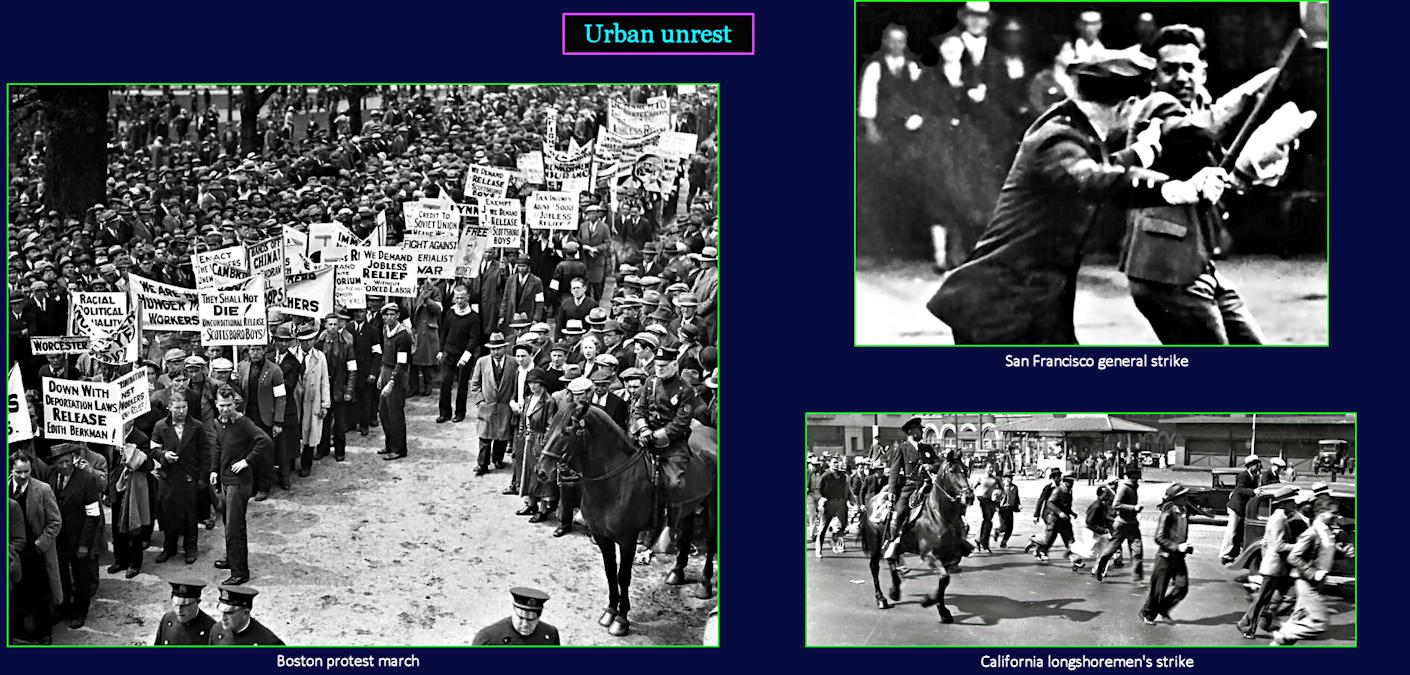
Is This Anarchy? As America continues to recover from the worst depths of the Depression, there's growing uneasiness that the expected return to normalcy isn't happening fast enough. The unemployment problem lingers through the late 1930s. By 1937, labor strikes are erupting five times more frequently than during pre-Depression years, with large street demonstrations and protests that sometimes escalate into very public violence. A strike by 5,000 truckers in Minneapolis overwhelms police, increasing concerns of an even worse breakdown to come. Some are calling for changes in government that would bring America closer to the Communist, or perhaps the Fascist model. | |||||||||
| |||||||||
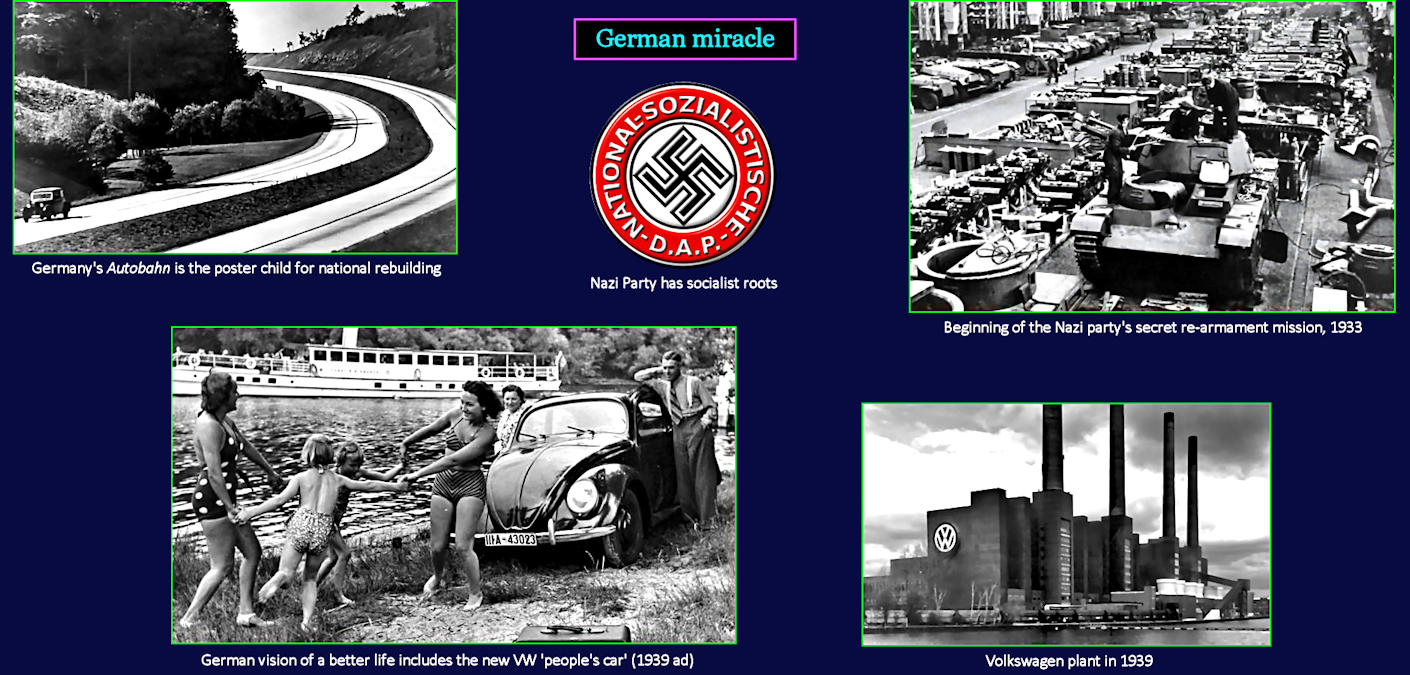
Highways and Secret Tanks The 'German miracle' is all the more impressive because Germany is emerging from a much deeper hole. It was devastated just 20 years earlier, after being defeated in the First World War, in 1918. As part of the peace settlement, Germany is required to disband what remains of its military, and repay enormous sums to Britain and France. Hitler rises to power with the promise of restoring Germany to her former greatness. A million Germans are put back to work in constructing his amazing new 'autobahn' highway system (top left). But millions more are being drafted into a revitalized military, and working secretly to rebuild the German war machine. The tank factory at top right is supposedly building heavy tractors. | |||||||||
| |||||||||
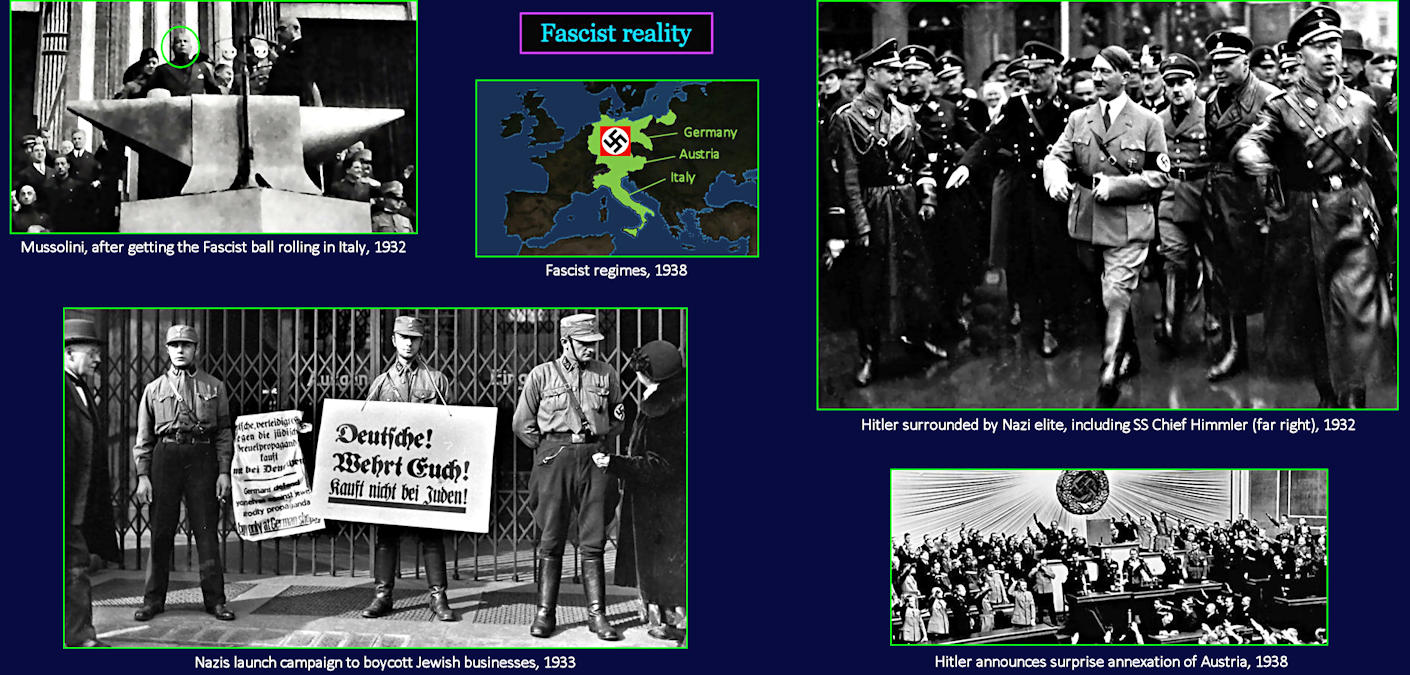
Hitler Unleashed Hitler's true intentions remain hidden behind repeated statements that Germany has no interest in territorial conquest. Starting back in 1933, however, Hitler begins unveiling a relentless anti-Jewish campaign. This begins with a boycott of Jewish businesses, followed by increasing limits on all Jewish activities. Then, in a stunning move, Hitler suddenly annexes the neighboring country of Austria. He gives no warning, but his sudden arrival in Vienna, at the head of his army, is met with cheers. Austrians are ethnic Germans, after all. There seems to be universal admiration for Hitler's ambition. Fascism is also gaining traction in Mussolini's Italy, completing a new central axis of power in Europe (see map). The three countries are now called the 'Axis' powers. | |||||||||