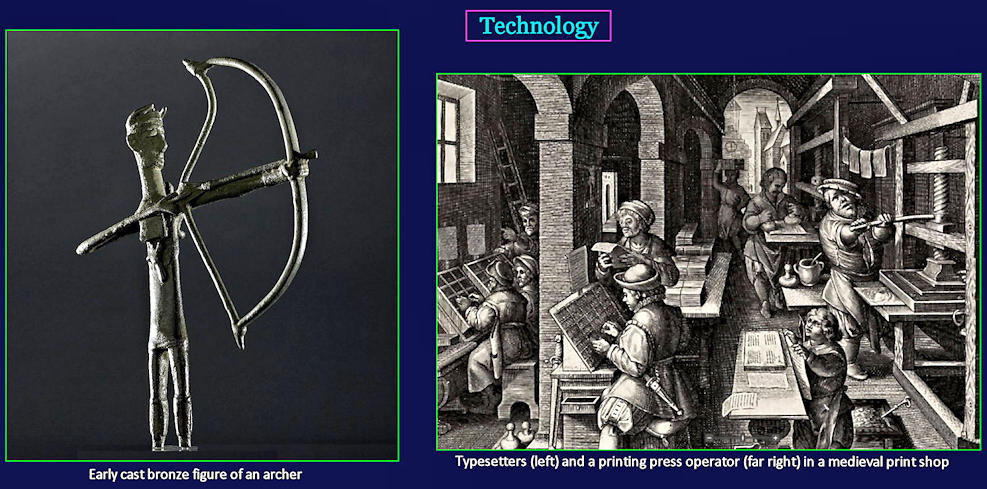
Technology TransformsThe bow and arrow, for instance, is invented before the discovery of hard metal. You can't make anything very sophisticated from just stones, bones and sticks, beyond simple tools for digging, scraping and pounding. Yet stone-age man somehow figures out how to attach a twisted length of deer tendon to a wooden bow, allowing a sharp stone to fly through the air with great force. Tail feathers are the key, as they help the arrow fly straight. |
| ||||||||||||||||
| |||||||||
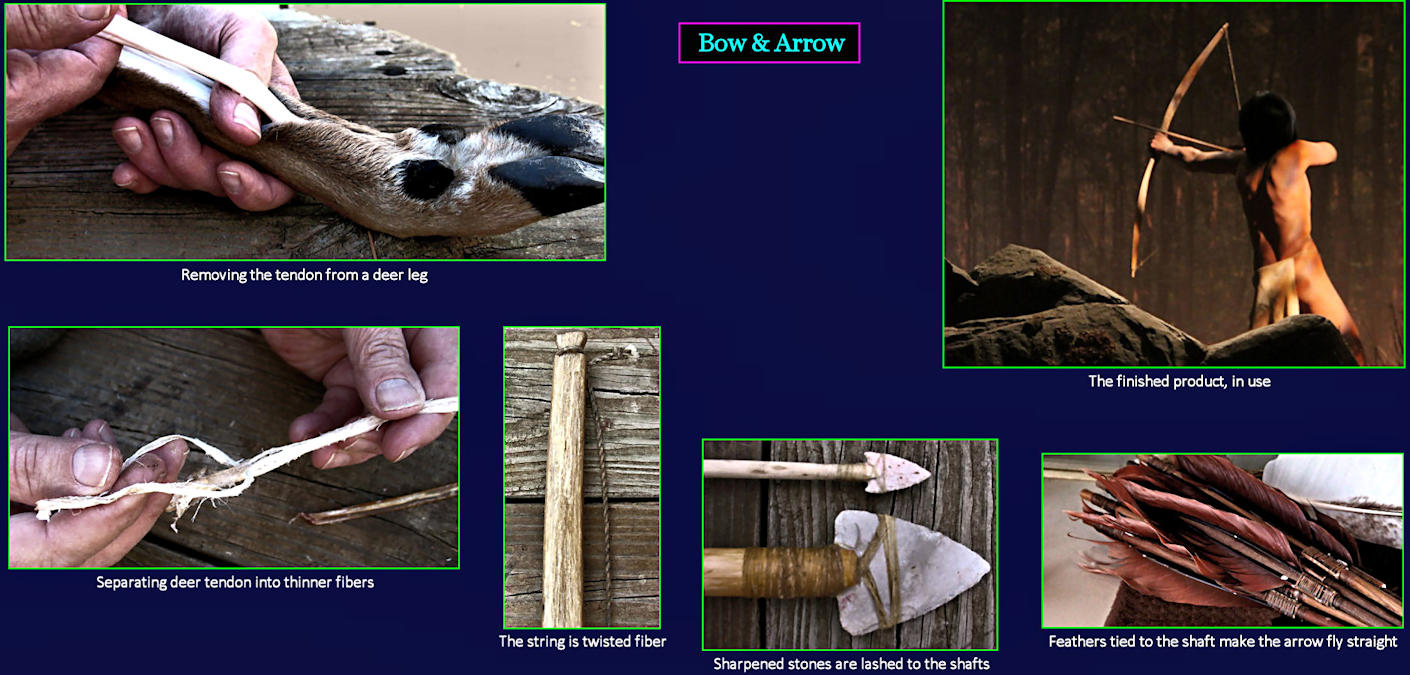
Applied Physics, in the Stone Age Stone-age man already knew how to make a spear. But imagine what a leap in thinking is required to devise the combination of bow and arrow, complete with stabilizing tail feathers. Nonetheless, humans are eventually able to perfect the complicated process required to make and use such a weapon. First, you cut the tendon from the leg of a deer, then pound it with a rock to separate the tendon into tough, flexible fibers. These fibers are then twisted into a string, which is tied to a finely shaped piece of springy wood. The final touch is attaching bird feathers to the shaft of the arrow as fins, to keep it flying straight through the air. Learning to combine all these separate steps, 5,000 years ago, is a stunning achievement. | |||||||||
| |||||||||
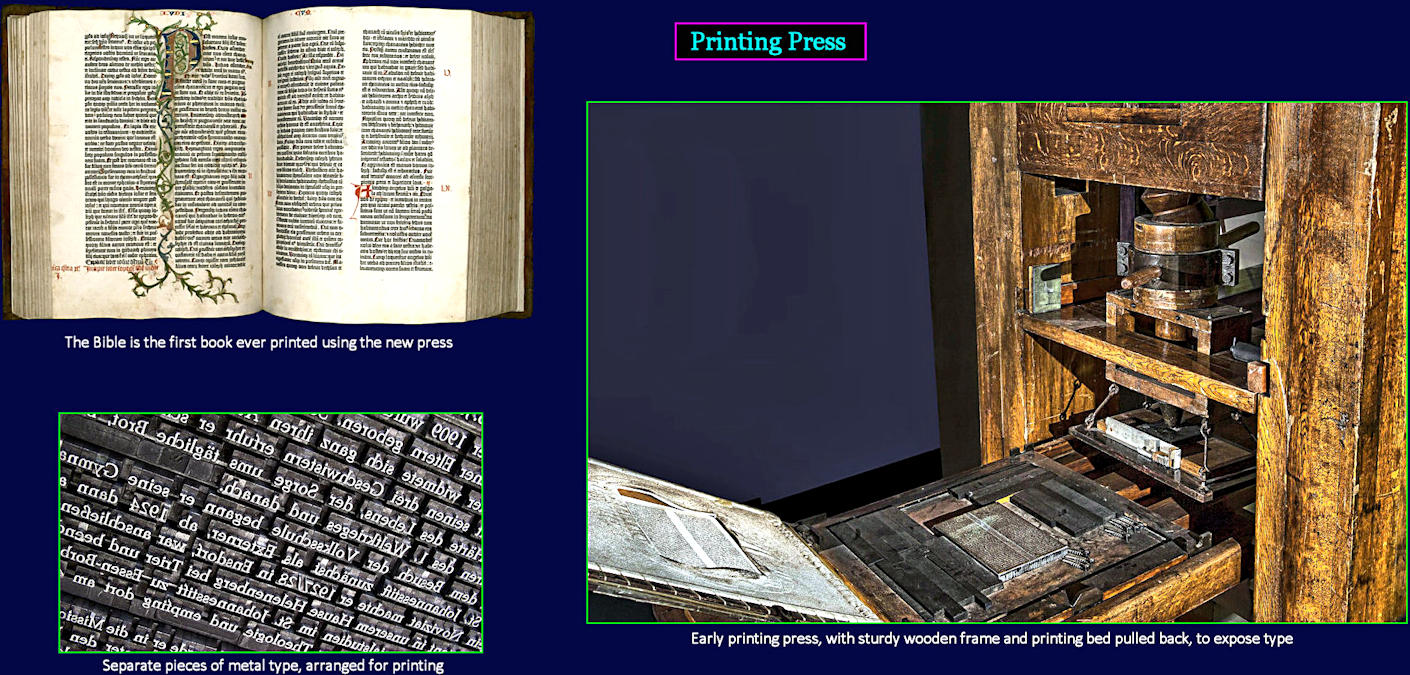
Multiple Copies The Gutenberg bible (top left) is the world's first mass-produced book, appearing just a few years before the discovery of America. The pages are printed using a separate piece of metal type for each letter in every word. Ink is rolled onto the face of the type, and a sheet of paper laid on top. This whole array is then slid underneath the press mechanism. Pulling the press handle turns a sturdy wooden screw to force the paper down hard against the type. Because the ink is transferred to the paper as a mirror image, the type must be 'reversed,' so that it appears to read backwards (lower left). The pieces of type are made by pouring molten metal into a mold, a process which allows many identical letters to be cast from a single pattern. | |||||||||
| |||||||||
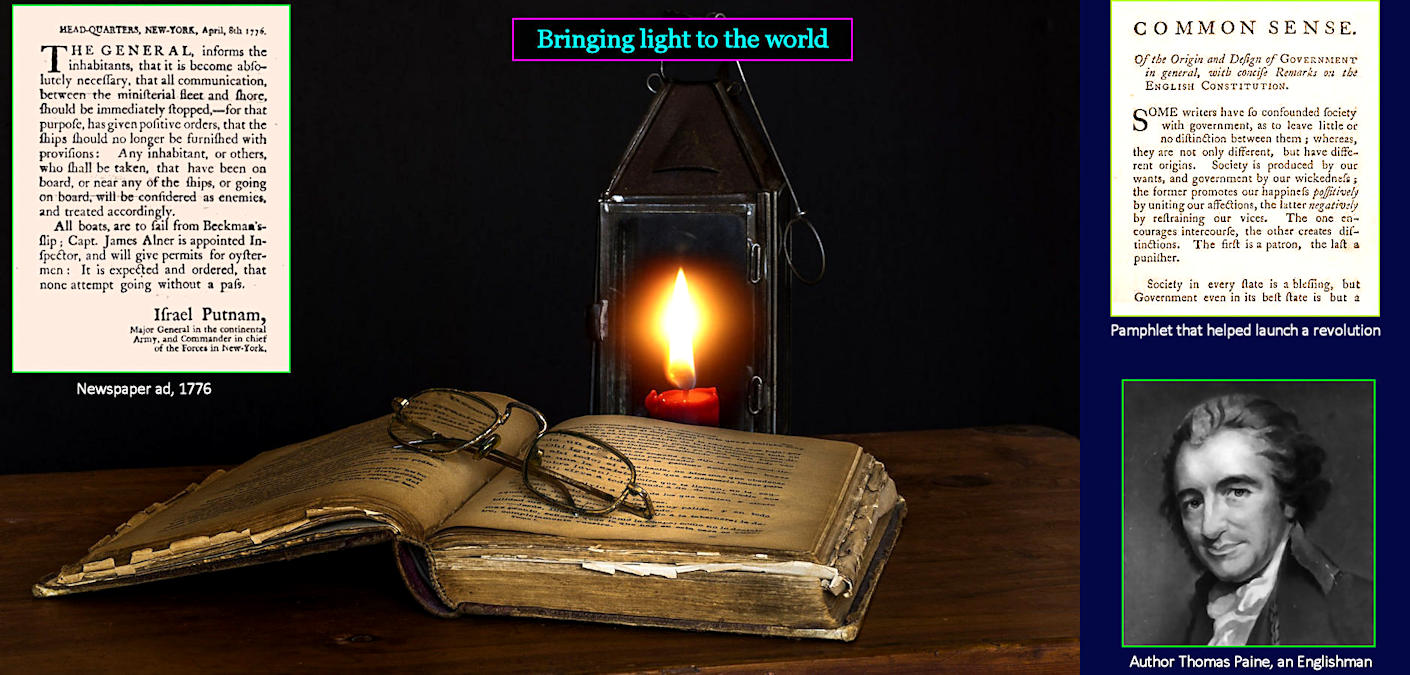
Spreading Ideas The printing press is so revolutionary that over 30 million books are sold in Europe during just the first 50 years. Over the next 100 years, another 200 million are printed, which seems impossible. And it isn't just books. Single-sheet newspapers are also important for sharing information. The news item at upper left is printed during the American Revolution. (At this time, the letter 's' is often printed as 'f.') When colonists begin the American Revolution, it's due in large part to a pamphlet called Common Sense, which challenges the notion that kings are necessary to manage society. It's written by a man who develops his ideas back in England, but finds a more receptive audience when he comes to America, just before the Revolution. | |||||||||
| |||||||||
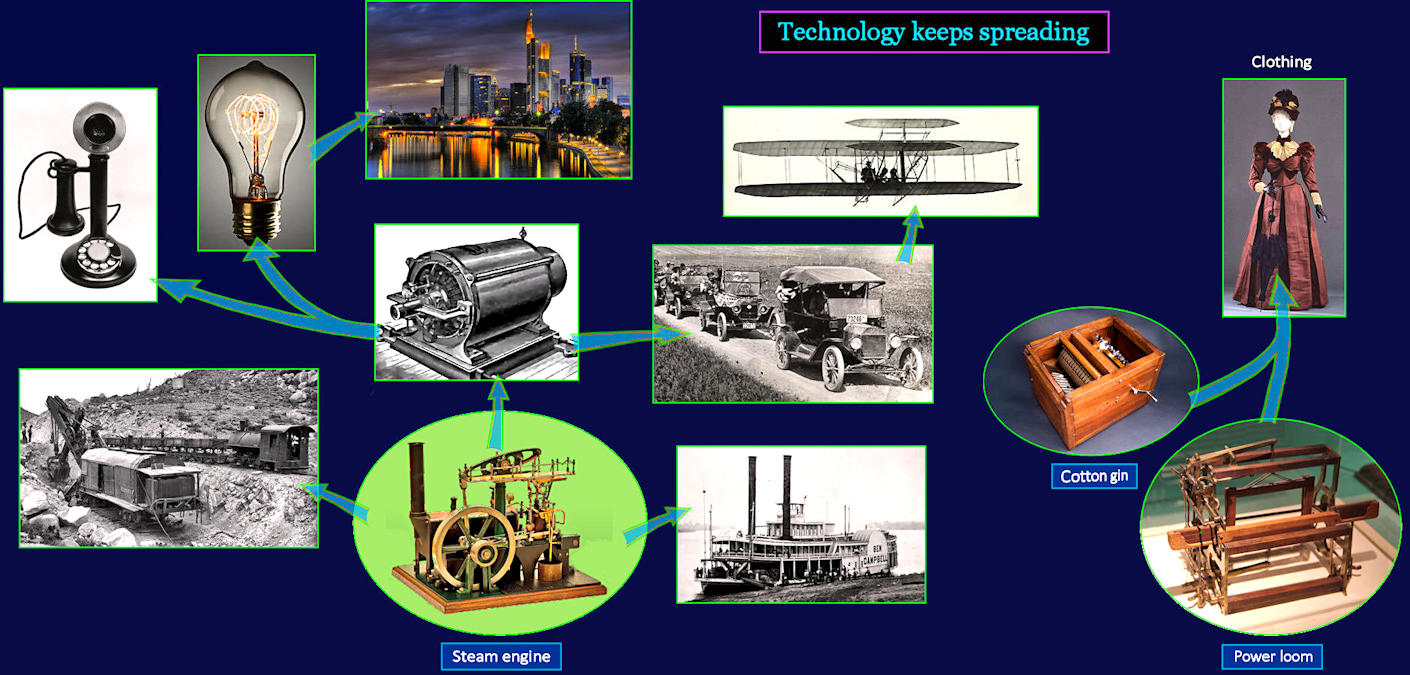
Snowball Effect One astonishing characteristic of technology is its natural tendency to snowball. Every advance leads to more advances. The first key invention after the printing press is the steam engine, which is used to power locomotives and all kinds of industrial equipment. This includes generators that power electric motors and lights. The combination of steam power and electricity is used to power almost everything else. The early textile industry is the only real exception. Waterwheels were used to power the original spinning and weaving equipment, but mills convert to steam power soon after it becomes available. The ability to produce cheap fabric leads directly to the availability of inexpensive clothing. | |||||||||
| |||||||||
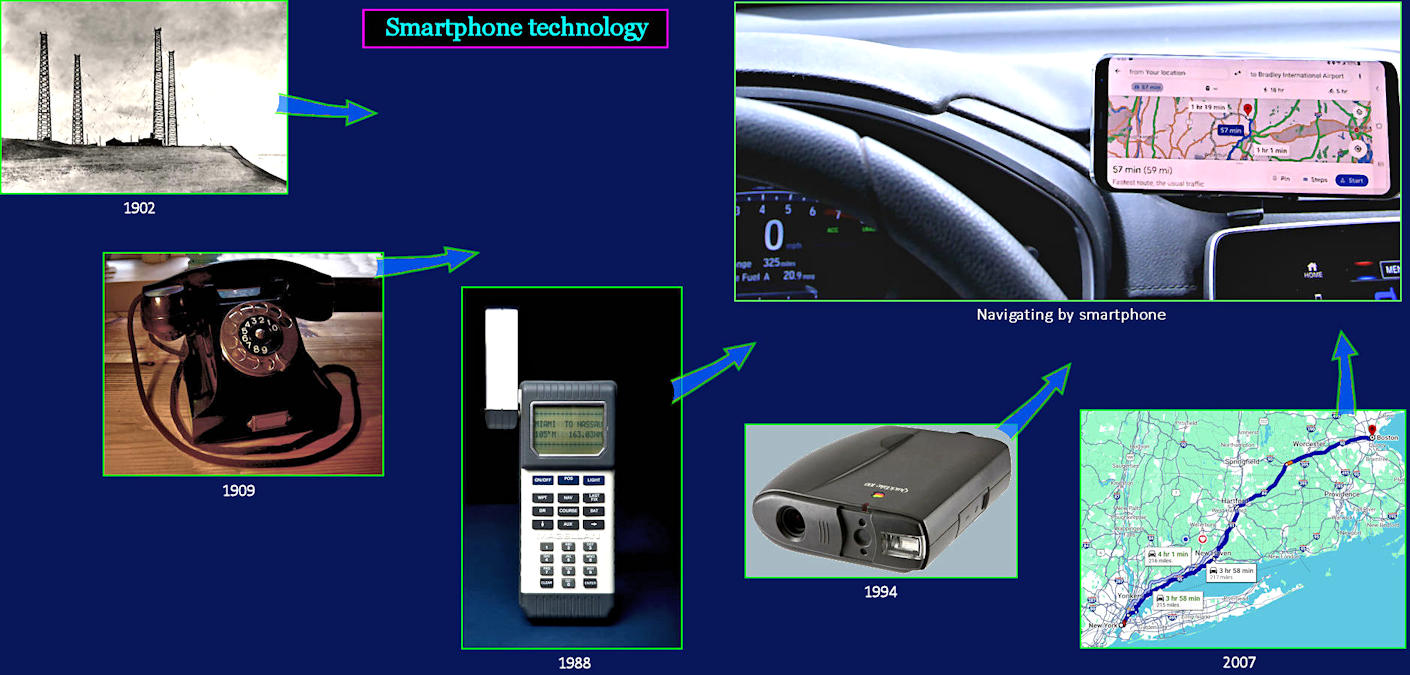
Evolution of the Smartphone 1902: Wireless signal transmission is the key to mobility. The wireless station on Cape Cod that receives a message from the sinking Titanic (top left), relays it to the ship that rescues survivors. 1909: Bakelite is introduced as the first moldable plastic material, and is used to produce the telephone shown above. Almost every product made today uses inexpensive light-weight plastic. 1988: Portable GPS is introduced. For the first time, a device can tell where it is. 1994: Digital cameras replace film with electronic image capture. No smart phone today would be complete without camera mode. 2007: Digital navigation is introduced with Google Maps, which allows easy travel planning to unfamiliar destinations. Smart phones make this portable. | |||||||||