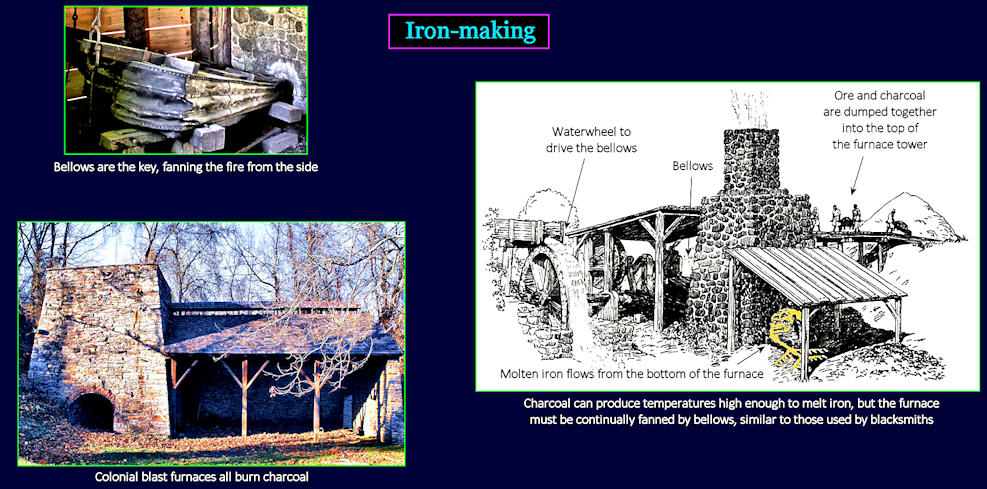
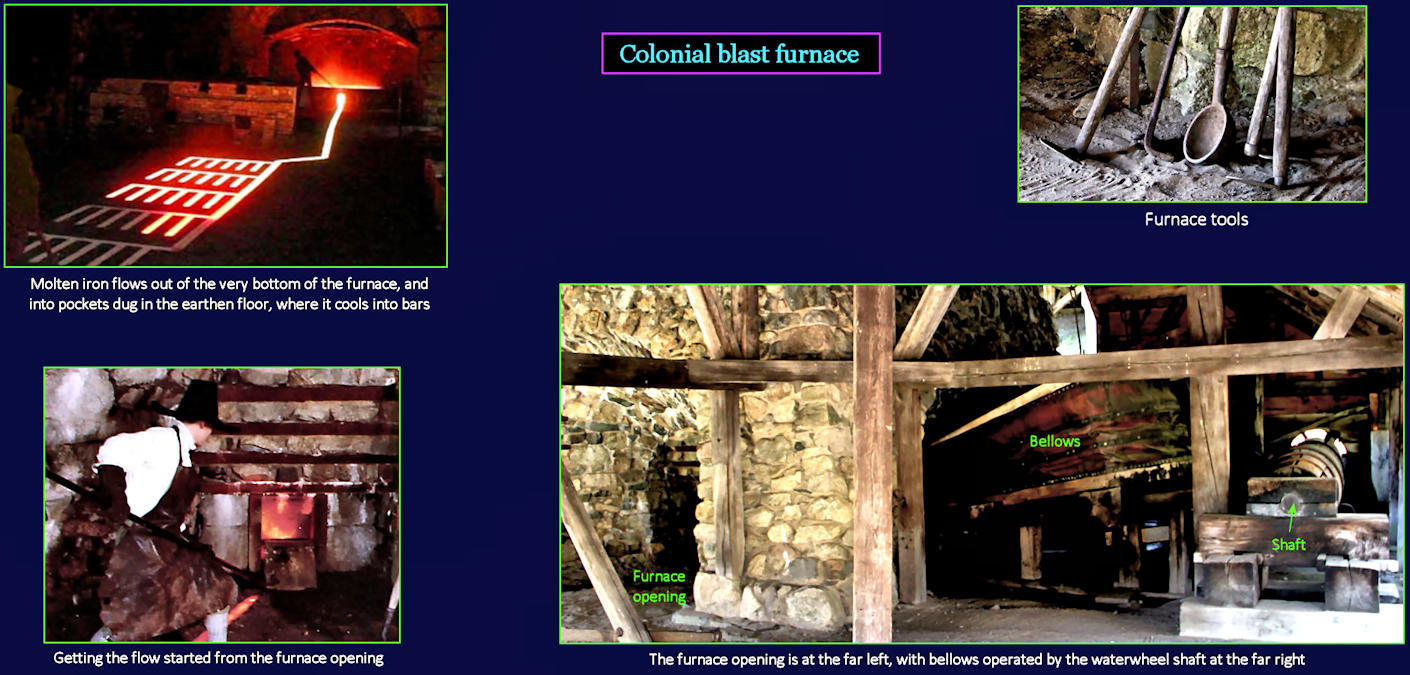
Early Blast FurnacesTo extract iron from iron ore, you need temperatures beyond the capability of a wood fire. Charcoal is the only available fuel that burns hot enough, if given a continual blast of air to keep fanning the flames. In early blast furnaces, this is provided by a pair of giant leather bellows, which operate continuously. A waterwheel is required to keep the bellows operating until the iron reaches melting temperature. When melting iron, you need one wheelbarrow of fuel for each wheelbarrow of iron ore. This requires making lots of charcoal, which is made by keeping a long stack of wood slowly smoldering under a covering of dirt, for a week. Most colonial furnaces close after exhausting their local deposits of ore, but others are forced to cease operation after stripping the surrounding woods of trees. Without railroads, it's too expensive to ship in coal. |
| ||||||||||||||||
| |||||||||
First of its Kind The iron-producing facility shown at lower right is a replica of the first one built in America, financed by London bankers, and equipped with state-of-the-art equipment for rolling and slitting iron bars. The facility includes the blast furnace shown above, and a separate rolling mill shown further below. Waterwheels are used in both buildings to operate the equipment. | |||||||||
| |||||||||
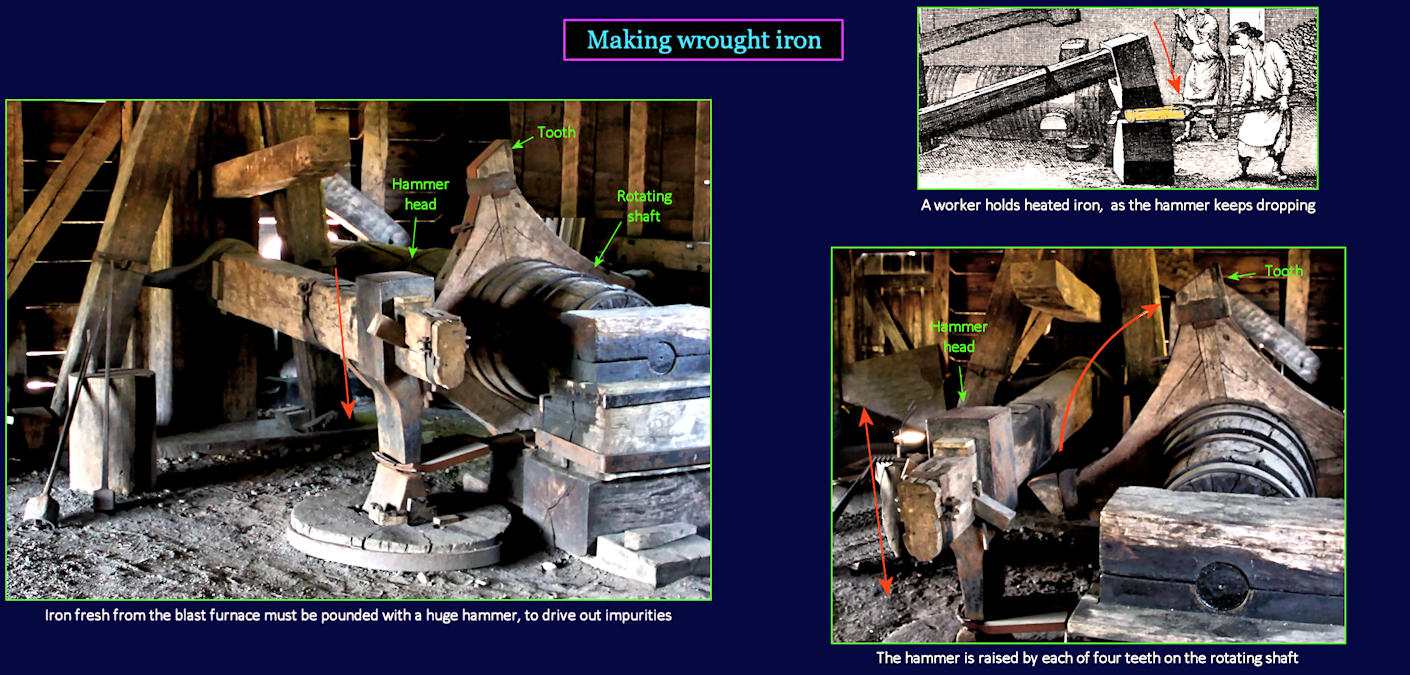
Big Hammer Iron that emerges from the blast furnace is allowed to cool, and then taken next door to the rolling mill. There, the iron is re-heated, and pounded repeatedly with a massive hammer, to gradually remove impurities. This produces wrought iron (also called bar iron), which can be formed into useful shapes without cracking. Four large protruding teeth on the waterwheel shaft lift the hammer in succession as it rotates (lower right). The hammer falls of its own weight, each time it slips off a tooth. | |||||||||
| |||||||||
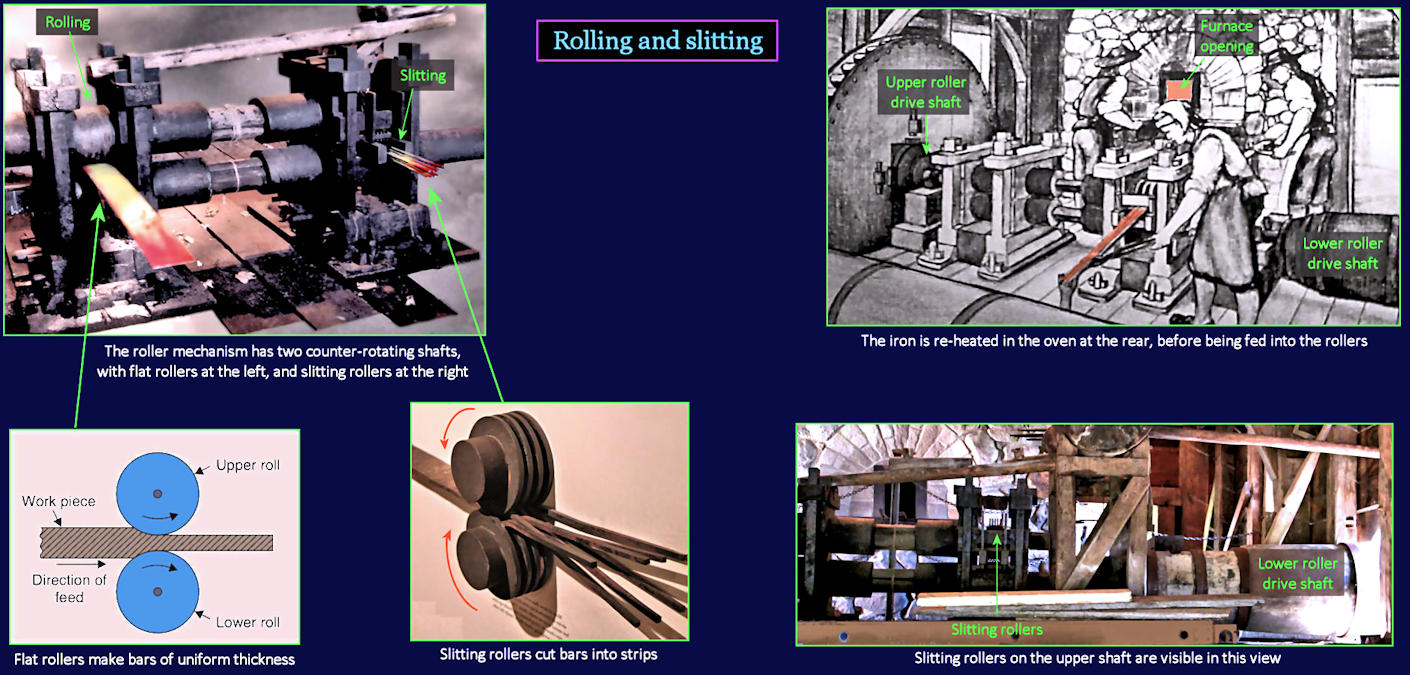
Making Usable Shapes After beating, the iron is again re-heated, to soften it before it is fed into the rollers to form uniform bars. The bars are then re-heated once more, before being fed into the slitting rollers, to cut the bar into thinner strips (bottom center). | |||||||||
| |||||||||
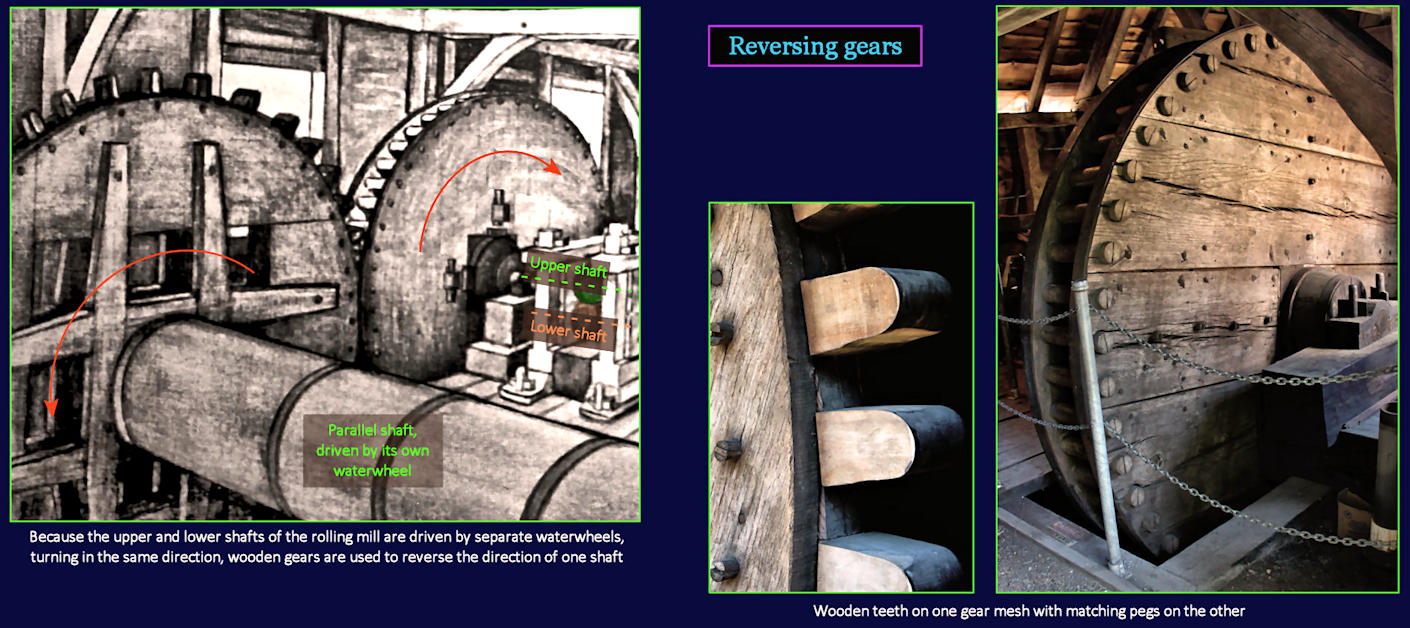
Big Wood Enormous wooden gears are used to reverse the direction of one shaft, relative to the other. The large size of the gears reduces the force that is exerted on the teeth and pegs. | |||||||||
| |||||||||
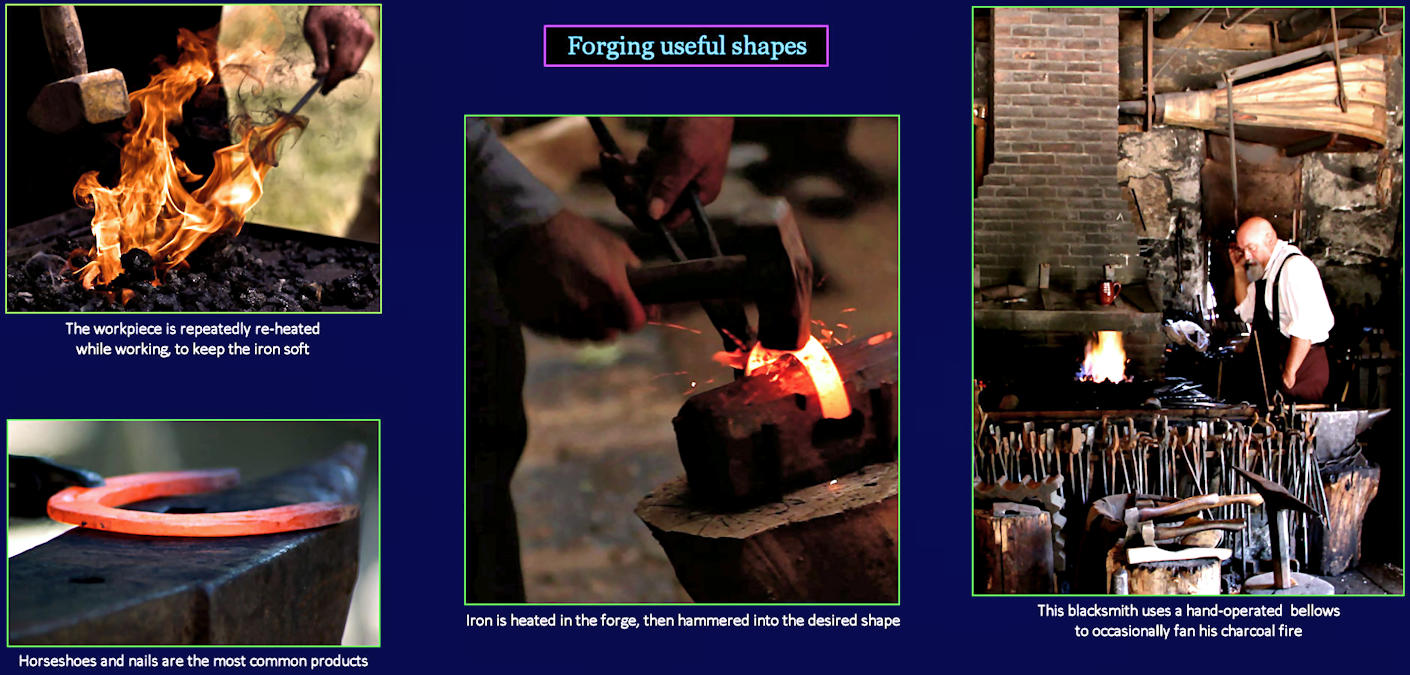
Final Shaping The skill of a blacksmith is needed to make the final product, like a horseshoe. A short length of bar is re-heated to a temperature that softens, but doesn't melt, the iron. The softened iron is then hammered into the desired shape. The beating further improves the quality of the iron, as impurities continue to be expelled by the force of the hammer blows. What appear to be sparks (bottom center) are actually bits of expelled material. | |||||||||