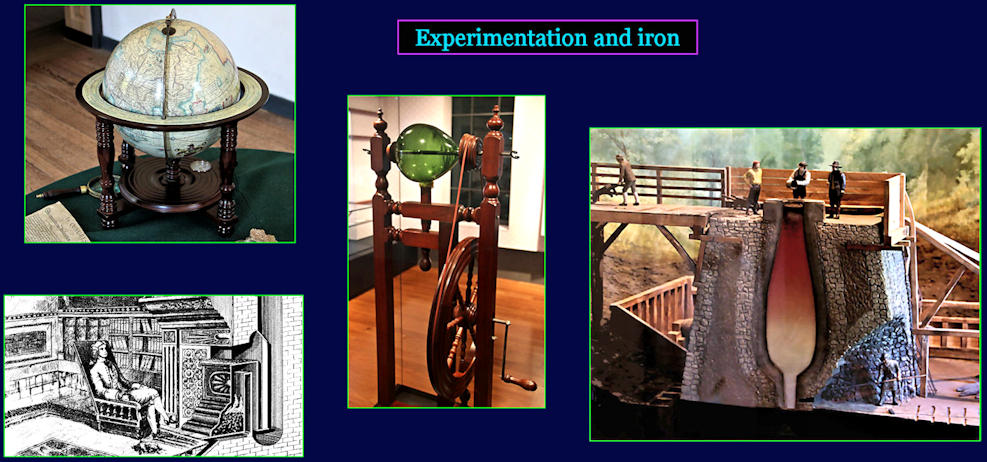
Tinkering at the EdgesIn Europe, the Enlightenment is in full bloom, a period when people are beginning to use scientific observation to understand the world. Many are seeking to replace tired religious dogma with enlightened reason. In America, men of wealth and education also begin to catch the scientific fever, as the latest books imported from Europe open eyes to the value of experimentation. Others are just seeking better ways to produce iron. |
| ||||||||
| |||||||||
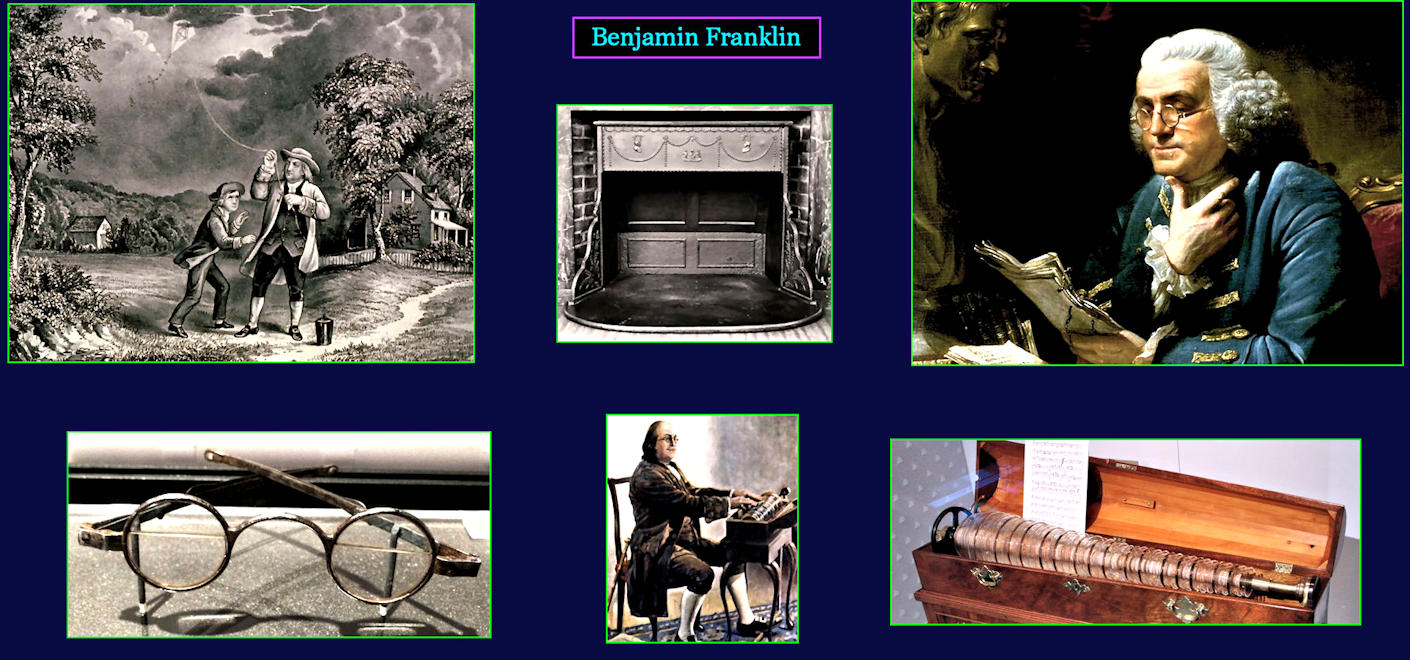
Gifted Amateur Of all America's Founding Fathers, Benjamin Franklin is perhaps the most interested in science. He famously flies a kite in a lightning storm, with a metal key attached to the string, to demonstrate that lightning is a form of static electricity (top left). He invents bifocals (lower left), and a cast-iron fireplace insert that is widely sold as the 'Franklin Stove' (center top). His own personal favorite invention is a musical instrument that makes sound by touching rotating glass bowls (bottom center and right). | |||||||||
| |||||||||
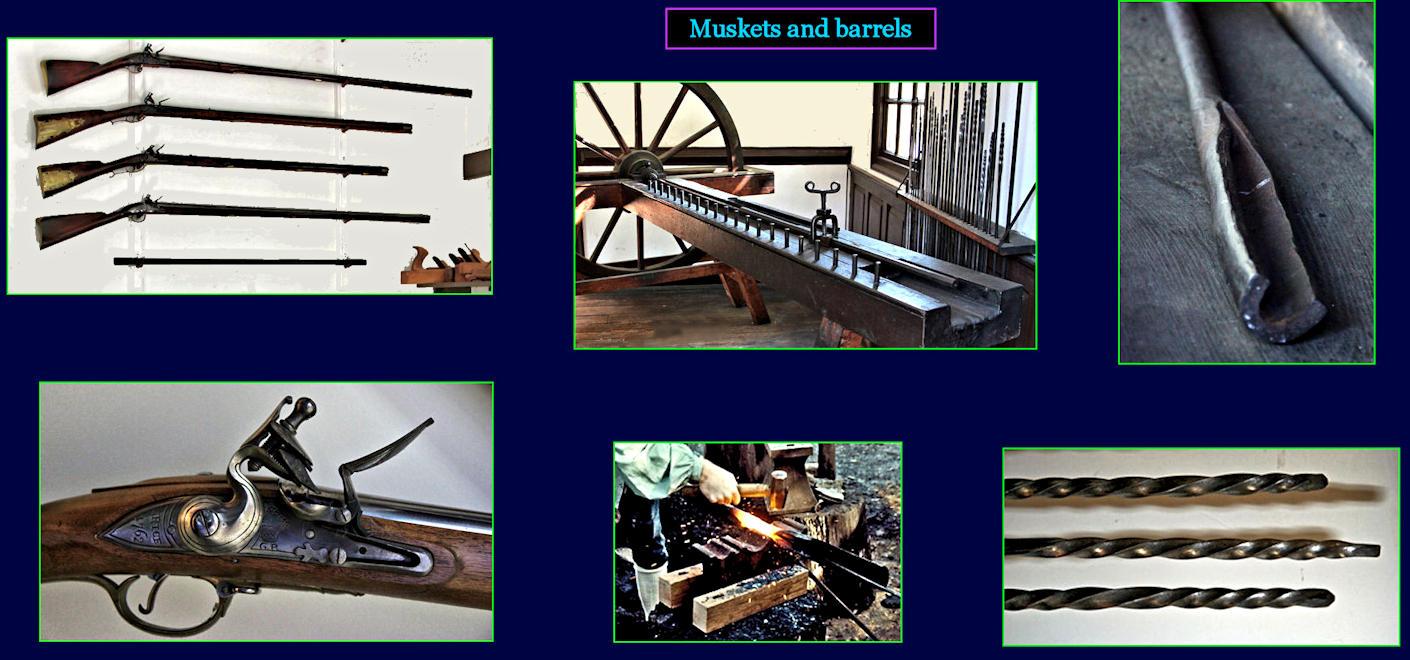
Gunsmith The highest level of skill is required to make the long barrel of a musket (top left). There are no drills capable of boring out the center hole, so the gunsmith starts out with a flat, slightly tapered, bar of iron. This is bent lengthwise into a long U-shape, like a roof gutter (top right). The long edges are gradually forced together, and joined by repeated heating and hammering, an inch or so at a time (center bottom). The inner bore is opened up and smoothed using a graduated set of reamers (lower right). | |||||||||