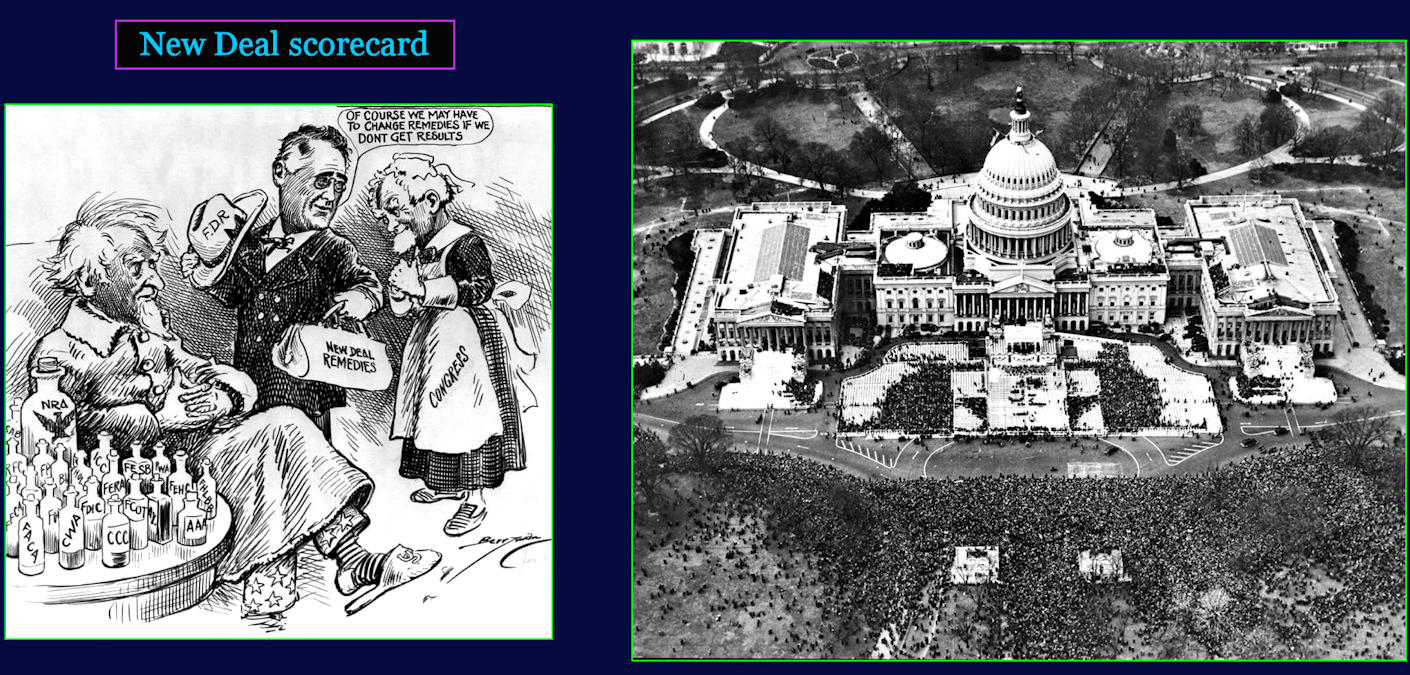
Success or Failure?Some believe that the government should never attempt to relieve individual hardship, as it leads to dependence. Others argue that Roosevelt just didn't go far enough. He didn't go big enough to achieve convincing success. There's no way to settle the issue, but there's plenty of evidence to sift through. Clearly, 1933 was the big year of turnaround. America hit rock bottom just as Roosevelt was taking office, and began recovering soon after. |
| ||||||||||||||||
| |||||||||
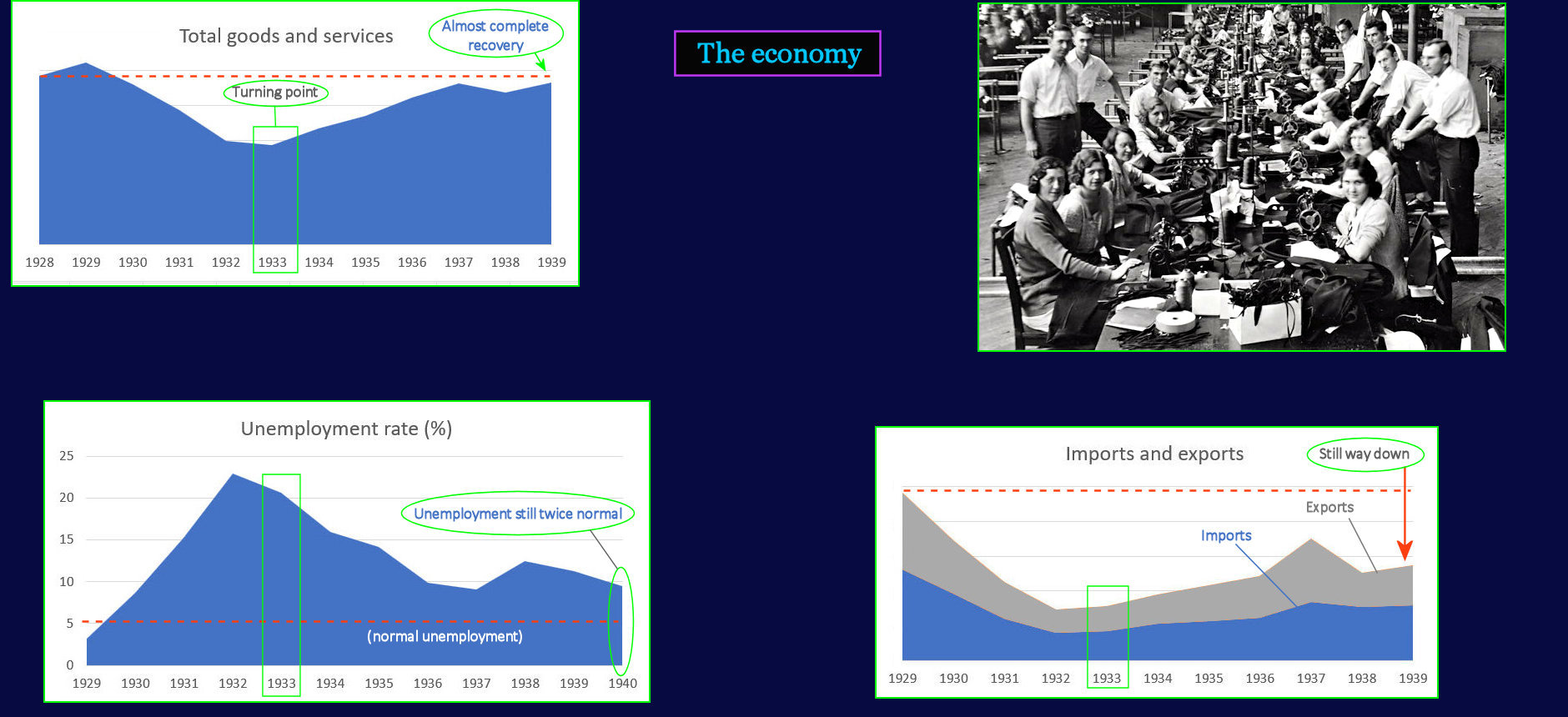
The Long View Clearly, 1933 is the turning point, while GDP, the broadest measure of national economic health, has almost fully recovered by 1939 (top left). Other measures are slower to recover, especially unemployment (lower left). Trade with Europe is the perhaps the biggest laggard (lower right). This may be related to very high tariffs, which America passed in 1930 to discourage competition from imports. European nations, however, are also still mired in a lasting Depression. | |||||||||
| |||||||||
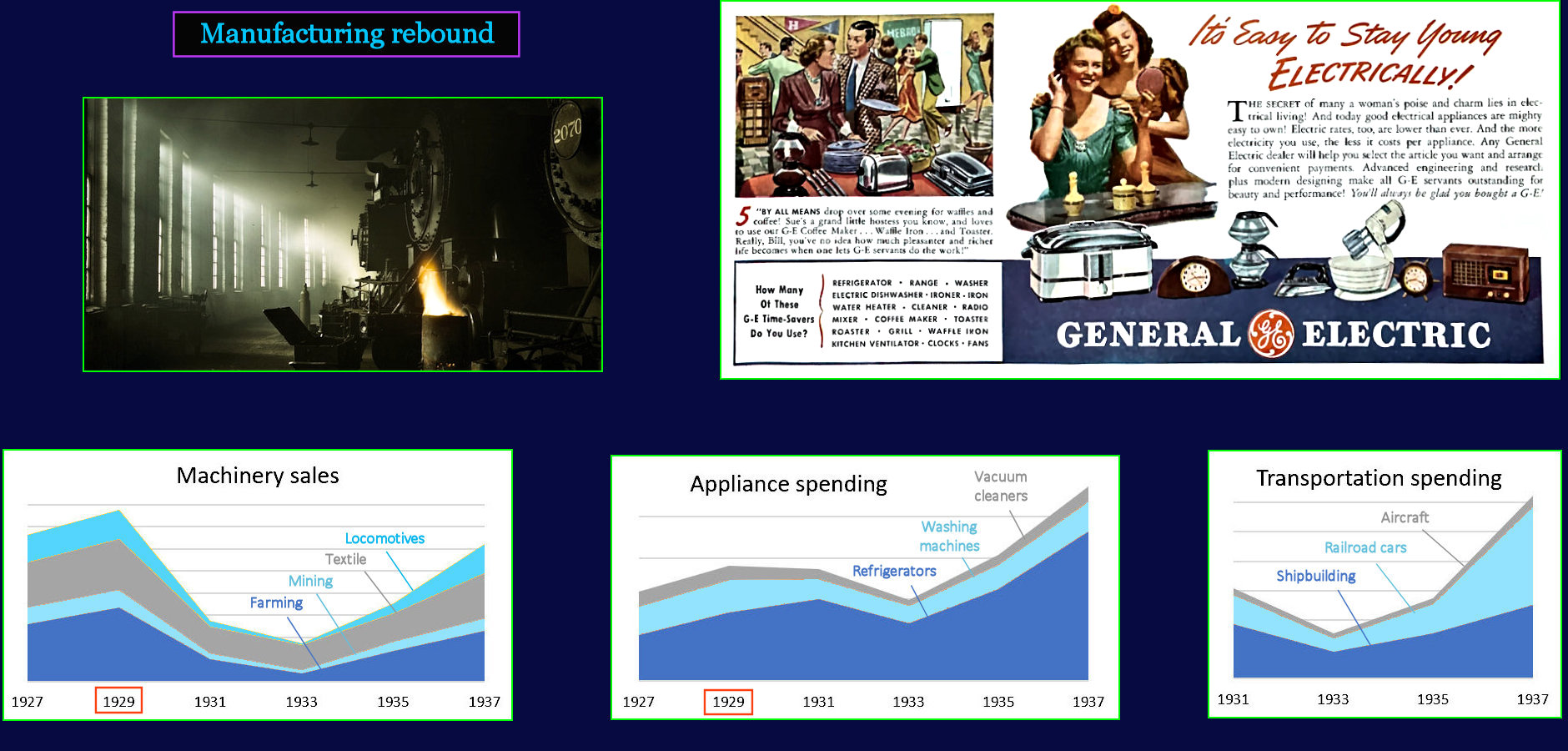
Business is Back The strongest rebound is in manufacturing, which suffered the steepest declines early in the Depression. Machinery and equipment sales have recovered 90% by 1937 (lower left), while sales of home appliances zoom to levels roughly double pre-crash levels (center bottom). Somewhat surprisingly, auto sales are still down by nearly 20%, while spending on other forms of transportation are up smartly (lower right). The economy actually enters another mini-slump in 1937, but recovers again by 1939. | |||||||||