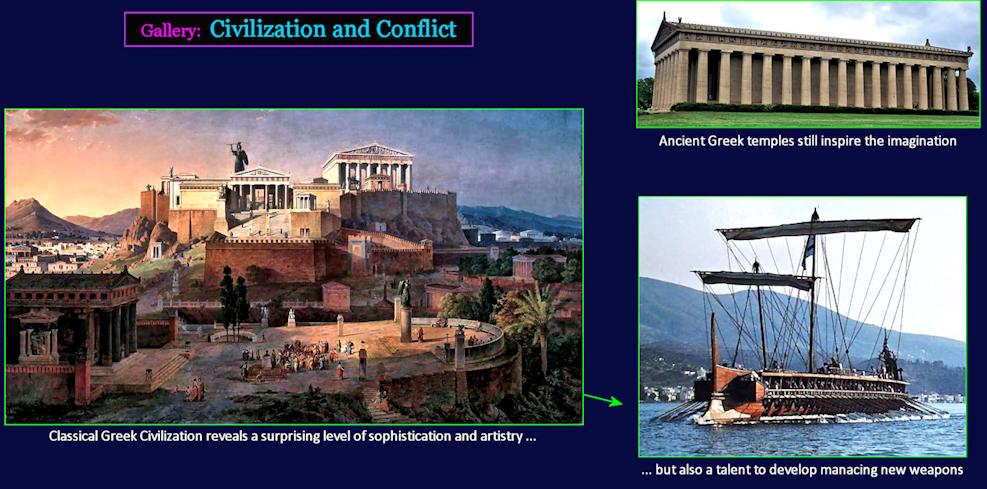
Jostling for ControlThis, by itself, is not an undesirable arrangement. It promotes the growth of cities, where human effort is organized in a productive manner. But it also leads to conflict over control of the governing apparatus. Over time, civilization has become more convenient and more complex, but the forces driving conflict have remained relentless. The technology of weaponry has improved, and warfare has become ever more deadly. Century by century, battles have been fought in every corner of the inhabited world. There has never been a pause, and the targets of aggression have until very recently been centers of wealth, known as cities. |
| ||||||||||||||||
| |||||||||
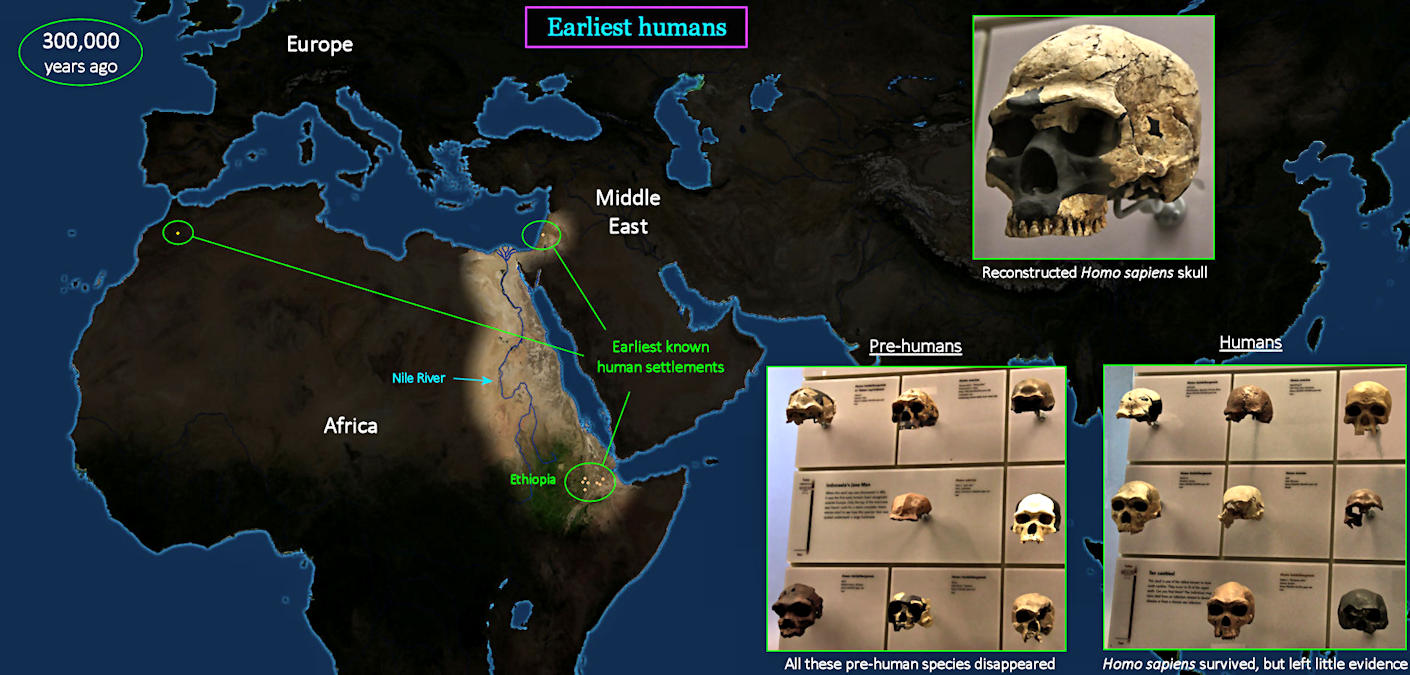
Homo Sapiens We know almost nothing about the earliest humans. They likely evolved from earlier species, but there are puzzling gaps in the evidence. Scientists have dug up fragments from thousands of ape-like pre-humans, including complete skeletons. Surprisingly, however, there is barely any evidence of the early presence of true humans (Homo sapiens). So far, just a handful of human skulls have been unearthed that date back more than 10,000 years. None of them are complete (the black portions have been added), and there is nothing remotely approaching a skeleton. Almost all the skull fragments were unearthed in Ethiopia (bottom of map), suggesting that the Nile River Valley may have served as a convenient route for humans who later migrated north. | |||||||||
| |||||||||
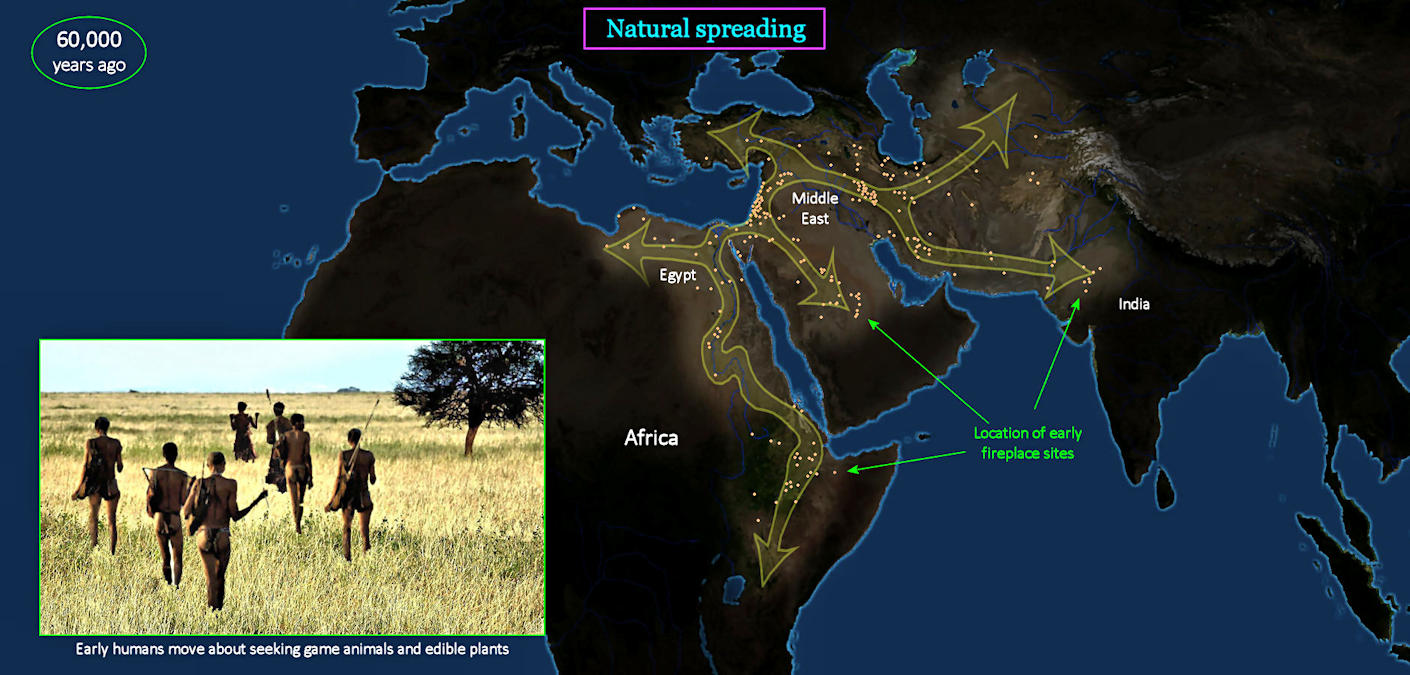
Room to Grow Based on the evidence unearthed so far, Stone Age humans seem to have spread outwards very gradually, at a rate of perhaps 10 miles per generation. This suggests that, as children became breeding-age adults, some moved a short distance from their parents to start families of their own. There may have been long-distance migrations, but early humans more likely chose to remain in regions with nearby relatives, for common defense and mutual support. The map shows that humans gradually spread in all directions from their initial location in Africa. Later evidence confirms that humans have a natural tendency to spread outward, as population density increases, until they encounter a firm barrier. | |||||||||
| |||||||||
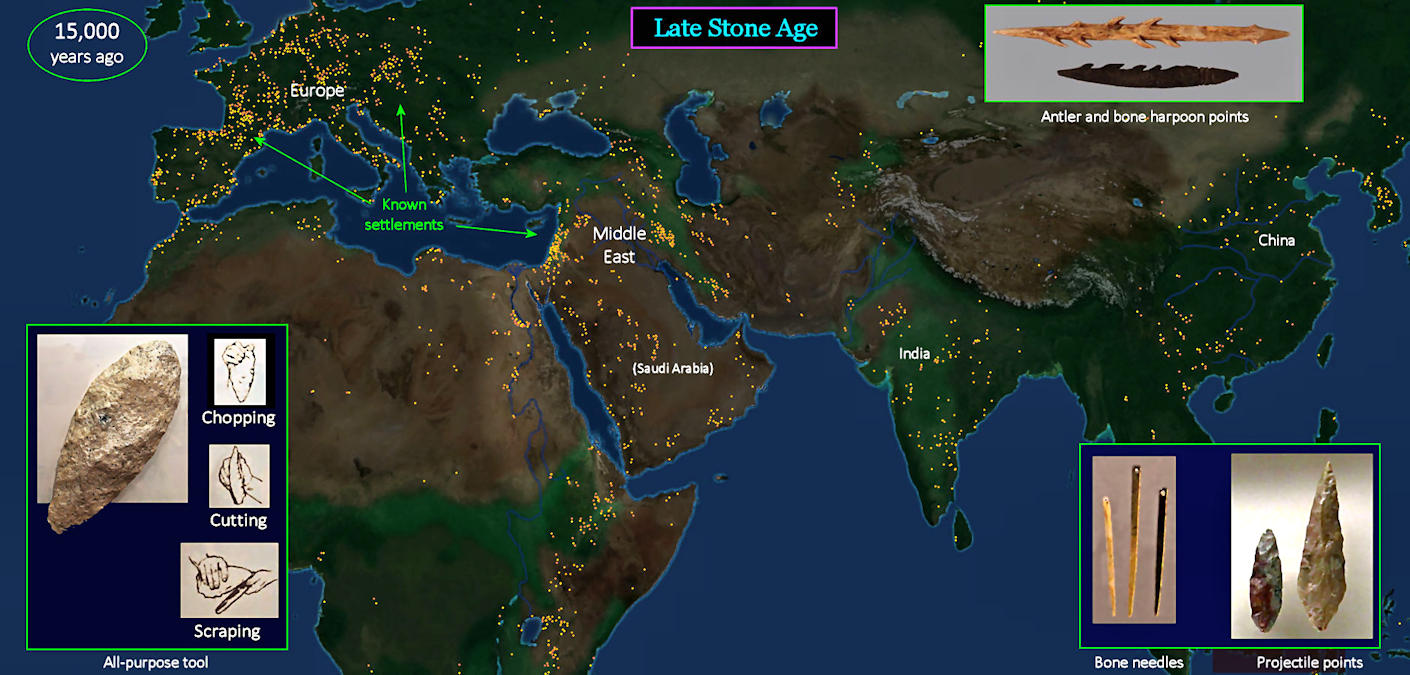
Mature Stone Age We call it the Stone Age because tools and weapons during this period are made from conveniently shaped stones, or bone fragments. Wooden handles are sometimes attached, using animal tendons or ligaments, but hard metals have not yet been discovered. Stone Age humans eventually spread to populate almost all of today's developed world. Regions in Europe and Asia that are densely populated today were relatively well-settled back then. The Middle East was populated early, with settlements spreading far down into what is now the desert area of Saudi Arabia. At that time, there was much more water. The regions that are dark on the map are mostly remote places that are not easily explored. They may contain additional, undiscovered sites. | |||||||||
| |||||||||
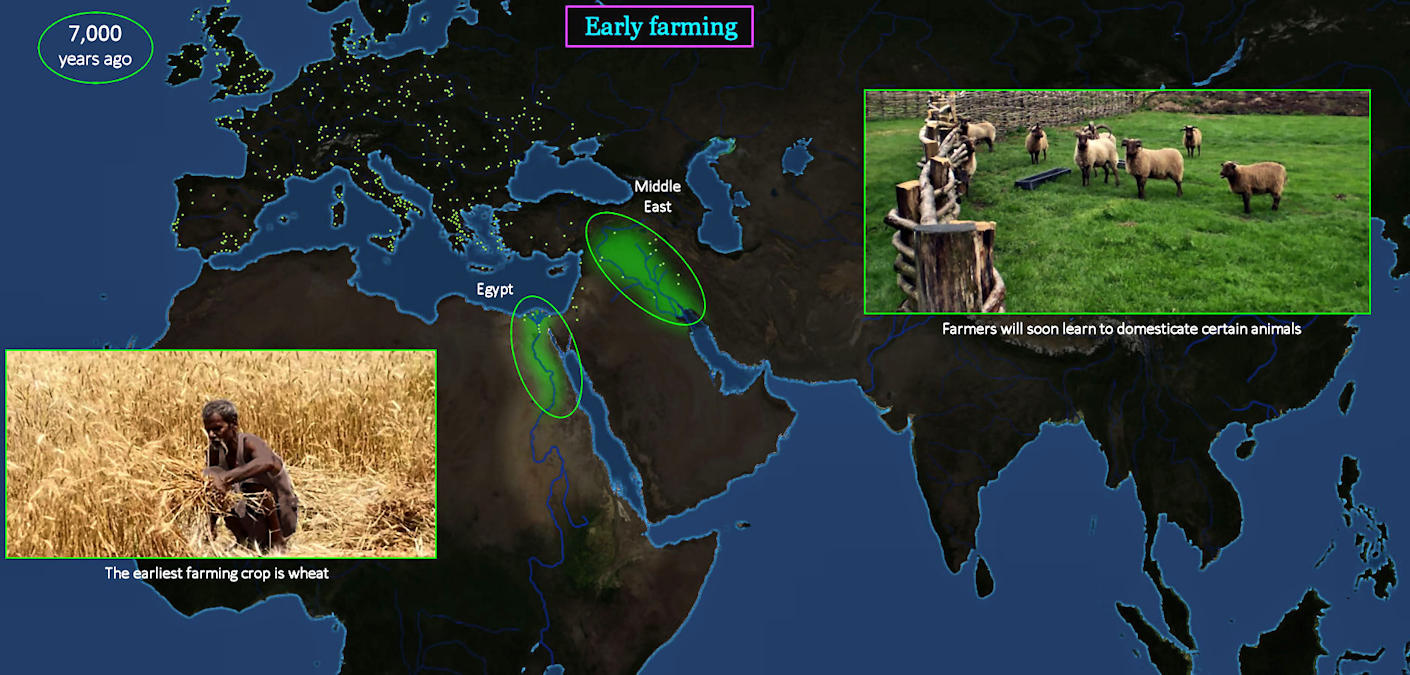
End of the Stone Age There are two major changes which slowly bring the Stone Age to an end. One is the discovery of bronze. The other is the gradual transition away from free-range food gathering. As human population continues to grow, and game becomes harder to find, humans adapt by planting gardens around their huts, and building more permanent settlements. This isn't a decision taken lightly, as farming is much harder work than simply roaming the surrounding woods in search of edible plants and wild game. Farming requires prolonged periods of hard work, with clumsy stone tools. Keeping the plants watered takes more time yet. Areas shown above in GREEN ovals are the first to be planted extensively. They all develop during roughly the same period. | |||||||||
| |||||||||
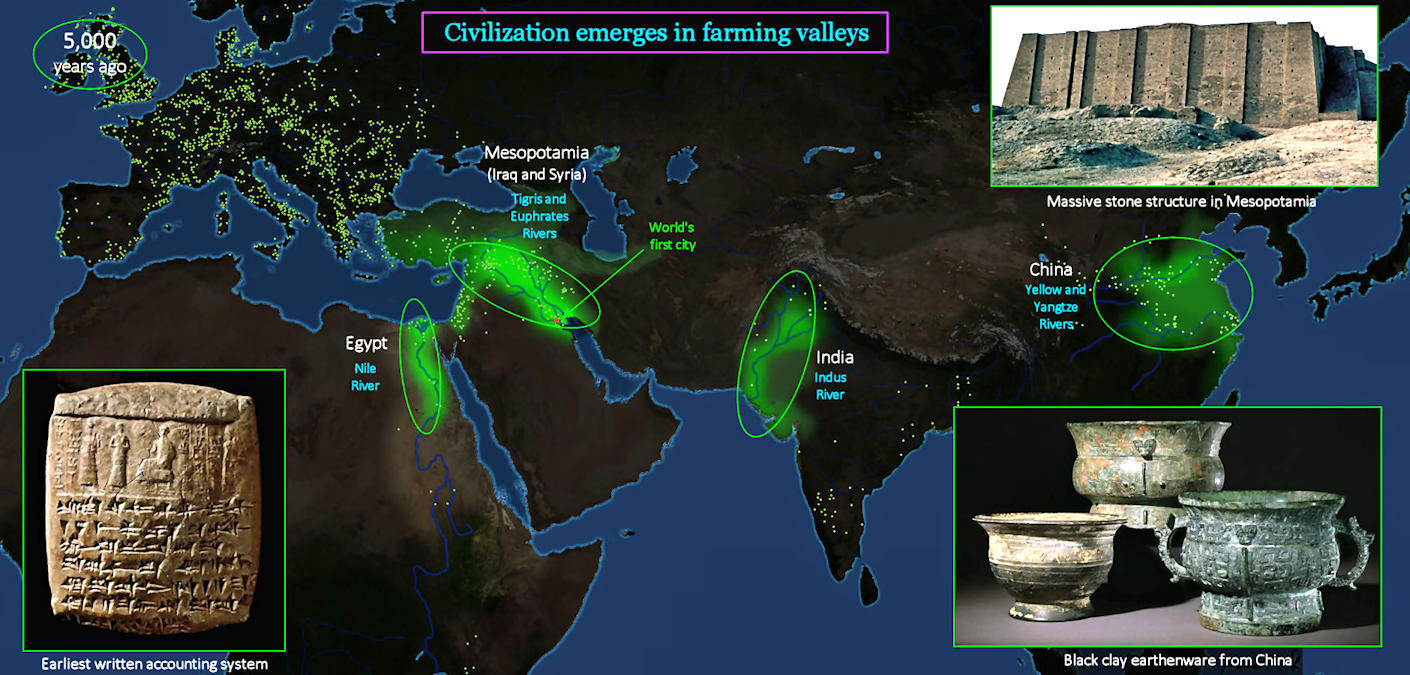
Civilizations Emerge Over time, four great early civilizations begin to emerge. Each is anchored on a major river valley, or pair of valleys. These broad flatlands are well-suited to sustained farming, as periodic flooding renews the soil with fresh nutrients. The growing wealth of these regions supports the emergence of organized governments, which help organize the activity. This fosters the development of the first writing systems, which are needed to register the value of grain stored in local warehouses (lower left). Major flooding is a problem in China, which leads to organized attempts to find a solution to the problem. Only the Indus Valley in India fails to develop a distinctive ruling class. | |||||||||