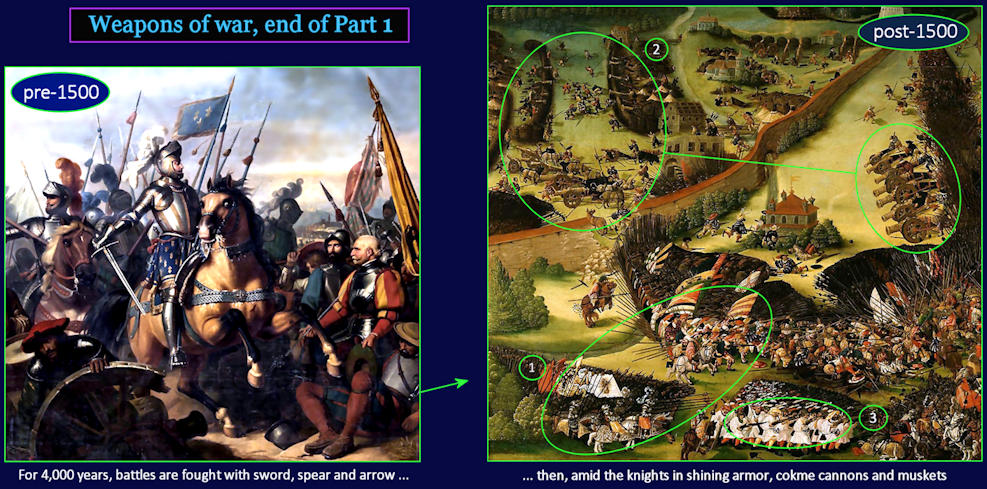
Bronze Age WeaponsIn our modern world of atomic warheads and drone attacks, it seems impossible that humans could have fought for so long, over so many battlefields, with essentially the same few hand-held weapons. Yet it's true. There are, however, a few technological advances along the way. Siege engines are developed to overcome walls, improvements in armor increase survivability on the battlefield, and crude field artillery begins to appear. By 1500, cast-iron cannon barrels are becoming light enough to travel along with the army, and strong enough not to explode when fired. Hand-held firearms are also improving, although still clumsy to load and fire. |
| ||||||||||||||||
| |||||||||
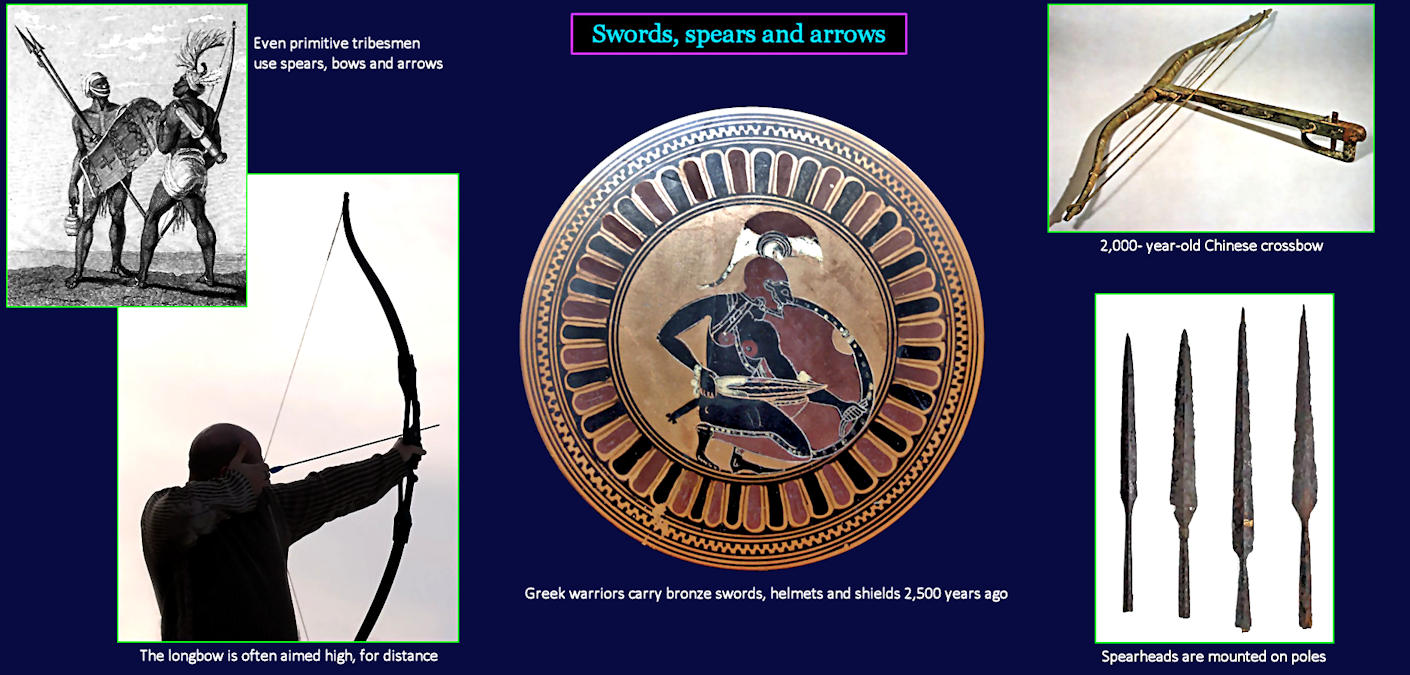
Hand-to-hand Combat The aim of battle is always the same. Kill your enemy before he is able to kill you. Swords are effective for jabbing or hacking at an opponent who is right in front of you, but your chances of survival improve if you can disable him before he gets that close. The two weapons for killing from a distance are arrows and spears, both tipped with a sharp metal point. The longbow and crossbow can impart enough velocity for the point to penetrate body armor, while spears are sometimes hurled for a short distance, as javelins. For the first 4,000 years of warfare, the only other means of launching projectiles through the air are wooden catapults, which hurl stones, and smaller machines that launch big darts. Everything else is vicious hand-to-hand combat. | |||||||||
| |||||||||
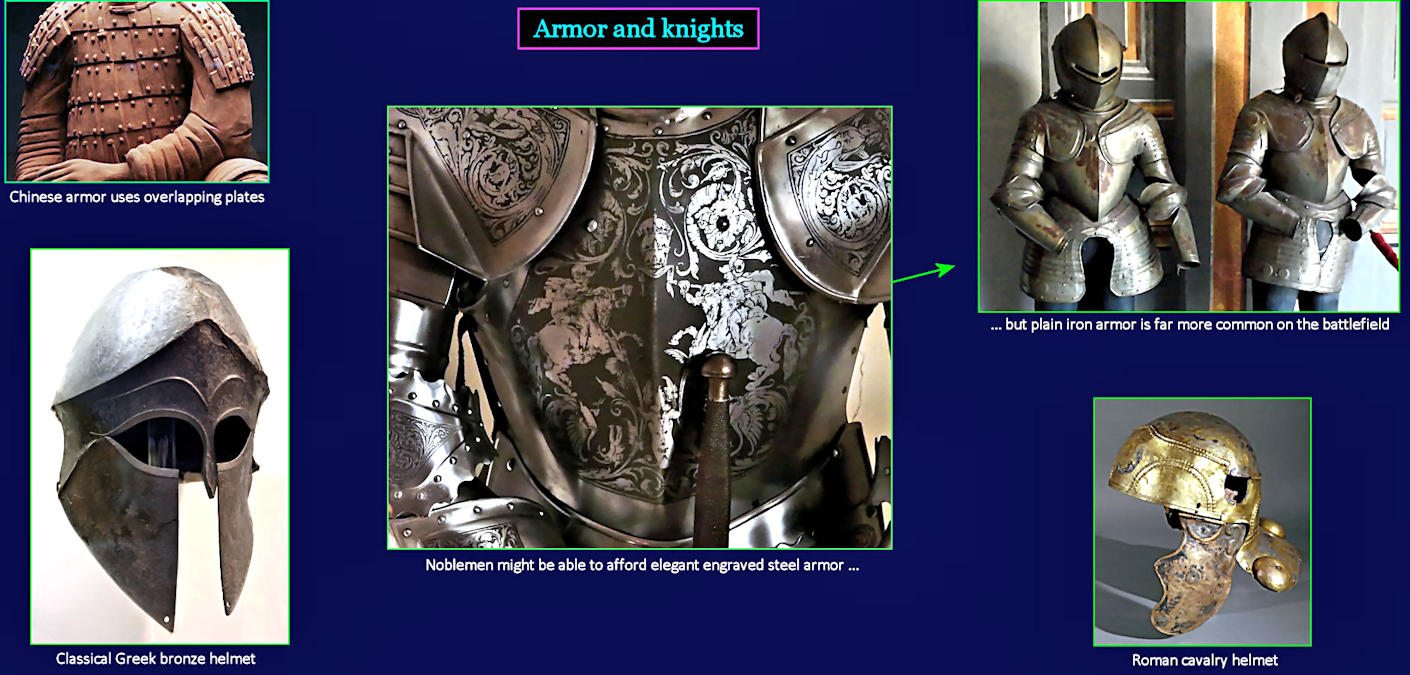
Protective Armor The technology for protection against sharp objects is improved over time. The earliest defensive armor is a simple wood-and-leather, hand-held shield, while body armor begins as padded leather. The Chinese use an array of hard tiles, which are draped over the body in an overlapping array. Metal breastplates, helmets and shields are added later by the Persians, Greeks and Romans, and improved upon during medieval times, as metal-working techniques improve. Armor gradually covers the entire body, and is added to horses as well, to keep a knight in fighting condition. If an army is badly outnumbered, it's usually wise to retreat to the relative safety of a walled enclosure, such as those protecting most cities. | |||||||||
| |||||||||
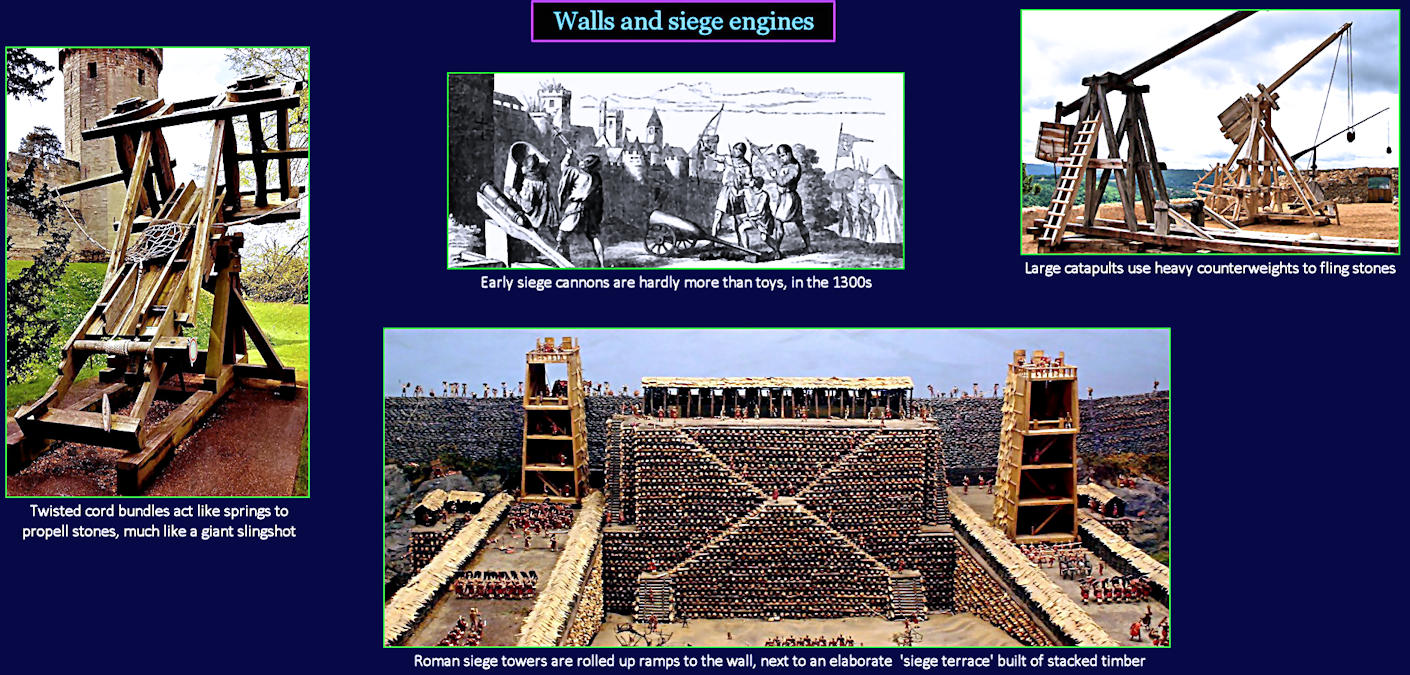
Overcoming Walls For defenders, the best option is often to hide behind stone fortifications. This leads to a long period of warfare when drawn-out sieges are the norm. Defenders try to keep invaders off the walls, and away from the gates, until they can be driven off by a relief force, or simply become discouraged and leave. Attackers have to devise ways to knock down, or get over the walls. The Romans, always master engineers, come up with a surprising array of complicated wooden siege engines to hurl heavy stones, or launch massive arrow-like darts, at the walls. Battering rams are often concealed under rolling siege towers, to bash down gates. | |||||||||
| |||||||||
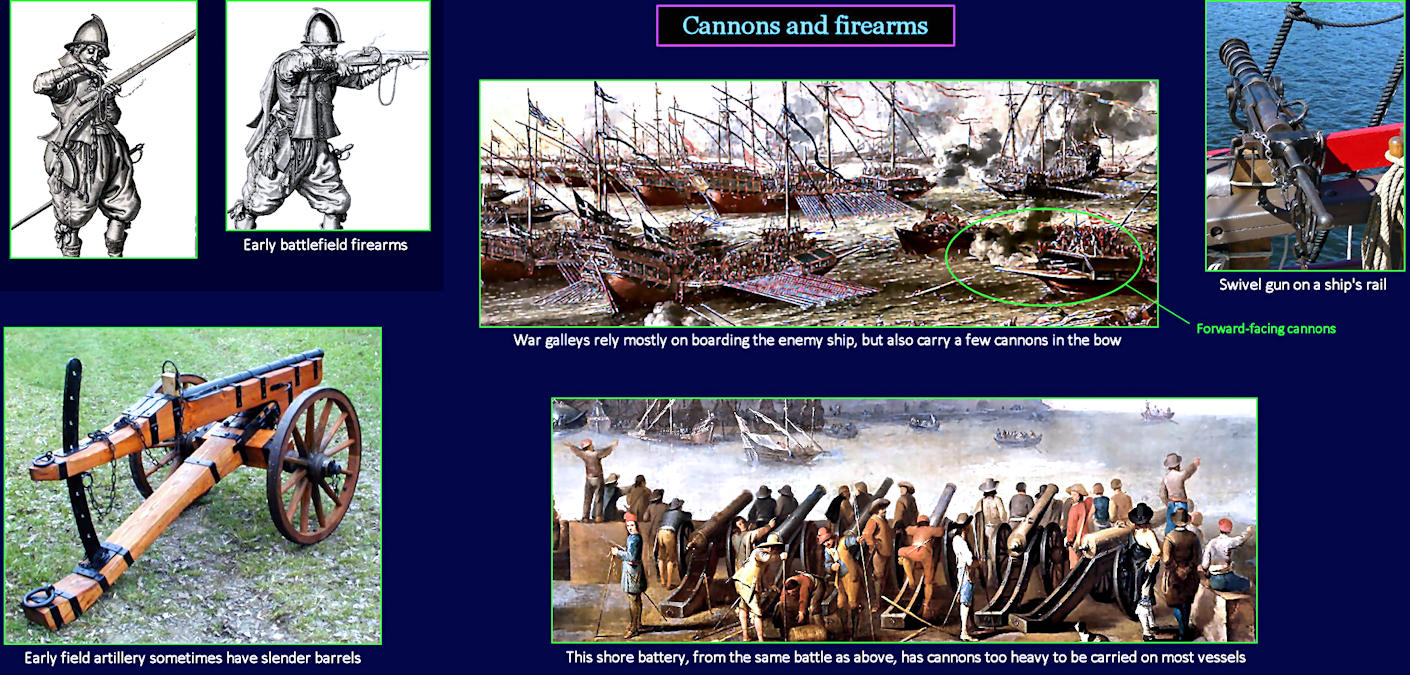
Gunpowder Brings Change Cannons are just beginning to arrive on the battlefield in 1500, after the development of better transport carriages to move them around. Warships often have small swivel-guns mounted on the rail, but larger cannons are generally so heavy that only a few can be carried. War galleys often mount a single large cannon in the bow, with a few smaller ones. Most naval battles are resolved by boarding, not cannon fire. Meanwhile, personal firearms are becoming easier to load and fire. Earlier weapons were ignited using a hand-held piece of slow-burning cord, while newer matchlock muskets hold the cord in a mechanism, operated by a trigger. Still, the cord has to be kept burning while waiting, and after firing. Stick matches have not yet been invented. | |||||||||
| |||||||||
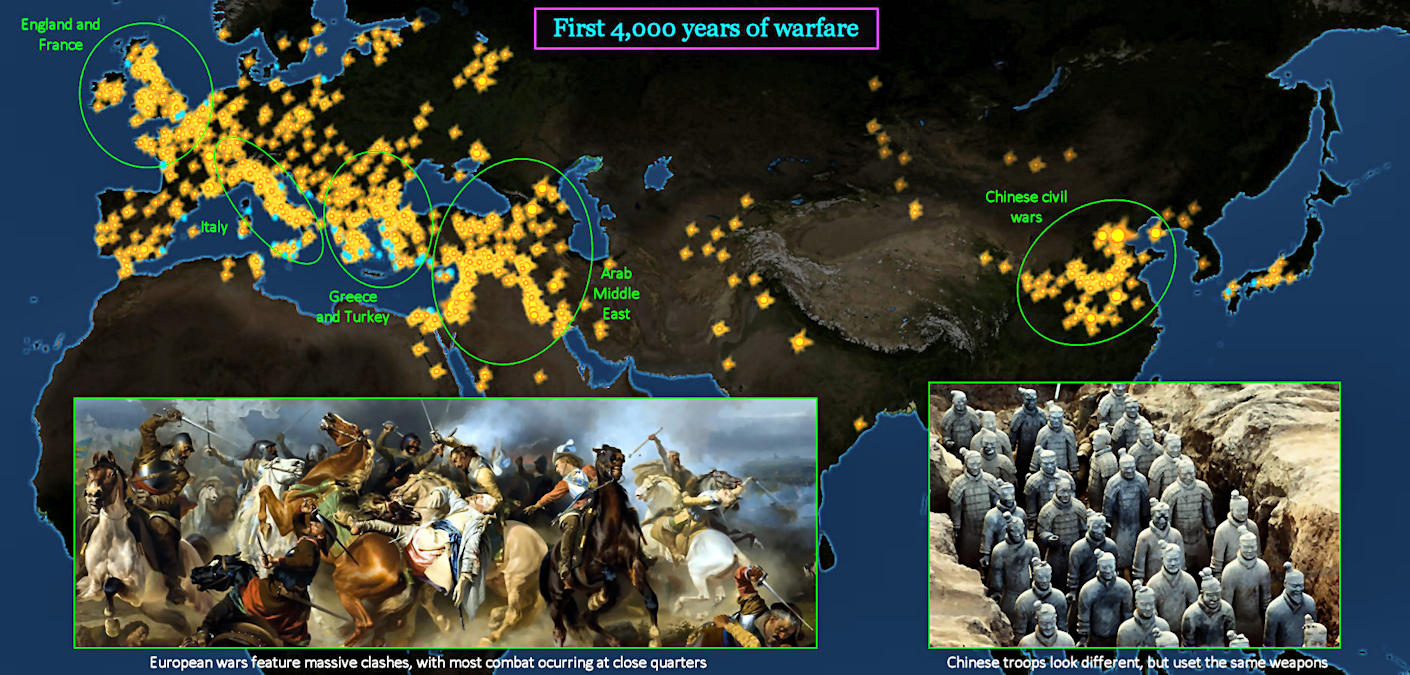
Continuous War This map shows the location of the 2,000 battles that were recorded before the year 1500. Battles were spaced so closely in the five major battleground areas (GREEN ovals), that many had to be plotted on top of earlier battles. Before the Romans, battles averaged about one per year, with the rate dropping by more than half during the years of relative peace under Roman rule. After that, the pace increased rapidly. By the time of the Mongol and Muslim wars, battles were occurring at twice the rate of ancient times, before subsiding back again. During the entire 4,000 years, the weapons of war barely changed at all. Afterwards, gunpowder allowed projectiles to be fired accurately over much greater distances, with much more power. | |||||||||