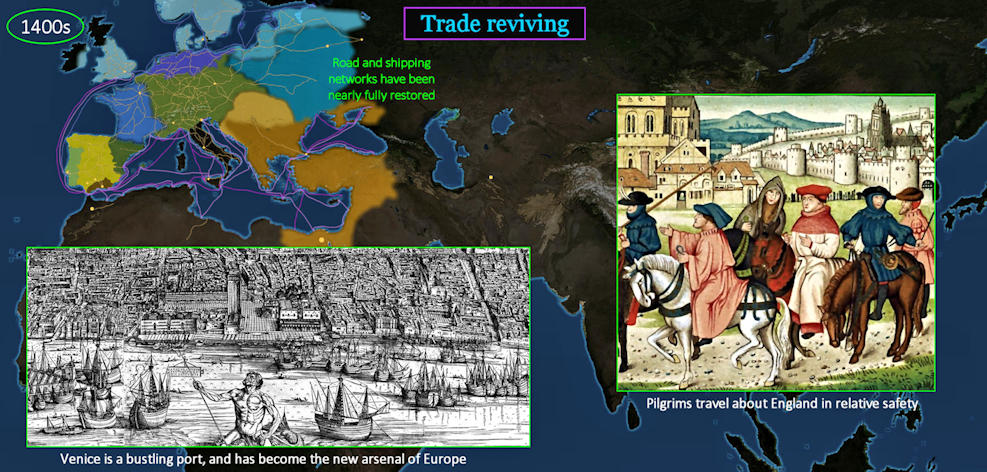
Expanding EmpiresThe period is shaped by the growing power of two aggressive empires. In the East, the Turks are again on the march, this time under a new set of Muslim rulers. In the West, Spain is suddenly rising as a new power. Spain has lucked into the discovery of vast silver and gold deposits in colonies they establish in Mexico and Peru. These are opened up by the discoveries of Columbus, and the Spanish Conquistadors that follow. At the same time, religion is suddenly coming to the forefront of history. The struggle between Christianity and Islam has shifted in favor of Islam, while Christianity itself is split in two by the Protestant Reformation. |
| ||||||||||||||||
| |||||||||
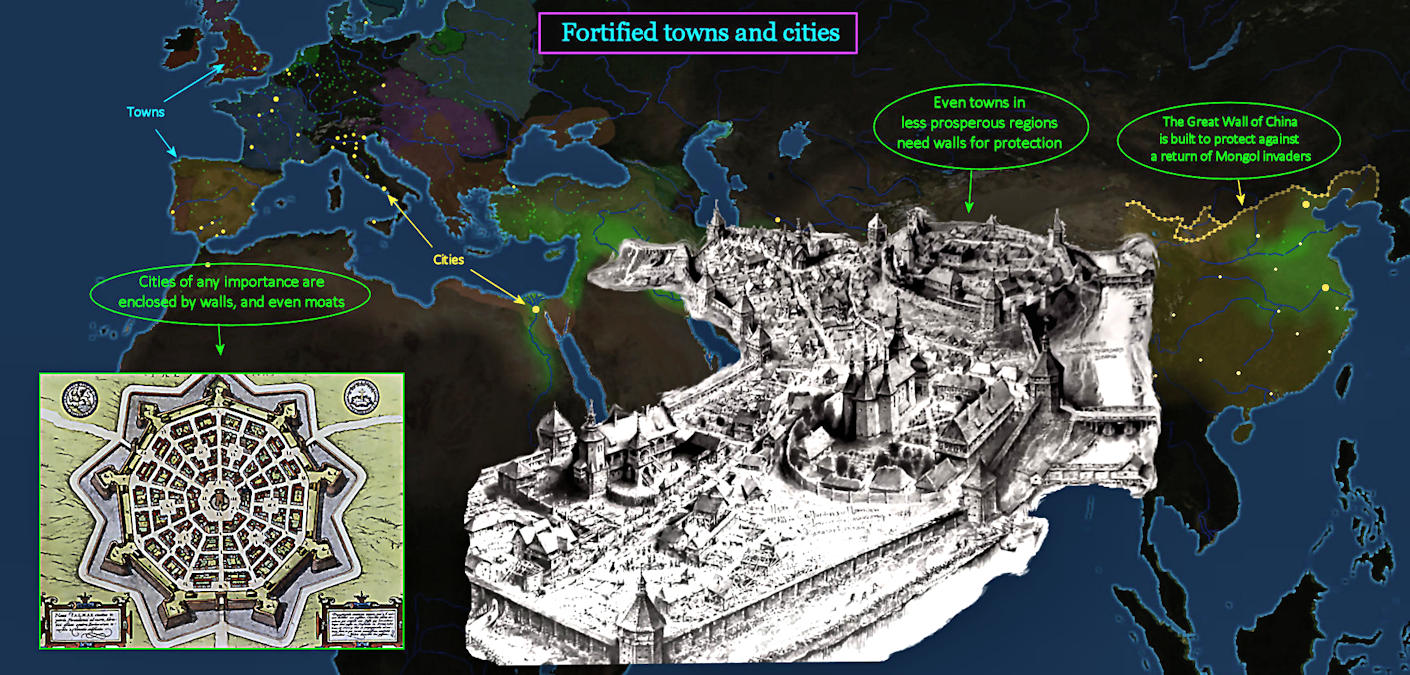
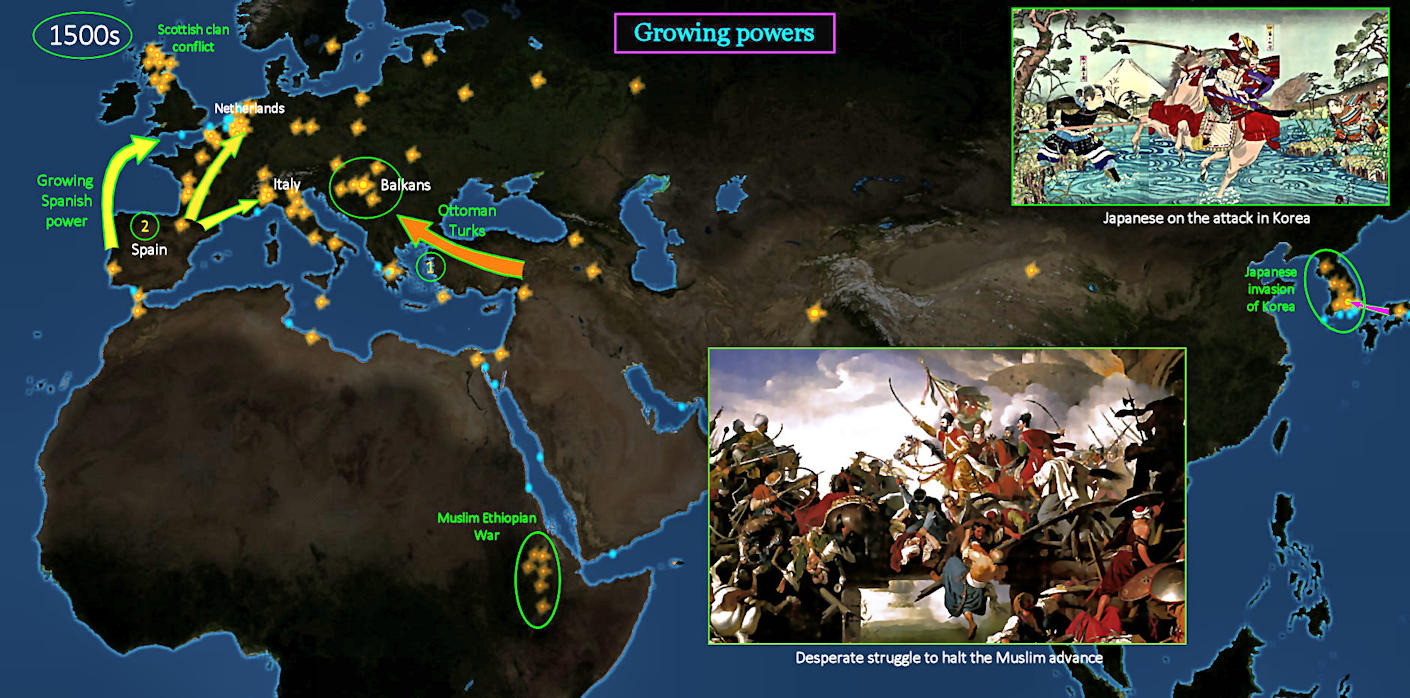
Cities and Towns Prior to 1400, almost all of the world's important cities were located in the Middle East, Egypt and China. The only cities of comparable importance in Europe are the capitals of Constantinople, Rome, Carthage and Paris. Even London has barely 50,000 residents. With the re-emergence of shipping networks in northern Europe during the 1400s, however, real cities begin to emerge at many strategic crossroad locations. The YELLOW dots above mark the location of cities with more than 30,000 residents. Each is fortified to some extent, and almost all have been subject to at least one siege, many to several. In addition, there are a growing number of towns with a few thousand residents each (faint BLUE dots). Many of these also have walls. | |||||||||
| |||||||||
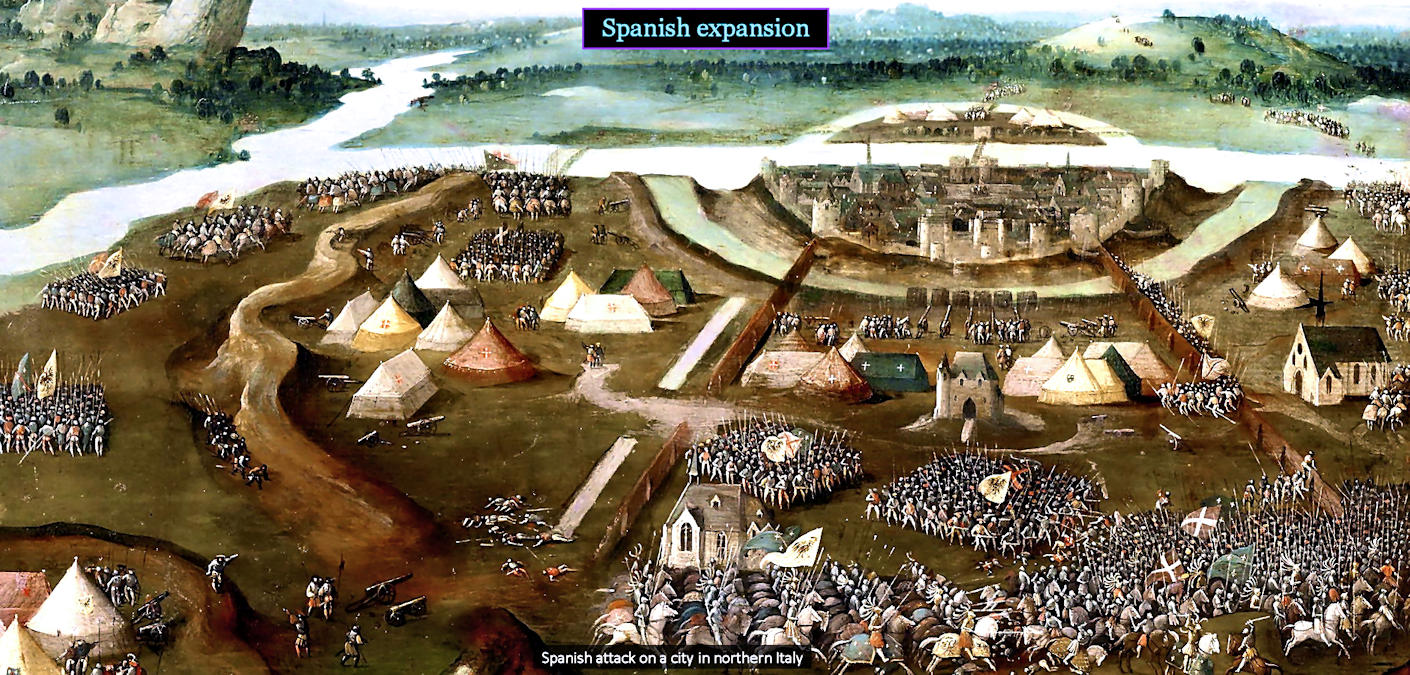
Ottoman and Spanish Power This map shows activity that dominates the 1500s. The Ottoman Turk advance is a continuation of the epic feud between Christian and Muslim powers, which began 800 years earlier. By this time, however, the battleground has shifted far to the north, threatening Central Europe. The Turks now control all of the Balkans, which is the region between Turkey and Central Europe (1). The other power competing for attention is Spain, which previously played little role in European affairs. Spain is growing in influence due to the sudden flood of gold and silver arriving in Spain from its colonies in Mexico and Peru. This allows Spain to simultaneously oppose France, exert control in Northern Italy and the Netherlands, and even attempt an invasion of England (2). | |||||||||
| |||||||||
Spanish Adventurism It has often been said that money and power are two sides of the same coin. There is no clearer example of this than the sudden emergence of Spain as a European power, as soon as seeming limitless wealth begins pouring in from Spain's American colonies. This comes with almost no effort, as the silver mines in Mexico and Peru are worked by indigenous slaves. The only cost is outfitting the immense fleets needed to transport all that wealth back home, The new income supports Spain's war against its former staunch Catholic ally, France, and its oppressive occupation of Belgium and the Dutch homeland. It also pays for the great, ill-fated Spanish Armada sent to invade England, and finally put a stop to sporadic English raids on its treasure fleets. | |||||||||
| |||||||||
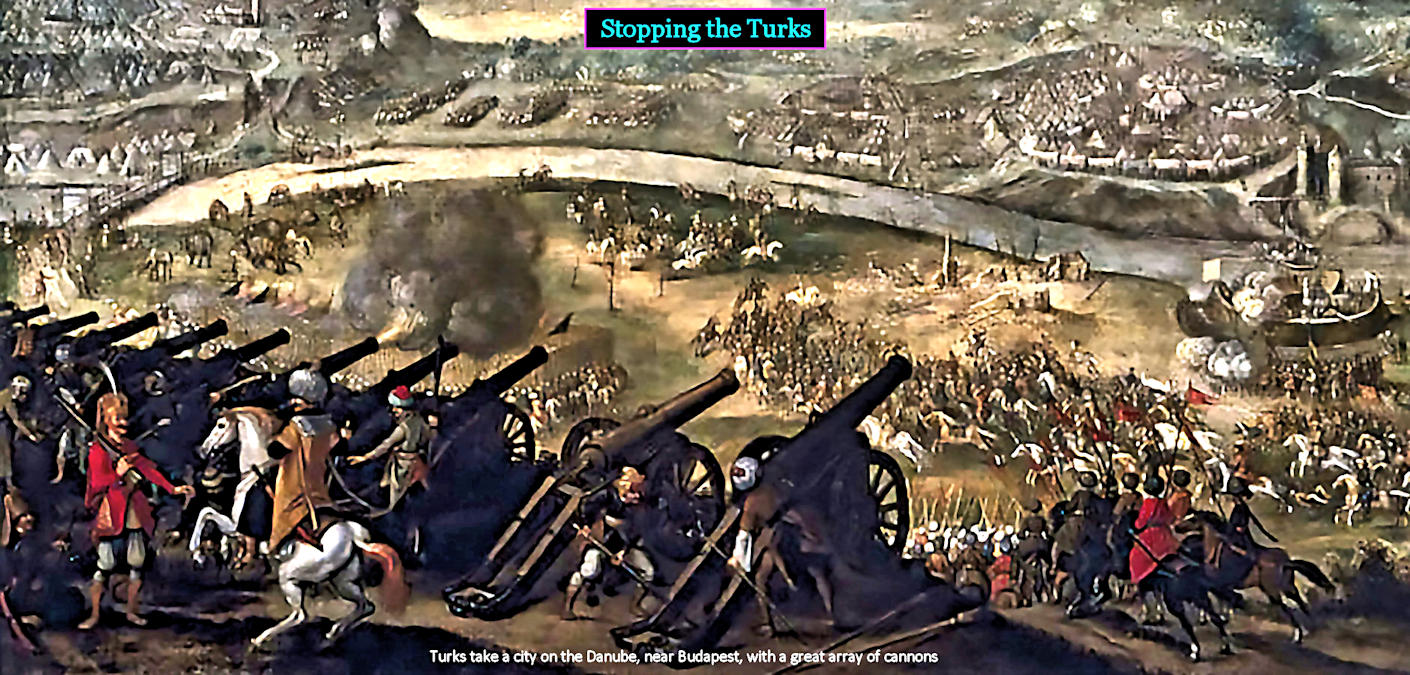
Renewed Muslim Threat By 1500, the threat from aggressive Turks to the south is again raising tensions. The Ottoman Turks, a new strain, have pushed through Constantinople into Bulgaria, to again threaten the survival of Christianity. They reach the Danube River by the mid-1400s, establishing a base at Budapest that will remain a potent threat for the next 150 years. The Danube leads directly to Vienna, just 160 miles upriver, so the threat is substantial. The Ottomans bring with them big new cannons, which render even stout city walls vulnerable. These are mounted on an improved wooden gun carriage, so they can be moved about the battlefield where needed, instead of remaining in mostly stationary defensive positions. | |||||||||
| |||||||||
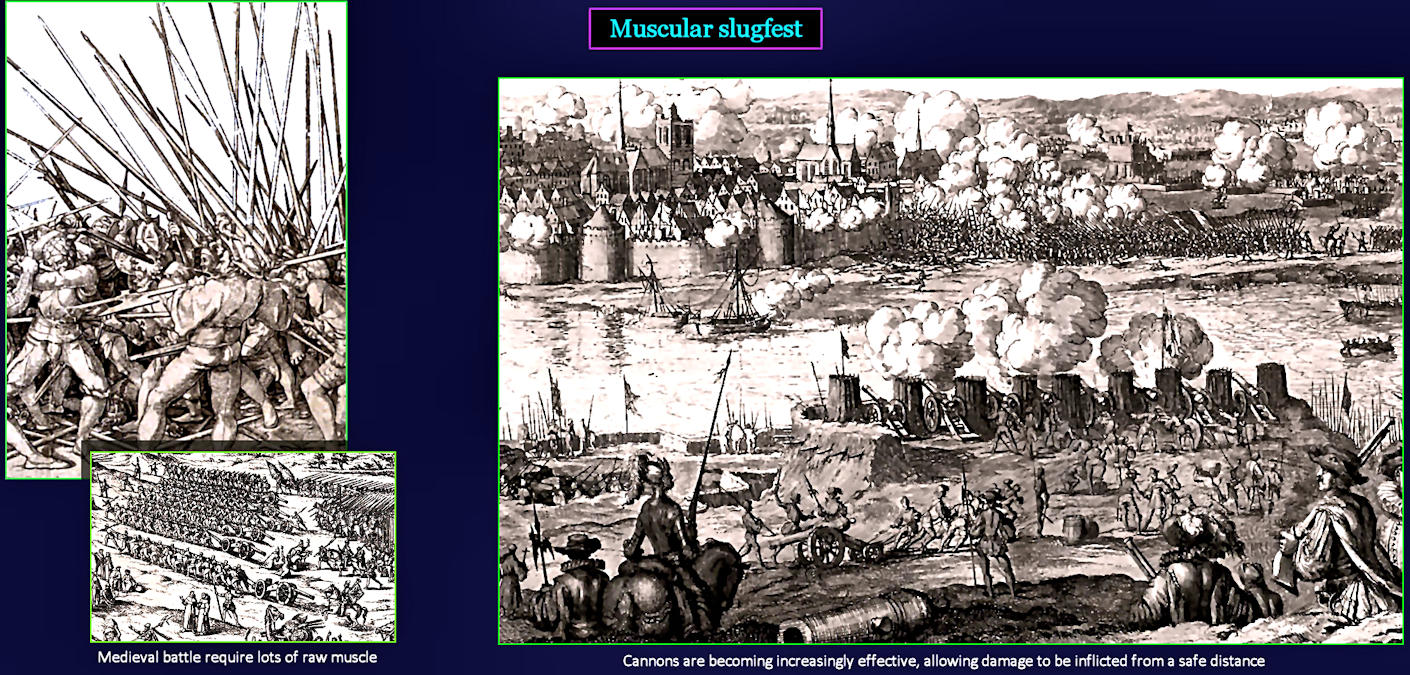
Field Artillery The growing presence of field artillery and hand-held firearms on the battlefield will eventually change warfare forever. But the change is gradual. The battles of the 1500s still require plenty of close-quarter struggle, where muscle-power is still dominant. Soon enough, however, volleys of musket fire from across a field will replace the clash of pikemen against infantry, and cavalry against cavalry. Sea warfare is changing at the same time. The great naval engagements of the 1400s are a tangle of galleys maneuvering for a position to board the enemy. Later naval engagements will be settled by broadsides of great 24-pounders and 32-pounders, arrayed on multiple gun decks of individual ships possessing the firepower of an entire army. | |||||||||