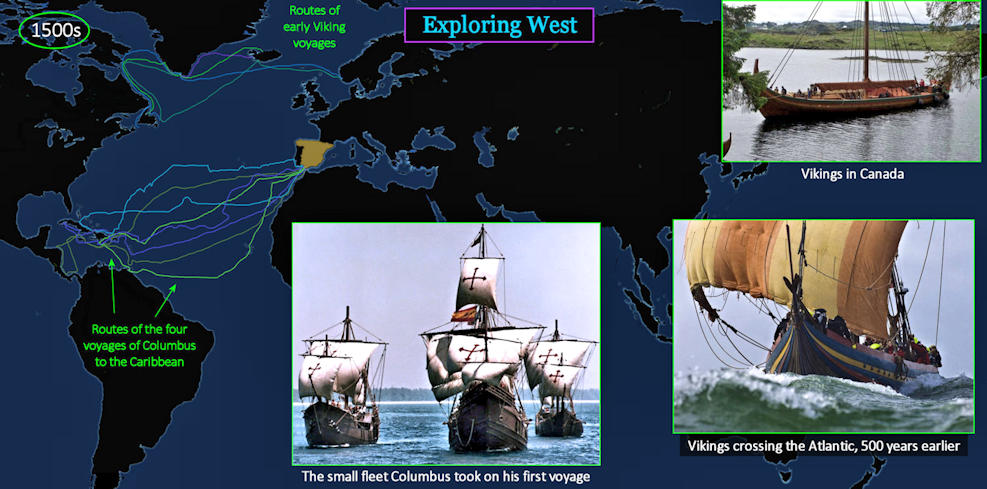
Going the Opposite WaySea captains have known for a long time that the world isn't flat. How else can you explain the obvious fact that you can only see the tops of the masts of ships, at first, as they approach port from the open sea? Columbus just happens to be born at a time when people have learned how to build sailing vessels large enough to manage open-ocean crossings. This includes enough stowage space to hold provisions for an extended voyage. The Vikings proved the concept of sailing west, 500 years before Columbus. They used a very different kind of vessel, which was longer but shallower, and completely lacking in stowage (or even sleeping space) below deck. |
| ||||||||||||||||
| |||||||||
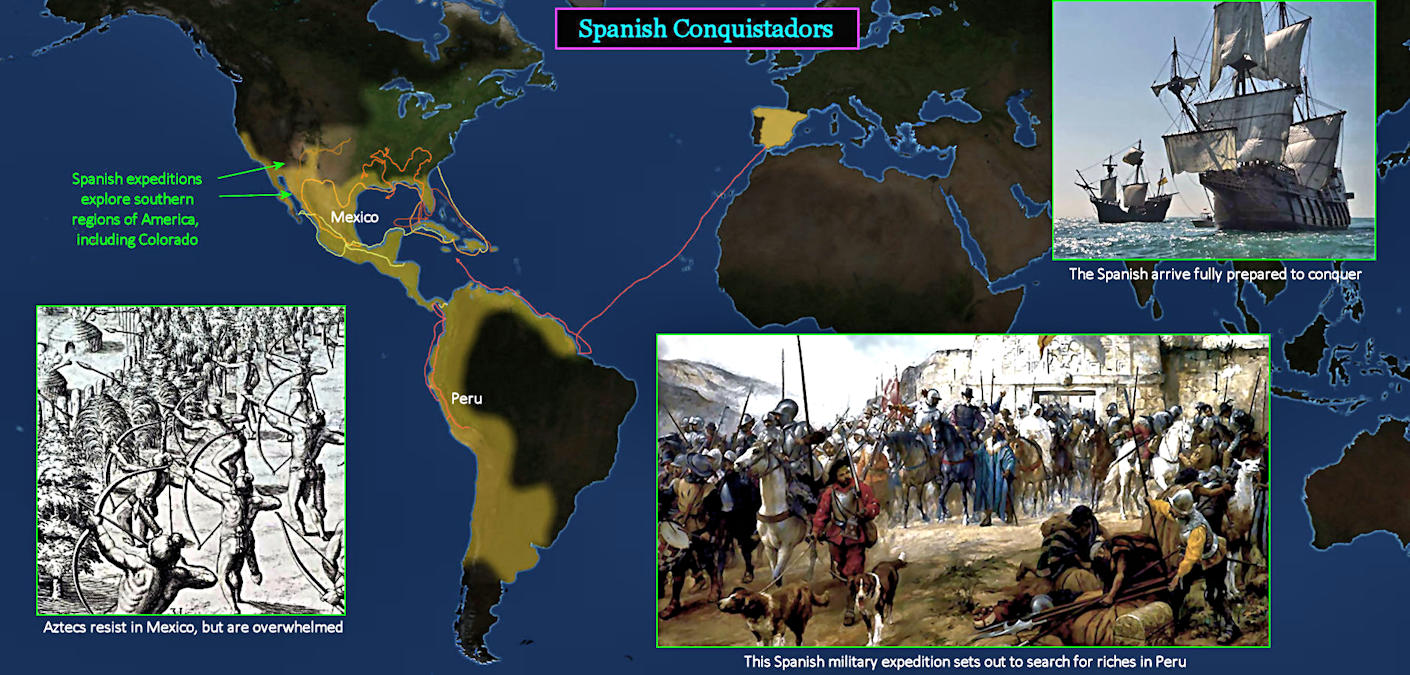
Spanish Military Conquest The Spanish are the first Europeans to establish overseas colonies in the Americas. This is due to the head start provided by Columbus, who was funded by Spanish rulers. When returning from his voyages, Columbus keeps talking about gold, though he never provides much evidence. But he is soon followed by Spanish expeditions that do find huge deposits of precious metals. This is the result of careful military preparations. Unlike thinly-funded English and French explorers, the Spanish send fully-armed expeditions, with armored troops, cannons and cavalry. When they find gold, in the region around present-day Mexico City, they ruthlessly slaughter to exploit it. They call themselves 'Conquistadors' because they come to conquer, not merely settle. | |||||||||
| |||||||||
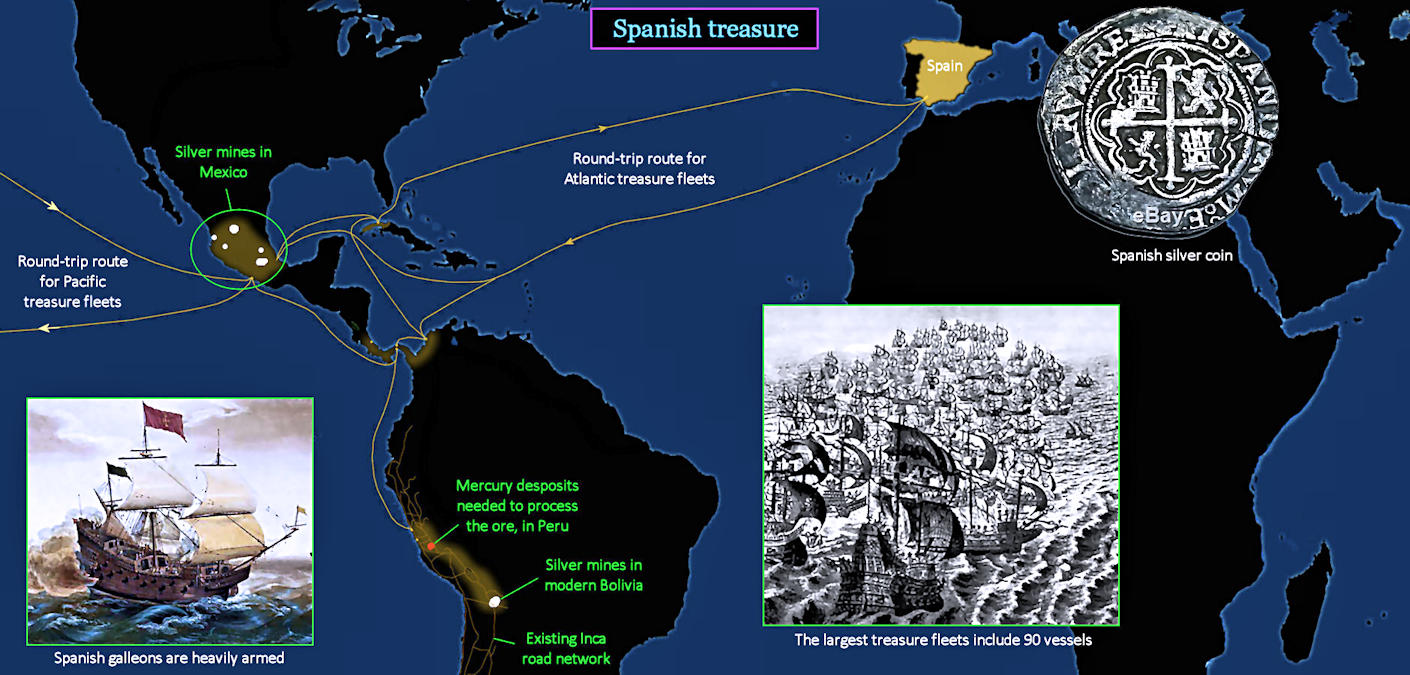
Treasure Fleets By the mid-1500s, the Spanish are sending regular twice-yearly fleets back to Spain, loaded down with gold and silver. In later years, it's mostly silver. The galleons they develop are massive by standards of the day, eventually equipped with two gun decks (lower left). For further protection, they sail in great convoys, to deter both pirates and enterprising English vessels, which sometimes attempt to grab some of the loot. There are actually two trans-oceanic routes for the Spanish galleons. One operates across the Atlantic to Spain, the other across the Pacific to the Philippines. This is because much of the silver comes from Peru (today, Bolivia), which is on the Pacific side, and is more easily shipped from Pacific ports. | |||||||||
| |||||||||
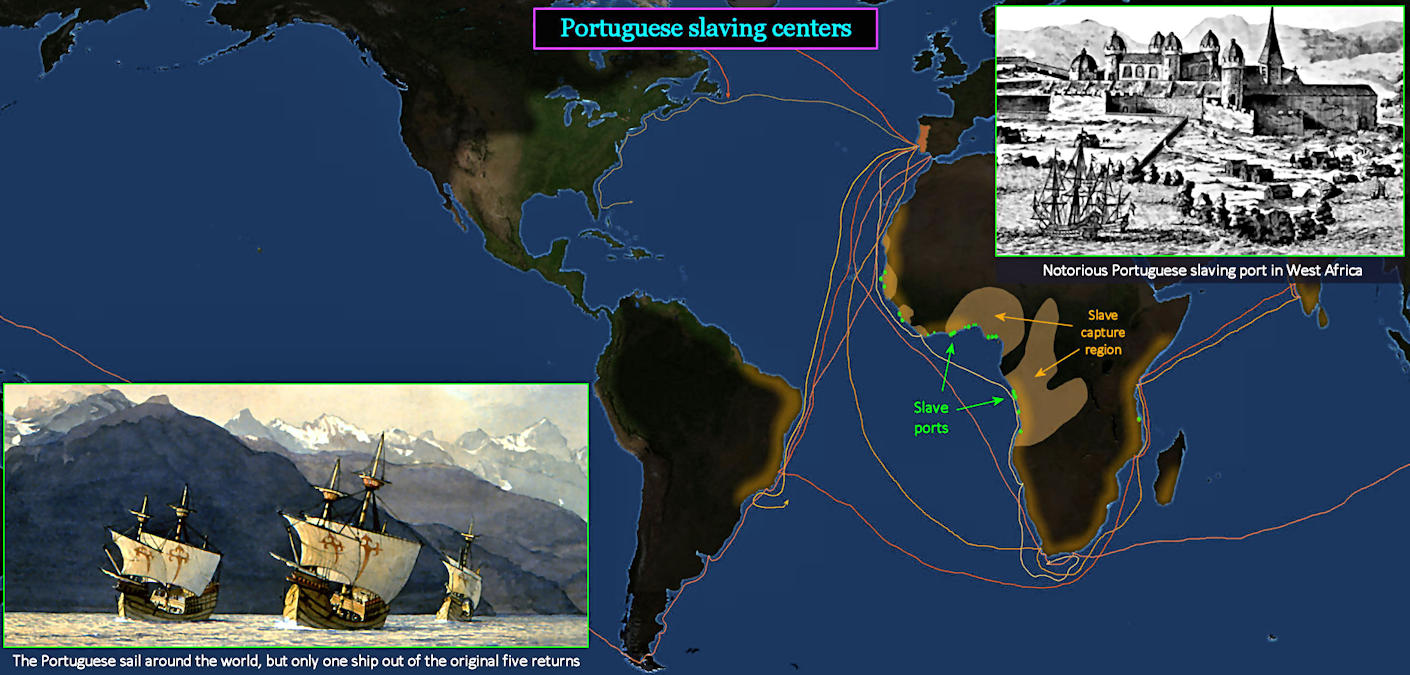
Portuguese colonies The Portuguese concentrate on the route they pioneered around the tip of Africa, to develop a spice trade in India and modern Indonesia. Due to seasonal wind patterns, they sometimes sail to Brazil before continuing east. But Africa itself offers tempting opportunities. The Arabs are already operating a brisk trade transporting Africans north to Europe, as slaves. Both Rome and Constantinople exhibited a robust demand for slaves, which persists after the Romans are gone. The Portuguese eventually establish an impressive array of trading sites all the way around the African coast. Profits from these ports continue long after the Portuguese lose the spice trade to the English and Dutch, during the 1600s. | |||||||||
| |||||||||
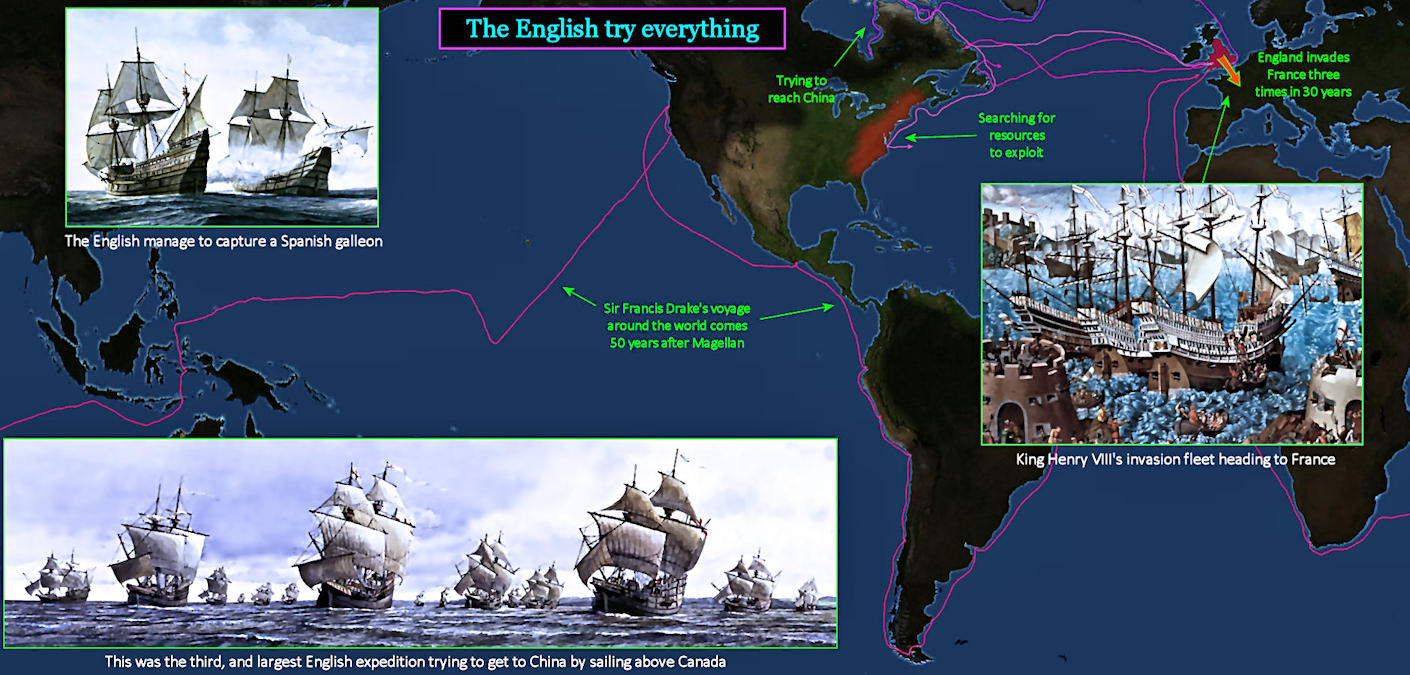
English Exploration The English are comparatively late to the game of colonization, partly because England has been consumed with struggles between Catholics and Protestants. It has only recently been unified under the rule of the Henry VIII and his daughter, Queen Elizabeth, who is keen to share some of the good fortune the Spanish are enjoying. The English are better seamen than their Spanish counterparts, and England gradually begins to exert a strong influence over European affairs. Still, English exploration in America is limited to areas well north of the Spanish colonies. The English spend a good deal of effort looking for a route to Asia above Canada, called the Northwest Passage. No such route is ever found practical, however, due to persistent sea ice. | |||||||||
| |||||||||
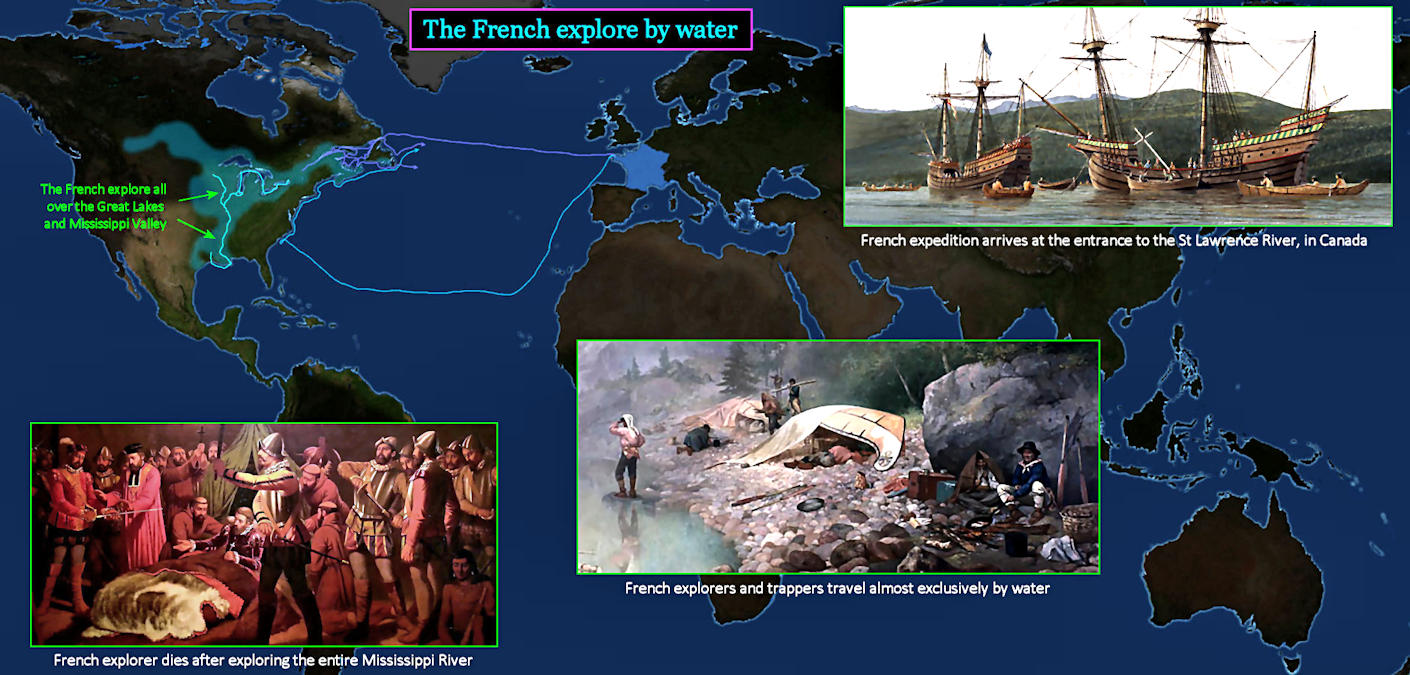
French Explorers The French pursue an altogether different strategy. Unlike the Spanish, who establish mining operations, or the English, who experiment with various land development schemes, the French mainly follow rivers and lakes that reach far into the interior. The French don't seem to be much interested in establishing colonies, preferring instead to extract beaver furs. This is as an export product that requires little investment or management. The lack of settlers eventually leads the French to lose control of the land they explore. This includes claims to the entire Mississippi and Missouri River valleys, which they later sell to finance military conquest in Europe. | |||||||||