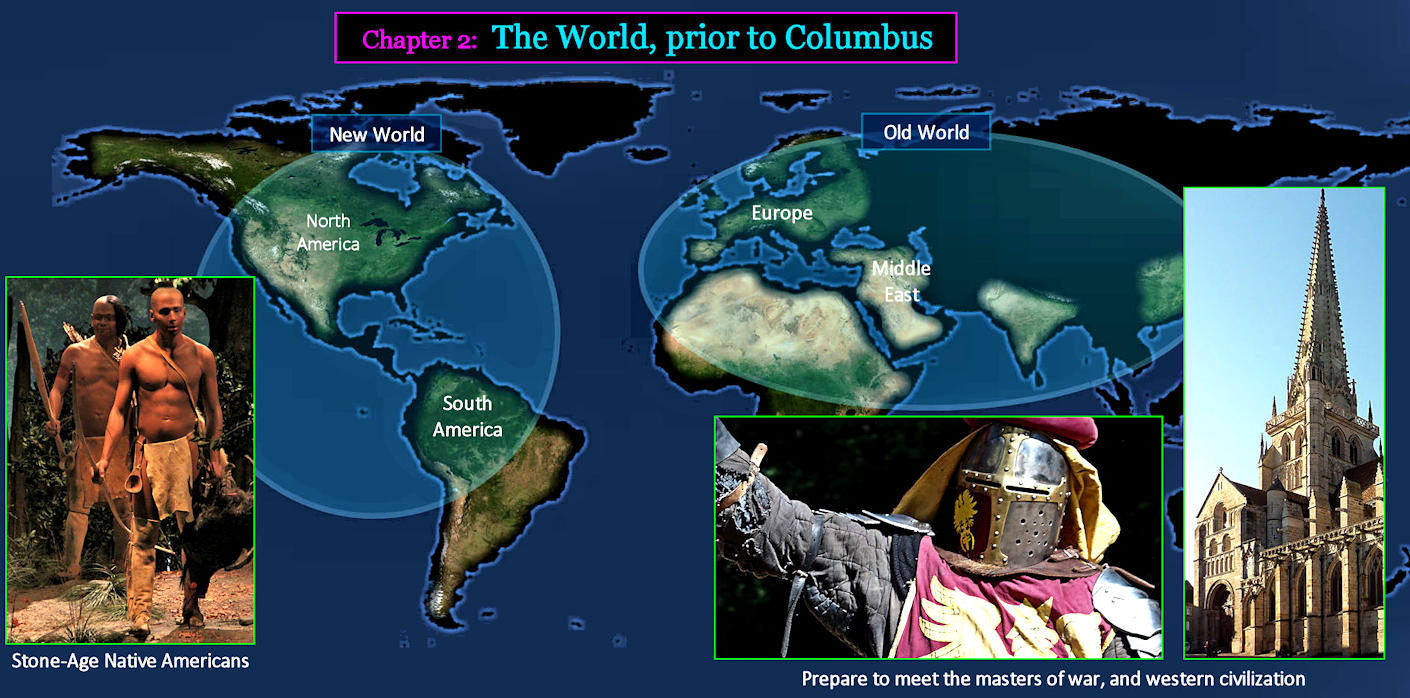
Human MigrationsWhen Columbus accidentally bumps into America (while believing he has actually reached India) he encounters strange dark-skinned people living here, whom we assumes must be 'Indians.' He is wrong, but the name sticks. Like Europeans, these American Indians are descendants of early humans, who originated in Africa, but then spread slowly all over the globe, arriving at America last of all. As a result, Indians are far less advanced than Europeans. Indian developed their own civilizations, but none that rivaled those in Europe, or China. Most importantly, Indians never discovered how to extract iron or bronze, and therefore lacked tools and weapons made of metal. |
| ||||||||||||||||
| |||||||||
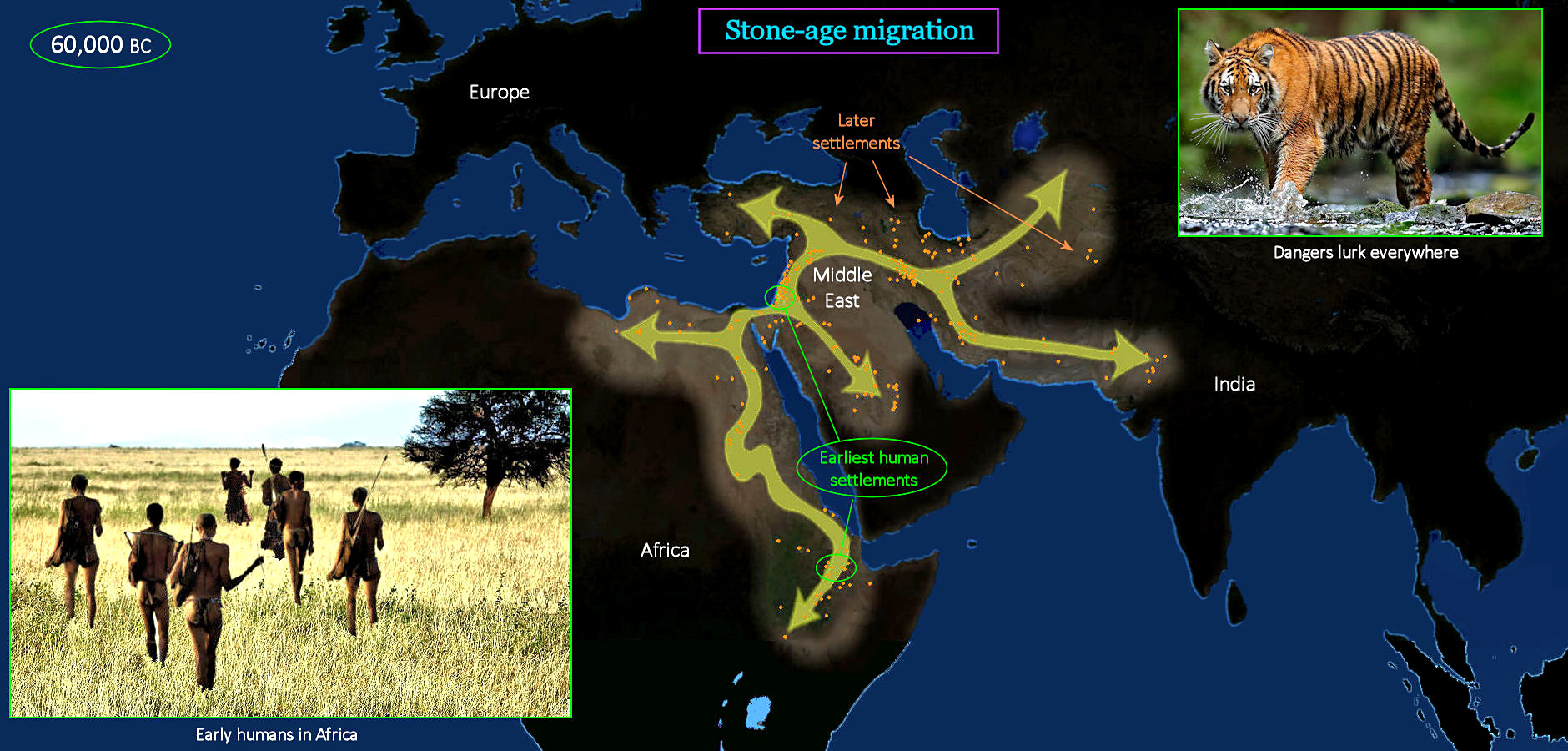
Humans Spread Indians that oppose the first European arrivals have been living on the continent for perhaps 20,000 years. This is at the tail end of the stone-age, after humans have already spread across the rest of the Old World. No one knows exactly where, or when, the first humans appeared on earth, because the evidence they left behind is surprisingly scanty. The oldest known settlements are located in East Africa and the Middle East (GREEN OVALS above), dating back perhaps 200,000 years. The smaller ORANGE dots indicate stone-age settlements that are at least 60,000 years old. The pattern of settlement suggests that humans possess a natural tendency to spread out in all directions. European colonists arriving in America will expand in a similar manner. | |||||||||
| |||||||||
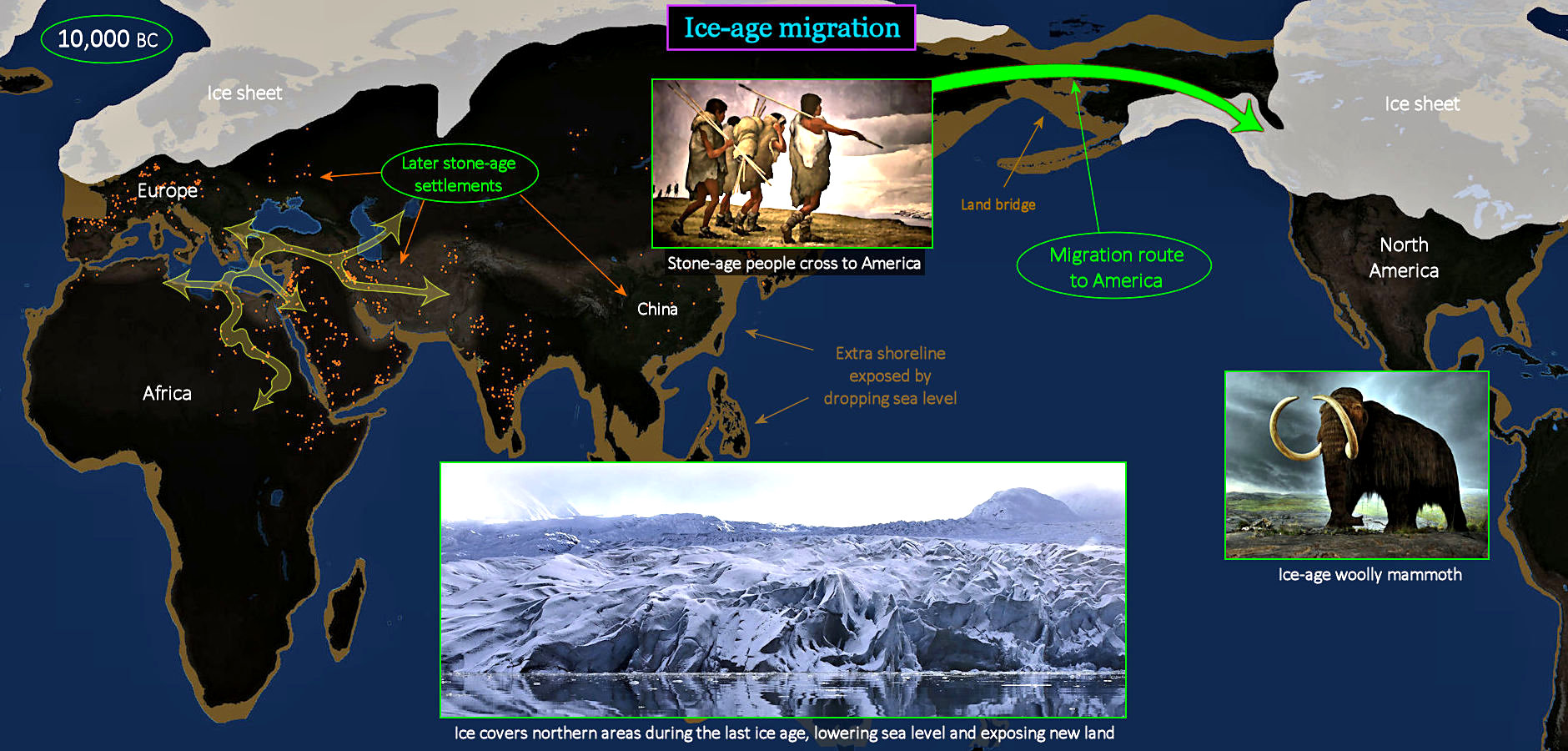
Land Bridge to America The ORANGE dots on this map indicate the extent of stone-age settlements at the time the earliest ancestors of the Indians first arrive in America. This is at the end of the last Ice Age, when huge sheets of ice cover vast northern regions of the earth (shown in WHITE). Amazingly, these immense glaciers are a mile or two thick, top-to-bottom. With so much water locked up in ice, sea level all over the world drops by several hundred feet. This uncovers new land extending far out from the previous shoreline (shown in BROWN, above), which includes a new pathway to America. Humans begin to cross over this new 'land bridge' about 20,000 years ago (large curved GREEN arrow). This bridge disappears when the ice sheets finally melt, and sea level rises again. | |||||||||
| |||||||||
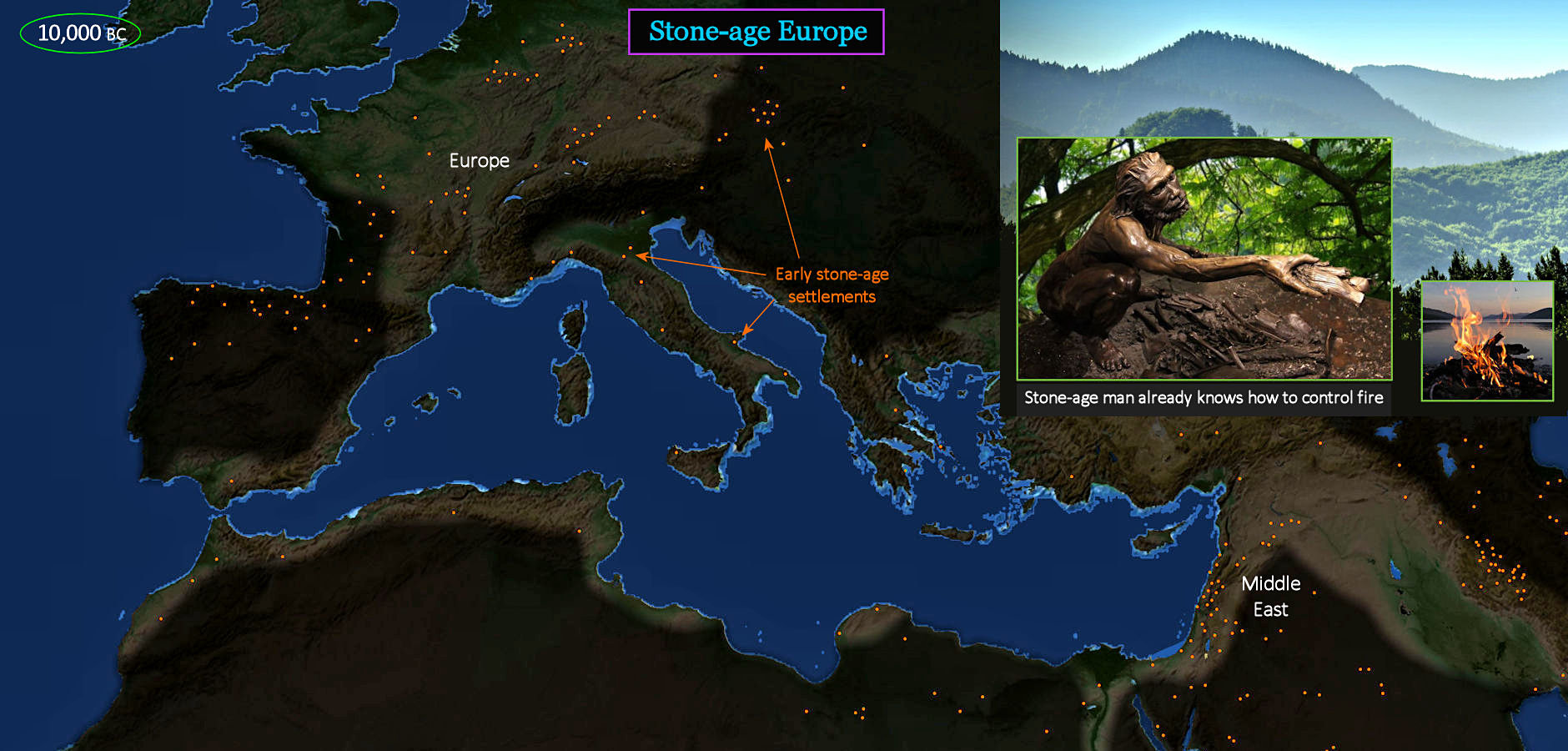
Simple Beginnings This is Europe just before the discovery of bronze, which brings an end to the Stone Age in Europe. The name 'Stone Age' does not mean that people during this period actually live in stone caves, though a few do. Rather, it denotes the period when tools are mostly made from stones. Some are also made of bone or horn, and might be lashed to crude wooden handles with lengths of animal sinew. ORANGE dots mark the location of primitive stone-age settlements, which are often not much more than a fire pit surrounded by a few huts, with a nearby rubbish dump. Scientists can date such sites by analyzing the bits of stone and bone still remaining when they are discovered and dug up. | |||||||||
| |||||||||
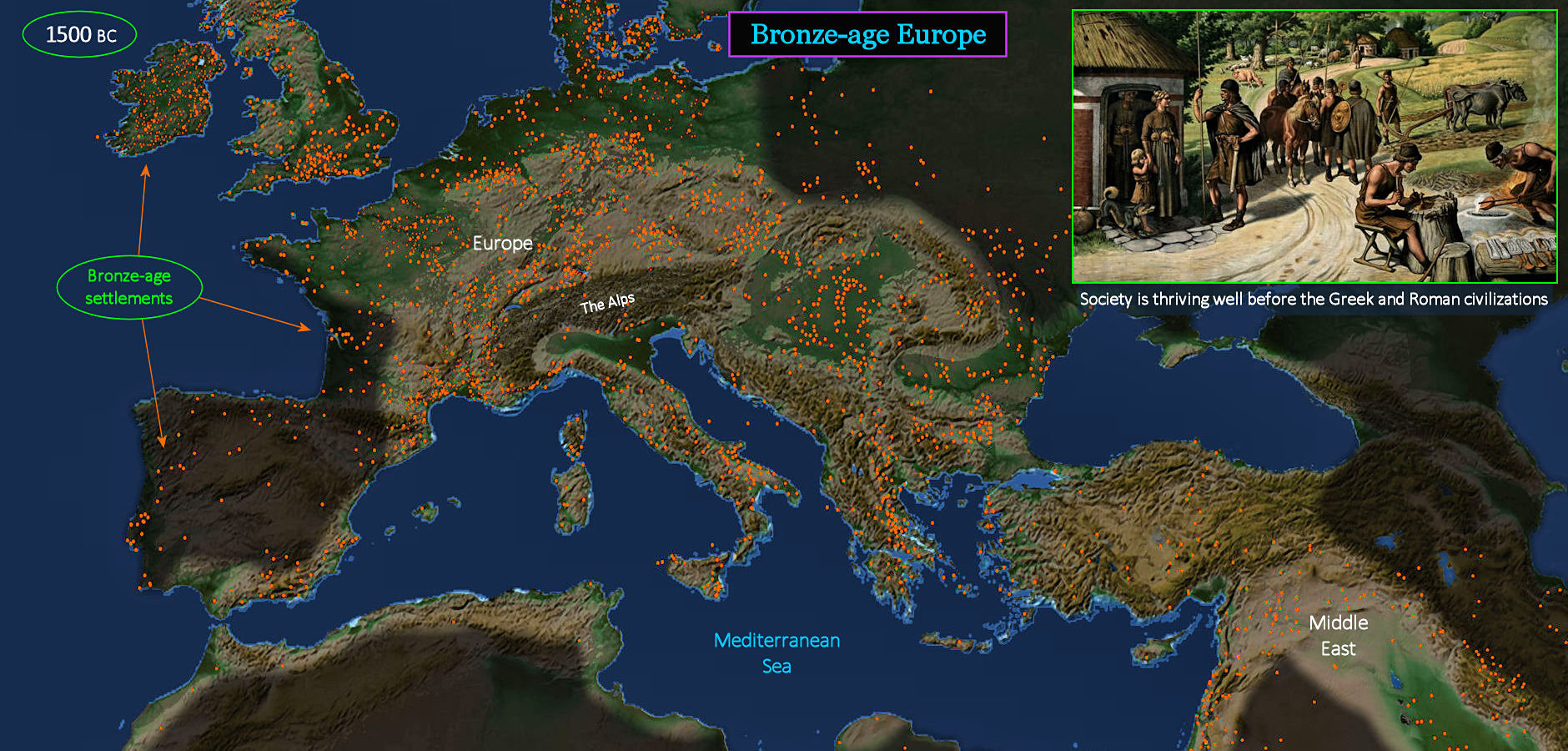
Later Growth This is Europe after the introduction of bronze. One crucial property of metal is its ability to melt over a very hot fire, and be poured as a liquid into a mold. The pattern for the mold can be reused over and over, to make as many duplicate castings as desired. Bronze axe heads are far superior to clumsy stone versions, because they possess a truly sharp cutting edge. More importantly, they can be molded with a central hole for securely attaching the handle. This allows cutting down much larger trees, which can then be shaped into beams and lumber for durable structures, and sea-going boats. Bronze swords and helmets will usher in a whole new era of warfare, featuring mass slaughter for the first time. None of this is available to the Indians. | |||||||||
| |||||||||
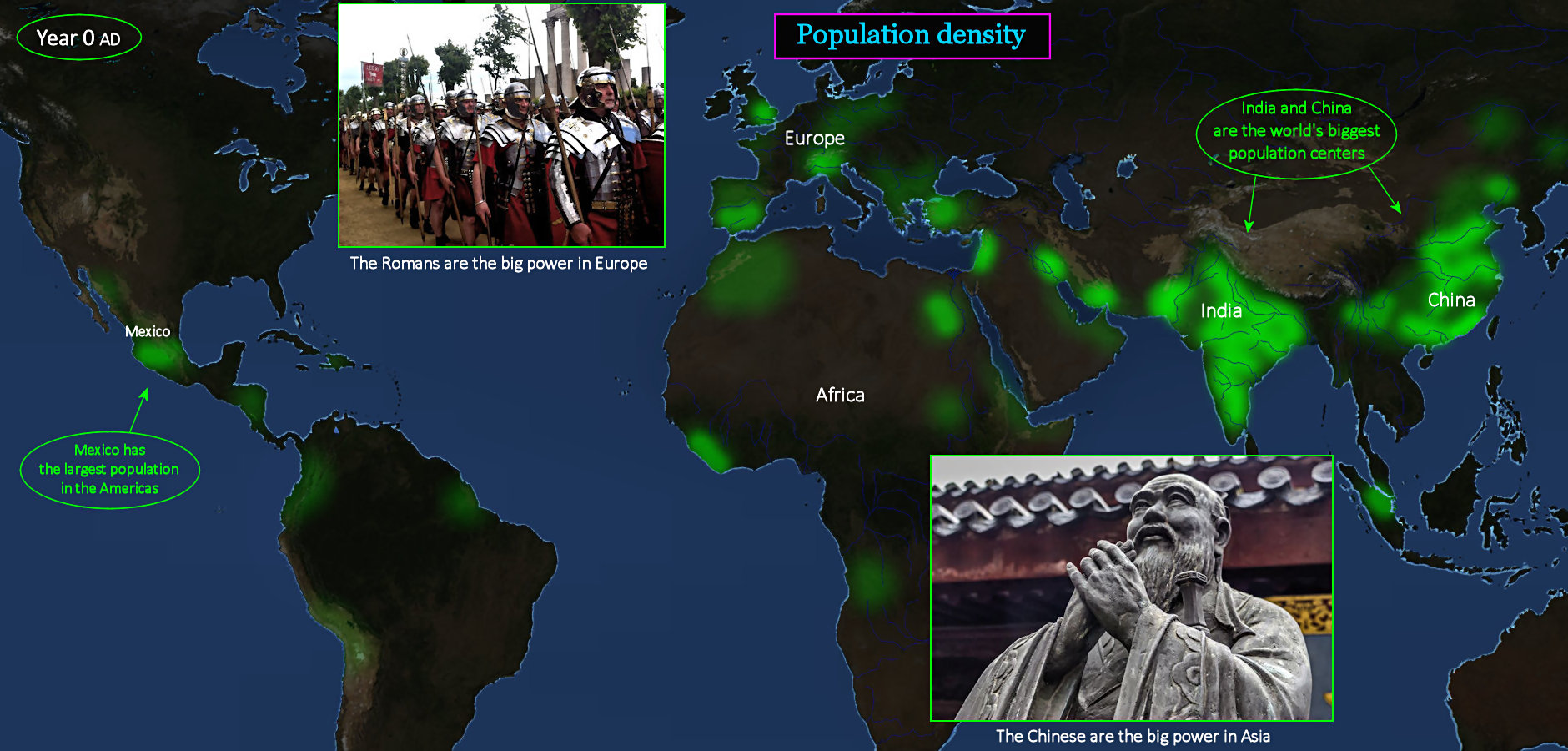
Rome, China and India This view shows population density during the early years of the Roman Empire. Brighter GREEN highlights indicate greater population density. Most people at this time are living in China and India, where they have built impressive early civilizations. Europe, by contrast, is more thinly populated, with hardly any cities. The Roman Empire unifies Europe for a time, with impressive engineering accomplishments, but eventually falls apart under pressure from loosely-related Germanic tribes to the north. | |||||||||