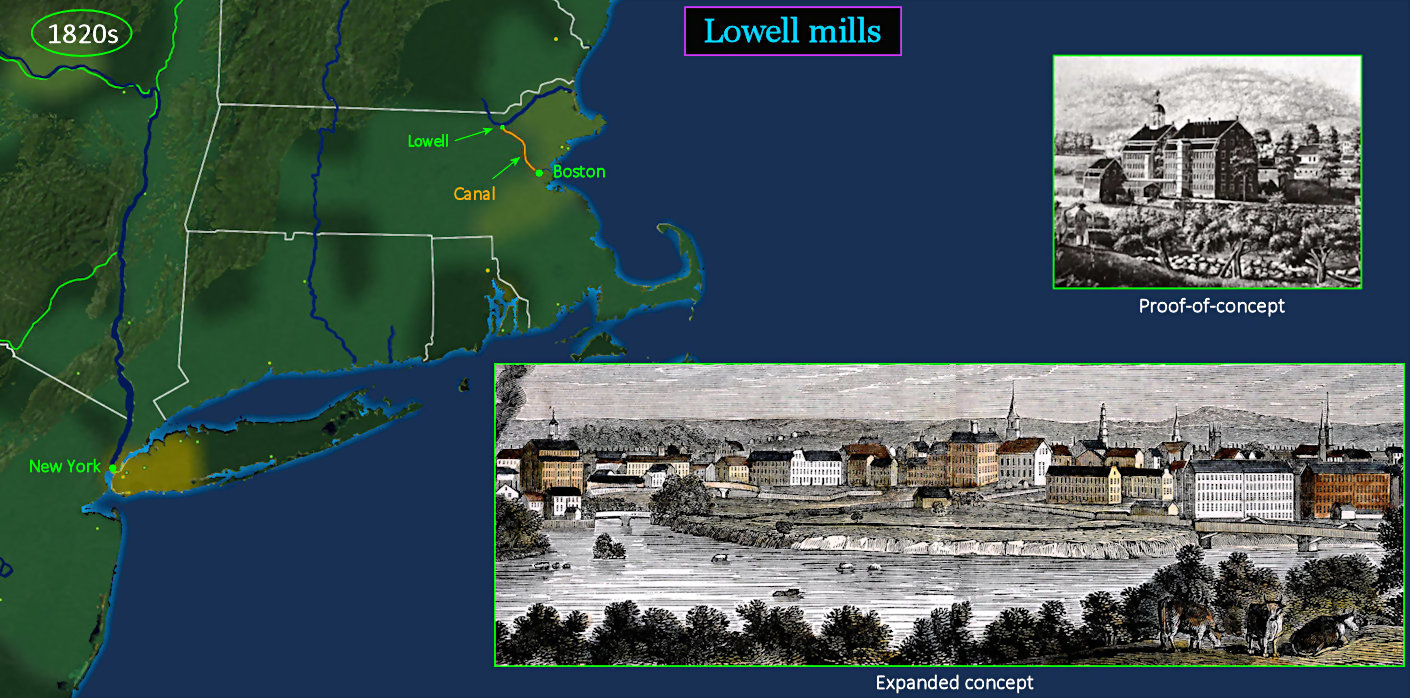
Big IdeasThey acquire a large parcel of land next to one of the most powerful rivers in New England. There, they construct a giant factory complex that will expand, year after year, until it consumes the full power of the river. The era of Big Business has arrived. Today, we would call it 'corporate', but back then it's just a monumental risk. The man who champions it is considered mad, even by his friends, but the venture pays off big. The factory complex in Lowell, Massachusetts is the largest business enterprise in America, by far. It produces monster profits, and increases the demand for more cotton from southern plantations. The machine age is launched. |
| ||||||||||||||||
| |||||||||
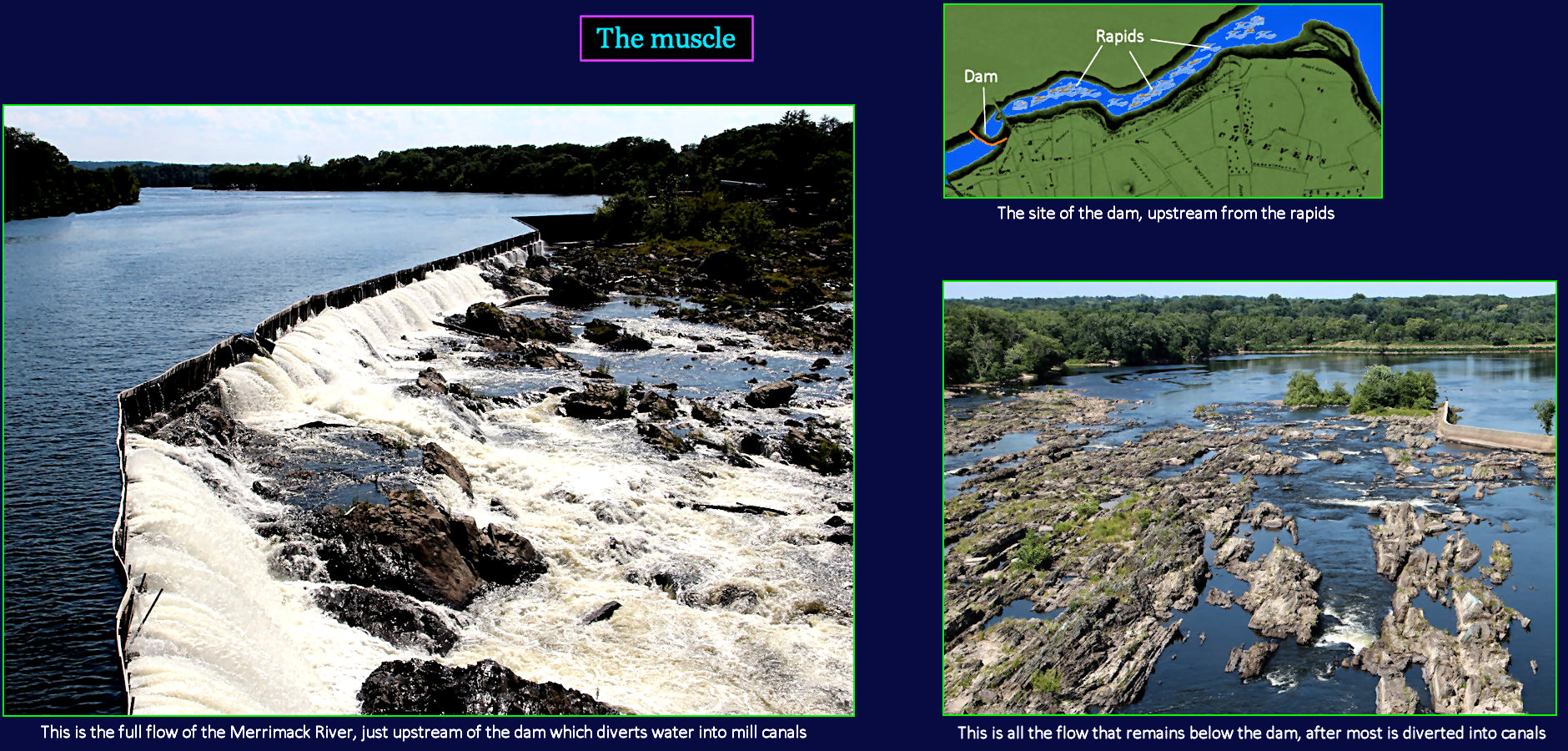
Harnessing an Entire River Steam power is not yet available when the Lowell textile complex is started, so planners have to depend solely upon waterpower. The Merrimack River is perfect for the job. It has plenty of water, and a full 30 feet of vertical drop. This power is harnessed by diverting most of the river flow above the dam (left, looking upstream) into the mill complex, and then dumping it back into the river downstream of the rapids. A set of boards is used on top of the dam, to increase the drop but still allow dumping some of the flow during spring flooding. When the force of water against the boards is too great, the iron pins holding the boards bend back, releasing the excess flow. | |||||||||
| |||||||||
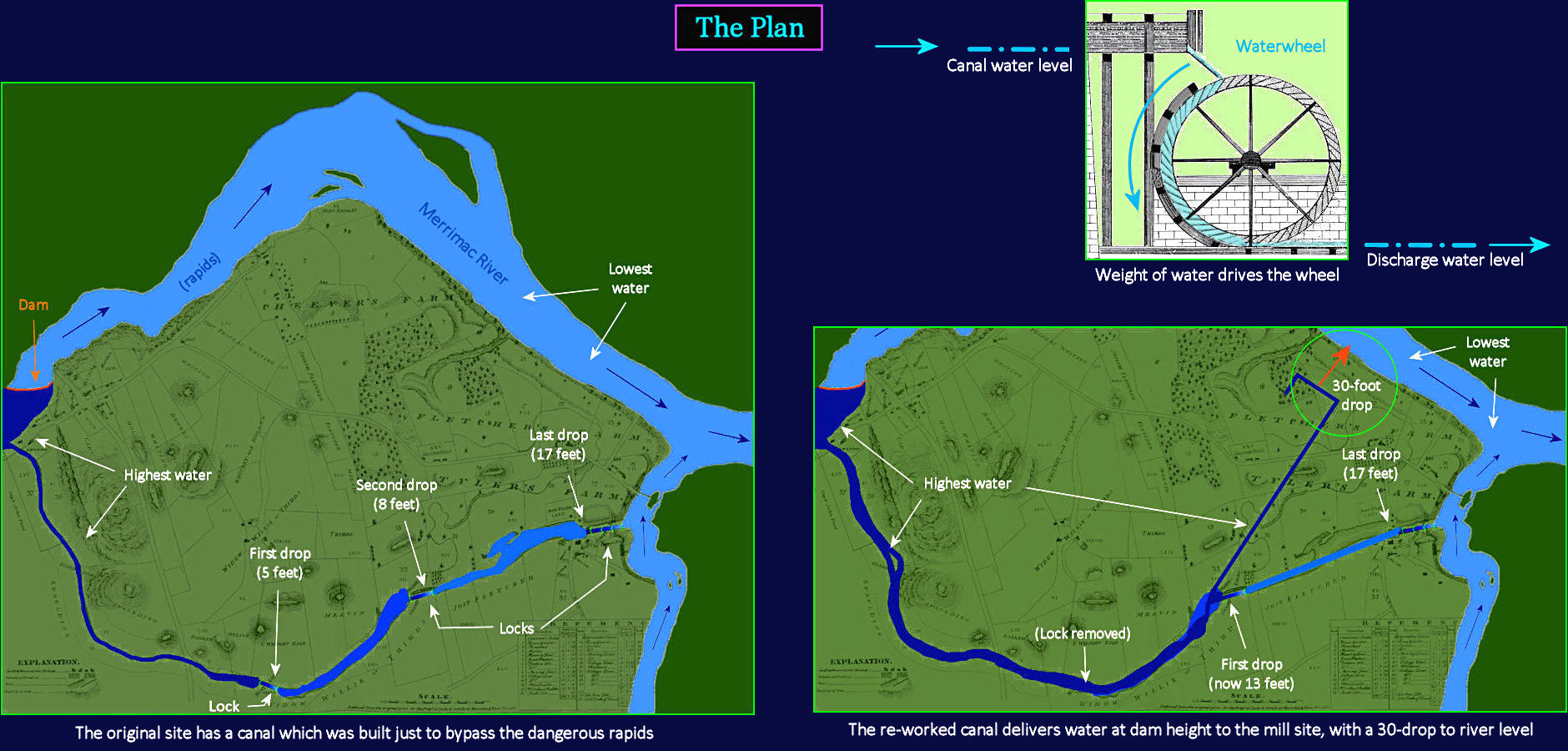
Engineering Challenge The problem at Lowell is figuring out how to harness the full energy of the Merrimack River, from the highest level at the dam, to the lowest level after passing the rapids. There is already an existing canal at the site, which was built to allow boats loaded with lumber to bypass the rapids. To extract the maximum energy, engineers need to re-route the water so that it arrives at the mill at the same water level as at the dam. The sweet spot is shown on the right-hand map, which can utilize the full 30-foot drop (RED arrow). Canal water entering a huge waterwheel fills chambers in the wheel only on the side nearest the chute (top right). The extra weight of all the water on this side turns the wheel in the direction of the arrow, with irresistible force. | |||||||||
| |||||||||
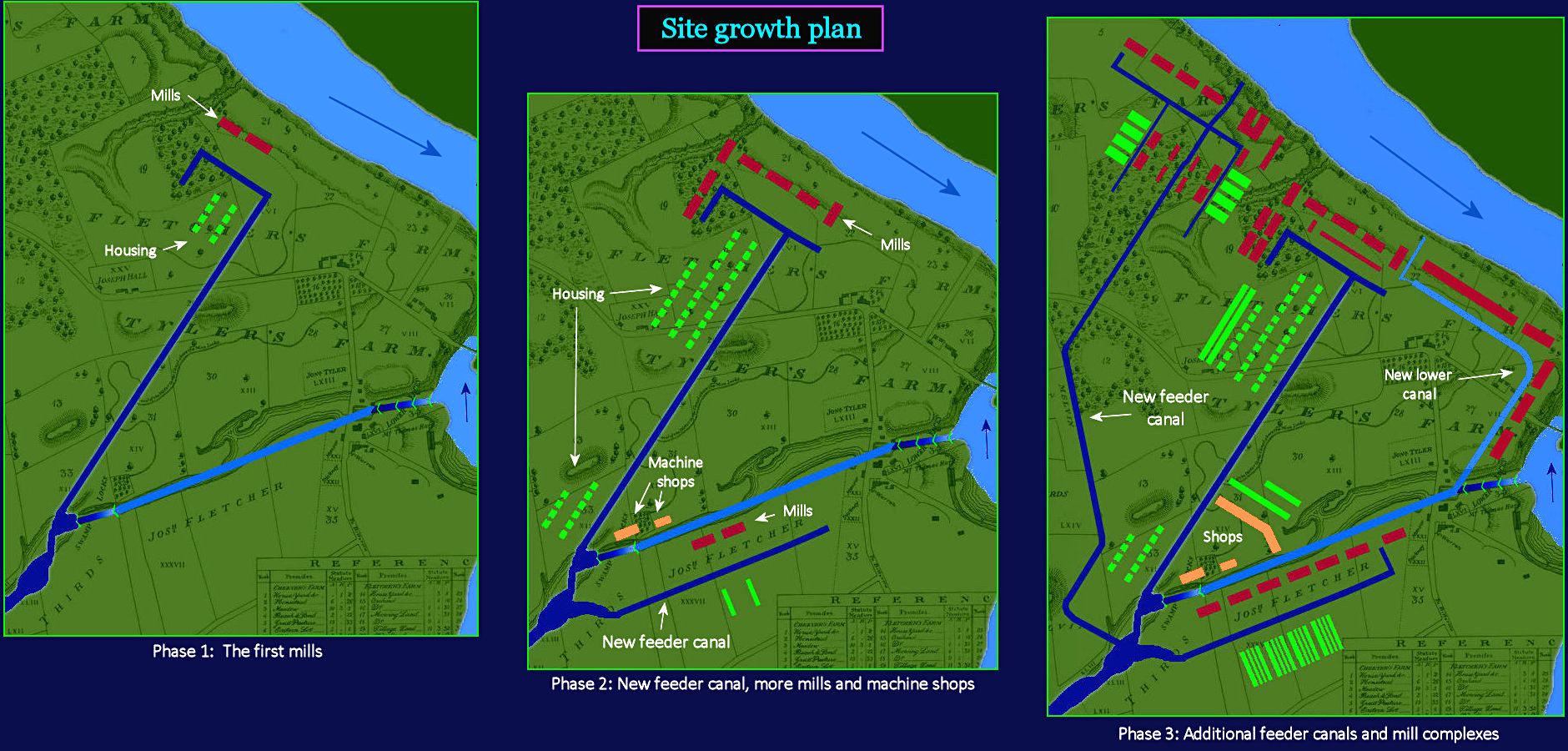
Three Construction Phases Initial engineering calculations determine that there is enough waterpower to operate an astonishing 60 mills at Lowell. The initial building phase includes just two mills (left), demonstrating the feasibility of the concept. Later phases (center and right) expand on the concept by providing enough feed water to power many more mills, built by additional investors. Mills are shown in RED, worker housing in GREEN, and machine shops in ORANGE. Each mill needs both feed water (dark BLUE) and a place to discharge spent water into the river below (lighter BLUE). By 1840, existing mills have all but exhausted the power capability of the initial feed canal. There is plenty more river power, but a new feeder canal is required to tap this additional energy (right). | |||||||||
| |||||||||
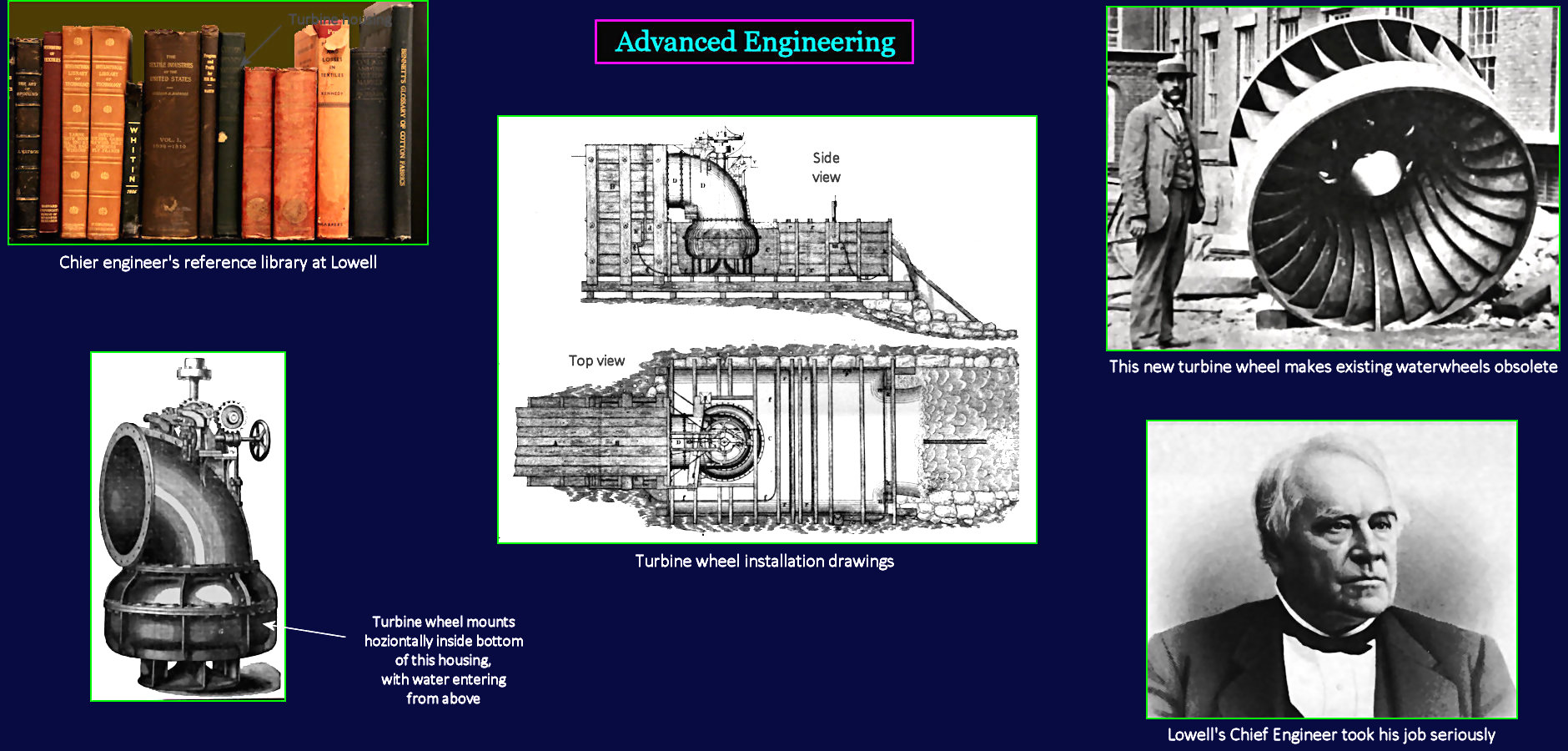
Dedication to the Task The Lowell mill complex is a commercial success beyond all dreams. It's an accomplishment of stunning vision, which later visitors to the site can never forget. This is partly because it's the first large-scale business enterprise ever attempted in America. But even more important is the new emphasis on engineering and calculation. The master engineer, who originally joined the project at age 19 as a draftsman, eventually rises to become the guru and driving force for nearly 50 years (lower right). He calculates and tests everything before moving forward. Along the way, he invents the all-metal water turbine (top right) to replace clumsy wooden waterwheels, which greatly advances the science of hydraulic engineering. His design is still used today. | |||||||||
| |||||||||
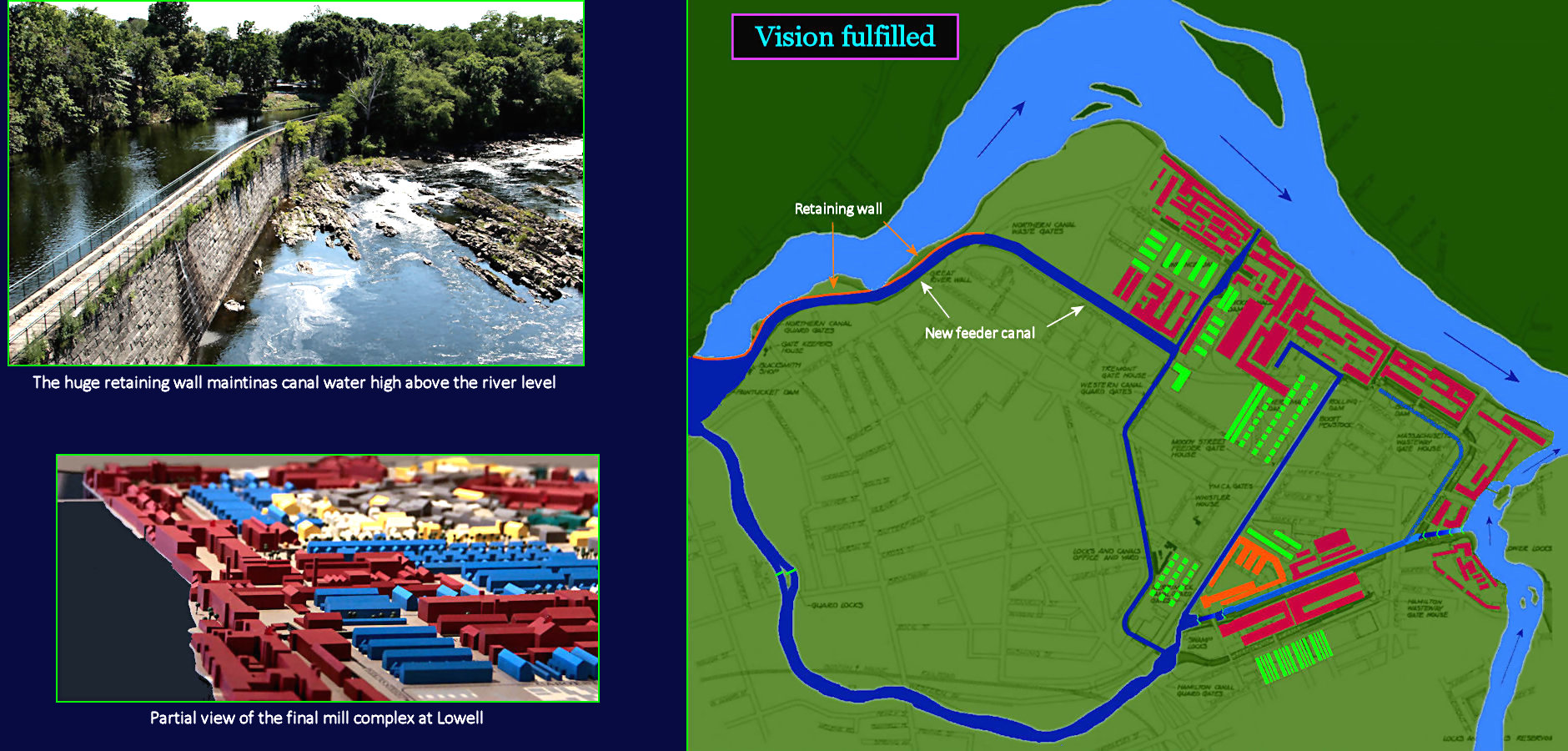
Maxed Out The views above properly belong in the next chapter, which deals with a later period, but are included here to show Lowell's later, fully-developed state. A new, and much bigger feeder canal is completed by 1850 (see map). It essentially diverts the entire flow of the Merrimack River into the mill complex, at the highest water level. This is a stunning accomplishment, requiring a quarter-mile long, 36-foot-high retaining wall (top left), to maintain flow at the same level as the top of the dam. The new canal provides additional water flow, which greatly increases the capacity to supply mills with power, even during summer drought. It makes possible the final expansion of mill sites (nearest the top of map) by the 1880s. | |||||||||