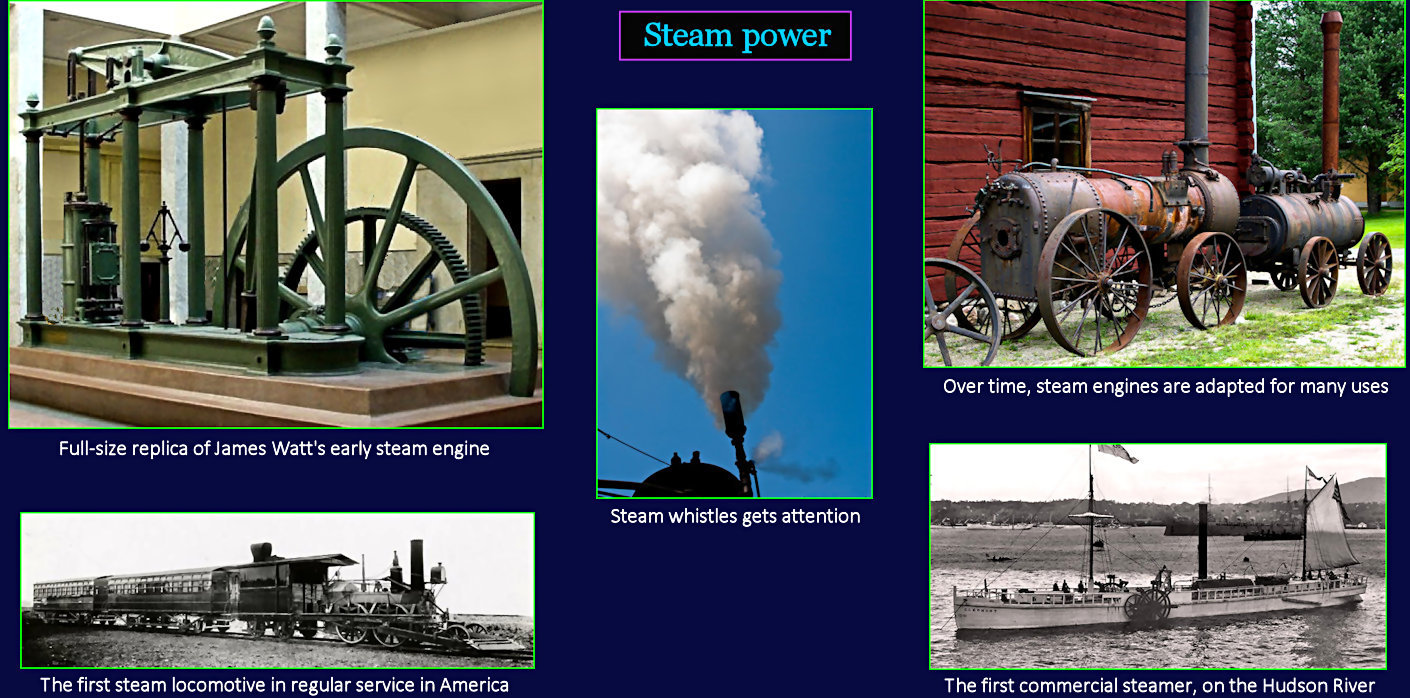
Mighty SteamExpanding steam has great power, but learning to harness that power takes time. Early steam engines are large and clumsy. As they become smaller and more efficient, they provide a huge boost to businesses of all kinds. Steamships are the first to benefit, being large enough to accommodate the primitive metal giants of the early days. Over time, more efficient engines are developed which provide the same power in a smaller unit. Soon, steam engines are mounted on wheeled platforms and called locomotives, pulling strings of carriages on smooth iron rails. As time goes on, the power of steam is adapted for many other purposes, from pumps to tractors. |
| ||||||||||||||||
| |||||||||
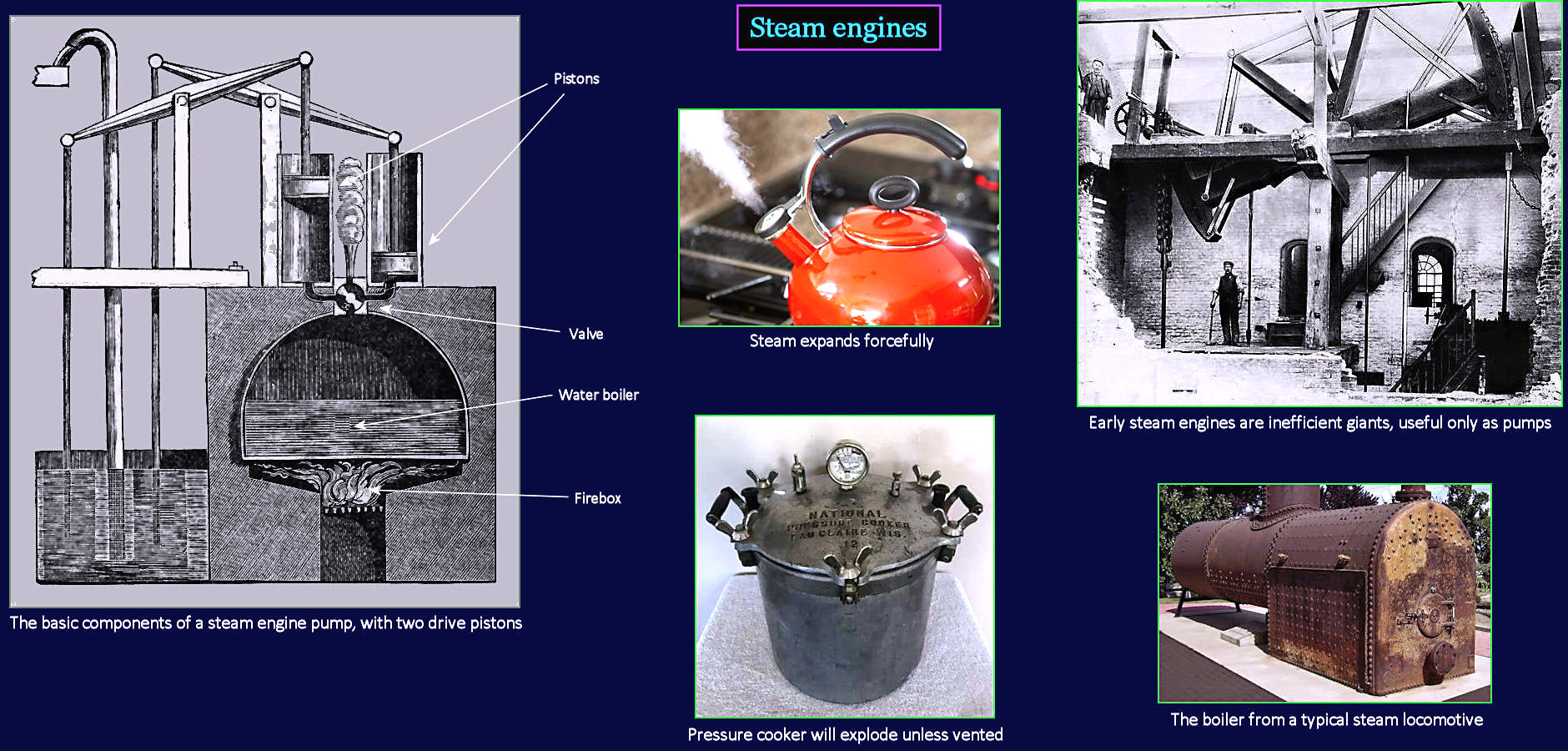
Limitless Power (almost) When water boils in a tea kettle, it produces a jet of steam which is hot, but otherwise harmless (center top). In you contain the steam in a pressure cooker, however, the pressure of expanding steam continues to increase. As the temperature rises far above the normal boiling point, the cooker will explode unless the pressure is limited by a vent (center bottom). A steam engine harnesses this pressure to perform work. This is achieved using a valve to direct the expanding steam into a cylinder, which drives a piston (diagram, at left). When the valve is switched to the other cylinder, the steam in the first piston is allowed to escape, and the cycle repeats. Large boilers, like the ones used to power railroad locomotives, simply expand on this concept (lower right). | |||||||||
| |||||||||
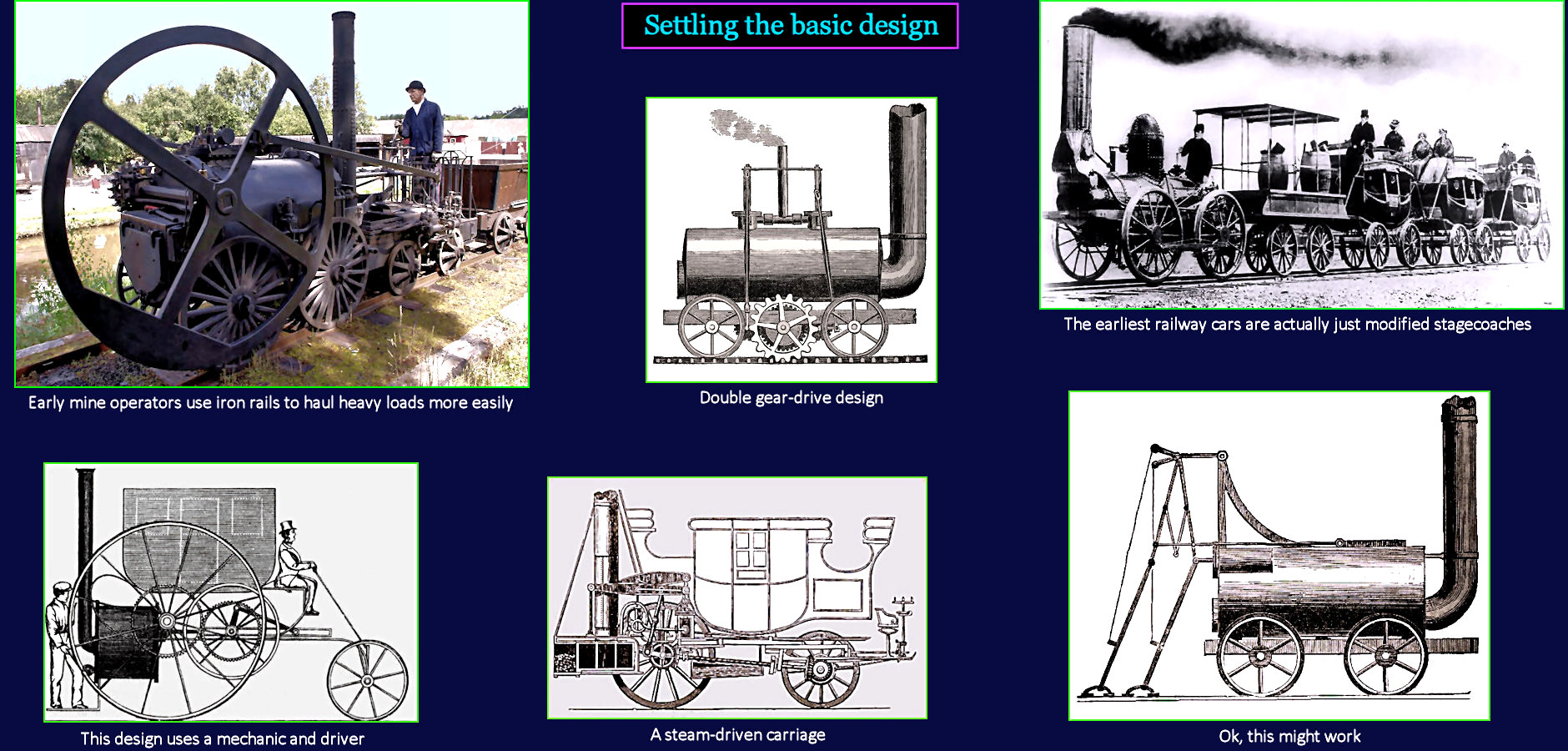
Experimenting with Steam Early attempts to use steam engines to move carriages are often comical. Some designs put the boiler behind the carriage, and operate on regular streets. Most are simply a boiler on wheels, rigged up to pull some kind of carriage behind, on iron rails. The driving force is delivered by pistons, gears and even walking feet (lower right). It is a period of wild experimentation. But all these designs share the need to include a firebox, with a burning fire inside which needs constant tending. Steam locomotives have to carry a supply of fuel near the engine, to keep the fire stoked and hot. In the early days, most burn wood, though coal is also sometimes used, where available. | |||||||||
| |||||||||
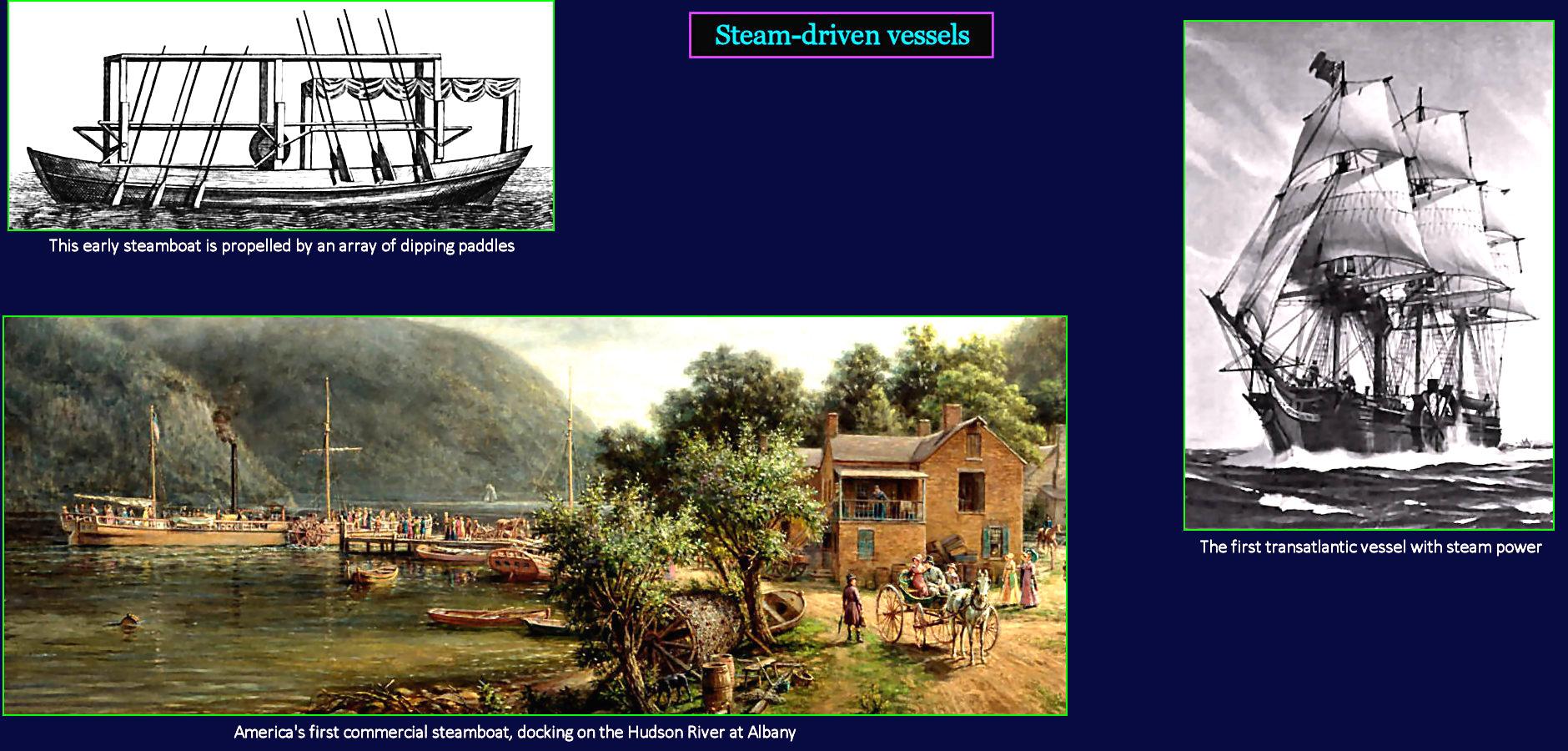
Powered Paddles Early steamboat designs are almost as comical as early locomotives (top left). But these quickly evolve into more sensible paddlewheel vessels, such as the first steam-powered vessel to operate on the Hudson River, in 1807 (lower left). The first steam-powered ship to cross the Atlantic, in 1819, (top right) also uses side-mounted paddlewheels, to augment its sails. The great advantage of river steamboats is the ability to power upriver, against the current. During the 10 years after the first steamboat proves that such vessels are practical, 100 more steamers of all kinds are launched. In the next 10 years, another 400 are built. This is the second example of a new technology enabling a great expansion of business. The first was the cotton gin. | |||||||||
| |||||||||
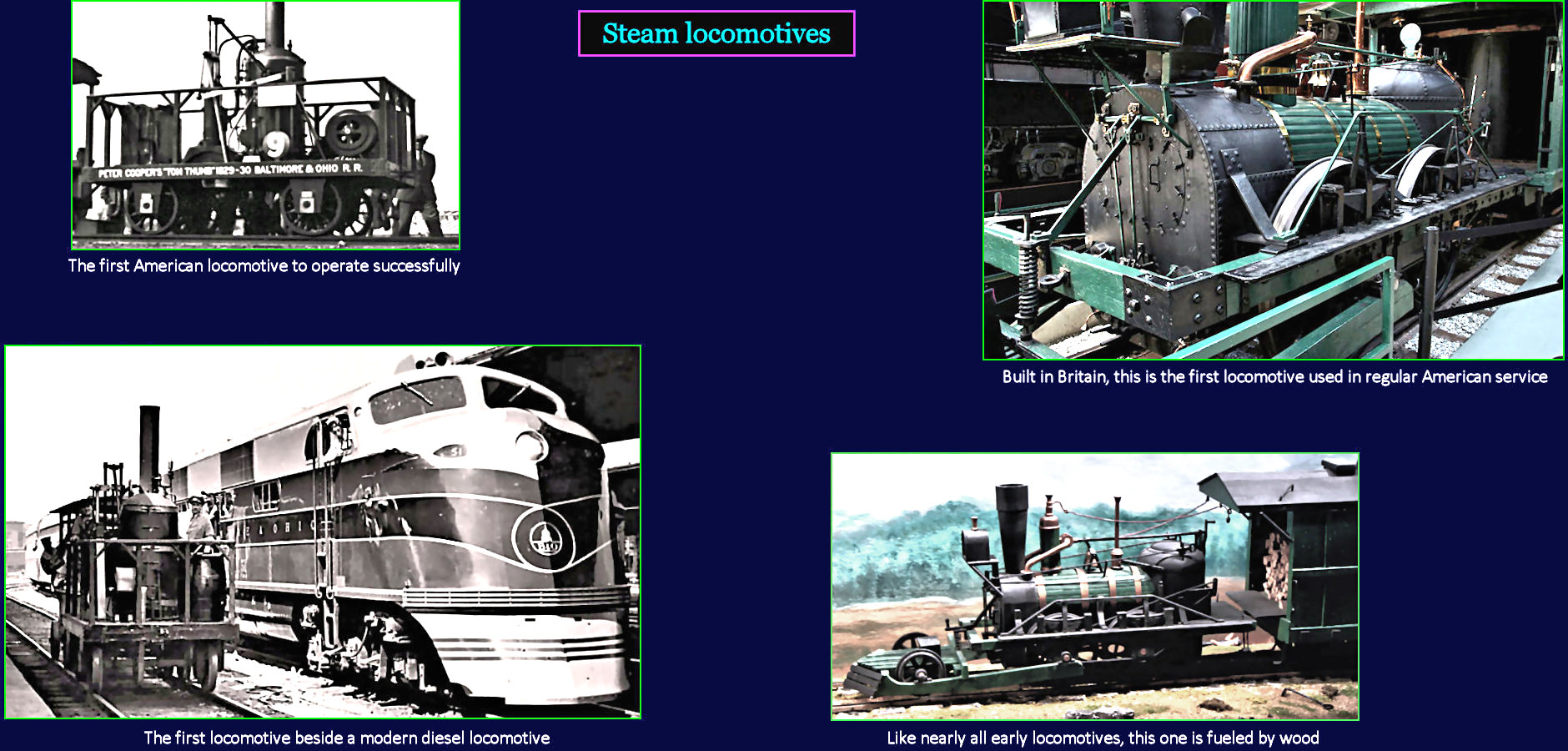
Steam Engine on Rails Tom Thumb is the first steam locomotive to be successfully operated in America (top and bottom left). It makes its first test run just four years after the completion of the Erie Canal. Four years after that, a British-built locomotive (top and bottom right) begins regular service on a rail line between New Jersey and New York City. And this is just the beginning. By 1840, railways connect Boston with cities in six neighboring states. Passengers are delighted with the ride, which is far more comfortable than that of a stagecoach, and so much faster. Canal barges still haul the bulk of cargo in America, but this will soon change. Canals are no longer the fastest way to transport people and goods, though they remain the least expensive. | |||||||||
| |||||||||
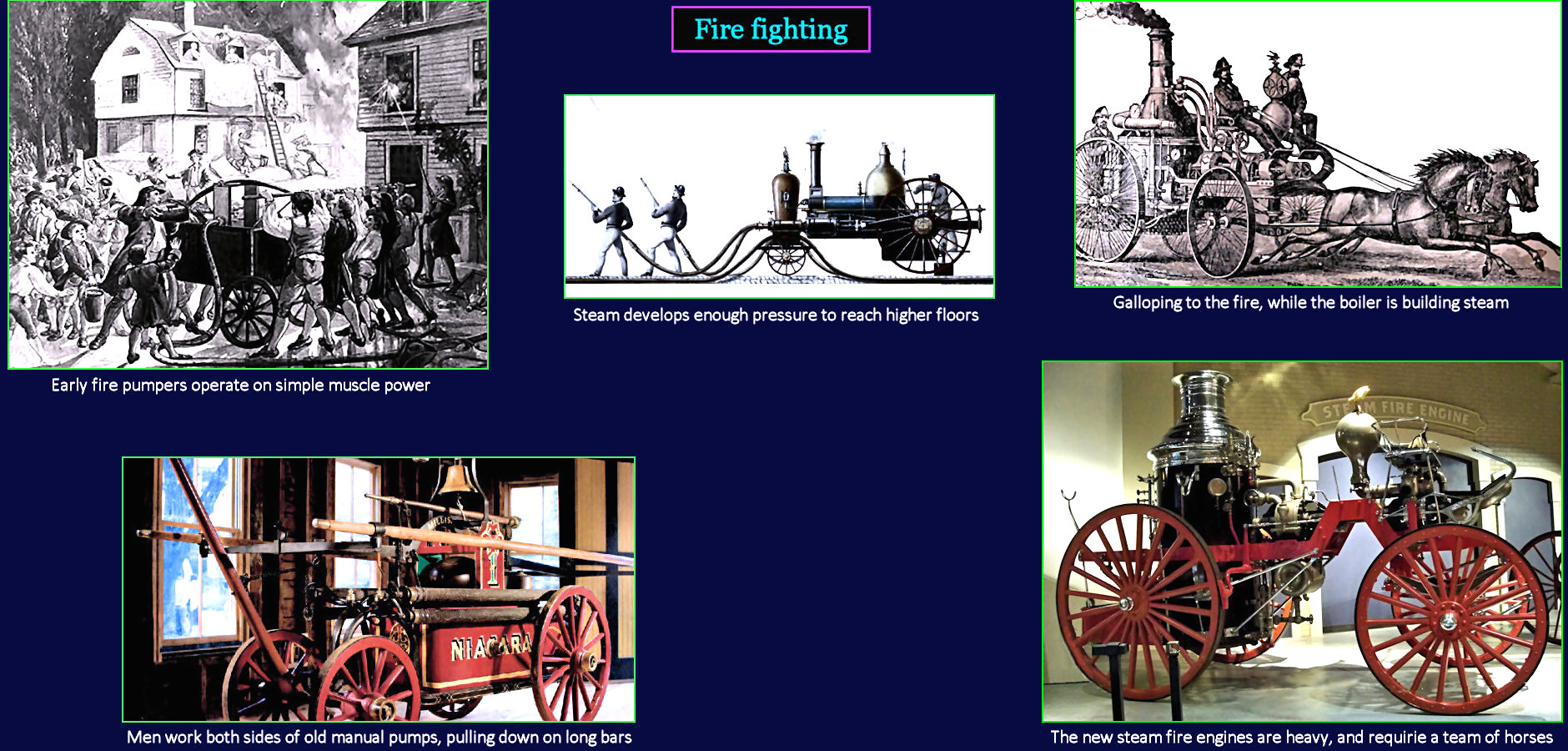
Steam Engine NOT on Rails We often use the term 'steam engine' to describe what is more precisely called a 'steam locomotive'. A steam engine is just the part that produces the power. It can be used to power all kinds of equipment, besides railway locomotives. Americans quickly figure out how to adapt steam engines to pump water, for fire engines. Previously, fire engine pumps were operated by gangs of men pulling down on long wooden handles, mounted on either side of the pump (top and bottom left). The new fire engines (right) are still pulled by horses, but use steam to force water from the hose. Firemen have to kindle a fire in the boiler before heading out, hoping it will be hot enough to produce steam pressure for the pump by the time they arrive at the scene of the blaze. | |||||||||