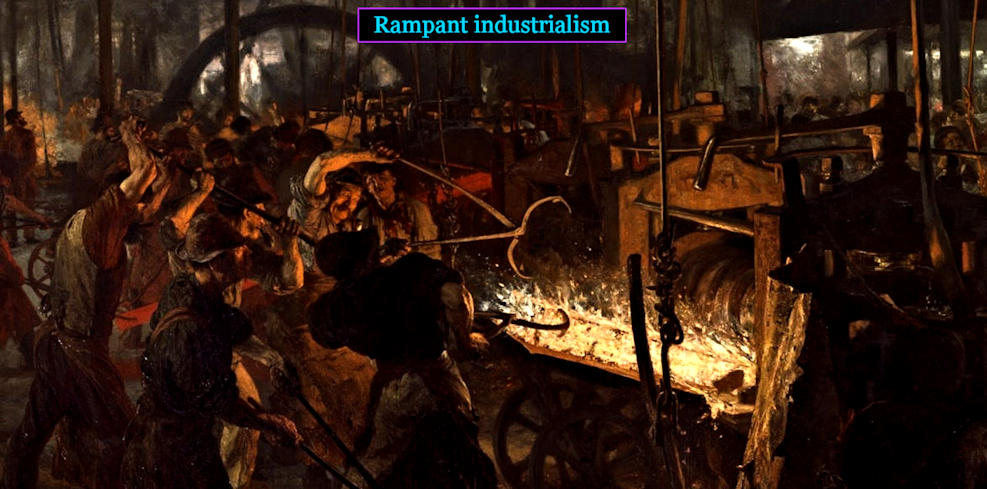
Hot WorkThe image shown here gives a pretty good idea of what that work is like. It all happens in large, drafty structures with little light, and the barest of comforts. There are no factory cafeterias, or employee lounges. But this is just the first step in the industrial process. What emerges from the rolling mills are large steel plates, which must then be further rolled into curved shapes for steamship hulls, or steam engine boilers. Rolling mills also produce long bars and rods, but the main product is railroad rails, in huge quantities. One-third of all steel produced is used to make rails, which last 10 times longer than those made of iron. |
| ||||||||||||||||
| |||||||||
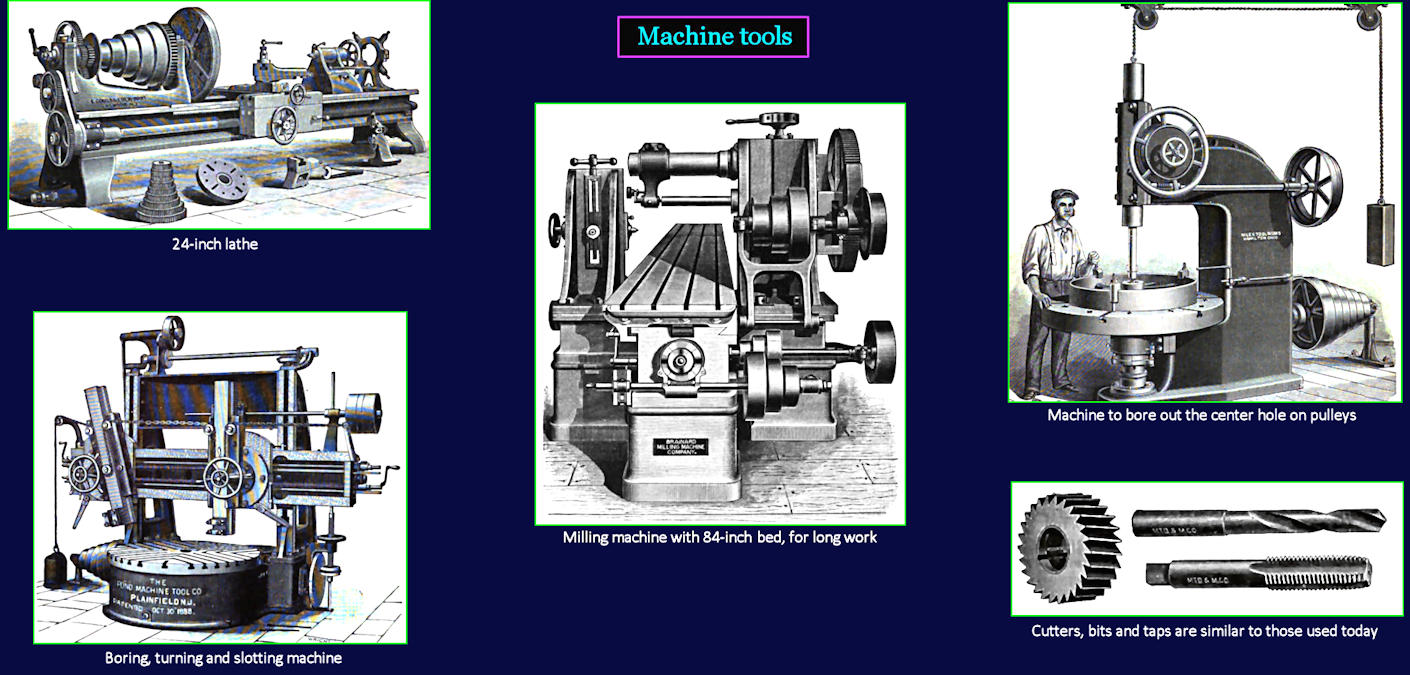
Metal-working Tools Factories purchase long plates and bars from rolling mills, and then work them into whatever shapes are required. Huge powered shears are used to cut the bars, while lathes, milling machines and drills are needed to make individual parts. The machines shown above are just a small sampling of the many, many machines devised for such tasks. Some are used for general machining, but most are set up for just one operation, like boring the center holes in wheels, or pulleys (top right). Fine shaping is done with bits and milling cutters made of the best steel, and sharpened using delicate abrasive wheels (bottom right). Similar-looking machines were used for 100 years, until replaced by today's digitally-controlled milling centers. | |||||||||
| |||||||||
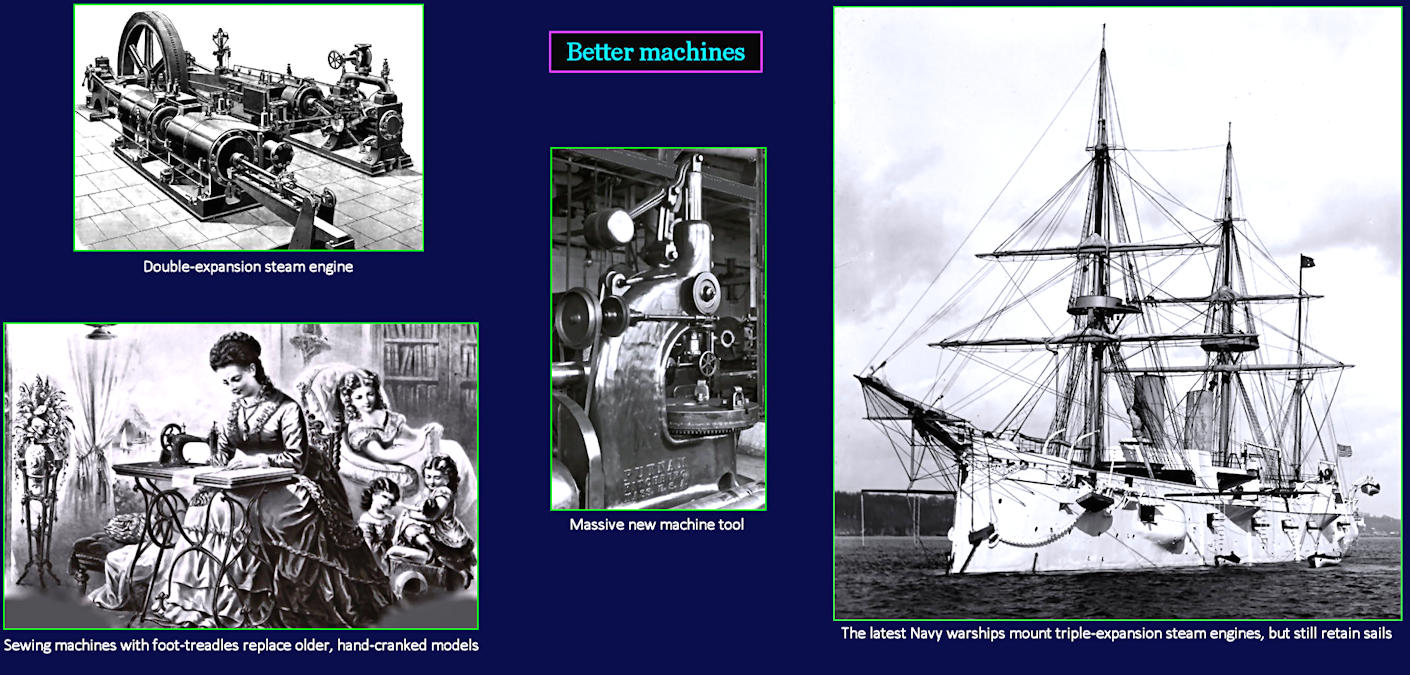
At Work and Home Machinery everywhere is getting bigger, and driven by more powerful steam engines. New 'double-expansion' (or even triple-expansion) steam engines use energy in the steam more than once. The primary cylinders operate in the normal way, but additional cylinders are powered by the energy remaining in the exhaust steam from the primary set. Warships are among the first to use multiple-expansion engines, to achieve the highest speed possible. Meanwhile, mothers can now make clothing in their own homes, on foot-operated sewing machines. | |||||||||
| |||||||||
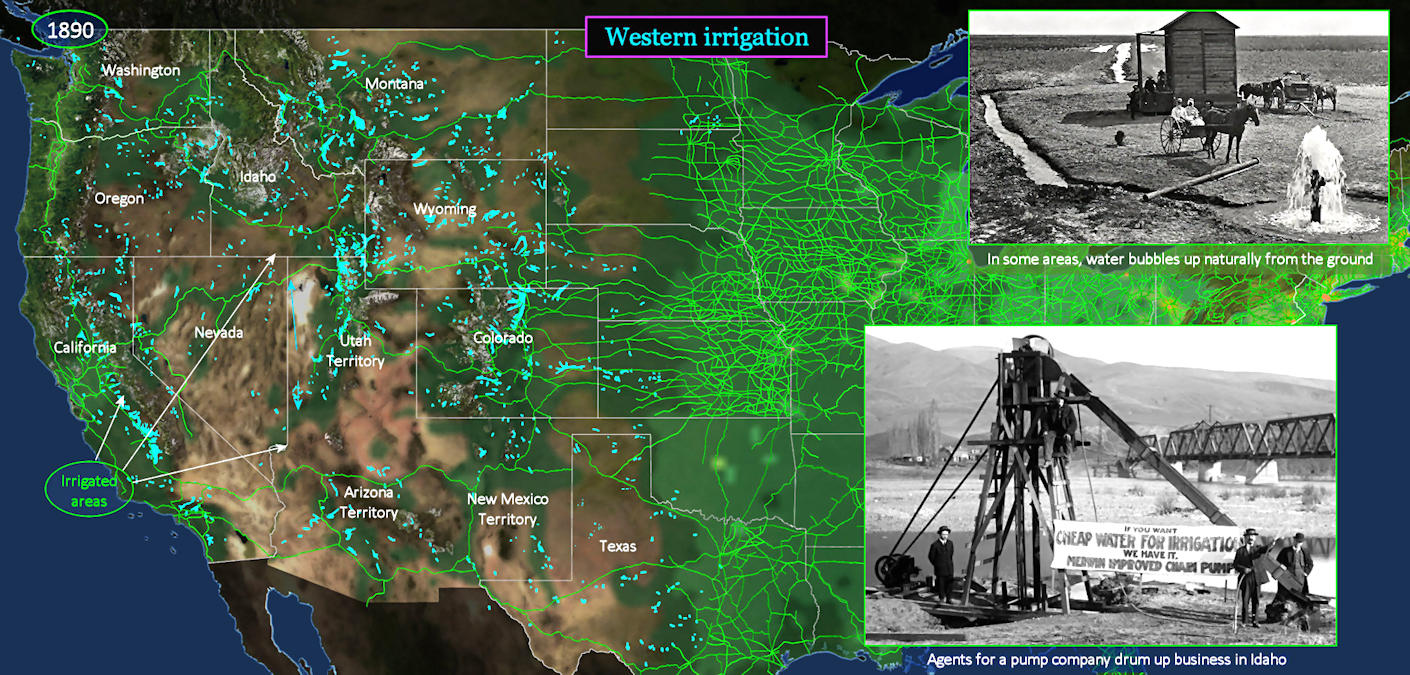
Extra Water The eastern half of the country is fully settled by 1890, with lots of farmland and growing cities. Meanwhile, the western half is only showing fitful signs of growth. There are settlers in all the new states shown above, and even in areas which have yet to be organized into states, but homesteads are widely scattered. The LIGHT BLUE highlights indicate areas where farmers are able to supplement sparse rainfall with irrigation systems. Water is sometimes diverted into irrigation ditches from nearby streams, where available, and steam pumps can be used to raise water from rivers (lower right). Even in areas where ground water gushes up under natural pressure (top right), a portable steam engine might be needed to drill down to the source of the water. | |||||||||
| |||||||||
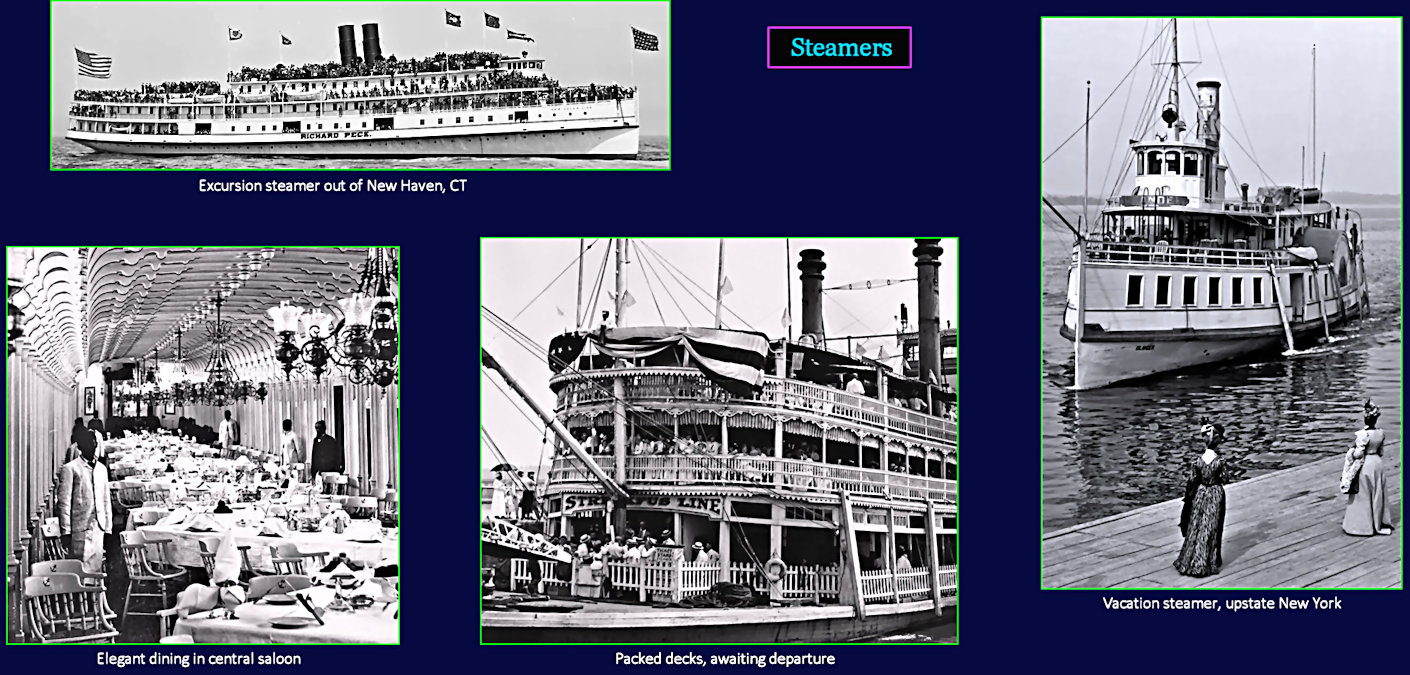
Vacation Palaces Steamships in the 1890s are knockouts. Full of decorative woodwork and fancy furnishings, some even have a grand central staircase, with elegant curved railings like the fancy hotels. Most are built for coastal or river service, and many still have stern or side-mounted paddlewheels. But sleek new steamers (top left) sport a brand-new, screw-like propulsion device called a propeller. Steamers often carry freight right on the main foredeck, while resort steamers (top right) are designed mainly for passenger comfort. Passengers dress for the occasion. | |||||||||
| |||||||||
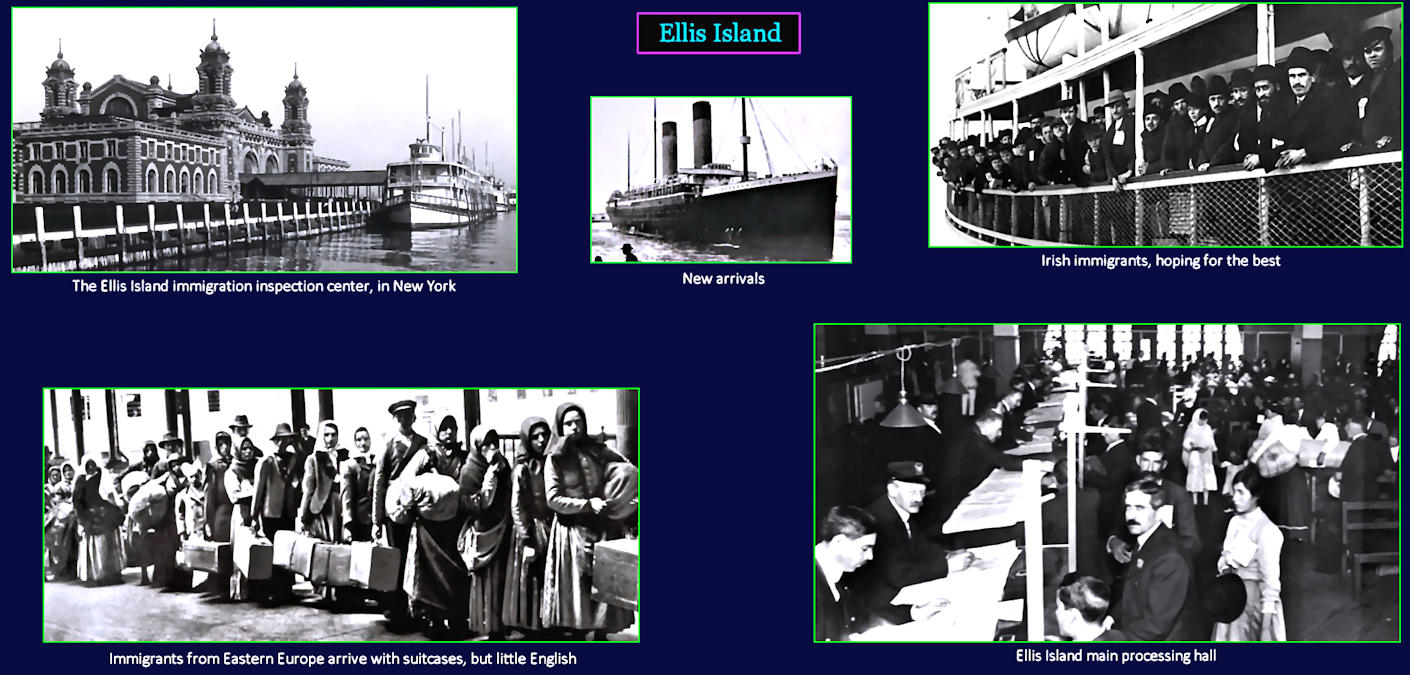
Give Me Your Tired, Your Poor All through the 1410s, immigrants are arriving from Europe in the greatest numbers ever seen. Many are now coming from southern and eastern countries, like Italy, Poland and even Russia. About half the new arrivals have no listed occupation, and an increasing proportion speak no English at all. About one in ten is listed as 'skilled,' while twice that number are simply called 'laborers.' To process all the new arrivals, an immigrant reception facility is built in New York harbor in 1892, on Ellis Island. The original structure soon burns down, and is replaced by a much grander brick facility, which still stands today (top left). | |||||||||