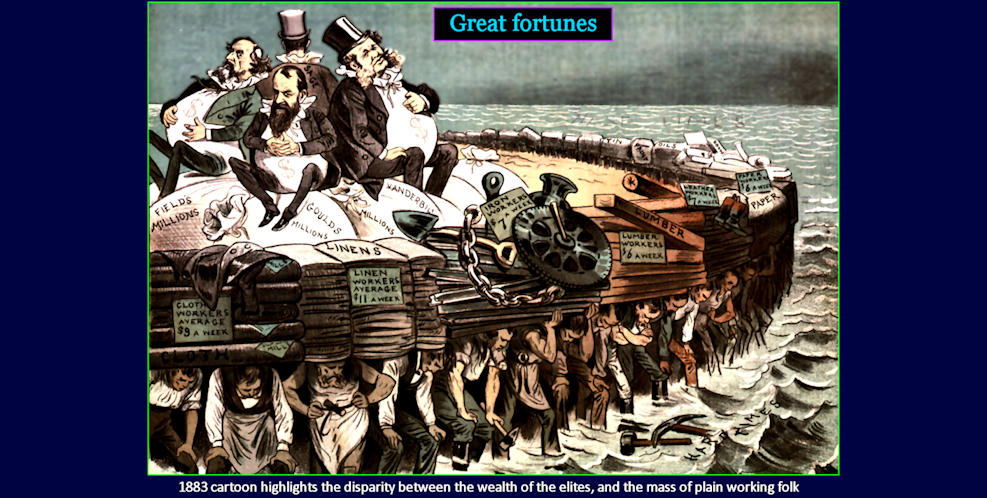
The Gilded AgeThis was what you might call ordinary wealth. Financiers, manufacturers and even retailers in earlier times often built themselves fine homes in the most fashionable districts. But few of these were real mansions. By 1890, the scale of wealth has expanded dramatically. As railroads companies merge to create ever larger entities, and bare-knuckle businessmen buy up both competitors and suppliers, the fortunes at the top grow fantastically. This produces a new crop of top-tier titans, like Vanderbilt and Carnegie, with personal wealth beyond anything ever known in America. They are the titans of their day, and live like it. |
| ||||||||||||||||
| |||||||||
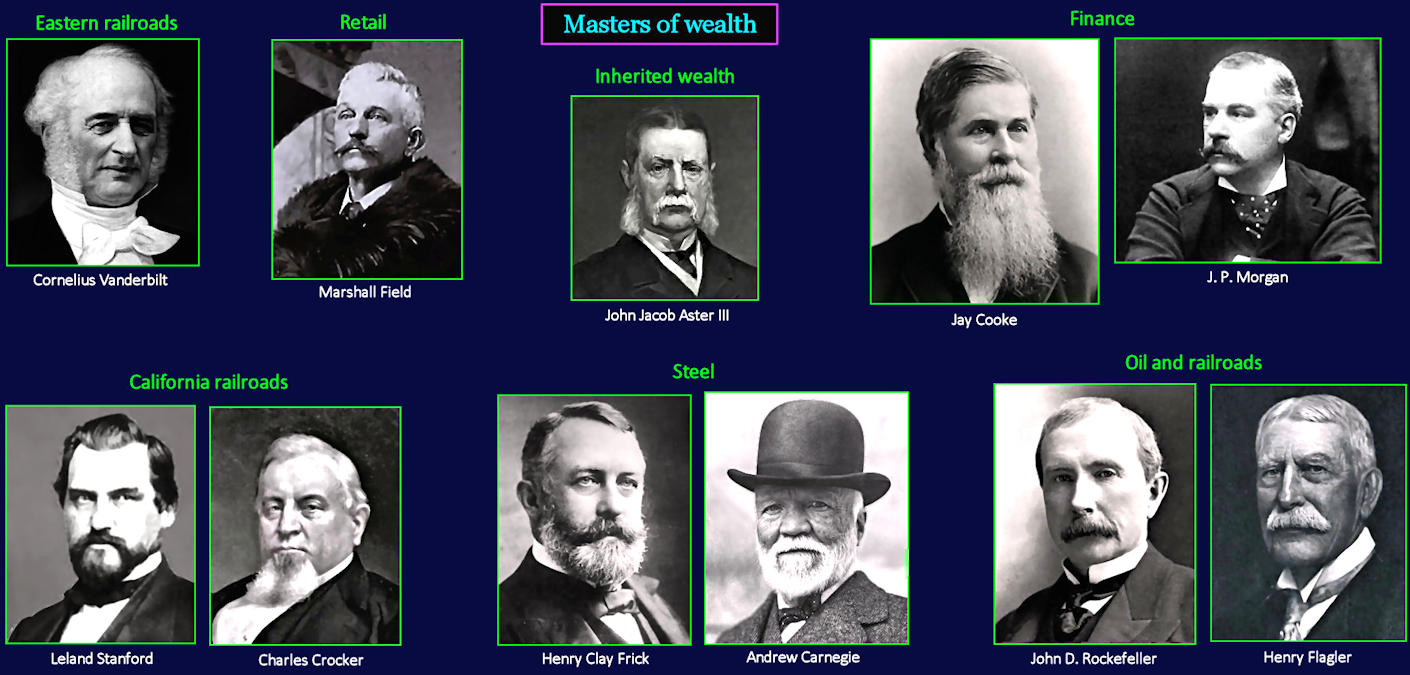
None Are Angels These men occupy the top tier of the mega-rich from this period, which today we call the 'top 0.1%,' but is really more like the top 0.0001%. John Jacob Astor III (top center) is the only one to inherit fabulous wealth (from his ruthless grandfather), but grows it still further managing the Astor real estate empire in New York. The others shown above build their own fortunes in railroads, steel, oil, finance and even retail. They are as rich as the billionaires of today, often climbing to the top on questionable, sharp-elbowed business practices. Later in life, men like Vanderbilt, Carnegie, Rockefeller and Frick bequeath large portions of their estates to philanthropic foundations, as endowments, which might ease the conscience. | |||||||||
| |||||||||
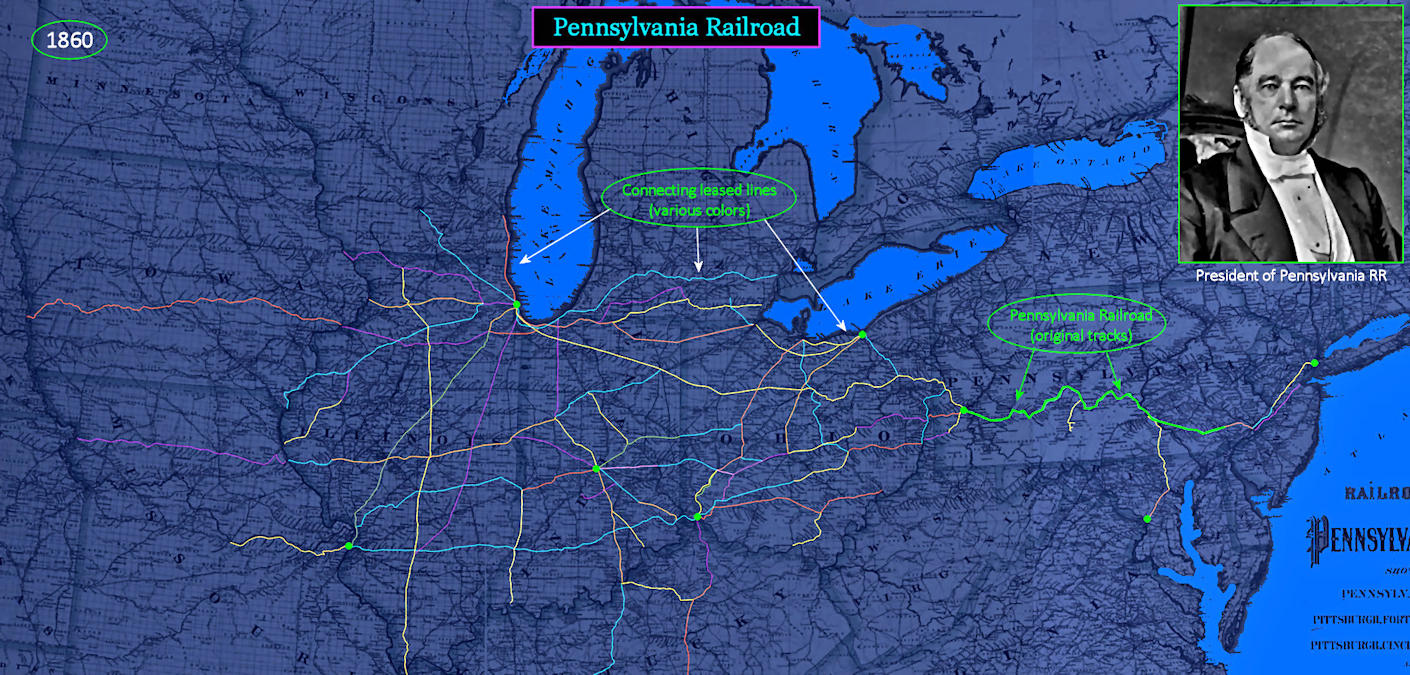
Forging an Empire Railroads are so expensive to build that most railroads only offer service to a few cities, usually within a single state. This makes it difficult for passengers to make connections. Unlike modern airports, with terminals shared by many airlines, railroads all build their own, stand-alone terminals. The Pennsylvania Railroad is the first to assemble a network by arranging connections between many independent lines. This map shows the lines actually built by the Pennsylvania Railroad in GREEN (at right). All the other lines (various colors) are still owned by the companies that built them. The Pennsylvania Railroad leases these lines, and often owns substantial blocks of their stock as well. This is America's first corporate empire assembled through interlocking ownership. | |||||||||
| |||||||||
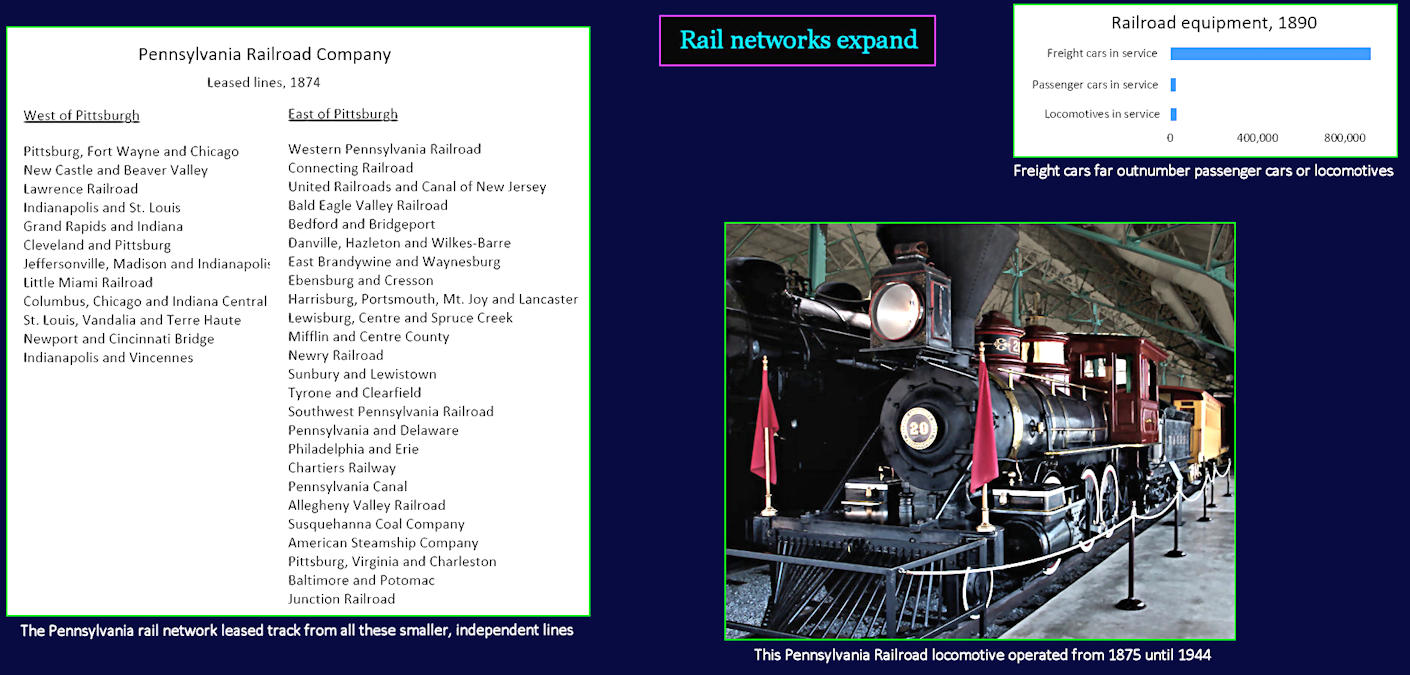
Interlocking Ownership The list at left shows how the Pennsylvania assembles its network, by leasing the right to operate its trains on tracks originally paid for these other companies. The Pennsylvania Railroad only owns the locomotives and rail cars which run on these rails. It's the operator. But it also owns stock in about half of these other, independent companies, which helps ensure cooperation. The chart at top left, which shows equipment owned by all railroads, highlights the fact that railroads overwhelmingly haul freight, not passengers. There are 30,000 locomotives, and a similar number of passenger cars. But freight cars are 30 times more numerous. About half of these are open-topped cars for transporting bulk goods, like wheat or iron ore. | |||||||||
| |||||||||
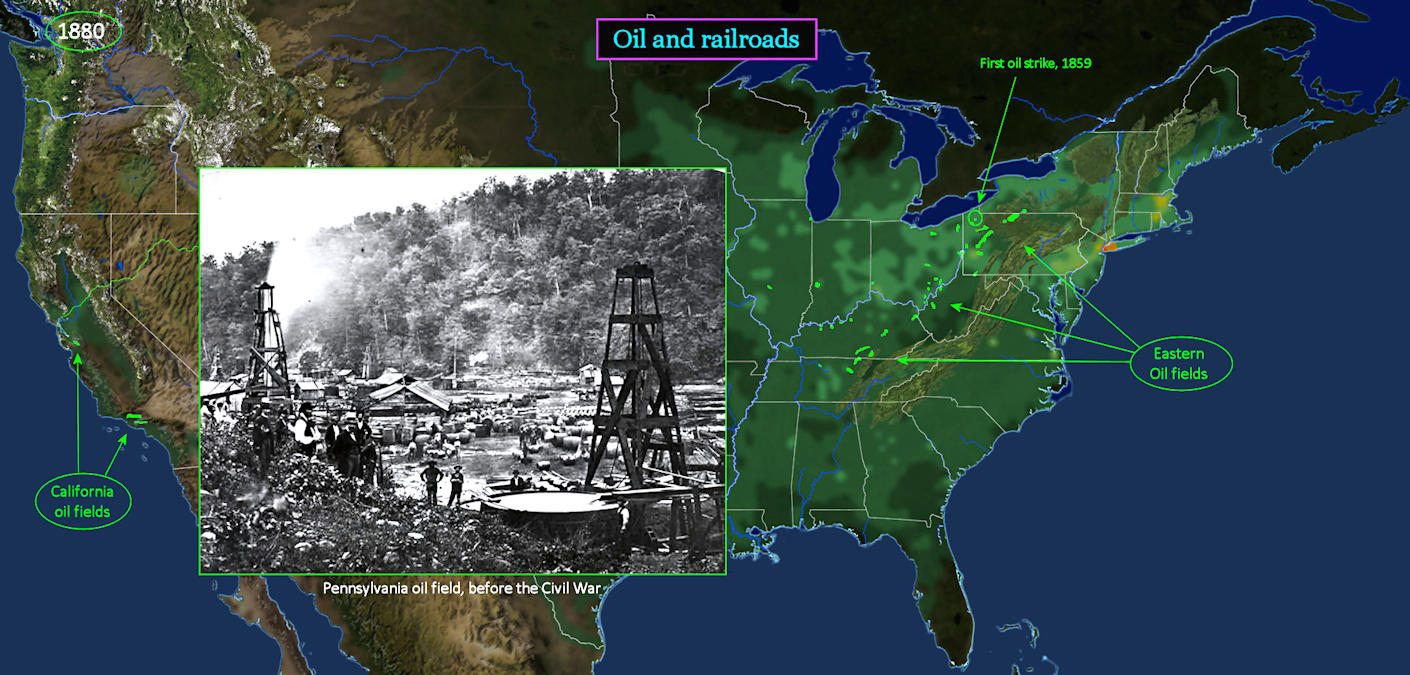
America's First Monopoly America's first oil well is drilled in 1859, in western Pennsylvania. At this time, whale oil is the fuel commonly burned in lamps, to provide light. By the mid-1860s, however, kerosene is replacing whale oil as the fuel. Kerosene can be extracted in large quantities from petroleum, without the need to go on a four-year whaling cruise. John D. Rockefeller sees the potential, and founds the Standard Oil Company in 1870, in Cleveland. Rockefeller uses aggressive tactics to develop a near-monopoly on the refining and transportation of kerosene, benefitting from rebates he secretly negotiates with railroad companies to lower his own transportation costs. This allows Standard Oil to absorb almost all independent operators, who must either sell out or go bust. | |||||||||
| |||||||||
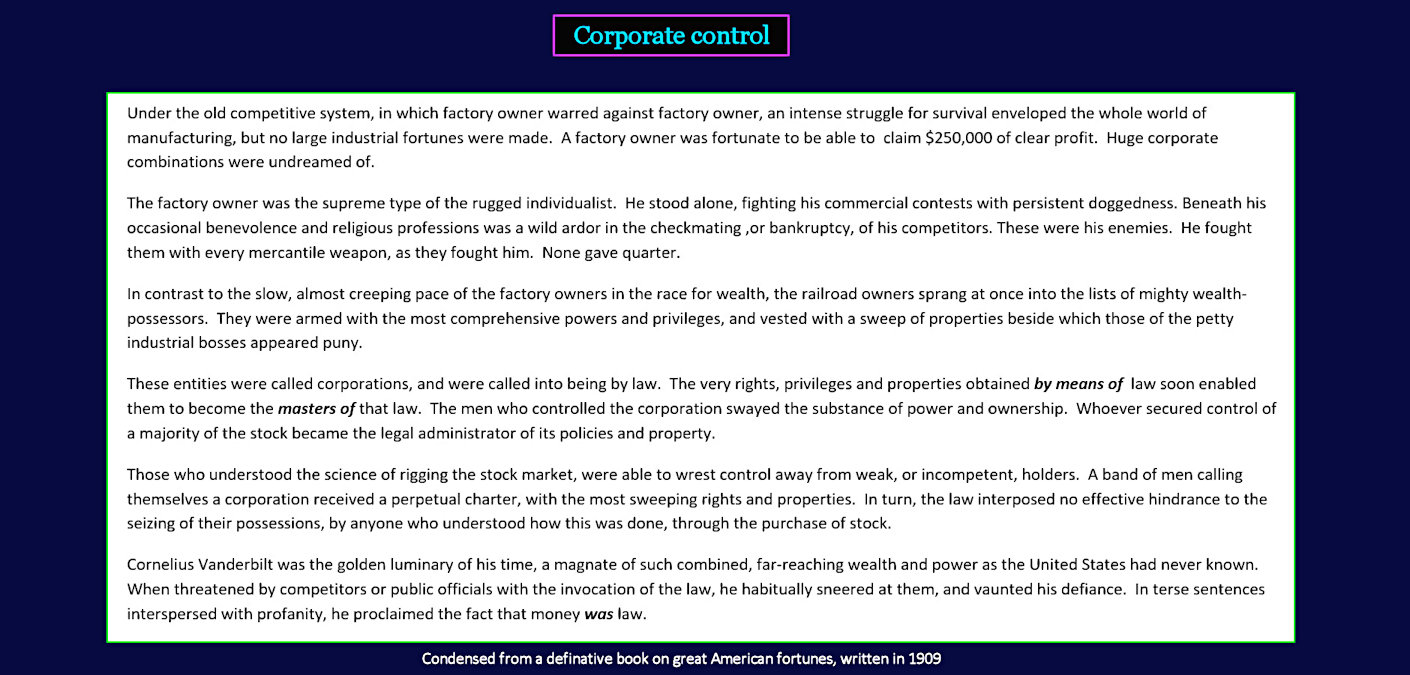
Who Owns the Stock? Railroads are the first giant corporations in the sense that we know them today, as sprawling networks of legal intricacies and hidden relationships. America has corporations from the earliest colonial days, but these are just legal conveniences for handling expenses that relate to an organization, such as a town or a church, as opposed to an individual. Later, in the early 1800s, corporations are established by state legislatures for limited projects, like building turnpikes, port facilities or canals. But corporations in the mid-1850s, formed by the public sale of stock, are something completely different. As ambitious Americans are discovering, corporations are controlled by whoever manages to acquire the largest number of shares. | |||||||||