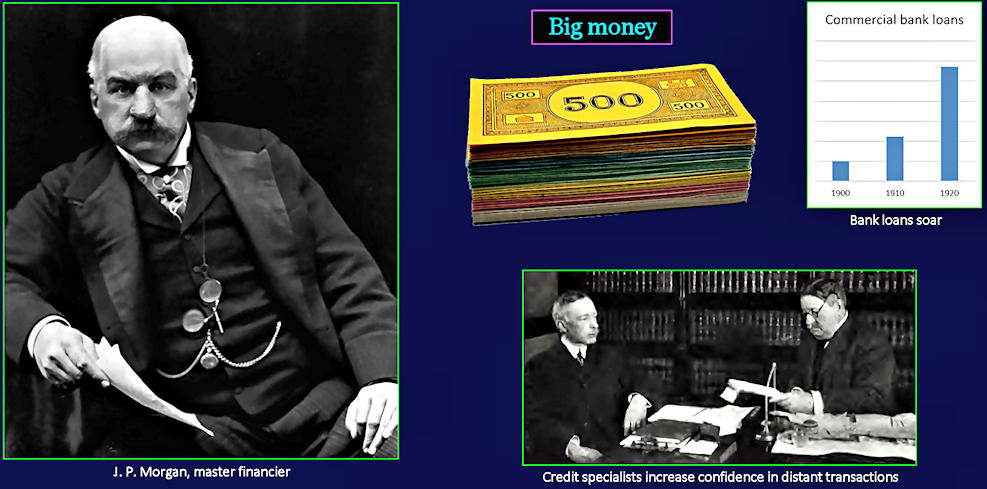
Financial InnovationsThis is also true of banks. The largest bank in the world is now based in New York, having merged with a string of rival banks during the 1920s. As it grows larger, it gradually transforms itself into an investment bank. Unlike commercial banks, which take in deposits and issue banknotes backed by these deposits, investment banks act as brokers, putting together deals between corporations and deep-pocketed investors, and charging advisory fees. The financial requirements of America's big corporations have grown far larger than commercial banks can manage, and investment banks now dominate corporate finance. New York is the center of this activity. |
| ||||||||||||||||
| |||||||||
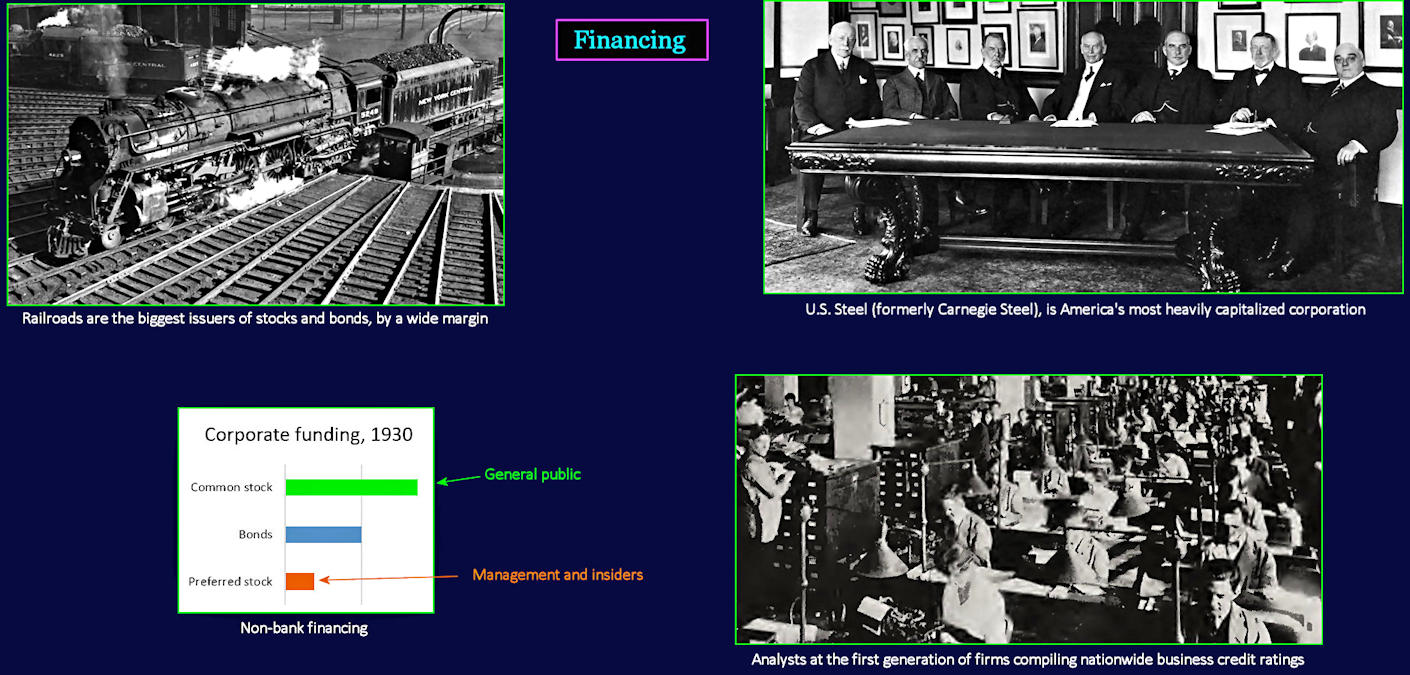
Stocks for Ordinary People Common stock is the clear favorite for financing large-scale operations, especially railroads. Of the 20 biggest stocks in 1917, 18 are railroads. When someone buys stock, they are actually purchasing a share of ownership in the business. The issuing company pockets the money, with no further financial obligation beyond paying out quarterly dividends (when profits allow). During periods of stable prices, stock investors are mainly interested in the dividends. Another factor favoring growth during this period is the appearance of independent networks of credit specialists. They allow businesses to check the credit-worthiness of distant customers in advance, lowering their risk. Products can thus be sold more widely, with greater confidence. | |||||||||
| |||||||||
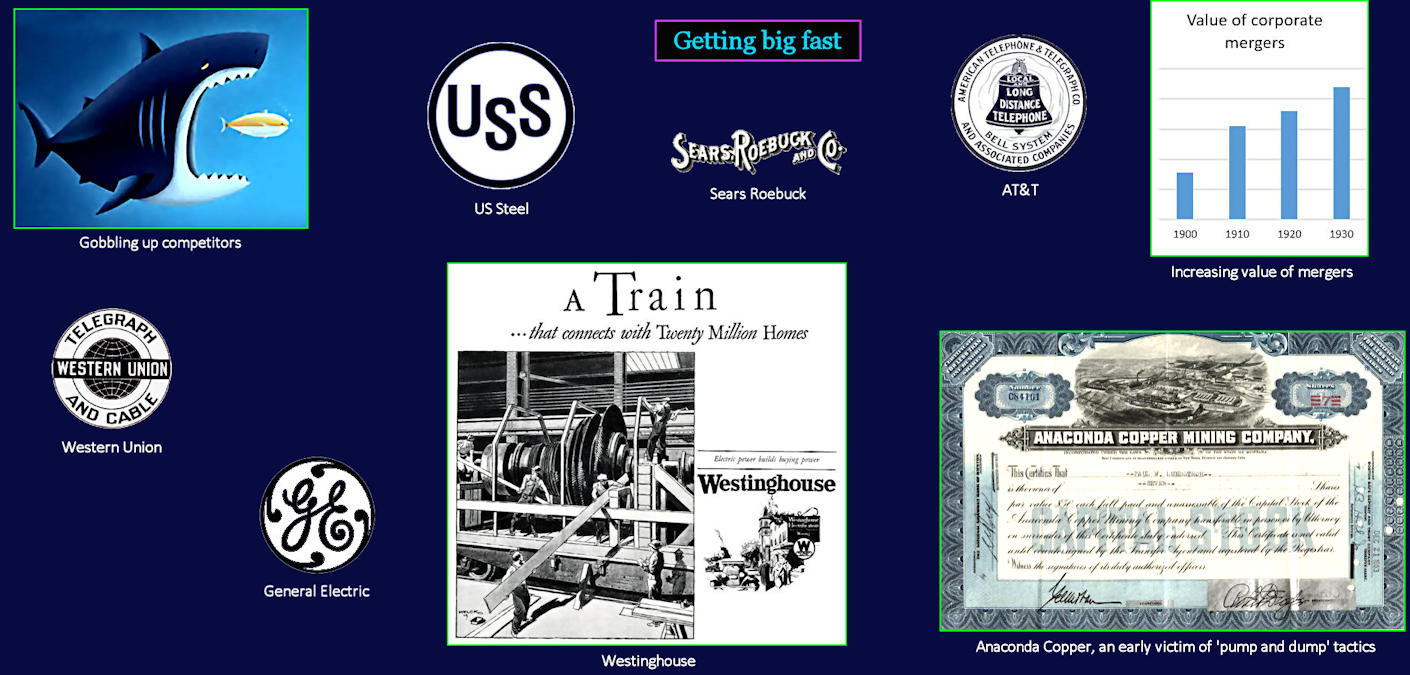
Acquisition Binge Big corporations are different from smaller manufacturing companies, in that they focus on growing big from day one. Many start off with large up-front investments arranged by New York banks. The whole game is to reduce costs with mass production methods, which then allows lowering prices enough to undercut the competition. This can eventually force competitors to sell out, or face financial ruin. There are also corporate takeover attempts via stock manipulation. The most notorious example involves Anaconda Copper, and John D. Rockefeller's brother, William. The logos displayed above identify some of the biggest non-railroad corporations. | |||||||||
| |||||||||
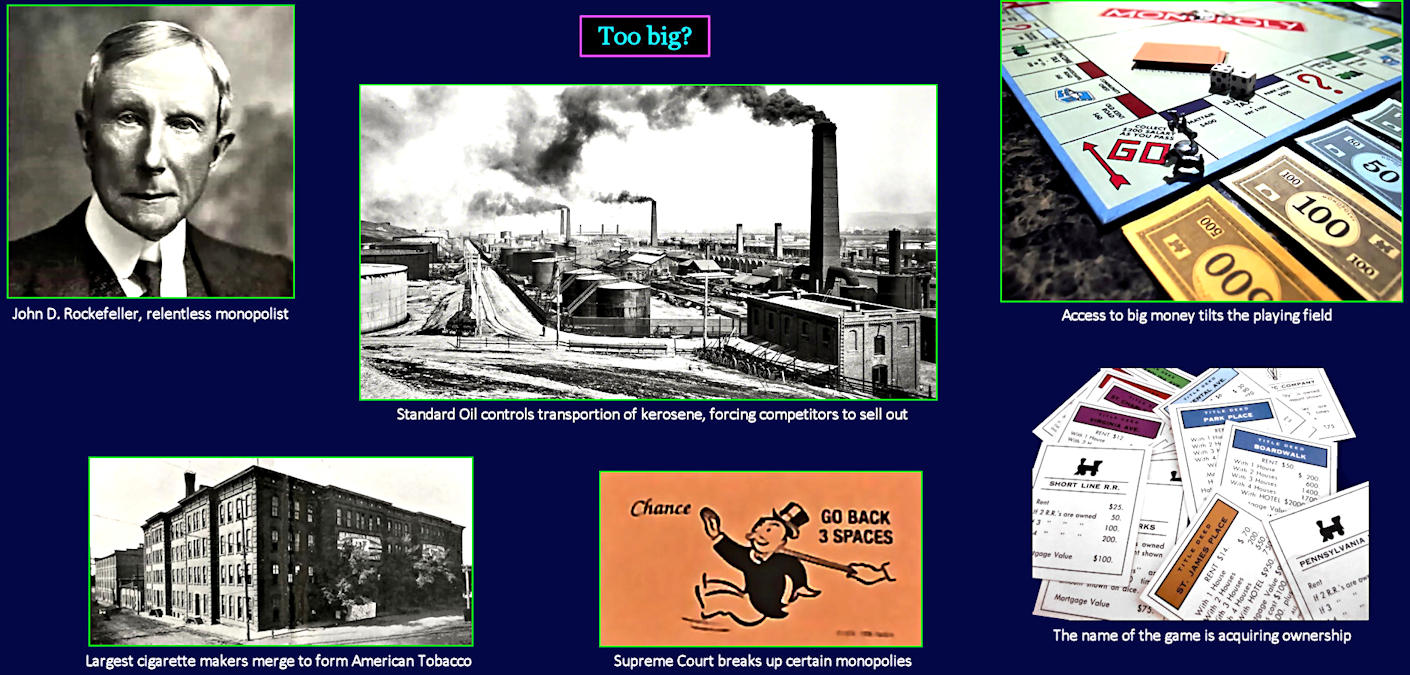
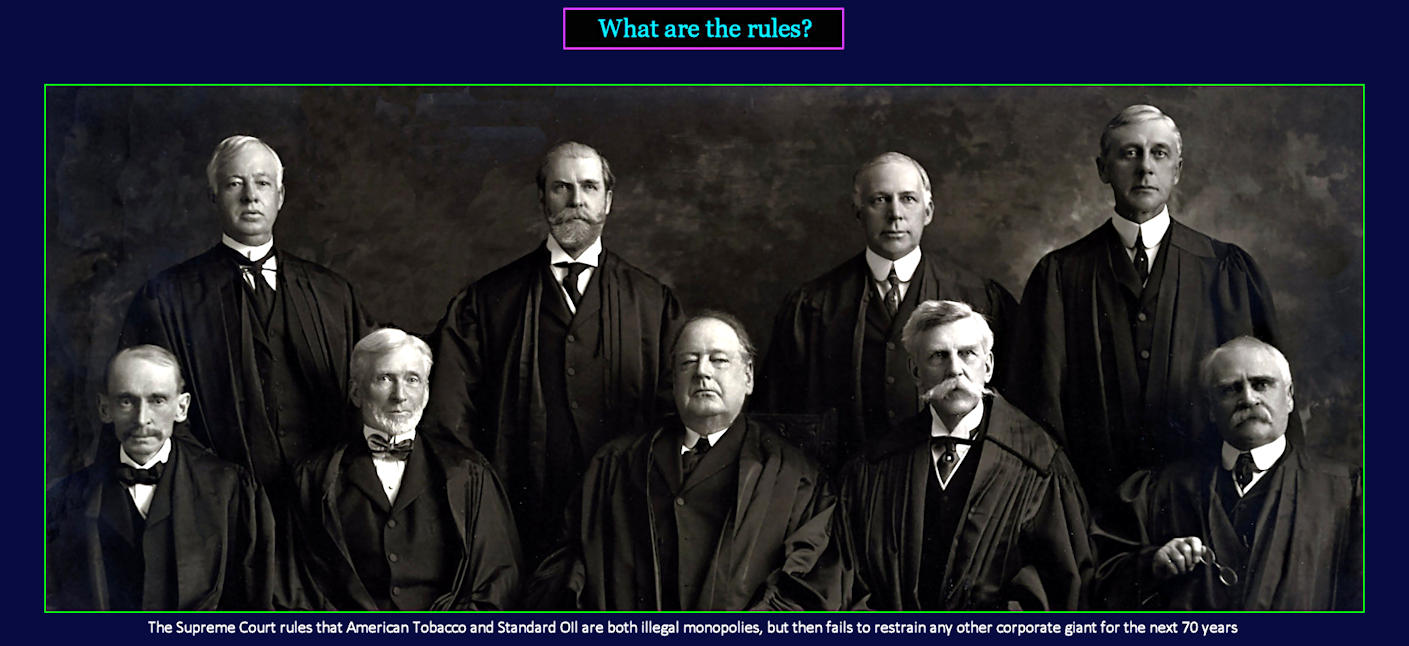
Pushing the Limits Inevitably, some industrialists take the game too far. John D. Rockefeller, who formed Standard Oil to refine petroleum into kerosene, hates competition. Any competition. He resorts to extreme tactics to absorb or ruin all his smaller rivals. Rockefeller persuades railroads to double the price for shipping kerosene, while secretly returning kickbacks to Rockefeller for his own shipments. This allows him to undercut competitor's prices. In addition, he cuts his rivals off from access to oil pipelines, which are the cheapest mode of transportation. The Supreme Court steps in, declaring that Standard Oil has restrained trade, and must be broken up. American Tobacco is also broken into pieces by the Court, in a separate case. | |||||||||
| |||||||||
Conservative Bastion The decision to break up American Tobacco in 1907 is relatively simple. The company had been created all at once, by merging the five biggest cigarette makers to form a single giant. This is a clear violation of prevailing views on healthy competition in markets. The Standard Oil breakup in 1911, however, is more complicated. Rockefeller's near-monopoly was built slowly, using means that are not technically illegal, but still result in the ability to charge rates that generate excessive profits. The Court rules that this constitutes illegal conduct. In subsequent cases, however, the Court finds it more difficult to define how big is too big, or which business methods are actually illegal. It doesn't order another break-up until 1984, when it splits up AT&T. | |||||||||
| |||||||||
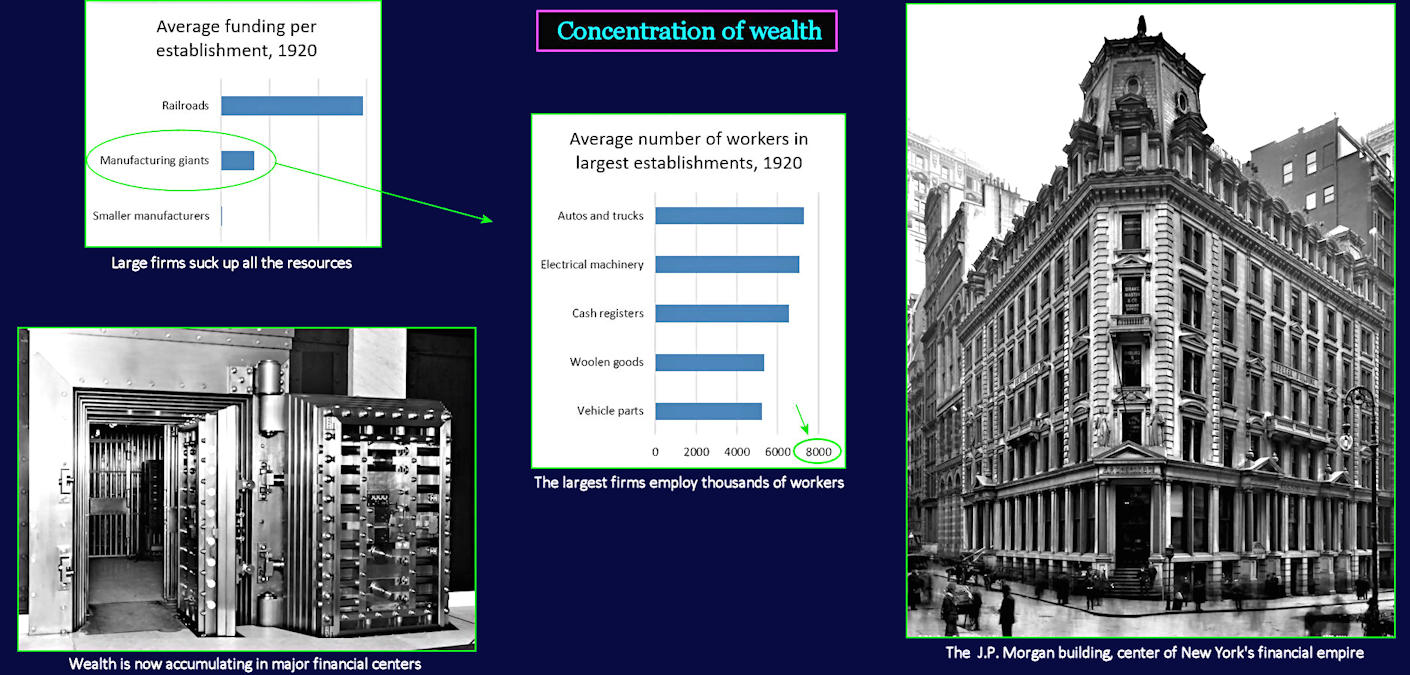
Unstoppable Giants Despite the break-up of two early monopolies, the continuing trend is towards the concentration of wealth in fewer and fewer hands. This trend persists to the present day. New manufacturing giants, led by Ford, are built on funding that is 200 times greater than that of the average manufacturer (barely visible, in chart at top left). The railroads are even bigger financial monsters. Huge financial deals are routinely engineered inside the biggest New York investment banks. Slowly but surely, business is being re-directed from regional banks into the hands of financial masterminds, hidden away in plush offices on top floors of the biggest New York firms (right). | |||||||||