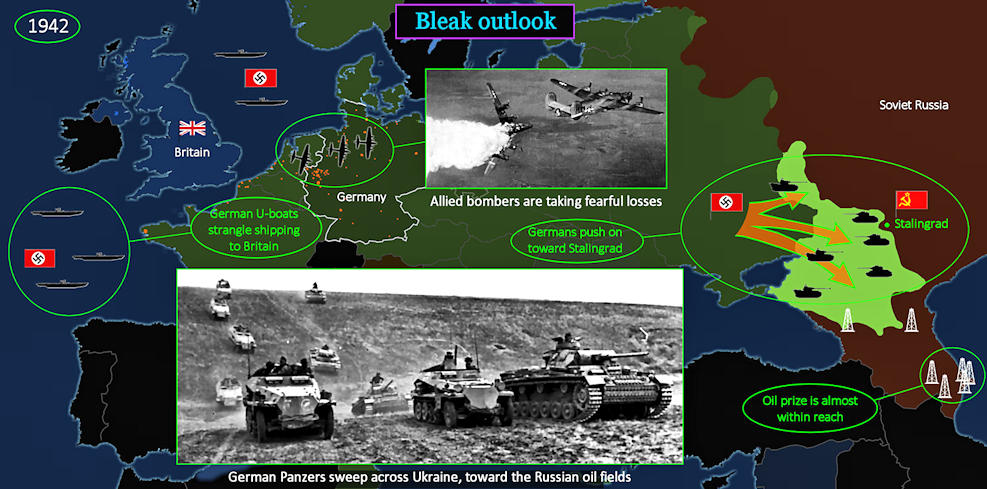
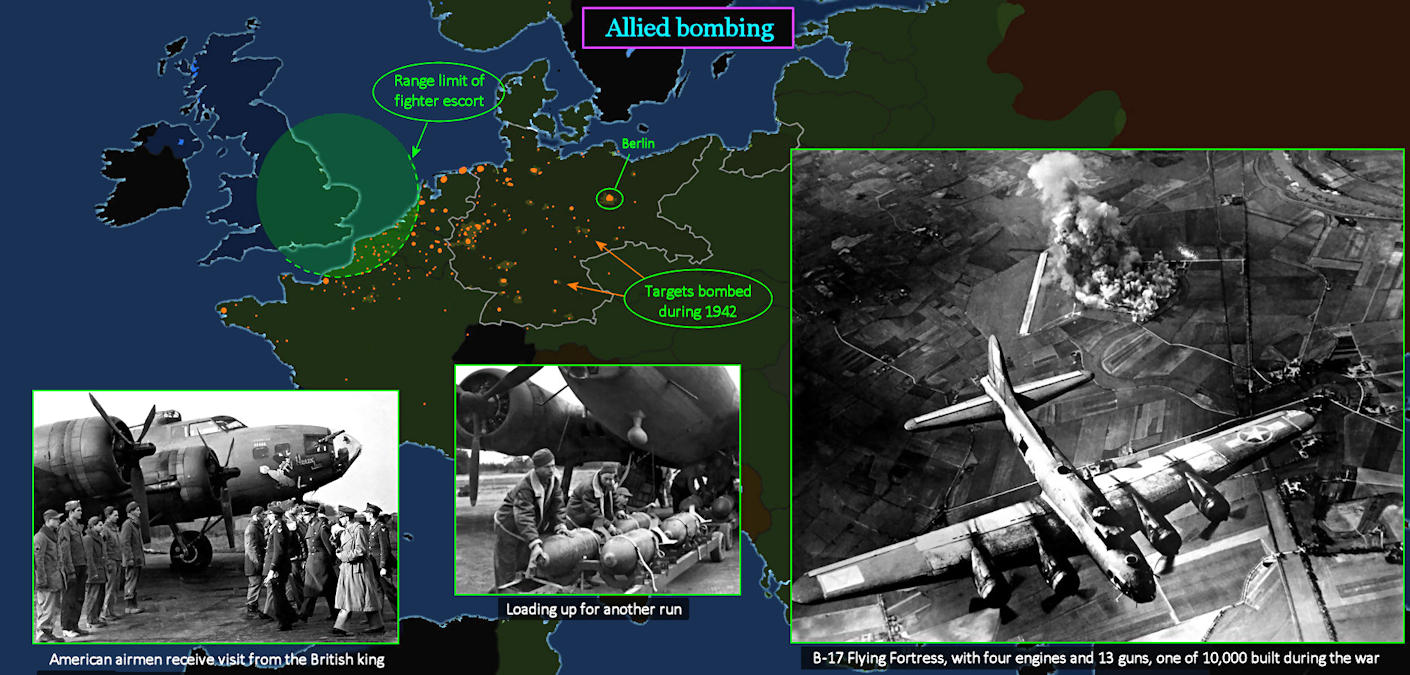
Big Job AheadThe outlook is grim at the start of 1942. America is just getting started, while Britain is still struggling to replace equipment abandoned in the evacuation from Dunkirk, and cleaning up from the bombing of London. Although Hitler has been forced to give up his attempt to invade Britain, his campaign to crush the Soviets has gotten off to a fast start. All the Allies can manage, in response, is a fairly disastrous bombing campaign. With only short-range fighter support, the loss rate during early bombing raids approaches 50%. The Allies soon learn to mount larger missions, with up to 1,000 bombers, in an effort to overwhelm German radar. Meanwhile, it's open season for German U-boats now prowling all up and down America's eastern coast, sinking freighters and tankers at will. Early action in the Pacific favors the Americans, but not without loss. |
| ||||||||||||||||
| |||||||||
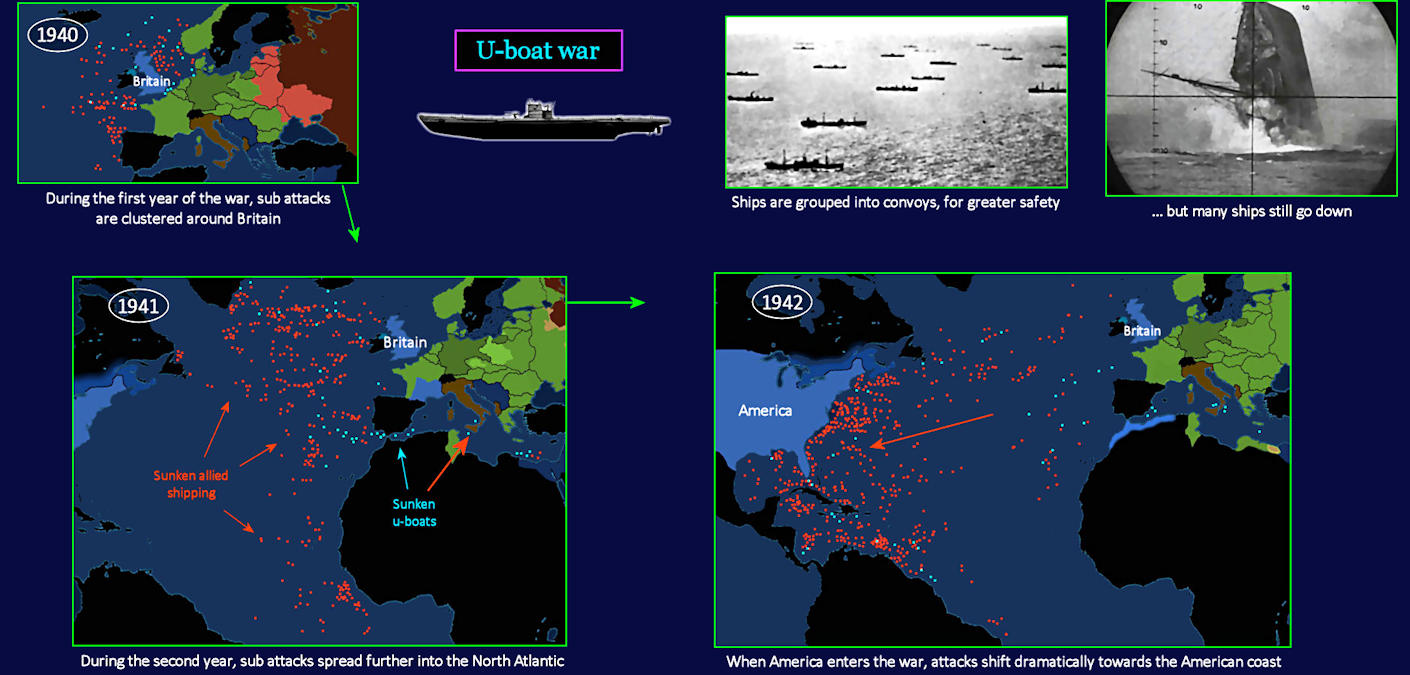
Subs Surround America When the Japanese attack Pearl Harbor, America responds by declaring war on Japan, but not Germany. Hitler, however, pounces on the news to suddenly declare war on America, a move he previously resisted. This allows him to shift his submarine attack from the large expanse of the North Atlantic, to the much more concentrated target of the American East Coast (lower right). Almost all support for the Allied war effort is shipped from American ports, and German U-boats can now choke this off with almost no loss. U-boat commanders call it the 'happy time,' attacking boldly on the surface, using just the gun on the foredeck. They sink 600 vessels. The Americans can mount almost no defense to this, at first. | |||||||||
| |||||||||
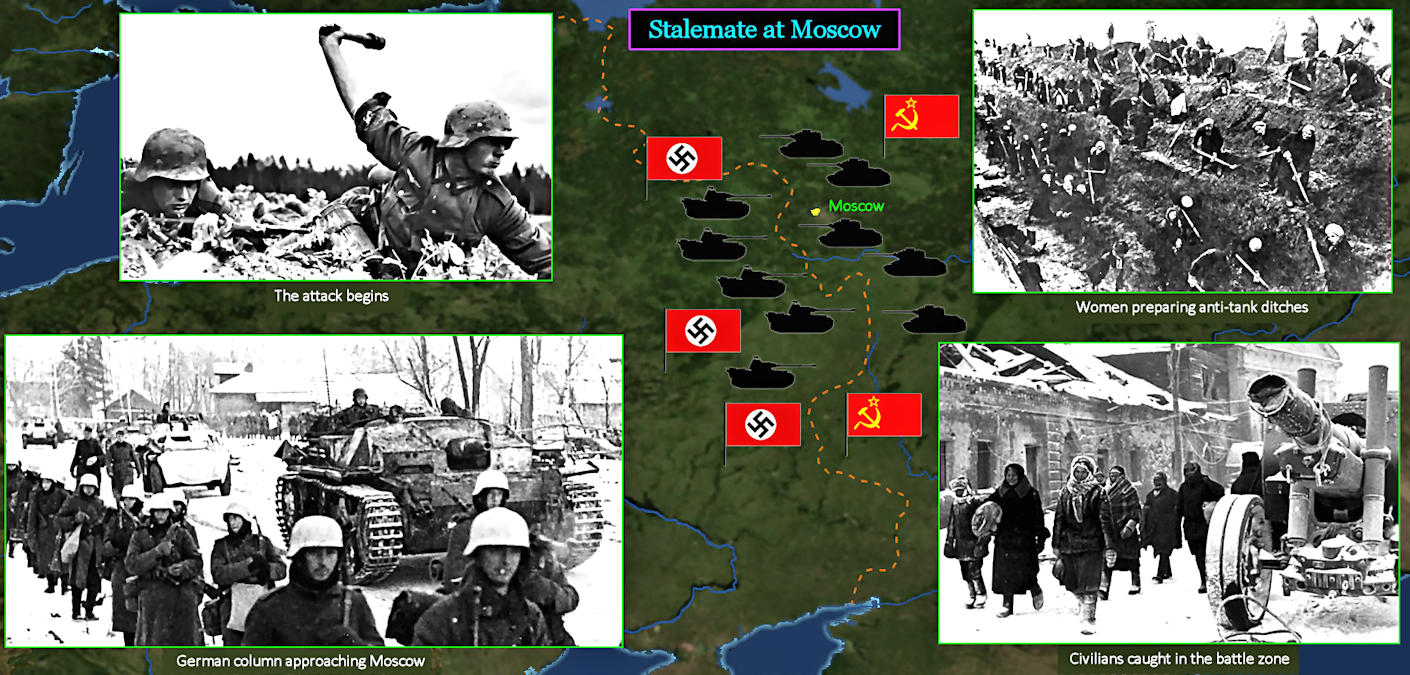
Winter Surprise The situation for the Russians appears nearly hopeless, as the Germans continue to pursue the battered Soviets back towards Moscow, where they dig in for a final stand. The Germans are within 100 miles of the city by October, when temperatures fall, and the weather worsens. Mud slows the German advance, and re-supply convoys through hostile territory lack enough trucks. Most have been lost in previous actions. Without proper winter clothing, the German advance stalls just as winter blizzards begin. In the end, they are unable to take the city, after losing a million men. Amazing. Hitler's dreaded Panzers have been stopped, at least for now. | |||||||||
| |||||||||
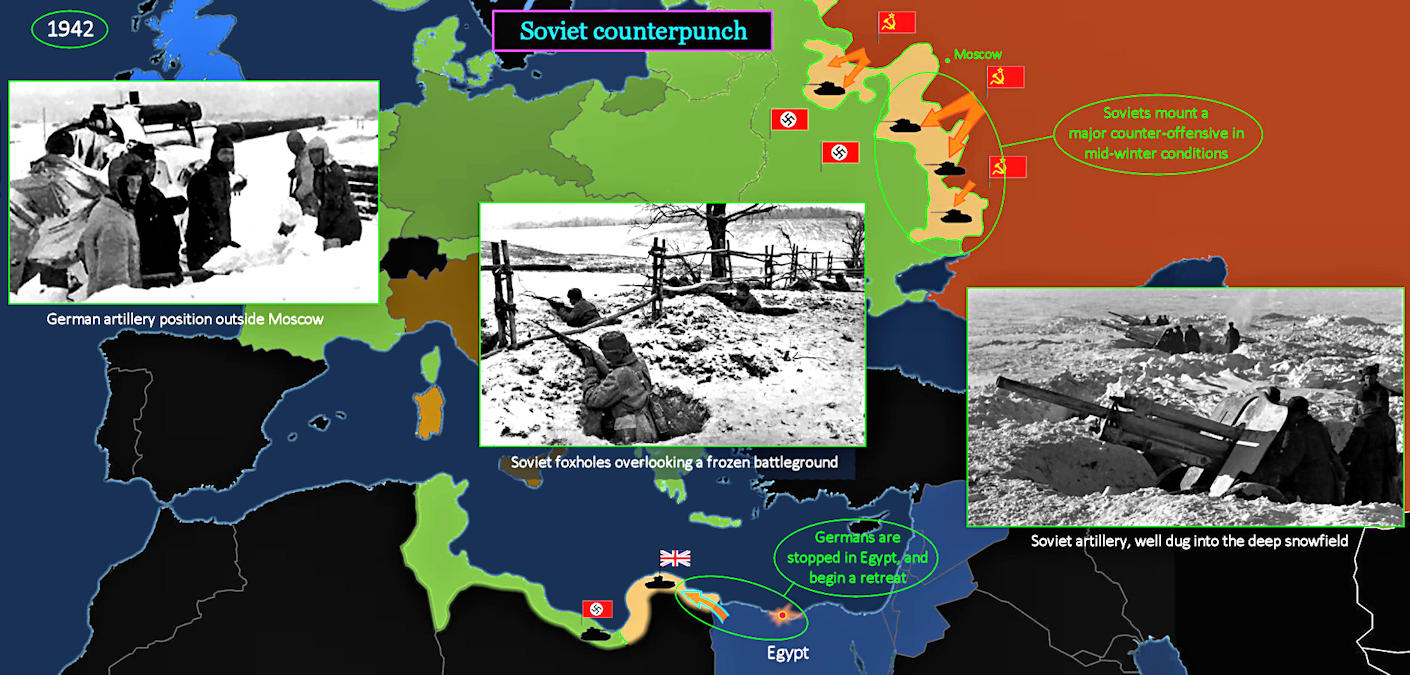
Germans Pushed Back The first really good news in the war comes at the very end of 1941. Stalin is able to transfer large reserves of fresh troops and tanks from Siberia, where they were being held to forestall an expected Japanese attack that never materialized. After stopping the German offensive just outside Moscow, the Soviets are able to mount a powerful counter-attack in mid-December. The exhausted Germans are pushed back all along the front (top right). At this point, each side is still fielding an army of over a million troops, with thousands of tanks. The Soviet attack is eventually stopped in January, after a moderation in the record-cold weather (-40° F). Meanwhile, the Germans suffer their first defeat in North Africa in a decisive tank battle, and are turned back (bottom of map). | |||||||||
| |||||||||
Targets Everywhere Despite losses, the Allies step up the bombing campaign against industrial targets vital to the German war effort, including almost all the big cities. The prime targets are protected by multiple rings of radar-supported anti-aircraft batteries, but the relentless bombing continues. Analysts eventually conclude that close to 90% of all bombs fail to hit their intended targets, falling instead on surrounding residential areas, and causing widespread civilian casualties. This appears unavoidable to Allied planners, who reason that civilians can actually be considered legitimate targets, since many work in the factories that are the actual targets. Bombers also attack canals, railroads and shipping centers, causing serious disruption to the German supply chain. | |||||||||
| |||||||||
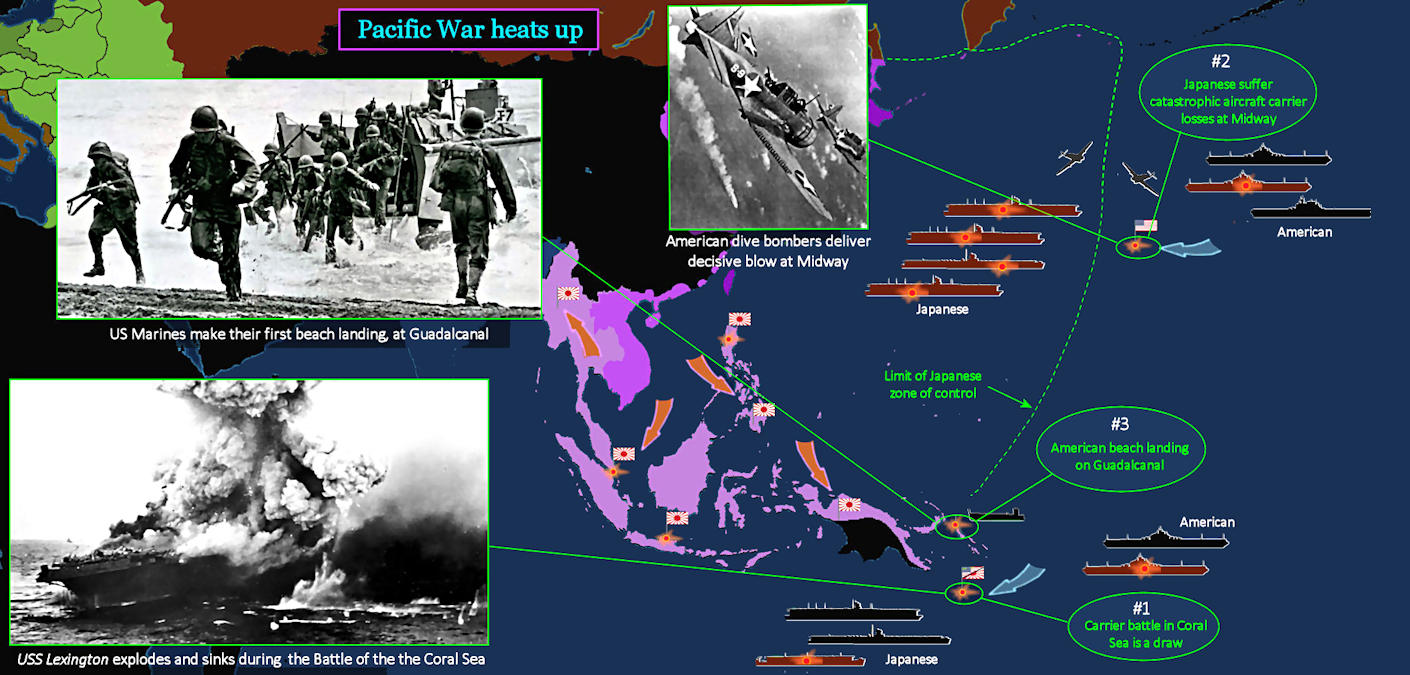
America Gets Going For America, the struggle against the Japanese in the Pacific is the real war, where aircraft carriers will be indispensable to victory. The US has only two carriers in the Pacific when Pearl Harbor is attacked, but both escape destruction because they're out on missions on the day of the attack. The first big naval battle of the war is a fleet action in the Coral Sea, in which both sides take losses, with no clear winner (#1, in WHITE). Then comes the decisive Battle of Midway, where breaking of the Japanese code helps enable American victory (#2). Through a combination of perseverance and good fortune, the entire Japanese carrier force is destroyed, a crushing blow from which Japan never recovers. America's attack on Japanese-held islands begins at Guadalcanal. | |||||||||