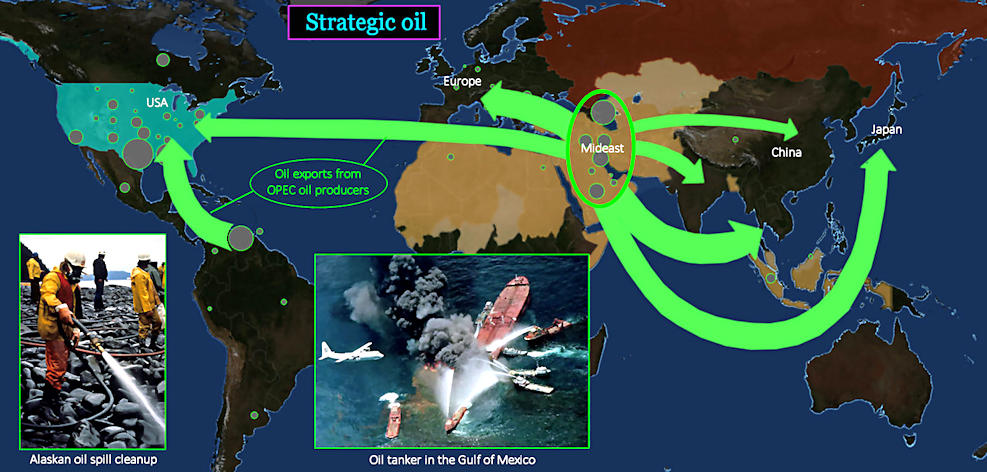
Global VillageAs the 1990s unfold, America is firmly back in the driver's seat. Without pushback from Russia, Washington has regained its place as the center of the universe. Oil flows return to normal, as the Middle East settles down. Without Soviet support of conflict, the world is also now a much quieter place, except for the continuing chaos in the former Yugoslavia. Even there, however, a UN-imposed 'no-fly' zone keeps the pot from boiling over. The new normal revolves around oil, which is strangely concentrated in just two places, the Americas, and the Middle East. Europe, China and Japan have little oil of their own, and are forced to import from the Mideast. America, under President Clinton, is the traffic cop for much of world commerce, which is dominated by oil revenues. The US is still a net importer of oil, however, as its large shale-oil fields have not yet been developed. |
| ||||||||||||||||
| |||||||||
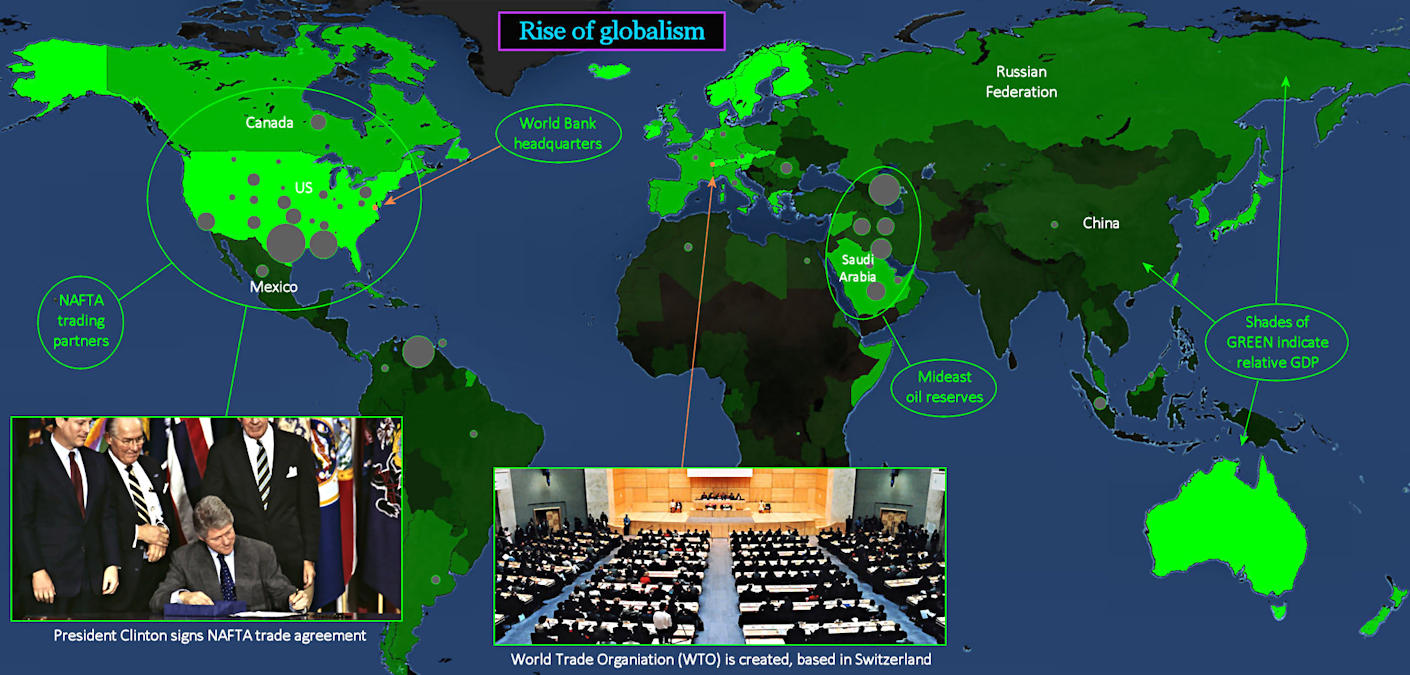
Globalists in Control By the mid-1990s, a new surge of global awareness has penetrated deeply into the thinking of economic planners. They champion a reduction of anything that impedes world trade, which is seen as the magic that produces economic efficiency. The new World Trade Organization (WTO) is created to be the traffic cop. In America, Clinton signs a new 'NAFTA' trade pact with neighboring Canada and Mexico, to reduce trade restrictions. Meanwhile, giant global corporations are moving their industrial production to low-cost Asian countries. 'Globalists' are eager to exploit the 30-50% reduction in labor costs that can be achieved by shutting down aging American factories, and building new ones in Asia. This is called 'offshoring.' | |||||||||
| |||||||||
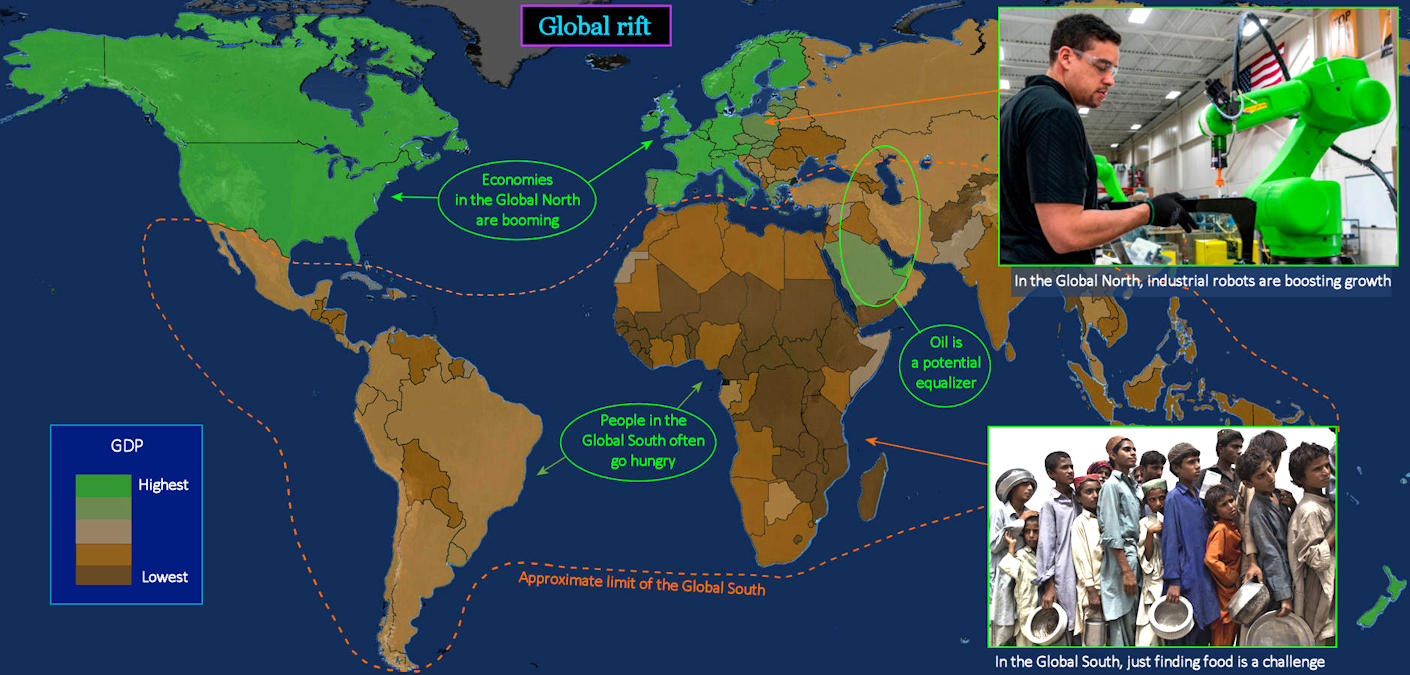
Two Worlds With the new focus on global connections, it becomes increasingly obvious that the world has quietly drifted into a polarized condition. Almost all the global wealth is concentrated in the north. The unequal distribution of oilfields on the planet is mirrored by a similar pattern in the location of coal fields. Over time, this has resulted in a lop-sided pattern of industrial development. With abundant fuels, industrial cities have developed almost everywhere in the Global North, while Africa is dominated by a barren desert of sand in the north, and a matching industrial desert in the south. A similar imbalance exists in global power. The Americans have an outsized share, while the Global south has only the income from exported Mideast oil. | |||||||||
| |||||||||
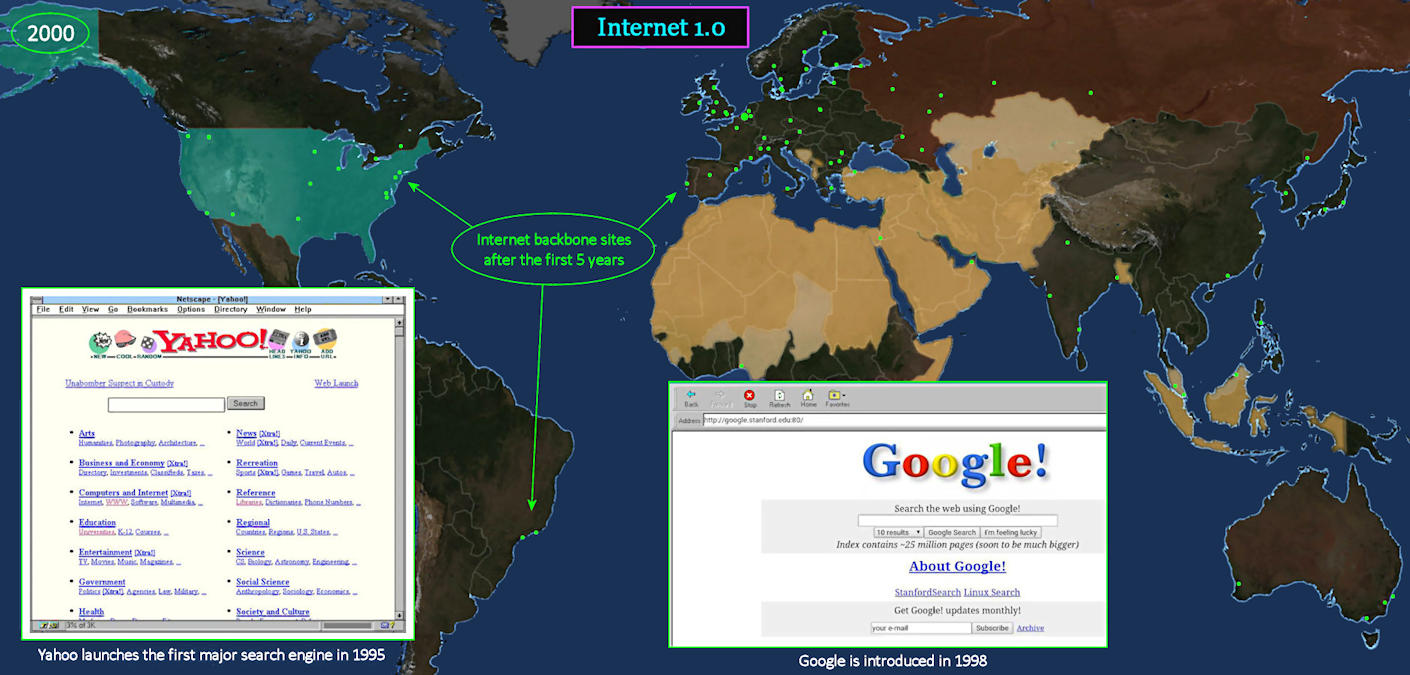
Digital Big Bang Suddenly, in 1995, the world is transformed by a seismic event. The arrival of the internet. At first, it's little more than a resource for academics, but soon enough balloons into global prominence, adopted by corporations at every level. This is a huge boost to corporate globalists, who no longer have to rely on satellites, or undersea cables, to maintain communication with their distant facilities. Suddenly, they're all part of a single vast organism, with instant delivery of information, and data. This concentrates the ability of global giants to extract wealth from every corner of the planet, sending it directly to a handful of financial capitals. New York, London and Paris now form an elite club sucking up the bulk of world output. Beijing will soon join the club. | |||||||||
| |||||||||
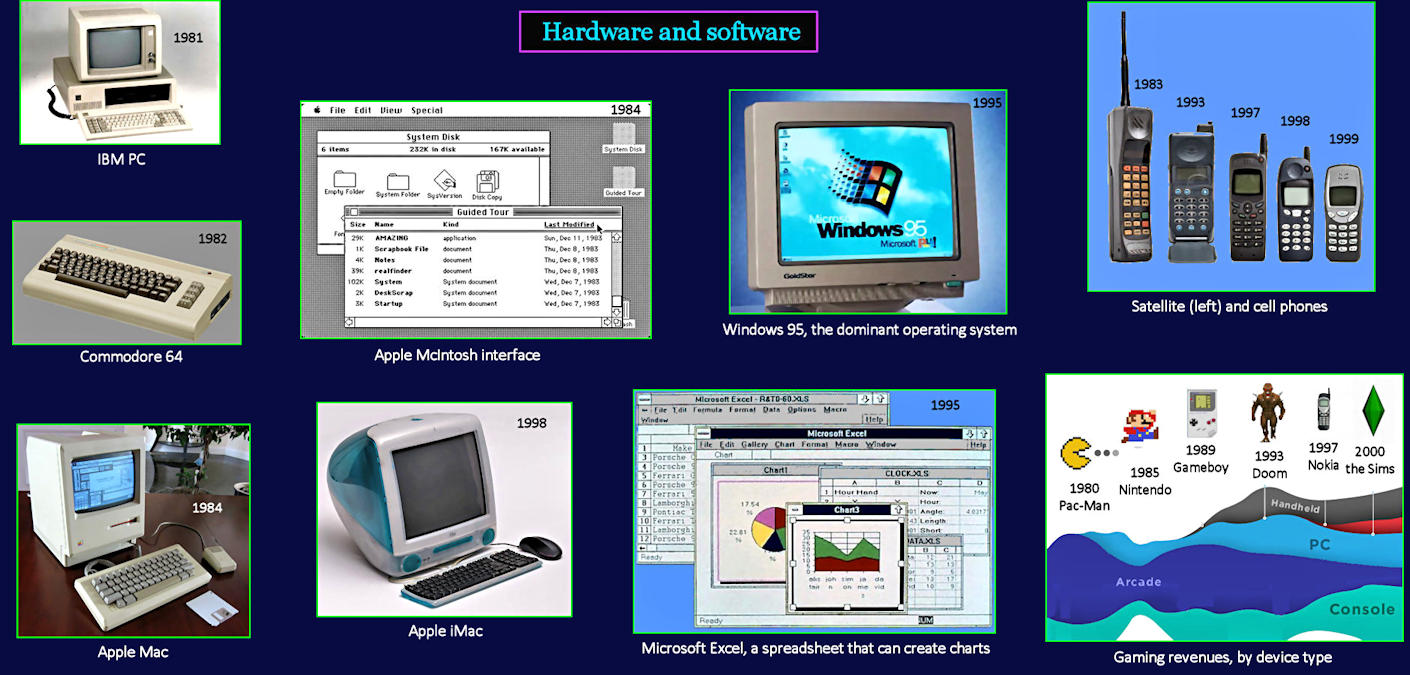
Fun, Games and Spreadsheets Big mainframe computers helped astronauts return safely from the moon, 30 years earlier. Since then, large corporations have used them to manage their complex internal accounting, in their own private data centers. But the new desktop computers ramp innovation up several notches, by distributing computer power to every desktop. It's difficult to overstate the effect this has on human ingenuity. Not only is it now much easier to communicate with friends, but corporate managers can now oversee entire global production networks from their office chair. Centralized control is the name of the game. Slowly, corporations learn to leverage new network-enabled software to micro-manage workers, in a relentlessly performance-driven workplace. | |||||||||
| |||||||||
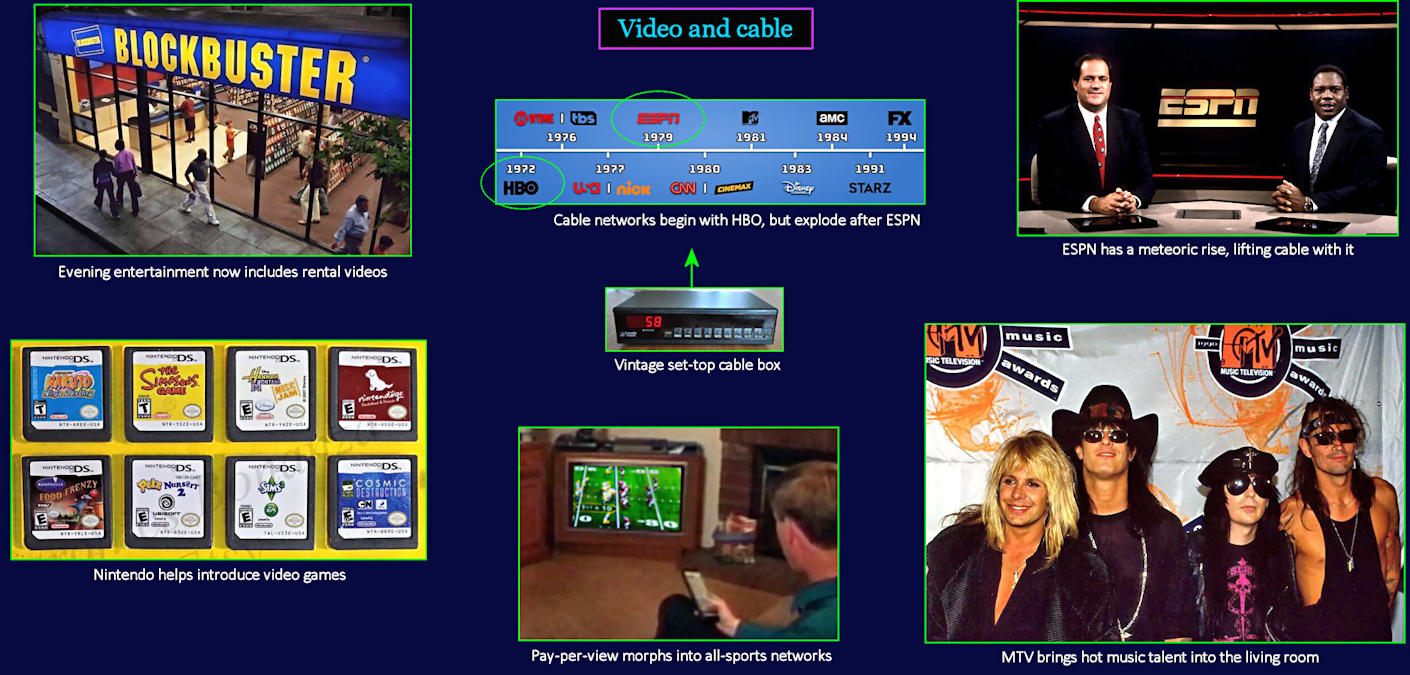
Fun at Home Meanwhile, the digital age also livens up everyday life for Americans in their own homes. Video disk rentals become an essential ingredient of evening entertainment, while ESPN is now delivering NFL football directly into living rooms, via cable. Music-lovers are treated to the fabulous new world of music videos, thanks to MTV. Predictably, all this enthusiasm spawns a fresh wave of mergers and acquisitions, as corporations scramble to lock up the seemingly endless potential of digital processing. | |||||||||