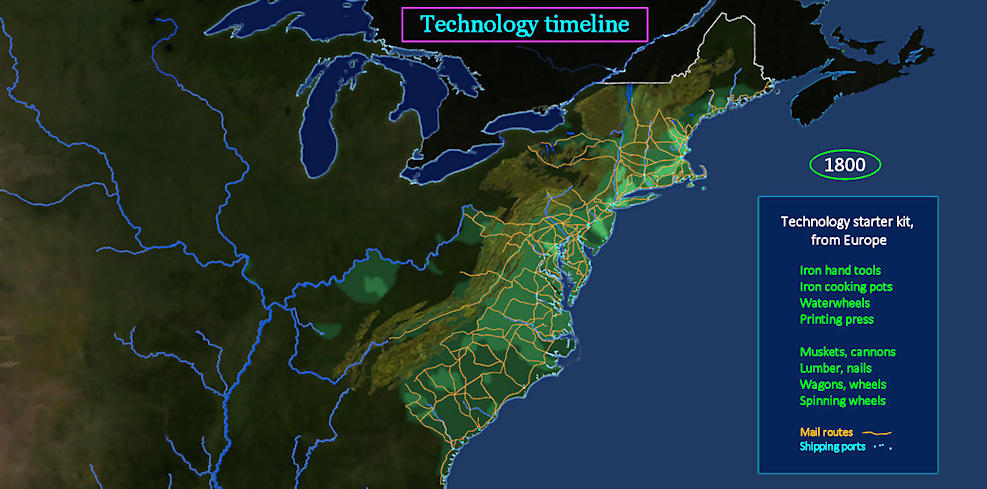
Summing UpAs we wrap up the final chapter in the American story, we take the final two pages to summarize the advances in technology which have boosted life on earth to its current frenzied pace of production and consumption. Back in 1992, Bill Clinton popularizes the slogan 'It's the economy, stupid!' as his election theme. In other words, don't get lost in the weeks, but focus on the single biggest issue. In 1992, this is the economy. Today, we might substitute the word 'technology' for the word 'economy.' If there is a single dominant force at work in the world today, it is the influence of technology. Looking back, we can see this began abruptly, around 1800. |
| ||||||||||||||||
| |||||||||
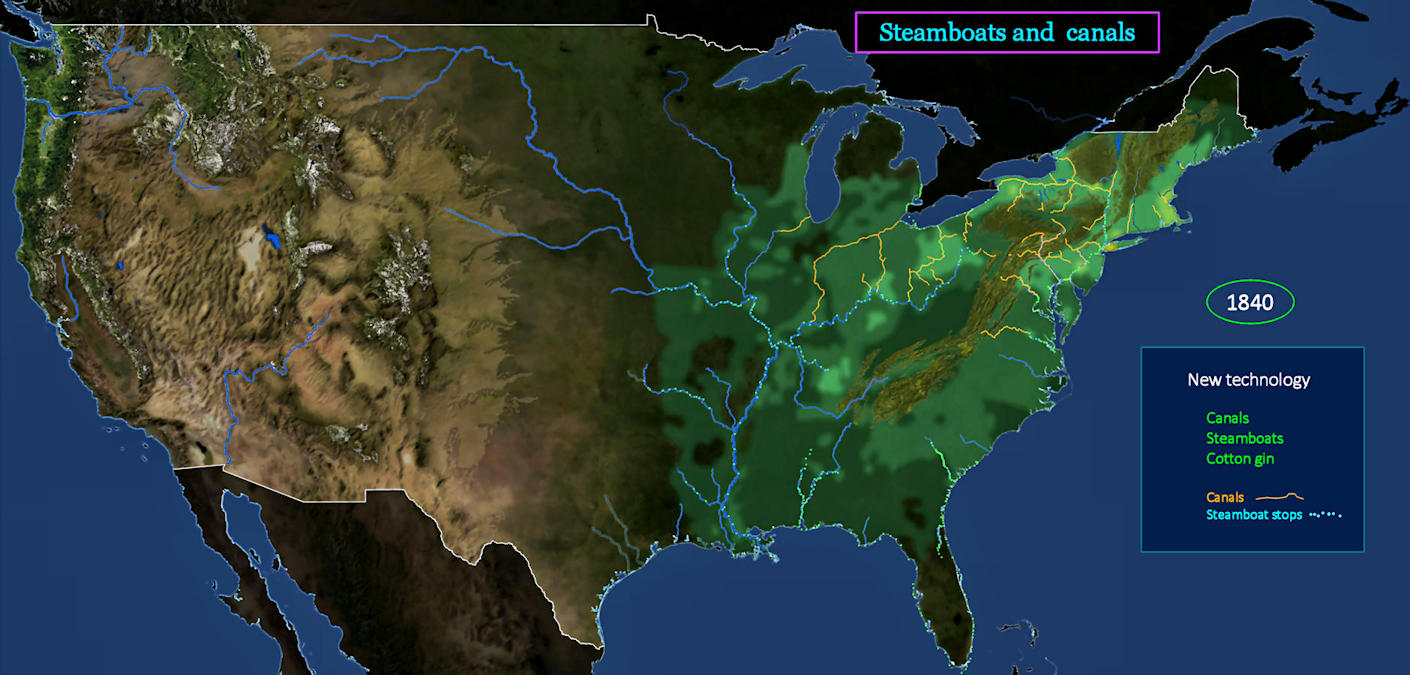
Arrival of Steam The next big event is the launch of the first successful steam-powered vessel, in 1806. Steam engines are developed earlier, in Britain, but don't find an application in America until adapted to vessels. They become an instant hit, arriving at precisely the moment that canals also begin to appear. A canal is a man-made ditch to create an artificial 'river' where none exists in nature. At this time, river transport is by far the dominant force in commerce, but navigable rivers don't exist in many places. Canals are dug to extend the reach of vessels, and to provide connections between the Great Lakes and Ohio and Mississippi rivers. The canal-building era is largely over by 1840, though this map includes canals built up to 1850 (ORANGE lines). Dots are steamboat stops. | |||||||||
| |||||||||
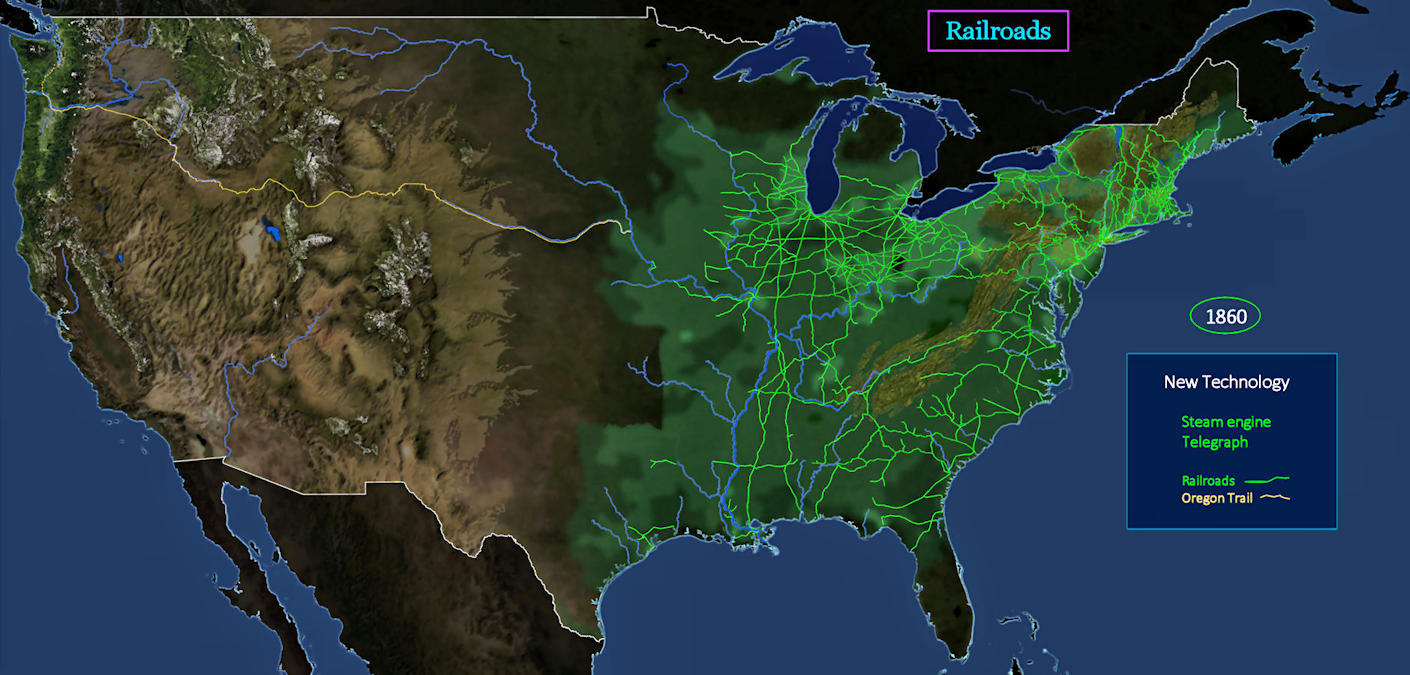
The Main Event Steamboats continue to be important right up to 1900, but canals quickly lose traffic to the much faster, and more versatile railroads. Locomotives use a smaller, improved steam engine to pull rail cars on iron rails, and begin to displace canal traffic at about the time the canal era is peaking, in 1840. The map shown here is from 1860, the time of the Civil War, when rail lines extend all the way to the Mississippi River. By this time, telegraphs are being used to send messages over wires, which are mounted on poles, to link railroad stations. This allows train dispatchers to track train movements, in almost-real time. | |||||||||
| |||||||||
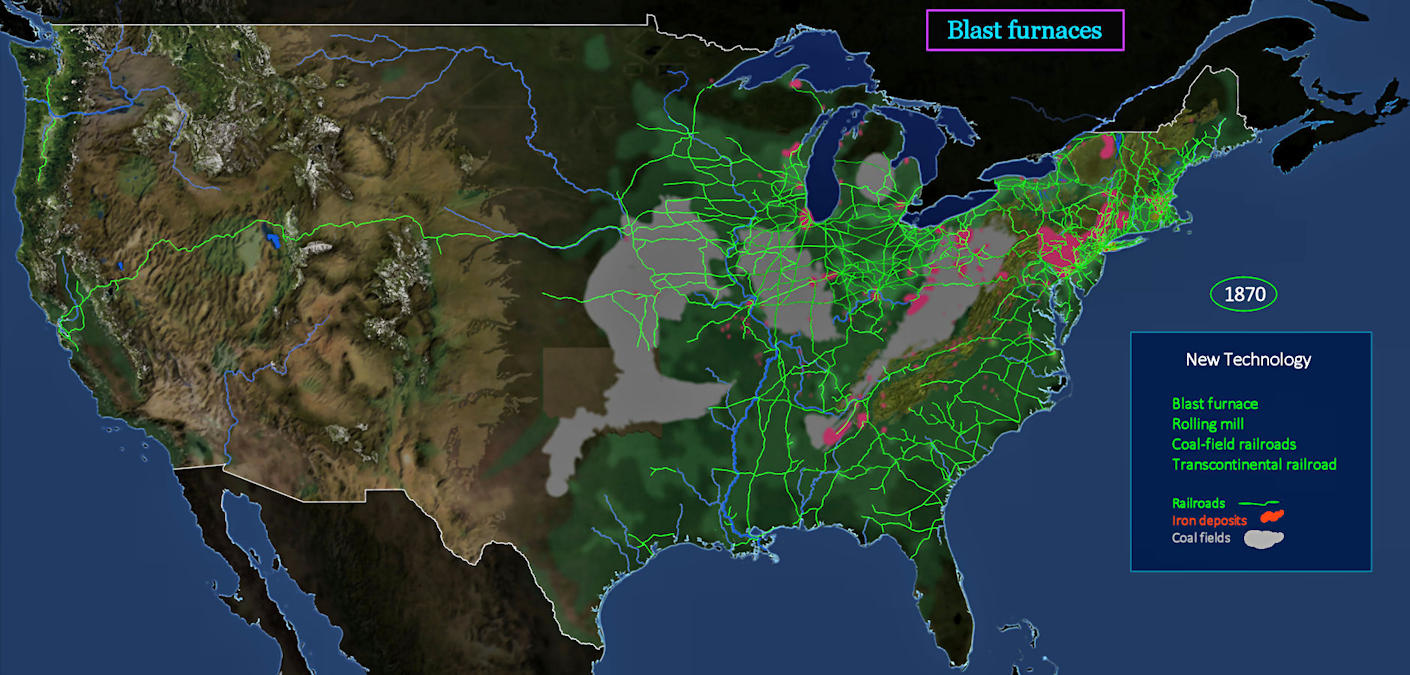
More Iron Americans are producing iron almost from their first days in America, but the process is tedious, and only produces small amounts. Things begin to change after the Civil War, when coal fields are exploited by rail, to produce much larger batches of iron in bigger blast furnaces. The new ingredient is availability of an abundant new fuel, coal, to heat the furnaces. Prior to this, charcoal is the only choice, produced slowly and in small batches by burning piles of wood under a blanket of soil. | |||||||||
| |||||||||
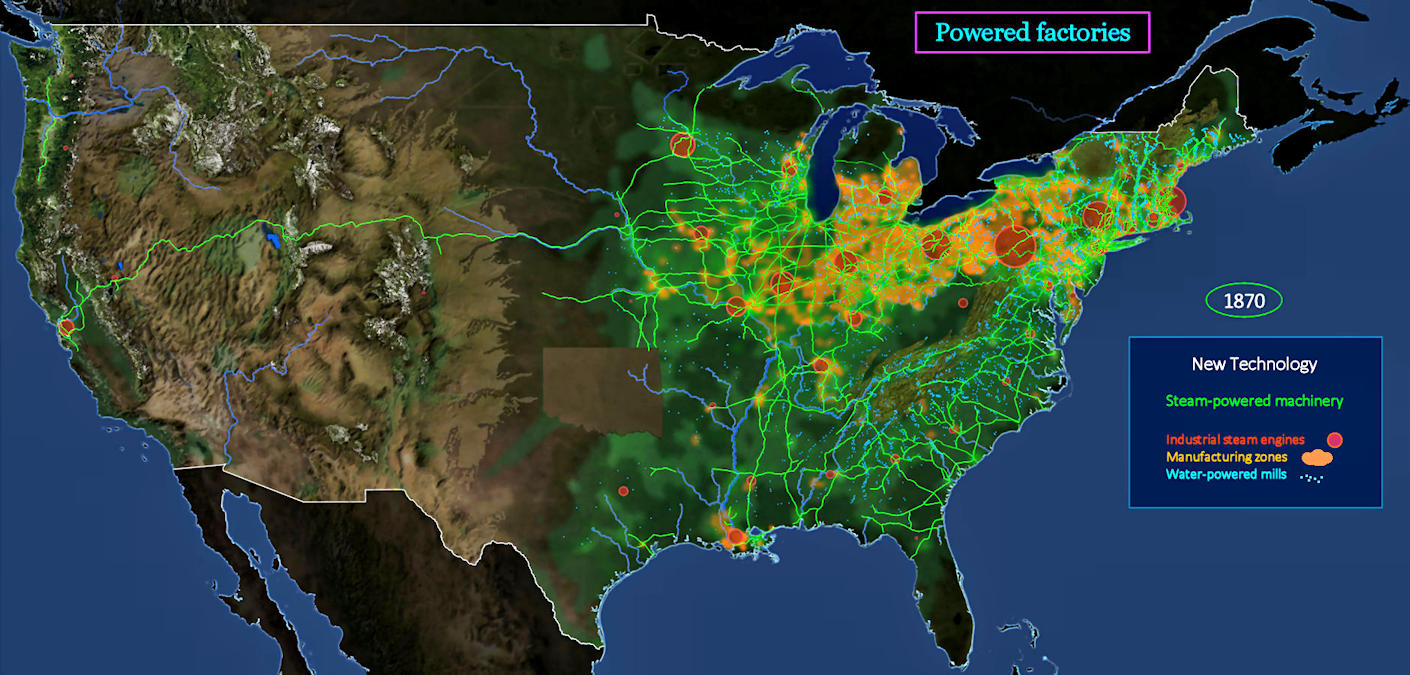
Available Everywhere This advance doesn't involve new technology, but rather an extension of existing technology to new uses. Prior to this time, steam engines are used to move people and freight. Stationary steam engines are now being used to power stationary equipment. This provides a big boost to manufacturing, which has been developing slowly, using manual methods, until the Civil War. Central steam engines now power entire factories, while lumber and flour mills still use waterwheels, which don't require any fuel. | |||||||||
| |||||||||
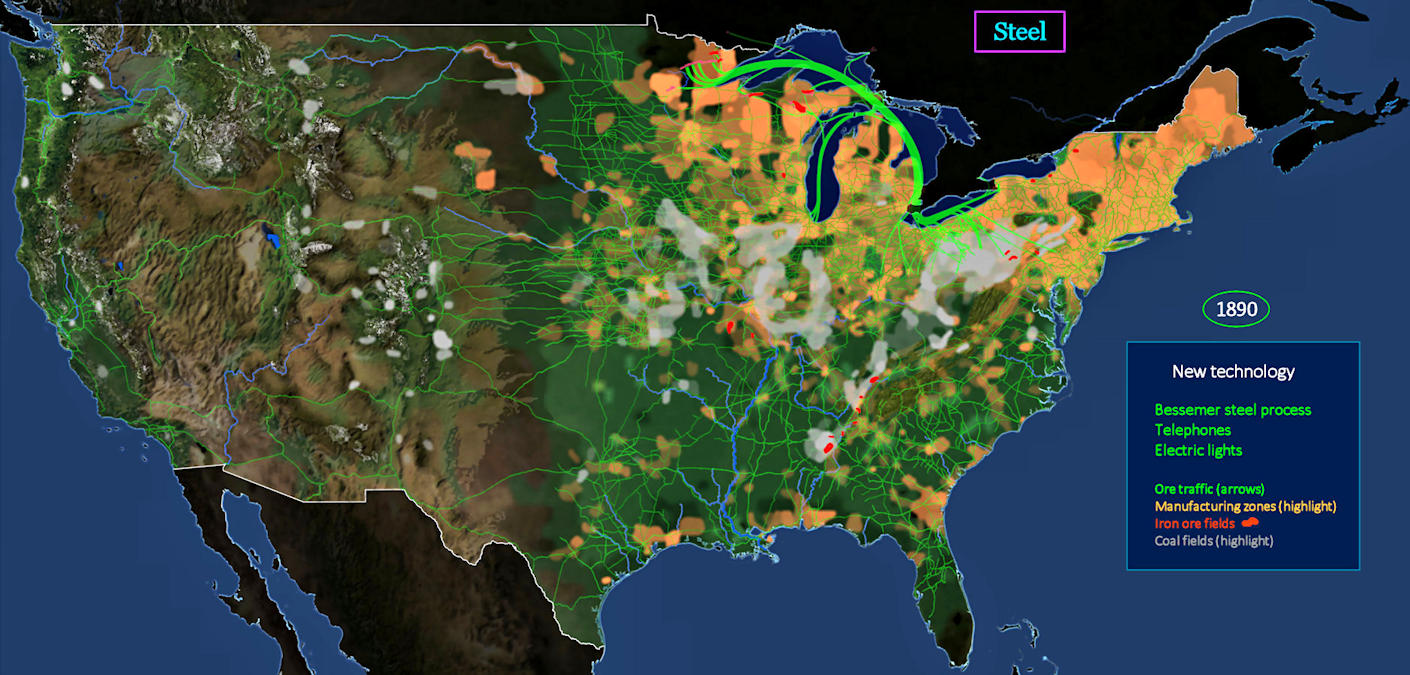
Big Upgrade Steel is made from iron, modified only slightly to control the carbon content, but the change in material properties is dramatic. Steel has toughness that iron lacks, permitting it to flex under load, rather than crack. It can also take higher loads. Steel girders can span longer distances for bridges, while railroads find that steel rails last 10 times longer, in service, than iron rails. Steel cable is used to support suspension bridges, like the amazing Brooklyn Bridge. The new Bessemer steel-making process makes steel suddenly much cheaper to produce, while new 'steam shovels' allow rapid strip-mining of both iron ore and coal. | |||||||||