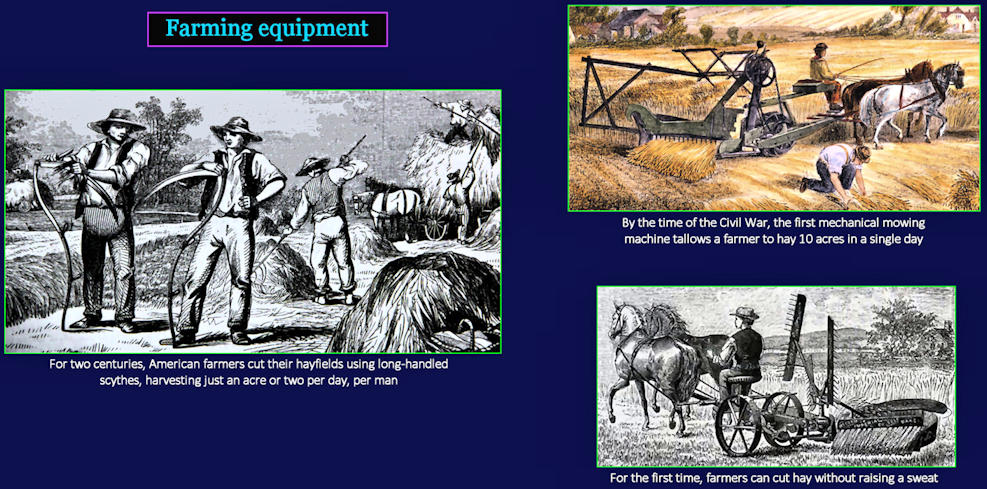
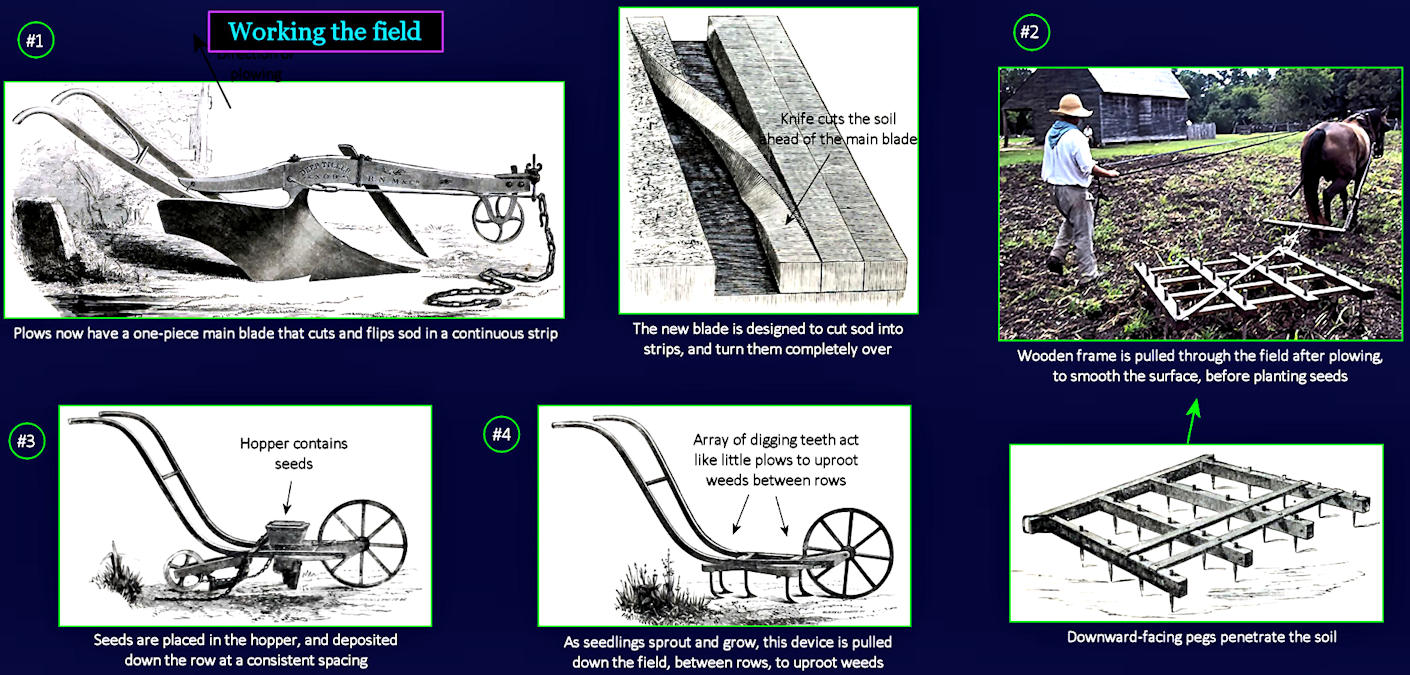
Machines on the FarmWhile America is still learning how to harness the full potential of steam power, life on the farm barely changes. The first big improvement doesn't come until mid-century, when plows with one-piece steel blades begin to appear. This is a big deal in the Midwest, where settlers are able to use the new plow to cut through regions of thick prairie grass. The dense root pattern of the grass extends down several feet, defeating most efforts with previous plows. At the same time, new mowing equipment is now available which can harvest a hayfield in just a fraction of the time it would take with hand-held scythes. The new thresher is still pulled by horses, but is entirely mechanical. |
| ||||||||||||||||
| |||||||||
Mostly Muscle Mechanical reapers are still beyond the means of most farm families, but the new steel-bladed plows (top left) offer a boost to production that almost any farmer can afford. The improved design uses a large, gently-curving steel blade to cut through roots and flip the earth to one side, as one continuous strip of sod, dirt side up (center top). Like everything else needed to grow field crops, however, they still rely upon simple muscle power. | |||||||||
| |||||||||
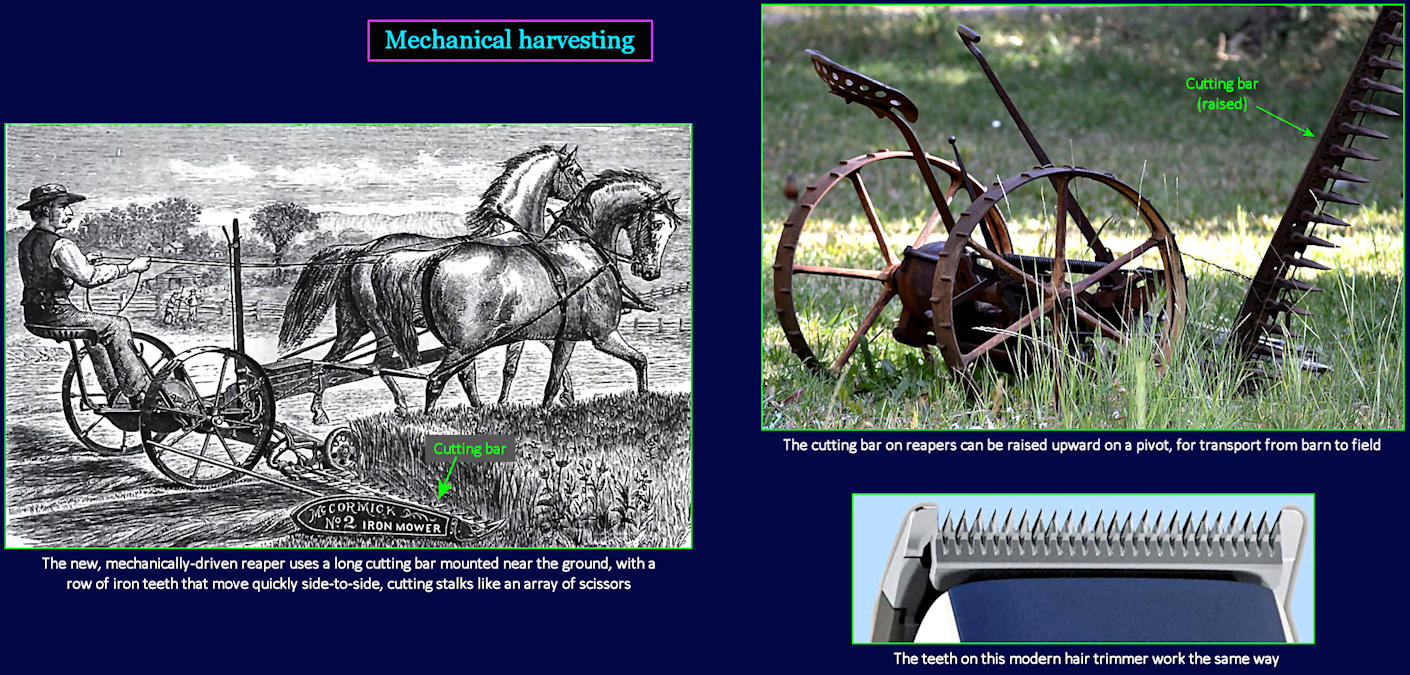
The Cutting Bar The main feature of the mechanical reaper is its cutting bar. A gearbox is used to translate the rotary motion of the main wheels into an oscillating, back-and-forth motion driving an array of cutting teeth against a set of matching fixed teeth. | |||||||||
| |||||||||
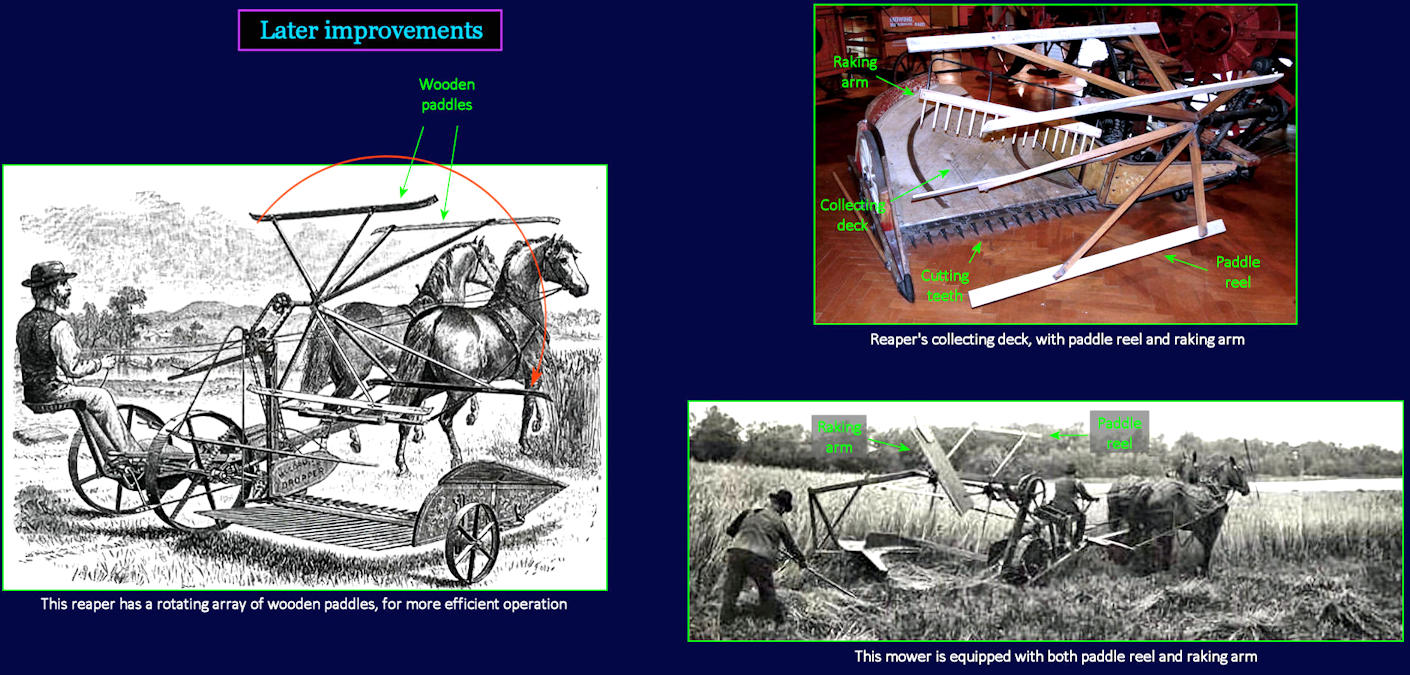
Add-ons Before long, reapers are being improved with the addition of a big rotating reel with four long wooden paddles, to guide the hay into the teeth, and topple it backwards onto a collecting deck (left). An equally awkward articulated rakes is sometimes used to continuously sweep the deck free of hay (top right). Some machines are equipped with both add-ons (lower right). By 1870, 10,000 reapers are being produced per year, which may sound like a lot, but still only amounts to one machine for every 30 farms. | |||||||||
| |||||||||
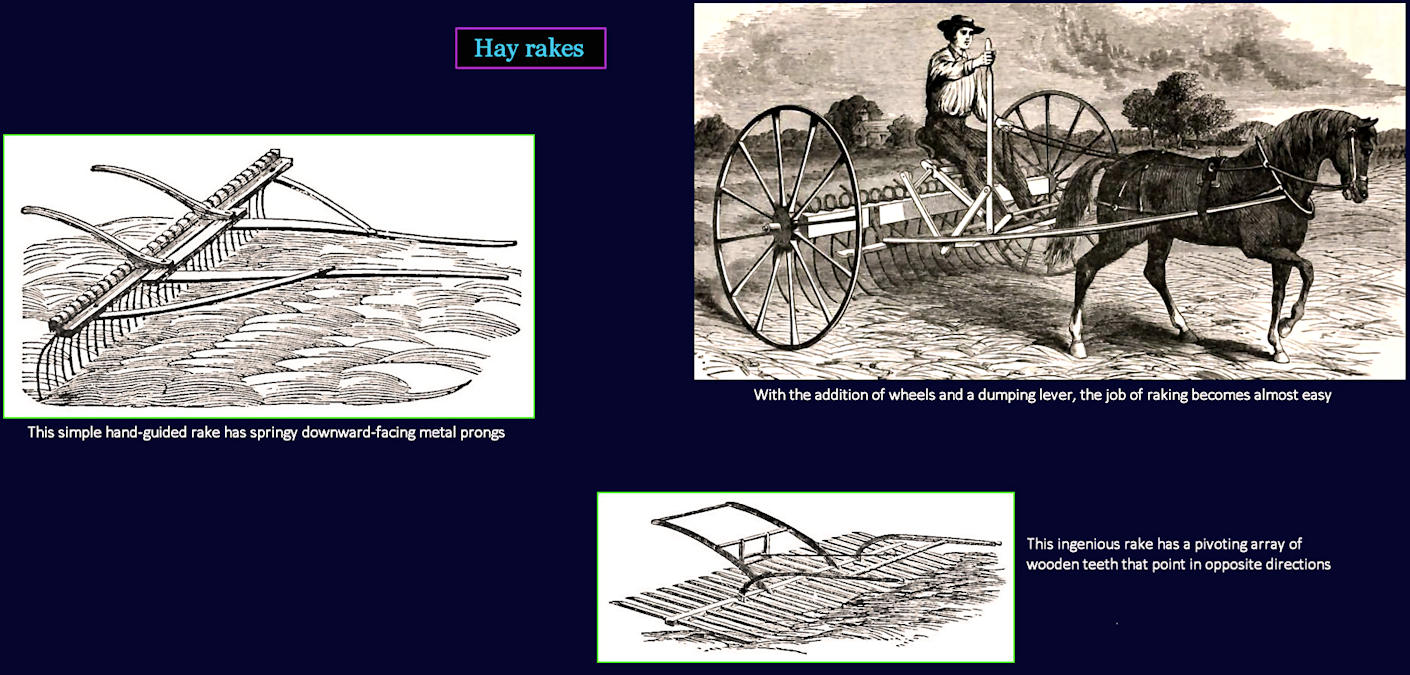
Easier Raking The two hay rakes at the top both use an array of springy metal fingers, which can deflect away from protruding stones or other obstructions. The design at left has handles which can be lifted to dump the hay, while the wheeled version uses a lever. The unusual flipping rake at the bottom is also unloaded by lifting the handles, which causes the forward-facing teeth to dig in. This forces the entire array to flip over, so that forward-facing teeth become rear-facing, unloading the hay at the same time. | |||||||||
| |||||||||
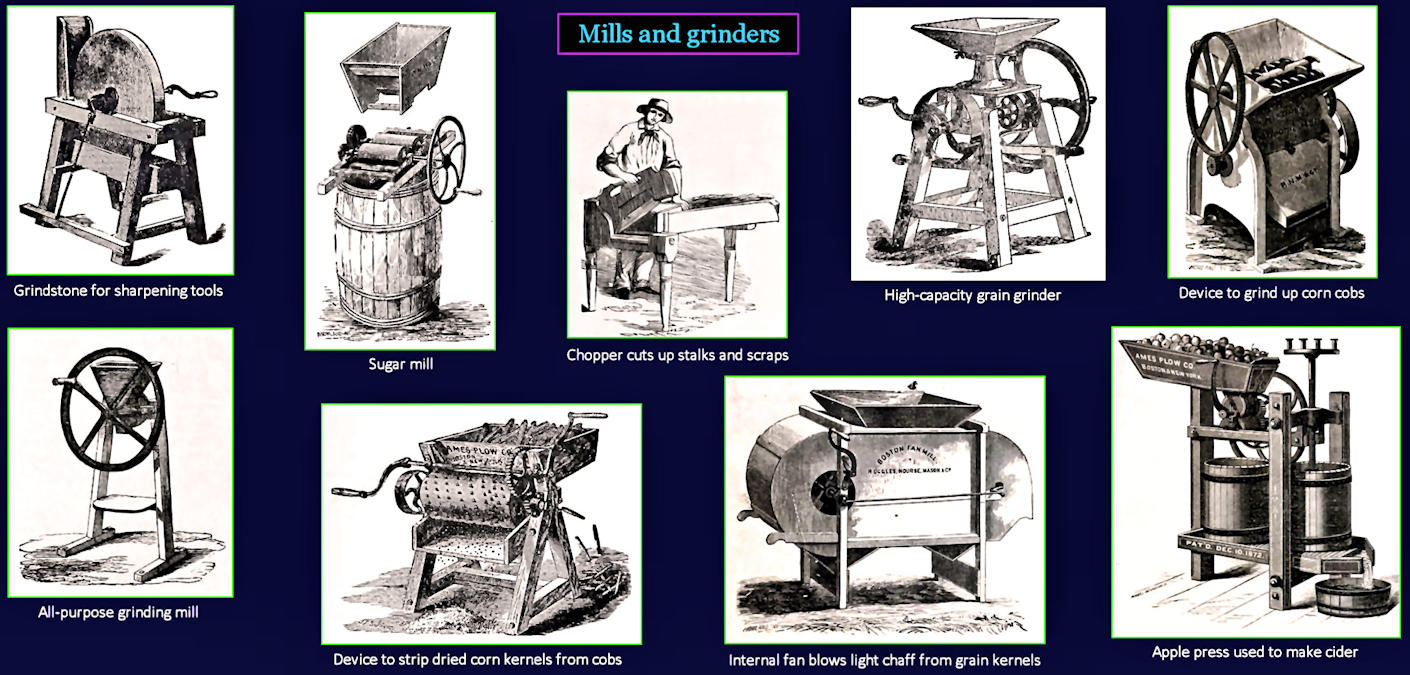
Odd Jobs Getting hay in from the field is just one of the tasks required to keep a farm running. The devices shown above for other chores are mostly made of wood, operated by a hand-crank, and ordered from a catalog. Such conveniences make life easier, but the cumulative cost raises the financial stress on farmers. Many are forced to focus their energy on growing crops that can be sold in town to generate income, rather than just feed the family. The result is a new trend of small farmers selling out to larger operators. | |||||||||