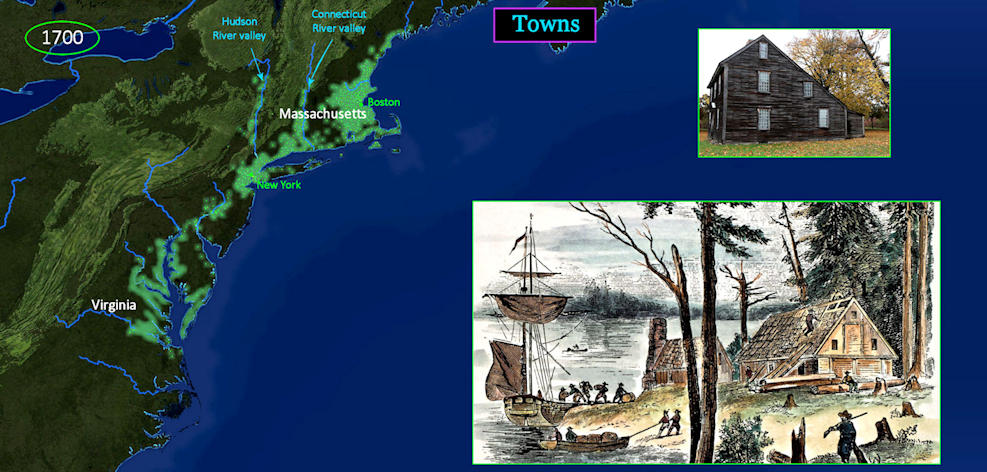
New England is ProsperingVirginia, meanwhile, has almost no towns. Yet Virginia and Massachusetts have almost the same number of people. Each contains about 20% of total colonial population. So why are there so few towns down south? One reason is the unusual nature of the land in Virginia. Most of coastal Virginia is flat, and very near sea level. It is a region with many swamps and marshes, cut up by salty tidal inlets extending far inland. |
| ||||||||
| |||||||||
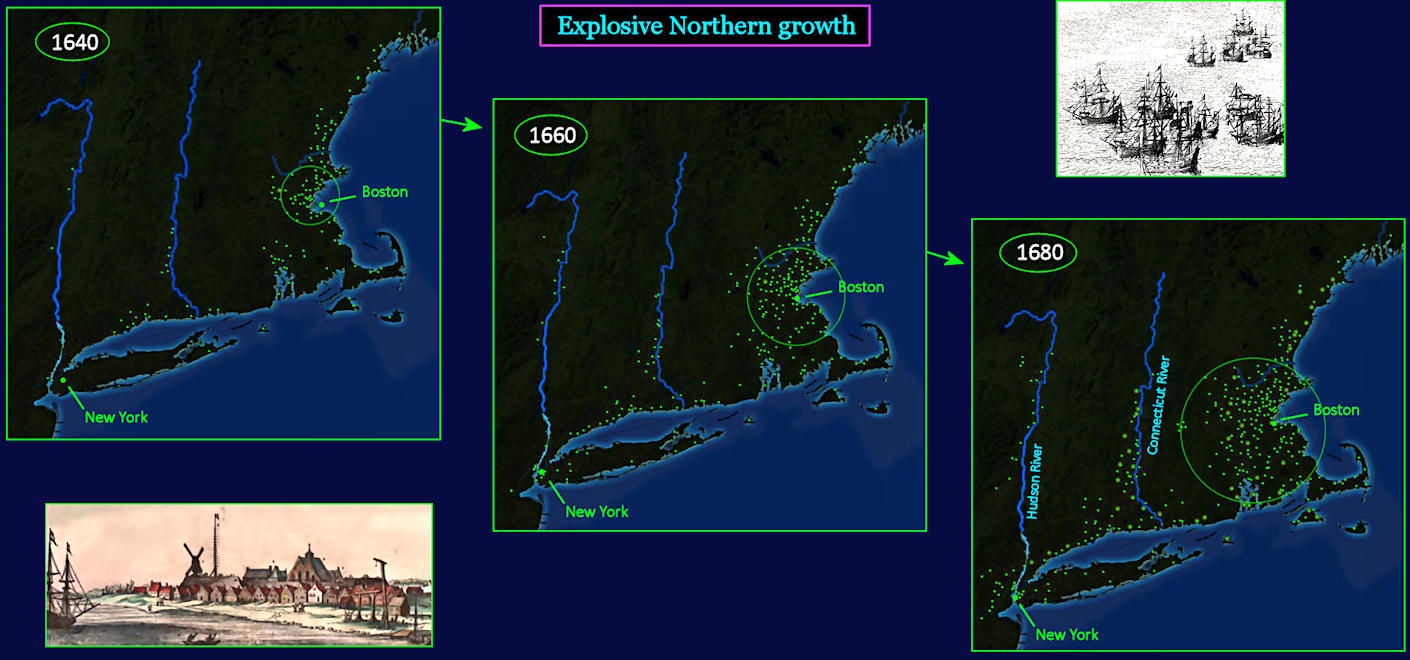
New England The maps above show New England after 60 years of growth. By 1640 (top left), the Boston region is already well populated, having been settled by a sudden flood of 20,000 Puritans, who leave England after failing to 'purify' the English Church (top right). The center view is 1660, shortly before the English seize New York from the Dutch. By 1680, the whole region is filling in, including the Hudson River Valley stretching north from New York, and the Connecticut River Valley, running up the center of the map. | |||||||||
| |||||||||
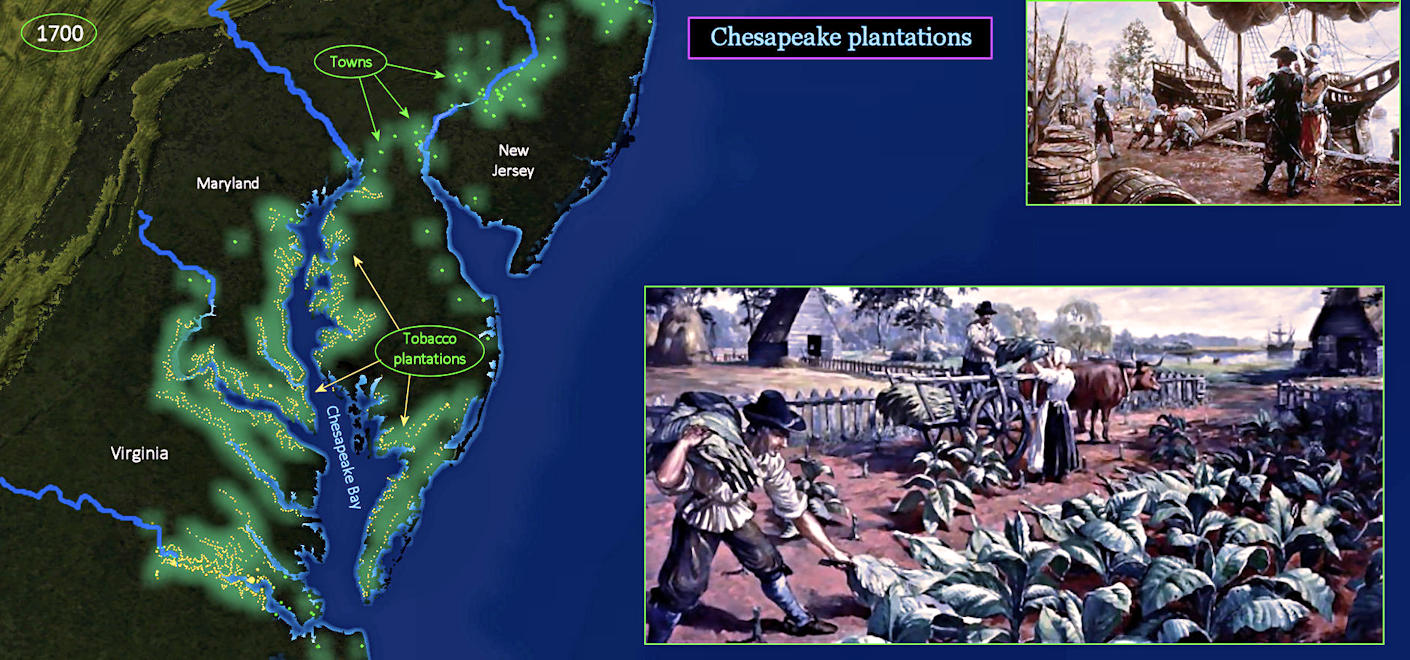
Chesapeake Bay This is the Chesapeake Bay region in the year 1700, with stand-alone plantations lining the shore of every inlet (tiny YELLOW dots). The plantations are dedicated to growing a single crop for export. Tobacco. Planters typically load their packed barrels onto transport vessels that visit each site as they travel up the shore (top right). Although tobacco no longer commands a high price in London, Virginians have few other options for making a living, and almost all available land is planted in tobacco. | |||||||||