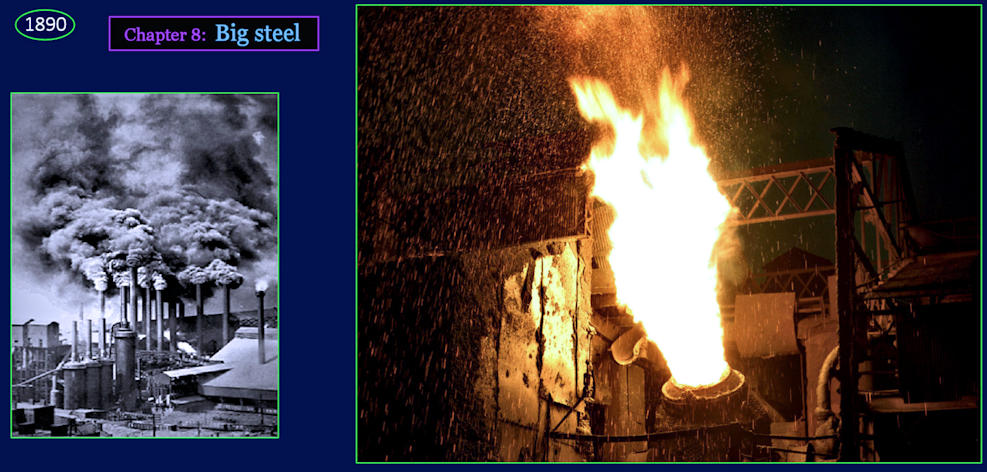
Stronger than IronPrior to 1870, there is no way steel can be produced cheaply. It is available, but only in small quantities. Even wrought iron, the most commonly used form of iron, is time-consuming and costly to produce. The process that allows producing steel easily is first developed in Britain. Within ten years, enterprising Americans like Andrew Carnegie are keen to give it a try. Pittsburgh is the red-hot center of this experiment. |
| ||||||||||||||||
| |||||||||
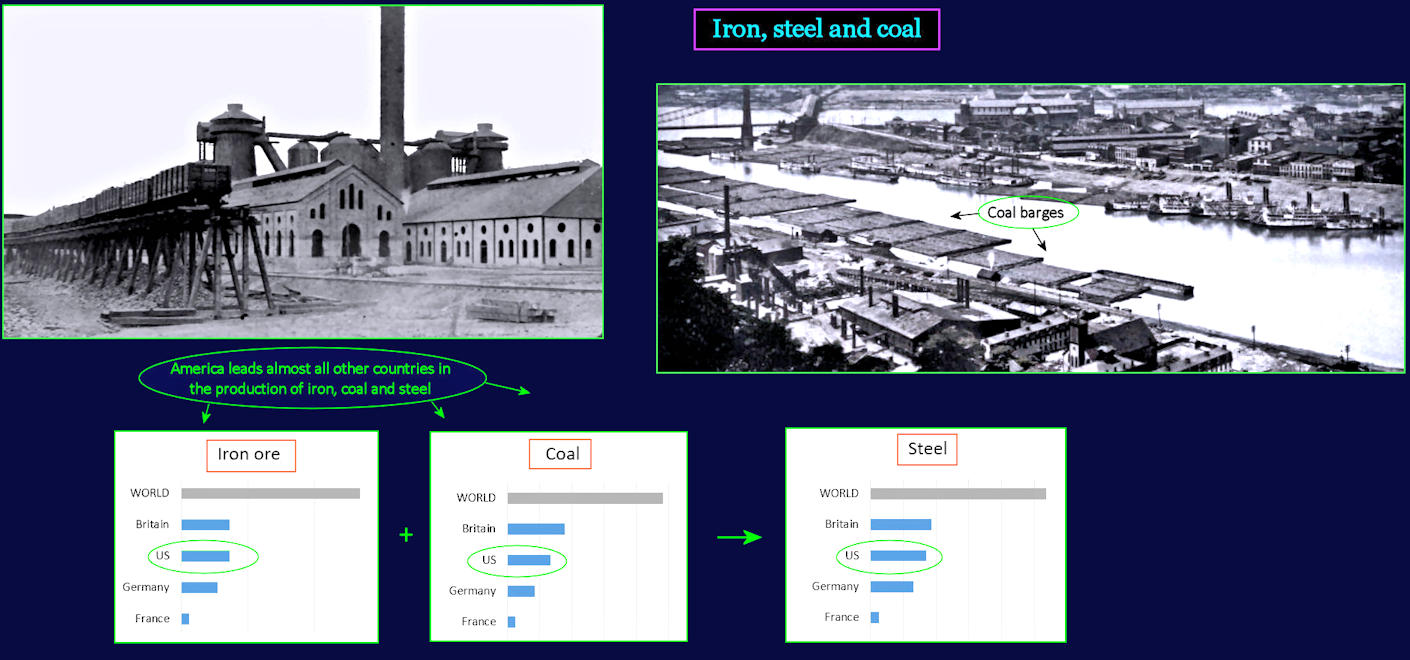
Global Competition The Industrial Era quickly turns into a world-wide contest involving all the major nations in Europe, and now the US. The charts above show the situation in 1890, when America suddenly becomes a major player in steel. This is made possible by the growing quantity of steel coming out of Pittsburgh, which in turn is enabled by the increased flow of ore from Michigan, and coal from Pennsylvania. | |||||||||
| |||||||||
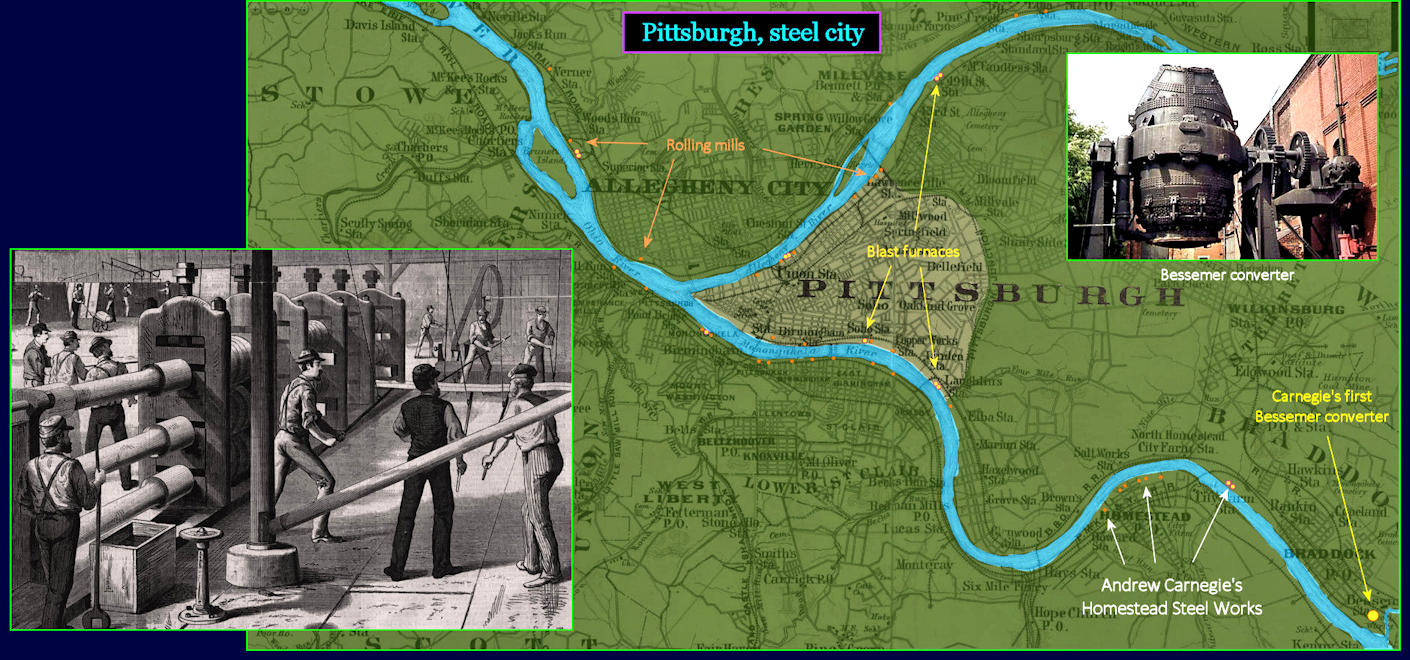
Furnaces and Mills America's dominant steel center is Pittsburgh. There are a dozen blast furnaces by 1890 (YELLOW circles). These support 30 rolling mills (ORANGE circles), which might each contain up to 30 small furnaces used to reduce the carbon content, converting the iron into steel. Bessemer converters remove the carbon much more cheaply, and in much larger batches, before a small amount of carbon is added back. Andrew Carnegie brings the process to Pittsburgh in 1885. | |||||||||