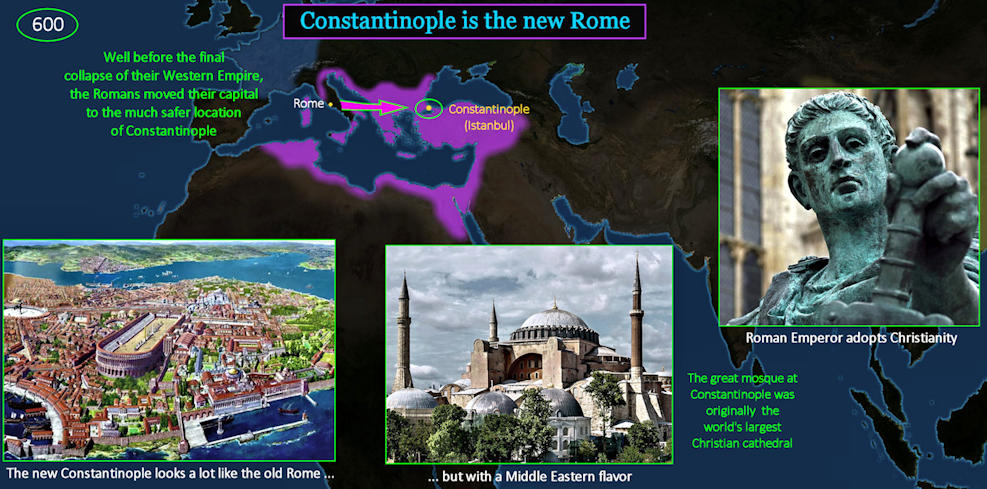
Rome Flees the BarbariansThe Romans establish a second capital at the strategically important site of Constantinople, transforming it into something very similar to Rome. The great Hippodrome is at the center, surrounded by palaces. Like the Circus Maximus in Rome, the Hippodrome is an open-air sports arena that functions as the social center of the city. It's five football fields long, and connected to the Emperor's palace by an underground passage. Then, a great change transforms the Empire. Previous Emperors had tried to suppress Christianity, but the new Emperor experiences a vision on the way to battle, leading him (and soon the Empire) to adopt Christianity. |
| ||||||||||||||||
| |||||||||
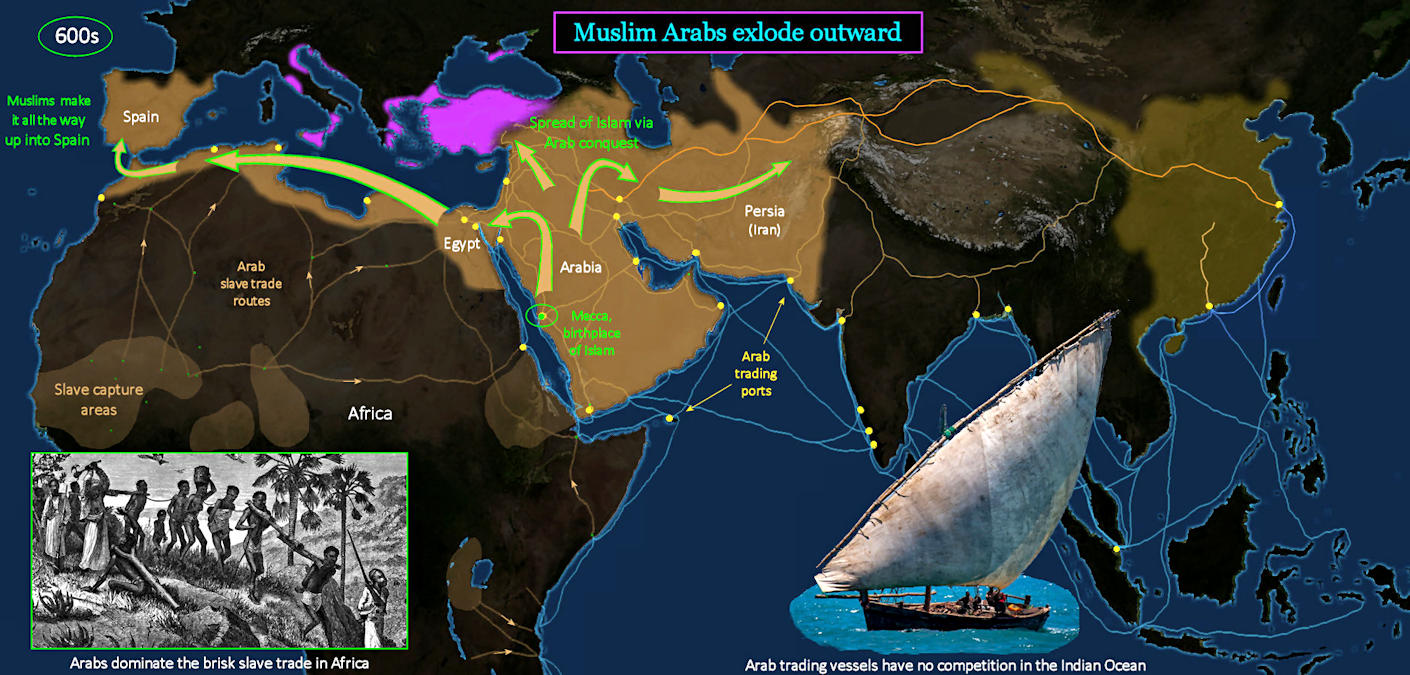
Arabs Adopt Islam Judging from events, the Arab world was primed and ready for the appearance of the great prophet Mohammed, when he introduces the new religion of Islam to the world in the 600s. At first, this is just a religious transformation of the existing Arab world, which had spent the previous centuries developing an extensive trading network throughout the greater Middle East, Africa and Asia. Soon, however, the movement turns aggressive. Within just 100 years, Arab armies carry Muslim banners all across the southern Mediterranean, and far out into Persia (today's Iran). This sets up a titanic struggle with Christianity for religious dominance, which will last 1,000 years. In some ways, that struggle continues today. | |||||||||
| |||||||||
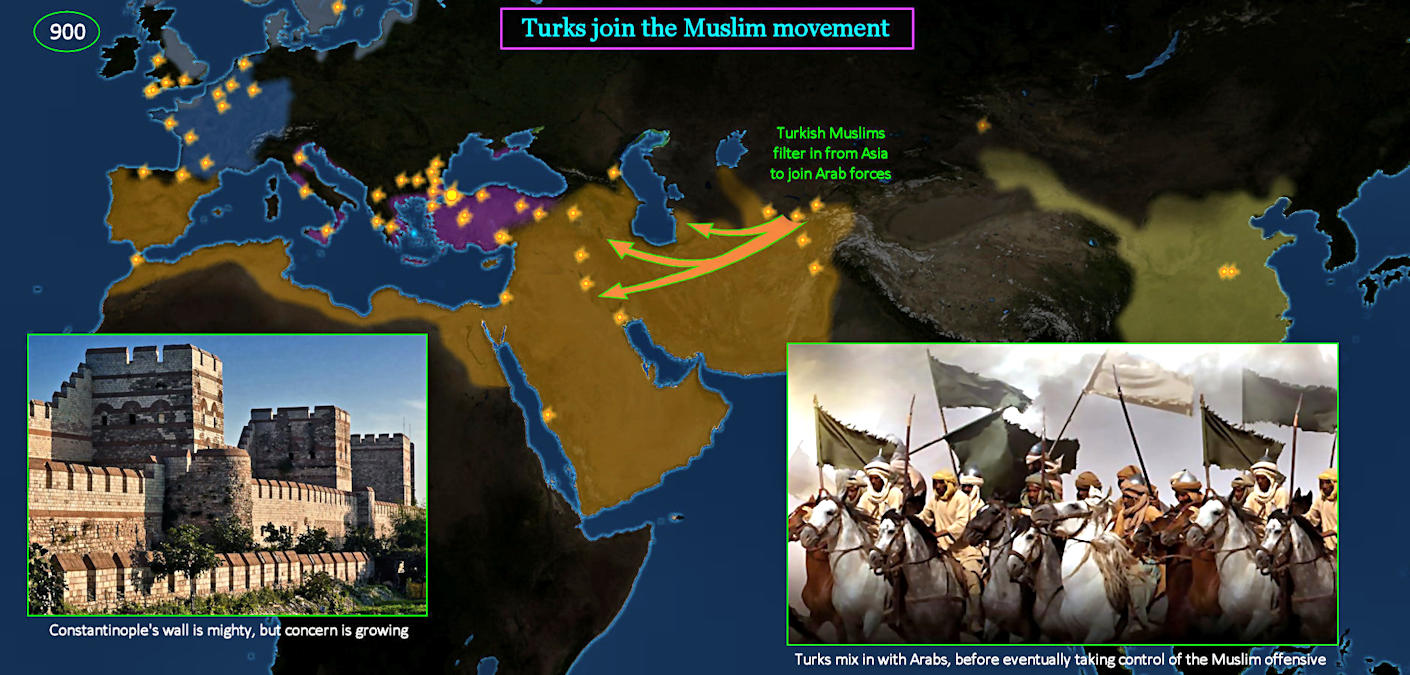
Turks Join Arabs The Arab conquests arrive in waves, under a sequence of Muslim rulers. The third and final wave is centered in Baghdad (modern Iraq), and is an alliance including Persian Muslims (from modern Iran) as well as a growing number of Asian Turks (from modern Kazakhstan). During this period there are numerous attacks directed against the Roman Empire, which remains firmly entrenched in its fortress at Constantinople. The Muslim alliance becomes increasingly dependent upon loyalty to the reigning Caliph, however, which leads to divisions, and a gradual loss of control after his death. This is followed by a period of relative calm. | |||||||||
| |||||||||
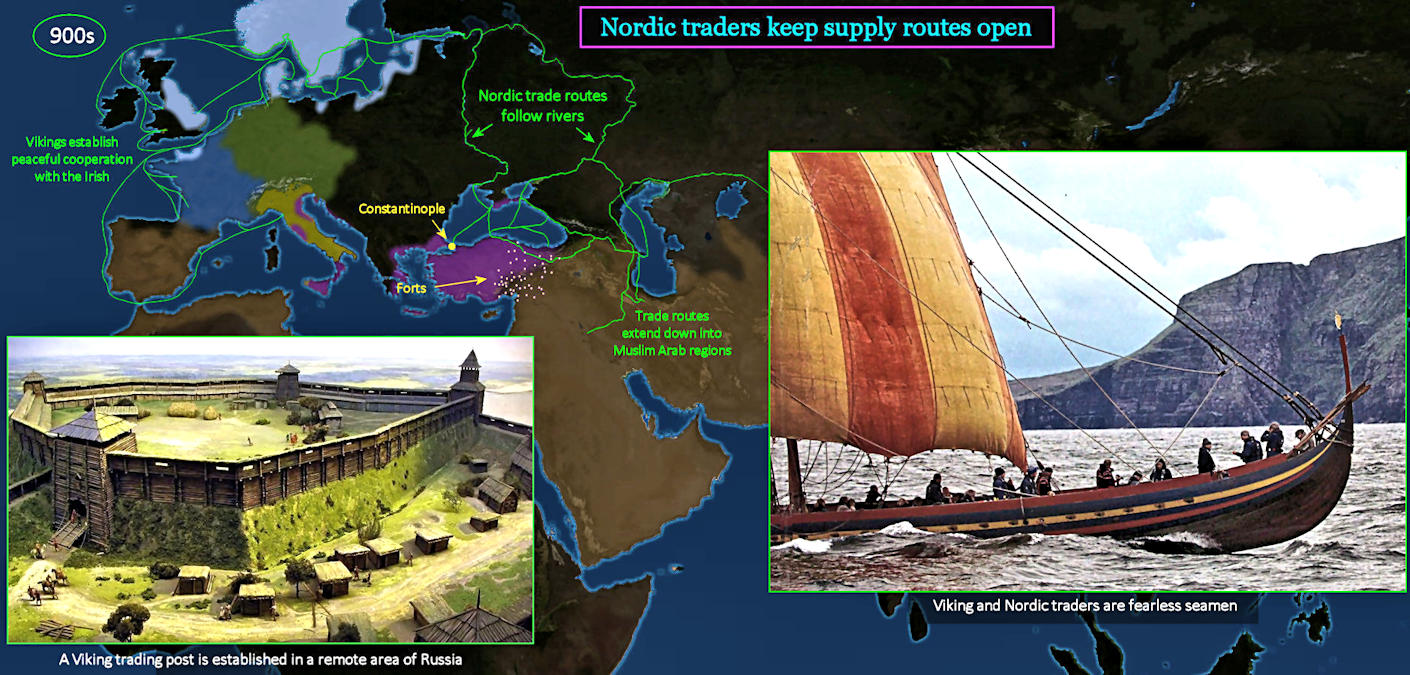
Nordic Traders One of the interesting features of this period is the brief flowering of Viking trade routes based in the Nordic region of modern Scandinavia. Unlike earlier Viking raiders, who seemed interested only in plunder, these new traders are men of business, seeking to expand economic ties with their trading partners. An early manufacturing center in York (in modern England) does a brisk trade in metal products with wide-flung regions via this network, at a time when traffic on the earlier Roman road system has all but vanished. Nordic voyagers establish a series of trading posts down the rivers in Russia and modern Ukraine, reaching all the way to the Arab trading center at Baghdad. | |||||||||
| |||||||||
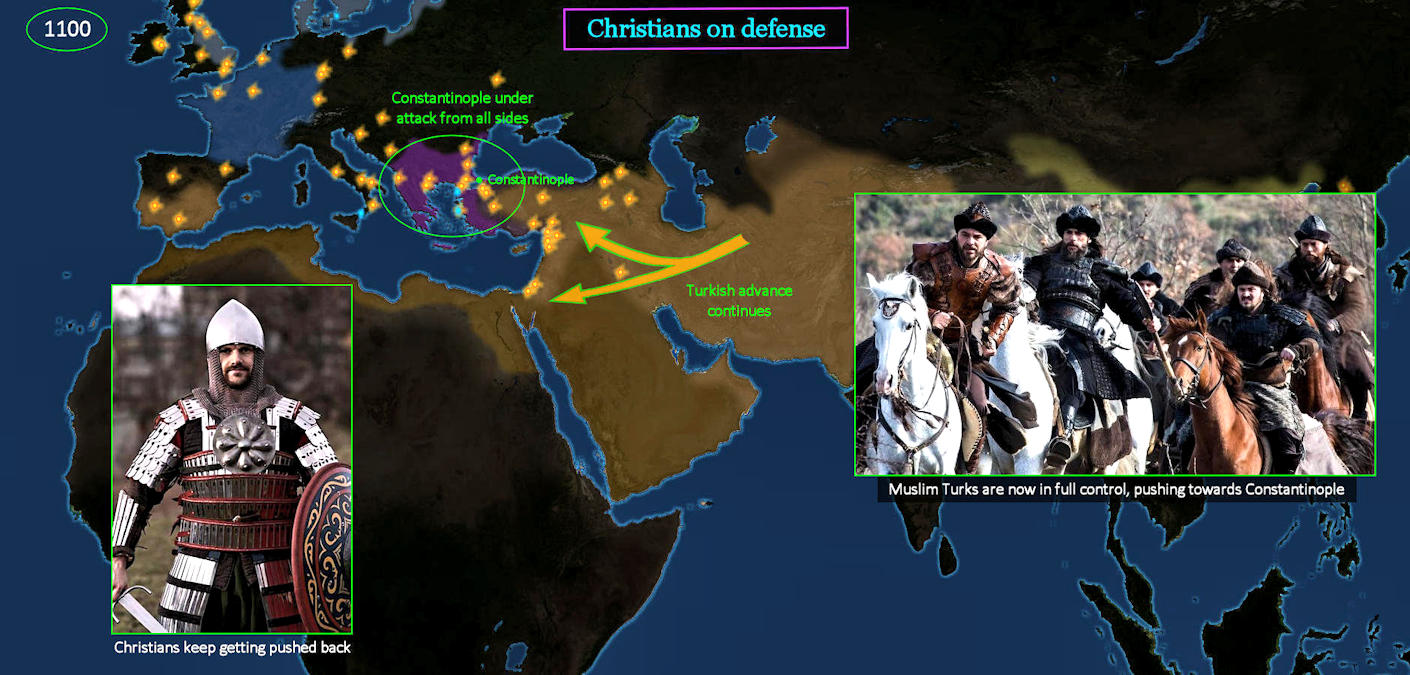
Romans Under Pressure There is a period of relative calm in Constantinople, as the Arab alliance which had threatened for so long gradually loses cohesion. In the lull, the Romans let down their guard. Leaders shifted their focus away from military preparedness, and towards civil administration. Foreign mercenaries are hired to pick up the slack, but this leads to increased costs that slowly drive the Empire into financial difficulty, and a period of chronic inflation. To cut costs, the military is scaled back, leaving the Empire vulnerable to invasion. Seizing the opportunity, the Muslims renew their drive to take Constantinople, this time under leadership of the Turks. Relentlessly, they push ever closer to the great walls of the Christian stronghold. | |||||||||
| |||||||||
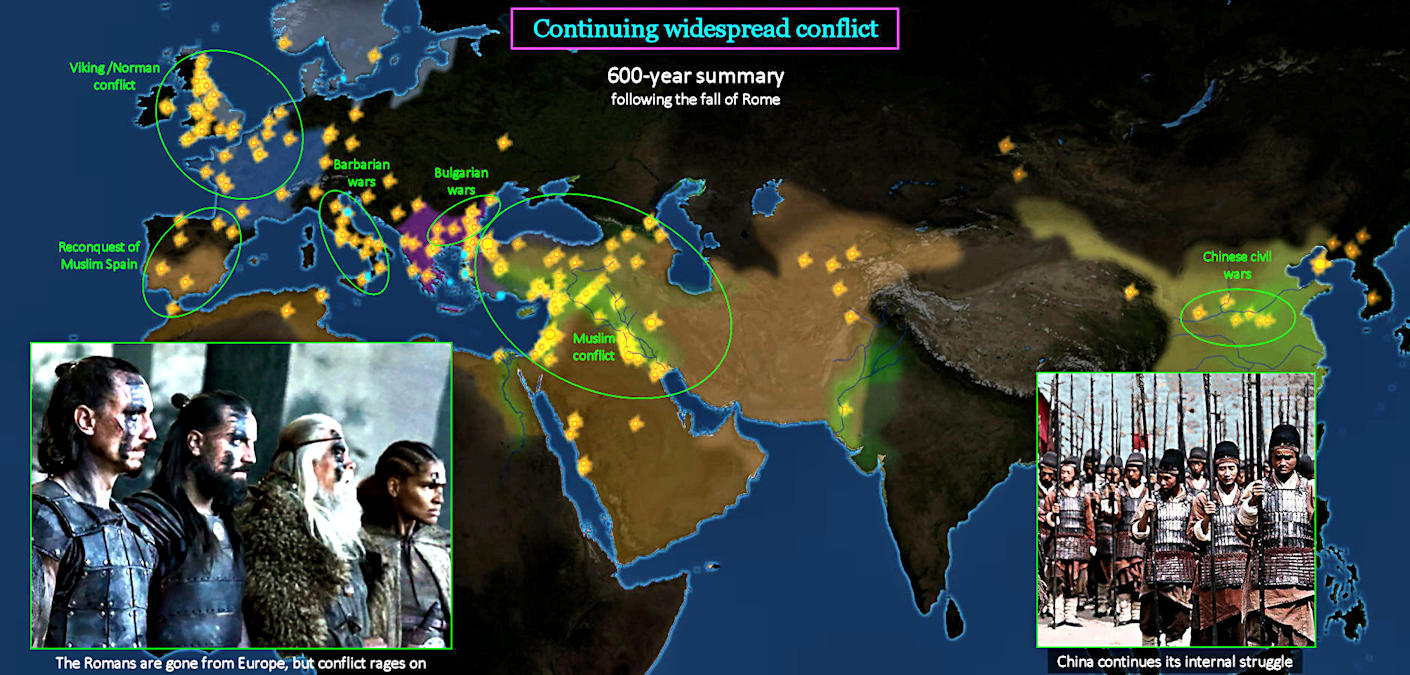
Dark Ages in Europe The long period after the fall of Rome to the Barbarians is sometimes referred to as the Dark Ages, although the Roman civilization in the East, at Constantinople, is still thriving. All of Europe is in a chaotic state of conflict. In the north, descendants of early Viking raiders have gradually morphed into a loosely-defined group called the 'Normans,' who mixed it up with tribal clans in what will later become France and Germany. Meanwhile, various Christian elements in land that will later become Spain work together to gradually push the Muslims back towards Africa. Barbarian and Slavic tribes from the Balkans fight it out for control of Italy. | |||||||||