
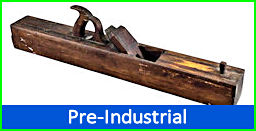
Summary: Technology Early
Page 1: Technology as Inspired Invention
The medieval printing press is key to spreading ideas that lead to American independence, while advancing technology leads to the smartphone
Page 2: Ancient Technology
Humans know how to control fire from the very beginning, then do on to develop the bow-and-arrow as their first important invention, before learning to make hard metals
Page 3: Medieval Inventions
For 2,500 years after the Bronze Age, humans develop increasingly sophisticated stonework, but make few other important breakthroughs outside of weaponry
Page 4: Medieval Technology
By the medieval period, iron-working forges are being used in early businesses, but with little effect on ordinary life, until the invention of the printing press changes everything
Page 5: Primitive American Tools
Colonial settlers use axes, and other tools with metal blades, but fashion almost everything else they need from wood or cast iron
Page 6: Colonial Farming
Colonial families spend most of their energy enlarging their simple dwellings, and farming small surrounding fields, while developing a surprising variety of wooden tools
Page 7: Iron and Blacksmiths
Iron-working technology is slow, tedious and small-scale, using charcoal as the primary fuel, fanned with leather bellows to achieve the high temperatures required
Page 8: Homespun Fabric
Few colonists can afford fabric imported from Britain, so most spin wool from sheep, or fiber from flax, to produce a course yarn, which is woven into cloth on wooden looms
Page 9: Colonial Printing Press
Benjamin Franklin makes his fortune running a print shop, using a press that is little different from the one Gutenberg used to print his first bible, 300 years previously
Page 10: Waterpower
In colonial America, the only sources of power are animals and waterwheels, the latter being used to drive sawmills and grist mills, while wagons are scarce
Page 11: Textiles and Cotton
Free from British rule, former colonists copy British designs for spinning equipment, set up the country's first mills, and invent the cotton gin
Page 12: Steam Power
Steam engines can be used anywhere, but are first adapted to power vessels, then early locomotives, while canals prove wildly successful
Page 13: Age of Sail
Even as steamboats are appearing everywhere, great sailing ships are just entering their prime, as graceful clippers round the world, and whalers probe Arctic waters
Page 14: Animals on the Farm
Steam engines are driving industrial equipment in greater numbers, while farmers still rely on the horse, and mechanical reapers make haying easier for the biggest farmers
Page 15: Blast Furnaces and Coal Trains
As railroads open up Pennsylvania coalfields, iron production surges on newly cheap and abundant coal, while rolling mills produce wrought iron used to make industrial equipment
Page 16: Machines to Make Machines
Machinery is assembled from many separate parts, which must each be formed into particular shapes, but tools to create these shapes out of iron are still rudimentary
Page 17: Steam Engines Get Bigger
Early steam engines are so big and bulky that they are only useful on vessels, but gradual improvements allow for more compact engines used to power machinery
Page 18: Locomotives and Wagons
American expansion is propelled locomotives, which still burn wood to produce the steam, while urban transportation remains firmly based on the horse-drawn wagon
Page 19: Iron-working Machines
As the industrial revolution gears up, tools required to make machinery quickly transition from wood to cast-iron frames, for increased rigidity, allowing greater precision
Page 20: Big Tooling, from Catalogs
As machines become bigger and more advanced, equipment wholesalers offer printed catalogs, allowing distant customers to order the latest machinery
Page 21: The Milling Machine
The milling machine is a major breakthrough, being far more versatile for making complicated metal parts than earlier single-purpose tooling, and offering an expanded range of operations
Page 22: Rapid Industrial Transformation
In just 80 years, America grows from a simple supplier of raw materials into a powerful industrialized society, based on abundant iron, coal and steam power